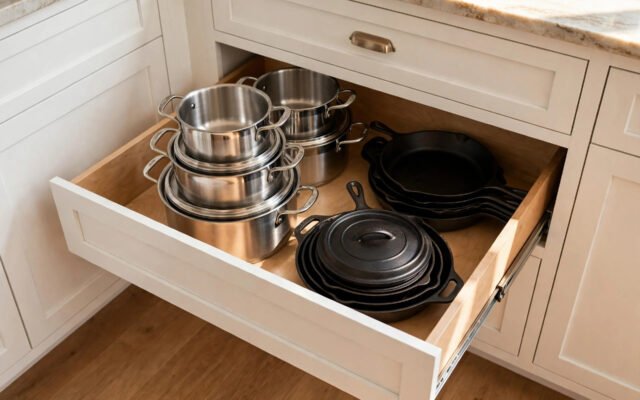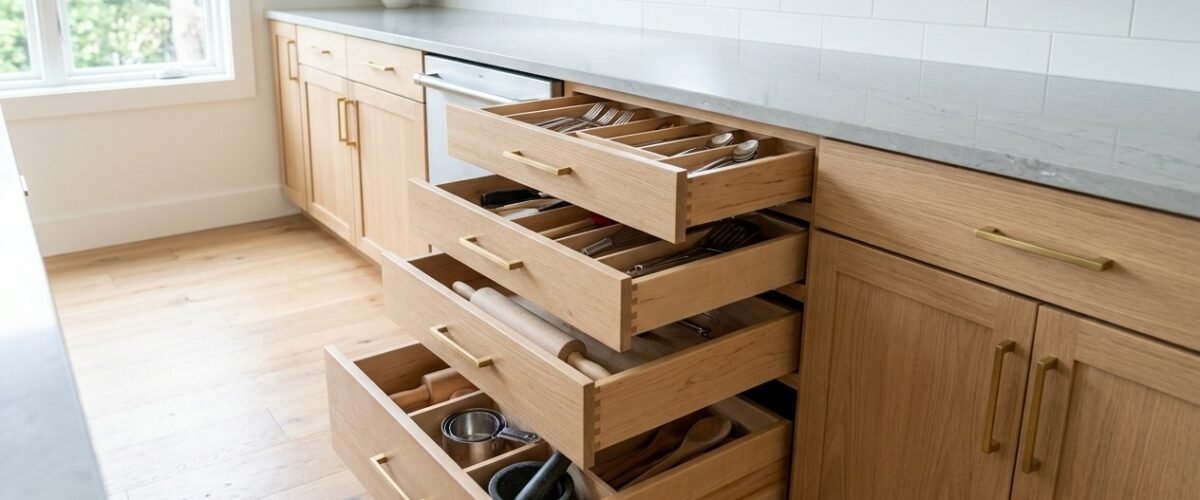
A 4 drawer base cabinet represents one of the most efficient, high-density storage components in modern kitchen design. While traditional standard base cabinets force homeowners to get down on hands and knees to peer into dark shelves. In contrast, a four-tier vertical drawer stack brings utensils, cookware, and pantry essentials directly out into clear daylight. Dividing standard thirty-four-and-one-half-inch cabinet height into four dedicated horizontal compartments eliminates wasted vertical space. As a result, you maintain strict visual order across your kitchen work zones.
However, selecting and positioning a four-drawer base cabinet requires careful planning. First, you must evaluate drawer box depths, slide load ratings, face overlay dimensions, and internal organizational dividers. In this definitive contractor guide, we explore standard width options, structural dovetail construction, heavy-duty soft-close slide hardware, ergonomic kitchen placement, and cost tiers. For instance, you might be outfitting a busy prep island or replacing a cluttered blind corner. In either case, this guide provides the practical guidance needed to optimize your kitchen storage.
Standard Dimensions and Drawer Height Stacks
Standard Widths from 12 to 36 Inches
Four-drawer base cabinets are manufactured in modular three-inch increments. Specifically, they range from twelve inches up to thirty-six inches in overall width. A narrow twelve-inch or fifteen-inch 4 drawer base cabinet is ideal for tight galley layouts. In addition, it works well flanking a cooking range. These compact configurations provide dedicated slots for cutlery, thermometers, spice jars, and baking mats. Furthermore, they fit without taking up excessive wall run space.
In contrast, wider eighteen-inch, twenty-four-inch, and thirty-inch drawer stacks serve as heavy-duty workhorses. They perform exceptionally well in primary food preparation zones. A twenty-four-inch four-drawer unit easily accommodates flatware sets and dish towels. In addition, it holds parchment rolls and shallow storage containers. For large baker kitchens, a thirty-inch or thirty-six-inch four-drawer stack provides broad, panoramic compartments. Consequently, it easily stores oversized rolling pins, baking sheets, and nested mixing bowls. To check standard cabinet exterior parameters, verify your layout against our comprehensive kitchen base cabinet dimensions reference guide.
Vertical Drawer Height Tier Breakdown
The vertical distribution of drawer faces in a four-drawer stack is carefully proportioned. Specifically, this layout maximizes practical everyday utility. In a standard framed cabinet, the overall box height is thirty-four and one-half inches. Consequently, this leaves approximately thirty-one inches of usable vertical face frame opening height. The four drawers are typically organized in a graduated tier arrangement from top to bottom.
The top drawer represents the shallowest tier, featuring an exterior face height of four to five inches. Meanwhile, interior clear depth measures two-and-one-half to three inches. This top slot is engineered specifically for everyday cutlery. In addition, it easily holds serving spoons and peeling tools. The second drawer features a face height of six to seven inches with an interior depth of four to five inches. Therefore, it is perfect for kitchen towels, foil boxes, and measuring cups.
The third drawer provides six to seven inches of face height. As a result, it comfortably accommodates shallow pots, prep bowls, and immersion blender attachments. Finally, the bottom fourth drawer features a deeper face height of eight to nine inches. It offers an interior clear height of six to seven inches. Therefore, it easily holds casserole dishes, strainers, and storage containers. In short, this graduated configuration prevents small utensils from getting lost under bulky cookware.
Interior Usable Depth and Clearances
Cabinet buyers frequently mistake exterior drawer face height for usable interior storage space. Drawer box bottoms are recessed one-half inch up from the side edges to receive undermount slide clips. Consequently, interior clear depth is always smaller than exterior dimensions. Furthermore, top subtop stretchers and horizontal face frame dividers consume vertical clearance. Specifically, they take up one-and-one-half inches of clearance between tiers.
In addition, standard base cabinets feature an exterior box depth of twenty-four inches. This exterior depth easily accommodates twenty-one-inch drawer slides. Consequently, interior drawer box front-to-back depth measures approximately twenty and one-half inches. Always verify internal usable measurements before purchasing pre-fabricated acrylic utensil dividers or modular knife blocks.
Drawer Box Construction and Wood Species
Solid Hardwood vs Plywood Drawer Boxes
The structural longevity of a 4 drawer base cabinet depends directly on craftsmanship. Specifically, drawer box joinery determines long-term box durability. Premium custom and semi-custom cabinetry utilizes solid hardwood for all four drawer box sides. Usually, builders specify five-eighths-inch or three-quarter-inch solid lumber. Solid maple and birch are the premier hardwood species selected by professional cabinetmakers. Because of their dense, closed-grain structure, they resist denting, chipping, and seasonal racking under heavy loads.
Alternatively, quality mid-range cabinetry employs nine-ply cabinet-grade birch plywood for drawer box sides. Plywood drawer boxes offer outstanding dimensional stability. For example, they resist warping in kitchens subject to seasonal humidity fluctuations. However, avoid budget cabinets built with stapled particleboard. Similarly, avoid folded vinyl-wrapped MDF drawer boxes. These inferior materials quickly disintegrate under weight. In addition, they cannot withstand repeated impacts from heavy metal utensils. To evaluate core materials in detail, see our analysis of kitchen cabinet plywood and kitchen cabinet boxes.
English Dovetail vs Dowel and Pocket Joinery
In fact, corner joinery is the true test of high-performance cabinet construction. English dovetail joinery features interlocking trapezoidal pins and tails. Specifically, these joints are precision-machined into the front and rear corners of the drawer box. The dovetail joint mechanically resists pulling forces when the drawer is yanked open. Therefore, it will never separate, even when loaded to maximum weight capacity.
In contrast, cheaper cabinets rely on simple butt joints. Builders secure these with wooden dowels, pocket screws, or metal staples driven through the box sides. Over time, repeated pulling cycles fatigue dowel glue bonds. As a result, the drawer box front begins to loosen and sag visibly. When shopping for cabinetry, always insist on fully dovetailed solid maple boxes. Furthermore, verify that they include durable baked clear-coat protective finishes.
Drawer Bottom Panel Thickness and Sag Resistance
A common structural failure in lower-grade drawer stacks is a sagging drawer bottom. In budget cabinetry, manufacturers insert thin one-eighth-inch hardboard bottoms. These thin panels bend downward when loaded with heavy metal silverware. Once the bottom panel bows, it scrapes against the drawer face below. Eventually, it pops out of its perimeter dado grooves entirely.
High-quality four-drawer cabinets feature one-quarter-inch or three-eighths-inch hardwood plywood bottoms. These panels are fully captured within continuous dados on all four sides. Furthermore, drawers wider than twenty-four inches should include solid wood underside stiffener cleats. Glued securely across the center span, these cleats guarantee permanent flatness under rigorous family use.
Hardware Specs: Slides, Ratings, and Soft-Close Mechanisms
Undermount vs Side-Mount Drawer Slides
Selecting the right drawer slide hardware transforms everyday kitchen usability completely. Undermount drawer slides represent the undisputed gold standard in modern kitchen cabinetry. These heavy-duty steel runners mount concealed directly beneath the drawer box. As a result, they hide all mechanical mechanisms from view when the drawer is pulled open. In addition, undermount slides allow the drawer box to be built wider. Consequently, this maximizes internal lateral storage capacity.
Side-mount ball-bearing slides, conversely, attach to the exterior box sides. Therefore, they consume one-half inch of clearance on each side. While side-mount slides are economical and sturdy, their exposed metal tracks present drawbacks. Over time, they collect crumbs, hair, and grease. If you are comparing runner systems, consult our detailed comparison of kitchen cabinet drawer slides and undermount vs side mount drawer slides.
Weight Capacity Ratings and Extension Profiles
Drawer slides are categorized by dynamic load capacity. Typically, ratings range from seventy-five pounds to one hundred fifty pounds per pair. In a four-drawer base cabinet, the top two shallow drawers perform flawlessly with standard slides. Specifically, seventy-five-pound to one-hundred-pound slides work well. However, the lower two drawers routinely hold heavy ceramic plates or cast iron skillets. Therefore, they benefit tremendously from one-hundred-pound or one-hundred-twenty-pound commercial runners.
In addition, always verify that your slides feature full-extension or over-travel capability. A full-extension runner allows the drawer box to glide completely clear of the face frame. Consequently, it grants unobstructed overhead access to items stored in rear corners. In contrast, three-quarter extension slides leave several inches of the drawer hidden beneath the counter overhang. This setup often frustrates everyday cooking workflows.
Soft-Close Damping and Push-to-Open Systems
Modern residential kitchens demand smooth, silent operation throughout daily prep. Premium drawer slides incorporate hydraulic or pneumatic damping cylinders. These cylinders catch the drawer during the final two inches of travel. Then, they silently draw it shut without slamming. This soft-close action prevents ceramic dishware from rattling. In addition, it protects dovetail joinery from repetitive shock impacts.
For minimalist, handle-free kitchen designs, push-to-open mechanical latches integrate into undermount slides. Consequently, homeowners can open drawers with a gentle tap of the knee or forearm. To explore installation and retrofitting procedures, review our contractor guide on soft close drawer slides.
4-Drawer vs 3-Drawer vs 2-Drawer Base Cabinets
Storage Capacity Comparison
Choosing between a two-drawer, three-drawer, or four-drawer base cabinet depends on storage needs. Specifically, the size of your culinary items dictates the right choice. A two-drawer base cabinet features two massive, deep drawer boxes. Typically, they measure ten to twelve inches deep. These cavernous bins excel at housing tall stockpots, Dutch ovens, and upright blenders. However, storing small spoons or spatulas in a two-drawer cabinet wastes enormous vertical volume.
A three-drawer base cabinet strikes a popular middle ground. It features one shallow top drawer for cutlery and two equal deep drawers for cookware. For an in-depth breakdown of this configuration, read our head-to-head analysis of 3 drawer vs 2 drawer base cabinet setups.
Meanwhile, a 4 drawer base cabinet provides maximum functional compartmentalization. Because it offers four distinct horizontal levels, you can segregate utensils, baking tools, linens, and spices. Therefore, you never have to stack items on top of one another. In fact, the four-tier system delivers the highest storage efficiency of any base cabinet design.
Culinary Workflow and Functional Mapping
In an active family kitchen, workflow ergonomics should dictate cabinet placement. Positioning a four-drawer base cabinet directly between the cooking range and prep sink creates an ultra-efficient workstation. The cook can pivot effortlessly from the cutting board to grab knives from the top drawer. Next, tasting spoons are ready in the second tier. Finally, prep bowls sit in the bottom tier.
Conversely, placing bulky pots in a four-drawer stack will quickly cause frustration. This occurs because individual drawer depths cannot accommodate tall stockpot lids. Therefore, efficient kitchens balance their floor plan thoughtfully. Specifically, they pair one four-drawer stack for small accessories with one two-drawer or three-drawer unit for heavy cookware.
Aesthetic Symmetry and Cabinet Door Alignment
From an architectural design perspective, integrating a four-drawer stack requires thoughtful alignment. Installers must align reveals carefully with adjacent cabinetry. Standard base door cabinets feature a single top drawer paired with full-height bottom doors. A three-drawer cabinet features horizontal drawer lines. As a result, it harmonizes naturally with standard drawer-over-door profiles.
A four-drawer cabinet, however, introduces multiple horizontal reveal lines. Consequently, this creates distinct visual texture. In modern transitional and farmhouse kitchens, designers frequently flank a range with matching four-drawer stacks. This placement creates appealing geometric symmetry across the primary wall elevation.
Best Kitchen Placements and Organization Ideas
Flanking the Range for Utensil and Spice Access
The premier location for a twenty-four-inch 4 drawer base cabinet is right beside your cooktop. In this position, tools are immediately at hand. This prime real estate allows immediate access to spatulas, tongs, thermometers, and basting brushes while standing at the stove. Furthermore, fitting the second drawer with angled spice drawer inserts keeps dozens of seasoning jars labeled. In addition, it protects delicate spices from stovetop steam and heat.
If you have additional wall space, consider pairing your drawer stack with functional accessories. Explore our guides on kitchen cabinet organizers and pull-out trash bin cabinets to design a cohesive cleanup and prep triangle.
Kitchen Island Prep Station Integration
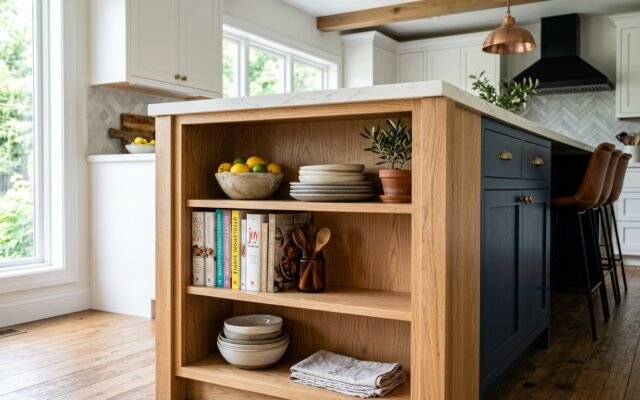
A central kitchen island serves as the primary culinary hub in open-concept floor plans. Embedding a thirty-inch four-drawer base cabinet into the working side of an island creates a self-contained prep station. The broad top drawer accommodates chef knives and measuring spoons. Meanwhile, the lower tiers house pastry cutters, rolling pins, parchment rolls, and cutting accessories.
To plan electrical conduit routing and seating overhangs on your island build, review our comprehensive tutorials on kitchen island base cabinets and our detailed unfinished kitchen island installation guide.
Baking Zone and Flatware Station Layouts
In large kitchens featuring dedicated zones, dedicating a four-drawer stack to table setting simplifies entertaining. Positioning this cabinet near the dining area allows family members to retrieve spoons, napkins, and coasters. Furthermore, they can do so without stepping into the cook active prep zone.
Furthermore, custom wood dividers can be inserted into the third and fourth tiers. These create upright slots for cookie sheets, muffin tins, and cutting boards. Consequently, they turn awkward stacks into accessible vertical slots.
Base Cabinet Drawer Configurations Comparison Table
Drawer Base Specifications Comparison
To help you select the perfect drawer configuration for your kitchen remodel, review the detailed comparative specifications in the table below:
| Configuration | Standard Widths | Average Drawer Depth | Best Kitchen Use | Recommended Slide Rating | Price Range (Semi-Custom) |
|---|---|---|---|---|---|
| 4-Drawer Base | 12 in to 36 in | 2.5 in to 7.0 in | Cutlery, spices, baking tools, linens | 75 lb to 100 lb full extension | $380 to $720 |
| 3-Drawer Base | 15 in to 36 in | 3.5 in to 9.5 in | Flatware plus pots, pans, and mixing bowls | 100 lb heavy duty undermount | $340 to $650 |
| 2-Drawer Base | 24 in to 36 in | 10.0 in to 12.0 in | Tall stockpots, Dutch ovens, appliances | 100 lb to 150 lb heavy duty | $320 to $610 |
| Standard Drawer/Door Base | 12 in to 36 in | 3.5 in (drawer only) | General storage with fixed shelf below | 75 lb standard extension | $240 to $480 |
Installation, Leveling, and Hardware Alignment
Leveling Drawer Stacks for Flawless Slide Operation
Precision leveling is critical when installing a 4 drawer base cabinet. Undermount soft-close slides rely on delicate internal gear synchronizers and hydraulic pistons. Therefore, an out-of-square cabinet box will cause slides to bind, squeak, or fail to latch. If the cabinet tilts backward or forward, heavy drawers may creep open. Alternatively, they may require excessive pulling force.
Prior to fastening the cabinet to studs, use a four-foot precision spirit level across the face frame stiles. Also, check along both side panels. Place composite shims underneath the toe-kick frame until the box is perfectly level in both planes. Review our step-by-step instructions on how to level kitchen base cabinets on an uneven floor to master laser alignment techniques.
Securing to Wall Studs and Adjacent Cabinets
Never rely on drywall anchors to secure a fully loaded drawer cabinet. When all four drawers are pulled forward simultaneously, the center of gravity shifts forward. Consequently, this exerts powerful outward torque on the rear fasteners. Always anchor the cabinet hanging rails directly into solid wall studs. Specifically, use two-and-one-half-inch or three-inch hardened washer-head cabinet screws.
After securing the back panel to the studs, clamp the front face frame stiles to adjacent cabinetry. Wood screw clamps work best for this step. Pre-drill countersunk pilot holes through the stiles carefully. Then, drive connecting screws to lock the face frames together into a rigid bank. For hardware recommendations, see our review of cabinet brackets.
Adjusting Drawer Fronts and Reveals
Even in meticulously built cabinetry, minor settling occurs once heavy stone countertops are installed. Fortunately, modern undermount slides include integrated six-way adjustment dials on the underside release clips. By turning these thumbwheels, installers fine-tune drawer face elevation by plus or minus two millimeters. In addition, they can adjust lateral alignment and tilt depth.
Carefully adjust all four drawer tiers until horizontal reveal gaps are completely consistent from top to bottom. In full-overlay cabinetry, maintaining a strict one-eighth-inch reveal gap delivers a clean, architectural finish. For proper bumper spacing and noise dampening, explore our guide to kitchen cabinet door bumpers.
Furthermore, check our advice on kitchen cabinet face frame construction and cabinet filler strips. These details ensure that drawer faces never rub against adjacent casings during opening cycles.
In addition, if you are working with ready-to-assemble lines, explore our review of ready to assemble kitchen cabinets. This guide identifies which brands offer pre-notched boxes and tool-free front clip adjustments.
Installing Cabinet Knobs and Pulls
Installing hardware on a four-drawer stack requires consistent vertical and horizontal indexing. For drawers eighteen inches wide or narrower, a single central pull works best. Positioned dead center on the drawer face, it provides comfortable balance. For wider twenty-four-inch or thirty-inch drawer faces, install two matching pulls. Specifically, space them approximately one-sixth of the drawer width from each outer edge.
Always utilize an adjustable acrylic cabinet hardware drilling jig to drill handle screw holes. Drilling jigs guarantee that every single hole is identical across all four tiers. Consequently, they eliminate crooked handles and protect finished wood faces. Discover design styling tips in our guide to kitchen cabinet knobs vs pulls and explore durable finishes in our review of kitchen cabinet hardware.
Moreover, consider the impact on your property appraisal by reading our research on kitchen cabinet resale value. This data demonstrates that solid hardwood drawer upgrades consistently deliver the highest return on investment among all cabinet enhancements.
Frequently Asked Questions
What is the standard depth of a 4 drawer base cabinet?
Standard four-drawer base cabinets feature an exterior box depth of twenty-four inches, matching standard kitchen countertops. The internal drawer boxes typically measure twenty and one-half inches deep front-to-back, riding on twenty-one-inch undermount or side-mount slides.
Are 4-drawer base cabinets more expensive than standard door cabinets?
Yes, four-drawer base cabinets typically cost fifty to eighty percent more than standard door-and-shelf base cabinets. This price difference reflects the additional materials required for four solid hardwood dovetailed boxes, four pairs of precision soft-close slides, and extensive assembly labor.
Can you fit pots and pans in a 4-drawer base cabinet?
While the top two shallow drawers are designed for cutlery and utensils, the bottom two drawers in an eighteen-inch or twenty-four-inch stack can hold shallow frying pans, sauté pans, and baking dishes. However, for large stockpots and Dutch ovens, a two-drawer or three-drawer base cabinet provides superior vertical clearance.
How much weight can a kitchen cabinet drawer hold?
Standard residential kitchen cabinet drawers equipped with quality undermount soft-close slides support seventy-five to one hundred pounds of dynamic weight. Heavy-duty commercial-grade drawer slides can carry up to one hundred fifty pounds, which is ideal for stacks of heavy cast iron cookware.
What width 4-drawer base cabinet is best for silverware?
An eighteen-inch or twenty-four-inch four-drawer base cabinet is the optimal width for a dedicated silverware and utensil station. This size provides ample lateral width for multi-compartment flatware trays while leaving adjacent space for measuring cups, peelers, and kitchen shears.
Editorial Note: This guide was researched and written by David Miller, founder of Kitchen Base Cabinets, and reviewed by Editorial Lead Marcus Vance. Prices are typical national ranges, not quotes — confirm locally before you buy.