The single fastest way to tell a quality kitchen cabinet from a throwaway build is to open a drawer and close it again. If it glides in silently and self-closes with a whisper, the cabinet is equipped with real kitchen cabinet hardware. If it rattles, tilts, and thumps shut, you are looking at the cheapest components the manufacturer could source. Hardware is not a cosmetic upgrade. It is the mechanical backbone of every cabinet in your kitchen, and the spec sheet reveals everything before you spend a dime.
This guide gives you the contractor-level breakdown on hinges, drawer slides, box joinery, and materials so you can walk into any showroom and evaluate what you are actually buying.
Quick Comparison: Budget vs Quality Kitchen Cabinet Hardware
| Hardware Type | Budget Tier | Quality Tier | What to Look For |
|---|---|---|---|
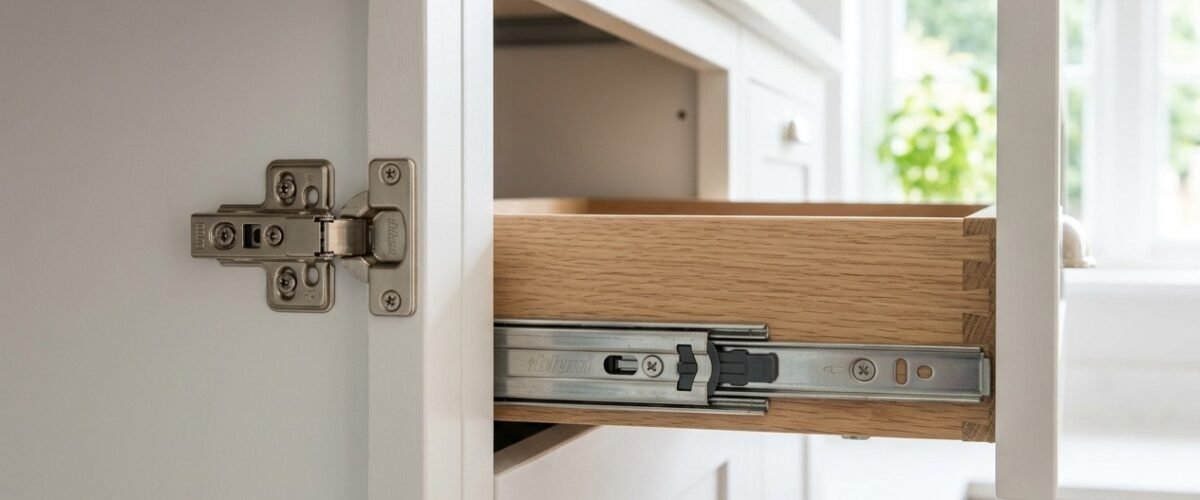
| Door Hinges | Generic cup hinge, no damper, stamped steel, <15,000-cycle rating | Blum CLIP top BLUMOTION, integrated damper, cold-forged steel, 200,000-cycle rating | Blum or Hettich brand stamp; six-way adjustment; visible damper cartridge |
| Drawer Slides | Side-mount epoxy-coated steel, 75 lb capacity, no soft-close | Blum Tandem 563H undermount, 150 lb capacity, BLUMOTION integrated, auto-level | Undermount position; full-extension travel; auto-leveling clip system |
| Box Joinery | Stapled butt joints or cam locks in particleboard | Dovetail or finger-joint glued solid wood or Baltic birch plywood | Pull a drawer box corner apart with both hands; quality will not flex |
| Cabinet Box Material | 3/8 in particleboard or MDF sides, paper laminate face | 3/4 in furniture-grade plywood, hardwood veneer face, solid wood edgebanding | Check the shelf pin holes; plywood shows layers, particleboard shows granules |
| Door Construction | MDF core with vinyl wrap, no center panel float | Solid wood rails and stiles, MDF or veneer center panel with float allowance | Look for a router-edged profile; vinyl-wrapped edges peel at seams |
| Box Assembly | Cam locks and flat-pack dowels, easily racked under load | Glue and staple or dado-and-glue, factory-squared before shipping | Grip the cabinet diagonally and try to rack it; a quality box will not move |
Hinges: The Blum CLIP Top BLUMOTION Benchmark
A hinge does three jobs: it holds the door weight, it keeps the door aligned over years of use, and it determines whether closing that door is satisfying or irritating. Budget hinges do the first job tolerably and fail at the other two within a couple of years.
The soft-close cabinet hinges that define quality kitchens today are dominated by Blum’s CLIP top BLUMOTION platform. Here is what the spec sheet says and why it matters in practice.
The Blum CLIP top carries a 200,000-cycle opening and closing rating. That translates to roughly 27 years of ten daily open-close cycles. A stamped-steel generic hinge carries no published cycle rating because no manufacturer bothers to test one. The Blum hinge uses cold-forged steel rather than stamped sheet metal, which means the pivot geometry stays tight as the metal work-hardens under load rather than loosening.
Six-way adjustability means door alignment problems are solved with a screwdriver at the hinge, not by shimming, re-hanging, or accepting a gap. Horizontal, vertical, and depth adjustments each move the door approximately 2.5 mm in either direction. Generic hinges offer two-way adjustment at best, and the set screws strip quickly.
The BLUMOTION damper is a hydraulic cartridge integrated into the hinge arm. It engages the final 15 degrees of closing travel and absorbs the door’s kinetic energy. You do not need a separate soft-close attachment, and there is no rubber bumper to compress flat over time. Competitors sell the damper as a clip-on accessory, which adds a failure point and a cost.
What to check at the showroom: Look for the Blum logo embossed on the hinge cup. Open a door 90 degrees and let go. On a BLUMOTION hinge, the door will drift about halfway closed on its own before the damper takes over. On a generic hinge, the door stays put or swings freely and slams.
Drawer Slides: Why Undermount Wins Every Time
Drawer slides are where budget cabinet lines cut corners most aggressively, and where the daily-use difference is most obvious. The comparison between undermount vs side-mount drawer slides is not simply a matter of aesthetics. It is a structural and mechanical question.
Side-mount slides attach to the sides of the cabinet box and the sides of the drawer box. Budget versions use an epoxy-coated steel channel rated to 75 lb with a three-quarter extension travel, meaning the back 25 percent of the drawer is always inaccessible. The ball bearings in budget slides are loose-tolerance steel, which allows lateral play that worsens every year. When you pull the drawer fully open, it will tilt nose-down under load because the rear of the slide is bearing all the weight with no front support.
The Blum Tandem 563H is an undermount system. The slides mount beneath the drawer box and inside the cabinet floor, completely invisible when the drawer is open. The system carries a 150 lb dynamic load rating with full extension travel, meaning the drawer comes all the way out to the last inch. The BLUMOTION function is integrated into the rear mounting bracket, not a clip-on add-on.
The defining showroom test: Pull a drawer all the way out. On a Blum Tandem system, the drawer stops at full extension, auto-levels to horizontal via a spring-loaded clip, and glides back silently under finger pressure. On a budget side-mount slide, the drawer rattles, tilts nose-down 3 inches before a rough detent catches it, and requires a small push past the detent to close. That behavior happens on day one. By year three, the detent is worn and the drawer bangs shut or stays open.
Tandem slide installation uses a rear mounting bracket that clips to the back of the cabinet and locks the drawer box in place without tools. Re-leveling or removing a drawer for cleaning takes five seconds. On a budget slide, removing a drawer requires pressing two plastic levers simultaneously, which usually requires a second pair of hands.
Box Joinery and Cabinet Box Materials
The cabinet box is the structure that holds everything else. Poor joinery and cheap substrate material produce a cabinet that fails quietly over time: shelves sag, fasteners strip, and the box racks out of square until doors no longer close properly.
The relevant comparison on MDF vs plywood cabinet boxes comes down to screw-holding strength and moisture resistance. Standard particleboard, which most budget import cabinets use for box sides, has a screw withdrawal resistance of roughly 200 lb per fastener in dry conditions. Baltic birch plywood at 3/4 in thickness carries roughly 600 lb per fastener and retains nearly that strength after a wet-dry cycle. Under a sink or adjacent to a dishwasher, particleboard swells, delaminates, and loses fastener grip within a few years. Plywood does not.
Drawer box joinery is the most visible quality signal. A dovetail joint, cut at 14 degrees with 9 to 11 pins across a standard 20-inch wide drawer front, creates a mechanical interlock that resists racking in all four directions. Dovetail joints are cut by CNC router on quality production lines. They do not require glue to hold, though quality manufacturers glue them as well.
Cam lock and dowel assembly, which dominates budget flat-pack construction, uses plastic cam locks threaded into low-density particleboard. The cam pulls a metal bolt through the panel face. Under repeated loading, the cam housing compresses the particleboard around it and begins to spin rather than lock. This is not a theoretical failure. Pull any budget cabinet out of service after five years and you can spin most of the cam locks with a fingertip.
The grip test: Grab the front corners of a drawer box diagonally and try to rack it. On a dovetail drawer box with glue, you will feel nothing. On a cam-lock particleboard drawer, you will feel flex immediately and may hear creaking from the joints.
Door Construction and Overlay Types
Cabinet door quality is visible at the edge. Budget doors use MDF or particleboard core wrapped in a thin vinyl film that is heat-pressed and folded at the edges. The fold seam is the failure point. Within a few years of thermal cycling in a kitchen environment, the vinyl separates at the fold, particularly at lower corners near the toe kick where steam and heat collect.
Quality doors use solid wood stiles (vertical members) and rails (horizontal members) joined with mortise and tenon, cope and stick, or loose tenon construction. The center panel floats in a routed groove rather than being glued in place. This allows the panel to expand and contract with seasonal humidity changes without cracking the door frame. Fixed-panel doors crack. That is why furniture makers have floated panels since the 17th century.
Overlay type affects both the visual appearance and the hinge specification. Understanding frameless vs framed kitchen cabinets is essential here because frameless (full-access) construction uses a full-overlay door that covers the entire box face, requiring a European-cup hinge with a 0-degree corner clip. Framed construction uses a partial overlay or inset door, each requiring different hinge boring specifications. A quality supplier will specify the correct hinge for each application. A budget supplier will ship a single hinge type for all installations and leave the installer to sort it out.
Full overlay: door covers the cabinet box face completely, with roughly 1/8 in reveal between adjacent doors. Half overlay: door covers half the face frame, used when two doors share one center stile. Inset: door sits flush inside the frame opening, the most demanding fit tolerance of the three and only practical with quality hinges that hold adjustment over time.
How to Spot Cheap Hardware at the Showroom
A showroom is a controlled environment designed to make every cabinet look its best. Here is how to get past the display and evaluate the actual hardware in four minutes.
Test 1: The drawer pull-out. Pull any drawer fully open. Check for nose-down tilt, lateral wobble, and how much travel remains before the stop. A quality slide stops cleanly at full extension with no tilt.
Test 2: The door release. Open a cabinet door 90 degrees and let go. A BLUMOTION hinge will drift partially closed on its own. Then close the door with a single fingertip from 3 inches away. A quality hinge will draw the door in and close it silently. A budget hinge requires a push to the last inch and often bounces back slightly.
Test 3: The shelf pin hole. Look at the adjustment pin holes drilled into the cabinet sides. In a plywood box, you will see the alternating grain layers of the plywood. In a particleboard box, you will see a uniform granule pattern with no layers. This is the fastest material identification test available.
Test 4: The drawer box corner. If you can reach a drawer box, grip it at diagonal corners and try to twist it. Any flex indicates cam-lock or staple construction in a soft substrate. No flex indicates dovetail or dado construction in a hard substrate.
Test 5: The door edge. Run a fingernail across the hinge-side edge of a door. A solid wood door has a routed profile that is continuous and smooth. A vinyl-wrapped door has a seam that you can feel and sometimes see as a faint line parallel to the edge. Press on the seam. If it flexes, the vinyl layer is already separating from the substrate.
Frequently Asked Questions
Is Blum hardware worth the price premium?
Yes, for most kitchens. Blum CLIP top BLUMOTION hinges add roughly $8 to $15 per door over a generic hinge when priced at the component level. Over a 200,000-cycle lifespan, that cost is negligible. The practical value is in the six-way adjustability, which eliminates callback service calls for door alignment, and the hydraulic damper, which needs no replacement parts over the cabinet’s life. For a 40-door kitchen, the total premium is approximately $400 to $600, which is a small fraction of total cabinet cost.
Can I upgrade drawer slides on budget cabinets after purchase?
Yes, but with limitations. Blum Tandem undermount slides require specific drawer box thickness (minimum 5/8 in) and a rear mounting bracket that must be screwed to the cabinet back panel. If the cabinet back is 1/4 in particleboard, the mounting bracket will not hold reliably. Side-mount slide upgrades are simpler and work in most boxes. Measure the interior cabinet width and existing slide length before ordering replacements.
What drawer box material should I insist on?
Solid wood or Baltic birch plywood are the two acceptable drawer box materials for a kitchen that will see 15 or more years of use. Solid wood (typically maple or poplar) is the traditional choice for dovetail drawer boxes and resists moisture well. Baltic birch plywood is dimensionally stable, lighter, and less prone to seasonal movement. Avoid MDF drawer boxes entirely in any high-moisture environment.
Does door overlay type affect durability?
Overlay type affects hinge selection more than durability. Inset doors require the tightest fit tolerances and depend on quality hinges maintaining their adjustment over time. If the hinges drift, an inset door that initially fits perfectly will bind within a year. Full overlay doors are more forgiving of hinge drift because a small shift in door position is less visible against the face of the cabinet box. Inset construction paired with budget hinges is a common and expensive mistake.
How do I identify plywood versus particleboard in an assembled cabinet?
The shelf pin hole method is the fastest approach and requires no disassembly. Any drilled hole through the cabinet side panel will show the internal structure. Plywood shows alternating grain layers. Particleboard shows a uniform brown granule pattern with no visible layers. A second method is weight: a 24-inch wide plywood base cabinet typically weighs 55 to 70 lb assembled. The same cabinet in particleboard typically weighs 75 to 95 lb because particleboard is denser than plywood of equivalent thickness.