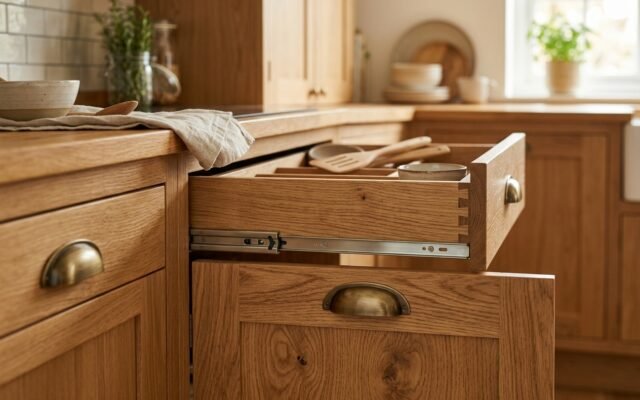
A kitchen cabinet face frame is the solid wood rectangular border fastened to the front of a cabinet box, providing a finished surface for door hinges, drawer slides, and decorative appearance. Face frame cabinetry remains the leading American construction style because it adds rigidity, provides hinge mounting options, and creates the traditional shadow line surrounding inset and overlay doors. In fact, cabinetmakers rely on face frames to square the carcass during assembly and ensure lasting stability.
When you remodel or build a kitchen, understanding cabinet construction prevents costly ordering mistakes. Furthermore, face frames determine hinge mounting, drawer box widths, and how adjacent cabinets connect. Therefore, selecting the proper wood species, stile dimensions, and joinery ensures your kitchen cabinets stay square.
What Is a Cabinet Face Frame
Face Frame Components
A standard cabinet face frame consists of four basic wood parts joined into a flat perimeter. Specifically, vertical boards running the full height of the cabinet box are called stiles. Horizontal boards connecting the stiles at the top and bottom are called rails. In addition, wide cabinets often include intermediate vertical dividers called mullions to separate double door openings.
Standard outer stiles measure one and a half inches wide on most factory and custom cabinets. In contrast, center stiles on two door cabinets typically measure one inch to two inches wide. Top and bottom rails usually measure one and a half to two inches wide. Consequently, these components create a rigid boundary masking raw plywood edges.
What the Face Frame Does
The face frame serves three vital structural and aesthetic functions in kitchen cabinetry. First, it squares and stiffens the kitchen cabinet boxes. Unframed boxes can flex during shipping or rough handling. However, a hardwood face frame locks the front opening into a rigid ninety degree rectangle.
Second, the face frame provides a dense hardwood substrate for mounting hardware. Hinges screwed directly into particleboard can loosen over time. In contrast, driving screws into three-quarter inch maple or oak provides exceptional holding strength. Third, the frame establishes a clean decorative outline defining kitchen aesthetics.
Face Frame vs Frameless (European) Cabinets
American cabinet shops typically build face frame cabinets, while European builders favor frameless designs. Frameless cabinets, often called full access cabinets, eliminate the front hardwood frame entirely. Instead, manufacturers apply edge banding directly to the raw front edges of the box panels.
Because frameless cabinets have no face frame, they offer slightly wider interior access. For example, frameless drawer boxes can be slightly wider than framed drawer boxes. However, face frame cabinets offer greater rack resistance and support diverse kitchen cabinet door styles, including classic inset doors that frameless boxes cannot accommodate easily.
Face Frame Materials and Wood Species
Hard Maple Face Frames
Hard maple is the premier wood species for painted kitchen cabinet face frames. Because maple features a dense, closed grain structure, it produces an ultra smooth finish without grain telegraphing. In addition, hard maple resists denting and holds screws better than softer hardwoods. As a result, factory cabinet builders use hard maple stiles and rails for painted cabinetry.
When applying lacquer or conversion varnish, maple does not require wood filler or grain sealing. Therefore, it delivers an immaculate glass-like appearance. If you plan to install durable white kitchen cabinets, hard maple face frames provide the strongest defense against daily door impacts.
Red and White Oak Face Frames
Red oak and white oak are the traditional backbone of stained American cabinetry. Both oak species feature prominent, coarse grain patterns that showcase natural wood character beneath clear and medium stains. In fact, white oak has surged in modern transitional kitchens due to its muted honey tones and straight grain.
Oak offers exceptional screw-holding power and remarkable resistance to mechanical damage. However, oak requires grain filling paste if you decide to paint over it. Without grain filler, open pores create visible texture through paint. Therefore, oak remains best suited for clear coats, light stains, or cerused finishes.
Poplar Face Frames
Poplar provides an affordable alternative to hard maple for opaque painted cabinets. In fact, poplar costs twenty to thirty percent less per board foot than hard maple. Poplar is relatively lightweight, cuts cleanly, and takes primer and enamel paints smoothly. Consequently, budget-conscious custom cabinetmakers frequently use poplar face frames.
Nevertheless, poplar is softer than maple. As a result, sharp impacts from heavy pots can dent poplar stiles more easily. Furthermore, poplar displays green mineral streaks in raw lumber. While paint covers these color variations completely, poplar is unsuitable for clear stain applications.
Cherry and Walnut Face Frames
Cherry and walnut represent the luxury tier for natural stained face frame cabinetry. Cherry features a smooth satin grain that oxidizes into a rich reddish amber patina over time. In addition, cherry machines crisply and creates tight glued joints when clamped properly. You can explore more species details in our guide on kitchen cabinet wood types.
Walnut offers deep chocolate heartwood tones and striking grain contrast. Because walnut is naturally dark, cabinetmakers rarely stain it. Instead, they apply clear satin conversion varnish to highlight the natural wood figure. Although walnut costs more than oak or maple, walnut face frames elevate a custom kitchen into fine furniture.
Standard Face Frame Dimensions
Stile Width Standards
Outer stiles on standard base and wall cabinets measure exactly one and a half inches wide. This dimension provides adequate structural strength while leaving generous opening space for cabinet shelving. When two cabinets sit side by side, their outer stiles butt together creating a three-inch vertical border between doors.
On two door cabinets without a center divider, doors meet in the center without an intermediate stile. However, on cabinets with a center mullion, builders often use a one-inch to one-and-a-half-inch center stile. Inset cabinetry requires strict stile consistency because uneven stiles create noticeably asymmetrical door reveals.
Rail Width Standards
Top and bottom rails on standard base cabinets measure one and a half inches to two inches wide. Specifically, the bottom rail must be wide enough to clear the internal bottom shelf. If the rail is too narrow, the bottom shelf creates an awkward interior lip.
Intermediate divider rails between a top drawer and bottom doors typically measure one and a quarter inches. This narrower dimension maintains balanced vertical proportions across the cabinet facade. In addition, wall cabinets use one-and-a-half-inch top and bottom rails to maintain consistent visual sightlines.
Face Frame Thickness
Standard American face frames are milled to three-quarter inch solid thickness. This dimension matches the three-quarter inch thickness of high-grade plywood carcass sides. Because the face frame and box panels share equal thickness, hinges and drawer slides align predictably without special shims. Learn more about sizing in our breakdown of kitchen base cabinet dimensions.
Some commercial cabinets use five-eighths-inch face frames to cut manufacturing costs. However, three-quarter-inch hardwood is the proven industry standard for structural longevity. Thinner frames can bow under heavy stone counters or split when driving pocket screws during installation.
Setback and Overhang Rules
On standalone cabinet boxes, the face frame outer edge is installed flush with the plywood side panel. In shop terms, this produces a zero overhang condition on finished end panels. When cabinetmakers attach decorative matching side panels, a flush face frame allows seamless alignment without gaps.
However, when modular cabinets sit against walls or adjacent boxes, installers intentionally allow a tiny one-sixteenth-inch frame overhang. This slight reveal lets installers scribe the face frame to wavy drywall without cutting into the box. For wider wall gaps, builders install dedicated kitchen cabinet filler strips to guarantee clear door clearance.
Face Frame Joinery Methods
Pocket Screw Joinery
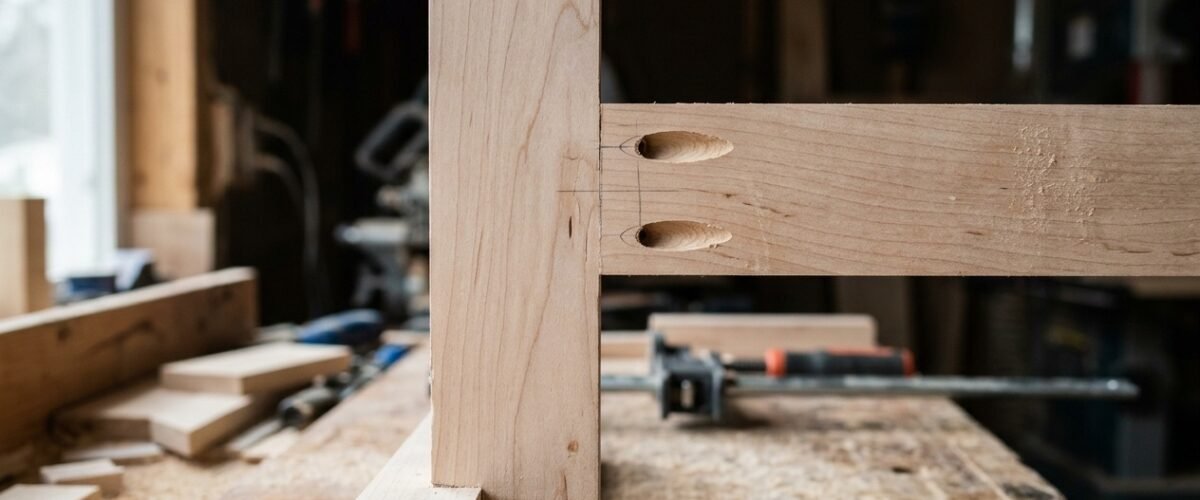
Pocket screw joinery is the most popular assembly technique in modern cabinet shops. Woodworkers clamp the rails and stiles face down on an assembly table. Next, a specialized drill jig creates angled pocket holes on the back faces of the horizontal rails. Installers drive self-tapping screws directly through the rails into the adjacent stiles.
Because pocket holes remain hidden on the interior side of the frame, the front surface stays pristine. Furthermore, applying wood glue to the butt joint before driving screws creates a joint that outlasts the wood fibers. You can check pocket hole jig prices on Amazon to equip your own workshop for face frame fabrication.
Mortise and Tenon Joints
Mortise and tenon joinery is the traditional benchmark for heirloom furniture and high-end millwork. In this joint, craftsmen cut a rectangular tenon on the end of each horizontal rail. Then, they plunge a corresponding mortise pocket into the inner edge of the vertical stile.
When assembled with wood glue, the interlocking wood fibers create unmatched mechanical shear resistance. Because mortise and tenon joints require specialized tenoning jigs and mortisers, they increase production time. Nevertheless, historic preservationists and luxury custom shops insist on mortise and tenon joinery for maximum prestige.
Dowel Joinery
Dowel joinery offers high mechanical strength and rapid alignment in automated factory environments. Specialized drilling machines bore matching holes into rail ends and stile edges simultaneously. Next, injectors shoot adhesive and fluted hardwood dowels into the holes before clamps compress the frame.
Fluted wooden dowels expand slightly when water-based glue contacts them, locking the joint firmly in place. Consequently, dowel joinery produces strong, flush joints without visible pockets on the back. Many manufacturers favor dowel joinery because it integrates smoothly into automated production lines.
Biscuit Joinery
Biscuit joinery utilizes compressed beechwood wafers inserted into half-oval slots cut by a biscuit joiner blade. Woodworkers coat slots with glue and insert number twenty biscuits before clamping components. As wood glue cures, the beech biscuit swells to create a tight friction fit.
However, biscuit joints offer limited resistance against twisting forces compared to pocket screws or dowels. Therefore, cabinetmakers use biscuits to keep joints flush during glue-up rather than as primary fasteners. For complete installation practices, review our contractor guide on kitchen cabinet installation.
Door and Drawer Overlay Options on Face Frames
Full Overlay on Face Frame
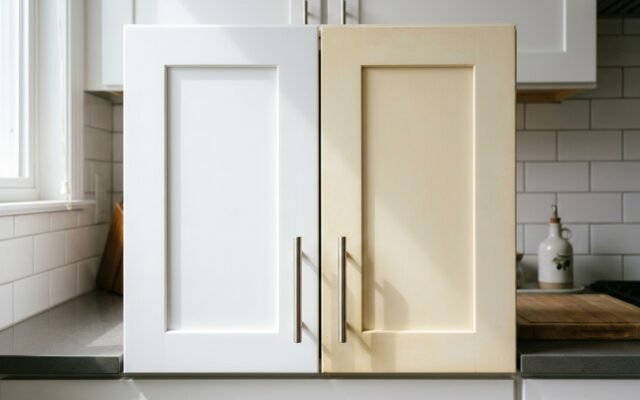
Full overlay cabinetry provides a sleek, modern aesthetic while retaining a rigid hardwood frame. In a full overlay layout, doors and drawer fronts cover nearly the entire face frame surface. Typically, only one-quarter inch or one-eighth inch of the face frame reveals between adjacent doors and drawer heads.
Because full overlay covers the face frame, homeowners enjoy contemporary clean lines combined with American frame durability. Full overlay requires compact concealed cup hinges engineered specifically for face frame mounting. Consequently, full overlay has become the most widely purchased cabinet door configuration across North America.
Half Overlay on Face Frame
Half overlay cabinetry, also called standard or traditional overlay, represents the classic American kitchen profile. In this configuration, doors and drawers overlap the face frame opening by one-half inch to three-quarters of an inch. As a result, approximately one inch of solid hardwood frame remains clearly visible around every door opening.
Half overlay cabinetry creates pronounced architectural depth and shadow lines across your cabinet run. In addition, half overlay doors allow wider manufacturing tolerances than full overlay or inset doors. If you want to compare standard overlay styles, you can browse cabinet options on Wayfair to examine classic and modern door reveals. Many homeowners pair half overlay with timeless shaker kitchen cabinets for a charming craftsman appearance.
Inset Doors on Face Frame
Inset cabinetry is the hallmark of custom luxury woodwork. Rather than resting on the frame face, inset doors and drawers sit flush inside openings. This design requires exact three-thirty-seconds-inch clearance gaps around all four perimeter edges.
Because wood expands with humidity, building inset cabinets demands premium kiln-dried hardwoods. Consequently, inset cabinetry carries a twenty to forty percent price premium over overlay cabinetry. If you appreciate traditional furniture craftsmanship, read our dedicated review of inset kitchen cabinets to assess installation requirements and hardware options.
Face Frame vs Frameless Comparison Table
Side-by-Side Construction Comparison
Deciding between face frame and frameless cabinetry depends on style, hardware preferences, and storage priorities. Face frame cabinets offer superior diagonal rigidity and accommodate flush inset doors seamlessly. In contrast, European frameless cabinets maximize interior drawer width and deliver seamless modern reveals.
The following comparison table breaks down the core structural differences between these two cabinet building methods. Use these technical specifications to choose the best configuration for your kitchen remodeling project:
| Feature | Face Frame Cabinets | Frameless (European) Cabinets |
|---|---|---|
| Front Structure | Hardwood rail and stile border | Thick edge-banded box edge only |
| Door Opening Width | Slightly narrower (frame reduces opening) | Full box opening width |
| Rigidity | Higher (frame squares the box) | Depends on box thickness |
| Traditional Look | Classic American shadow line | Clean contemporary reveal |
| Inset Door Compatibility | Standard | Uncommon |
| Cost | Comparable to frameless | Comparable to face frame |
| Best For | Traditional and transitional kitchens | Modern and European kitchens |
When selecting cabinets, inspect box materials and corner blocks carefully. High quality framed cabinets combine solid hardwood face frames with three-quarter-inch plywood boxes. You can browse options at Home Depot to compare stock and semi-custom face frame product lines before finalizing your order.
Frequently Asked Questions
What is the difference between face frame and frameless cabinets?
Face frame cabinets feature a solid hardwood border fastened to the front of the cabinet box. This frame provides structural rigidity and secure mounting points for hinges and drawer slides. In contrast, frameless cabinets omit the hardwood face frame, using edge-banded box panels and European concealed hinges mounted directly to interior box walls.
Is face frame or frameless cabinets better?
Neither cabinet construction method is universally superior because each style serves distinct aesthetic and functional goals. Specifically, face frame cabinets offer greater structural rigidity, handle uneven walls more forgivingly, and support inset doors. Meanwhile, frameless cabinets provide slightly wider interior storage openings and create clean, ultra-modern slab lines.
What wood is used for cabinet face frames?
Hard maple is the standard hardwood species for factory painted cabinet face frames due to its fine grain and exceptional dent resistance. Red oak, white oak, cherry, and walnut are the preferred hardwoods for natural stained cabinetry. In addition, budget-friendly custom shops often use poplar for painted face frames because it machines easily and costs less.
How thick is a cabinet face frame?
Standard cabinet face frames measure three-quarters of an inch thick in solid hardwood. This three-quarter-inch thickness matches the thickness of standard plywood cabinet box panels. Matching thicknesses ensure flush internal alignments and allow cabinet installers to secure adjacent face frames together without distortion or custom shims.
Can you add a face frame to frameless cabinets?
Yes, skilled woodworkers can build a custom hardwood face frame and attach it to the front edges of a frameless cabinet box with dowels or pocket screws. However, adding face frames after manufacturing changes the required door sizes and hinge offsets. Therefore, ordering factory-built face frame cabinets from the start is much faster, cheaper, and structurally sound.