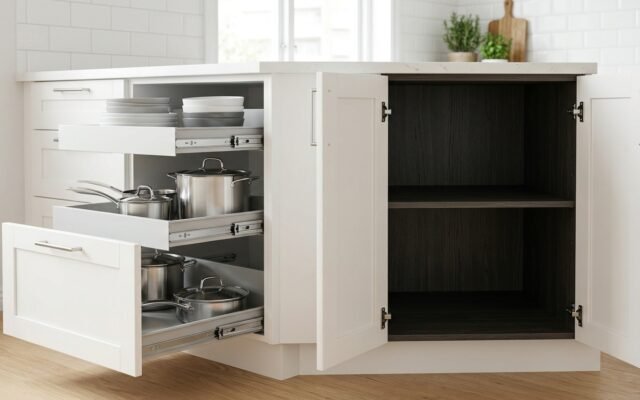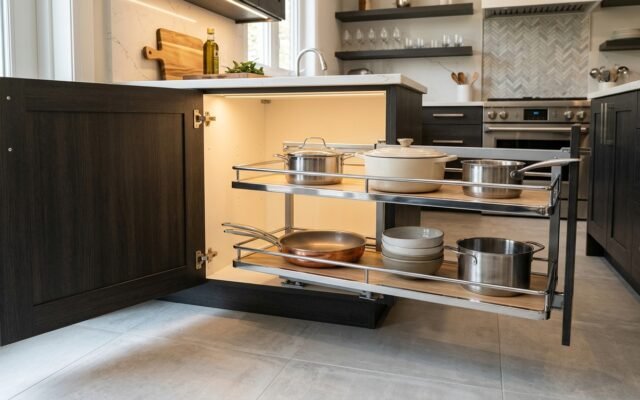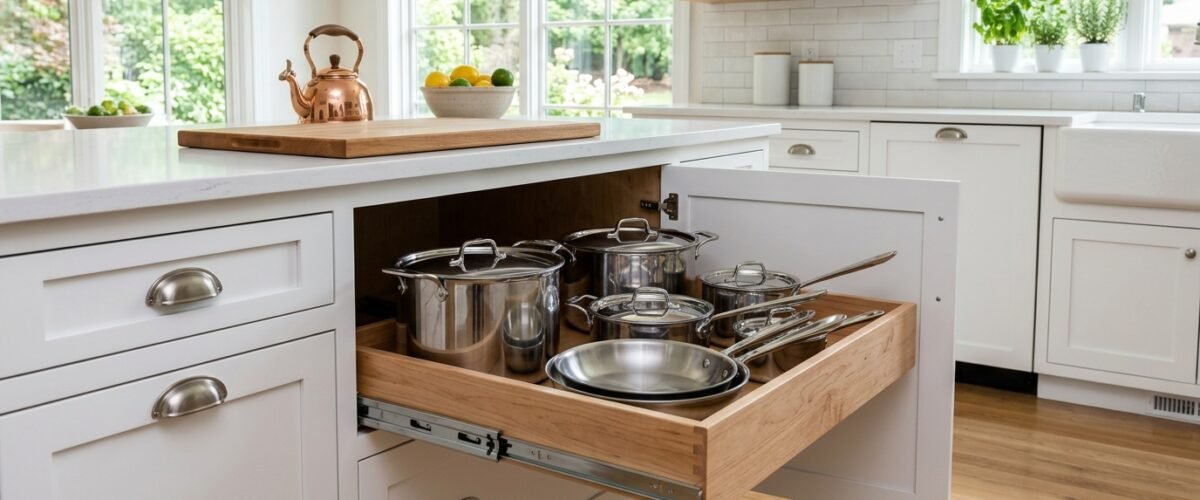
A 3-drawer base cabinet provides more versatile, organized storage for 80% of kitchen tasks by dividing vertical space into one shallow cutlery drawer and two deep pot drawers, whereas a 2-drawer base cabinet offers two massive 12-inch deep bins engineered specifically for oversized stockpots and tall small appliances. Standard base cabinets measure 34.5 inches high. How a manufacturer divides that vertical height into sliding drawers determines whether you enjoy effortless daily access or end up stacking items into disorganized piles.
Selecting the right drawer configuration prevents wasted interior air space while matching your daily cooking style. Before deciding on drawer banks across your kitchen, read our foundational comparison of drawer base cabinets vs door cabinets to understand why drawers outperform traditional hinged door units.
Quick Comparison
| Feature & Dimension | Standard 3-Drawer Base (DB30-3) | Deep 2-Drawer Base (DB30-2) |
|---|---|---|
| Top Drawer Usable Interior Height | 3.75 to 4.25 inches (shallow) | 11.5 to 12.5 inches (extra-deep) |
| Bottom Drawer(s) Usable Height | 8.0 to 9.5 inches (two identical drawers) | 11.5 to 12.5 inches (single deep bin) |
| Total Drawers per Cabinet Box | 3 sliding units | 2 sliding units |
| Primary Storage Capabilities | Cutlery, prep tools, frying pans, saucepans | 12-quart stockpots, slow cookers, blenders |
| Wasted Interior Air Space | Minimal (heights match typical kitchenware) | High (storing shallow pans leaves empty air) |
| Drawer Slide Hardware Requirement | 3 pairs of 75–100 lb undermount slides | 2 pairs of 125–150 lb heavy-duty slides |
| Average Hardware & Box Cost | $340–$580 per cabinet | $310–$520 per cabinet |
Interior Vertical Height: The 12-Inch “Air Space Trap”
A 2-drawer base cabinet frequently wastes 30% of its interior volume as empty, unused air space above shallow items. While two huge 12-inch deep drawers look impressive in a catalog, most kitchen cookware measures under 5 inches tall. When you place standard frying pans, 2-quart saucepans, or ceramic mixing bowls inside a 12-inch deep drawer, the top six inches of the drawer box remain empty air.
Consequently, homeowners instinctively begin stacking skillets and saucepans on top of each other to utilize that empty height. Stacking cookware creates noisy, scratched pans and forces you to lift two heavy skillets just to reach the one on the bottom. In contrast, a 3-drawer base cabinet provides two 8-inch to 9-inch deep lower drawers, which fit average cookware in single, unstacked layers, paired with a dedicated 4-inch top drawer for flat cutlery.
Where 2-Drawer Base Cabinets Truly Excel
A 2-drawer base cabinet is the undisputed champion for storing tall appliances and massive culinary stockpots that cannot fit anywhere else. If you own an 8-quart Instant Pot, an enameled cast-iron Dutch oven with a lid handle, a stand mixer bowl, or a high-powered Vitamix blender, these tall items easily exceed the 9-inch ceiling of a standard 3-drawer unit.
Therefore, dedicating one 2-drawer base cabinet directly beneath your cooktop or inside your kitchen island solves the storage dilemma for oversized gear. Furthermore, deep 12-inch drawers accommodate vertical lid racks and peg-board dish organizers. With wooden pegs holding stacks of 11-inch dinner plates securely in place, family members can unload dishwashers into lower drawers without lifting heavy ceramic stacks into high wall cabinets.
Hardware and Weight Capacity Under Heavy Cookware
Deep 2-drawer units concentrate immense weight onto only two slide pairs, making 125-pound commercial slides absolutely mandatory. A 36-inch wide deep drawer loaded with four cast-iron Dutch ovens and multiple stainless steel lids easily weighs 70 to 90 pounds. When you pull that heavy box fully outward, that concentrated weight exerts extreme downward leverage on the cabinet face frame.
Under ANSI/KCMA A161.1 standards, standard residential drawer slides undergo 25,000 continuous cycles carrying 15 pounds per square foot. However, for 2-drawer bases, you should demand heavy-duty slides rated for 125 to 150 pounds, such as the Blum Movento or Grass Dynapro series. In addition, verify that the drawer box features 5/8-inch solid wood dovetail joinery with a full 3/8-inch or 1/2-inch plywood bottom rather than a flimsy 1/4-inch hardboard panel.
Showroom Inspection Test: Corner Deflection and Reveal Check
Before choosing between 2-drawer and 3-drawer units in a showroom, perform this physical reveal check on the floor displays. Pull the bottom deep drawer all the way out and push downward on the right front corner with 25 pounds of hand force. Then, close the drawer gently and inspect the horizontal reveal gap between the drawer fronts.
If the drawer slides lack rack-and-pinion synchronization, the drawer will twist, leaving an uneven reveal gap where the front panel rubs against the cabinet frame. High-quality dovetail boxes equipped with synchronized undermount slides will absorb the localized force and close with laser-straight 1/8-inch reveals. If a display unit sags or rubs when empty, heavy cast iron at home will cause permanent alignment failures.
Kitchen Zone Allocation: How to Mix Both in One Remodel
The most functional kitchen designs combine both 3-drawer and 2-drawer cabinets into strategic work zones across the room. Because installing only 2-drawer units leaves you with nowhere to store silverware, while using only 3-drawer units leaves tall appliances on your countertop, smart layout design blends both styles.
| Kitchen Work Zone | Recommended Configuration | Purpose & Rationale |
|---|---|---|
| Main Food Prep Island | 3-Drawer Base Cabinet | Top drawer holds chef knives; lower drawers hold mixing bowls |
| Direct Cooktop / Range Flank | 2-Drawer Base Cabinet | Houses oversized 12-quart stockpots and tall Dutch ovens |
| Dishwasher Cleanup Station | 3-Drawer Base Cabinet | Top drawer holds flatware; middle and bottom hold mugs and plates |
| Baking Center | 3-Drawer Base Cabinet | Organizes measuring cups, rolling pins, and flat baking dishes |
| Small Appliance Niche | 2-Drawer Base Cabinet | Concretely conceals blenders, slow cookers, and food processors |
Pairing these drawer configurations with specialized utility cabinets like pull-out trash bin cabinets creates a highly efficient kitchen workspace.
Frequently Asked Questions
Which is better: a 2-drawer or 3-drawer base cabinet? A 3-drawer base cabinet is better for overall kitchen utility because it provides dedicated storage for flatware, cutlery, and everyday cookware without stacking. However, including at least one 2-drawer base is recommended for storing tall small appliances and 12-quart stockpots.
How deep is the top drawer in a 3-drawer base cabinet? The top drawer in a standard 3-drawer base cabinet features an interior depth of 3.75 to 4.25 inches. This shallow profile is specifically proportioned for flatware organizers, prep utensils, spices, and rolling pins.
Can you store dinner plates in a 2-drawer base cabinet? Yes, deep 2-drawer base cabinets work exceptionally well for dinnerware when paired with pegboard drawer organizer systems. Adjustable wooden pegs keep stacks of heavy ceramic plates firmly separated and stable when opening and closing the drawer.
Are 2-drawer cabinets cheaper than 3-drawer cabinets? Yes, 2-drawer cabinets typically cost $30 to $70 less than equivalent 3-drawer cabinets because the manufacturer builds one less dovetailed drawer box, installs one less pair of undermount slides, and finishes one less drawer front.
What is the maximum weight a 36-inch pot drawer can hold? A 36-inch pot drawer equipped with commercial-grade undermount slides (such as Blum Movento) holds between 125 and 150 pounds of dynamic weight. Always verify the slide rating before loading wide deep drawers with cast-iron cookware.