Meta description (154 chars): A 12-inch deep cabinet holds about half the volume of a 24-inch one. Standard sizes, what fits inside, where shallow cabinets work, and 4 costly mistakes.
Slug suggestion: 12-inch-deep-cabinet
Author: David Miller
Category: Measurement & Layout
Format: 1 Measurement / Reference
A 12-inch deep cabinet is the shallowest standard cabinet you can buy, and
it is also the most common depth in the kitchen: every wall cabinet is 12
inches deep. The box is 12 inches front to back, the interior is about 11
inches, and that 1 inch of frame and back panel is the difference between
what fits and what does not. A dinner plate fits. A stockpot does not. This
guide gives you the full size chart, the usable volume by width and height,
what fits inside, and where a 12-inch cabinet is the right call instead of
the standard 24-inch depth.
| Cabinet type | Standard depth | Heights | Widths |
|---|---|---|---|
| Wall cabinet | 12 in | 30, 36, 42 in | 9 to 36 in, 3-in steps |
| Wall cabinet, deep | 15 or 18 in | 30, 36, 42 in | 12 to 36 in |
| Wall cabinet over fridge/oven | 24 in | 12 to 24 in | 30 to 36 in |
| Base cabinet | 24 in | 34.5 in | 9 to 48 in, 3-in steps |
| Base cabinet, shallow | 12 or 18 in | 34.5 in | 9 to 36 in |
| Tall pantry, shallow | 12 in | 84, 90, 96 in | 12 to 36 in |
| Tall pantry, deep | 24 in | 84, 90, 96 in | 12 to 36 in |
| Bathroom vanity base | 18 to 21 in | 30 to 34.5 in | 12 to 48 in |
Read the kitchen cabinet depth guide for the full
depth chart across every cabinet type, and the base cabinet height
guide for the height numbers behind the 34.5-inch base and the 18-inch gap
above the counter.
How Much Does a 12-Inch Deep Cabinet Hold? The Volume Table
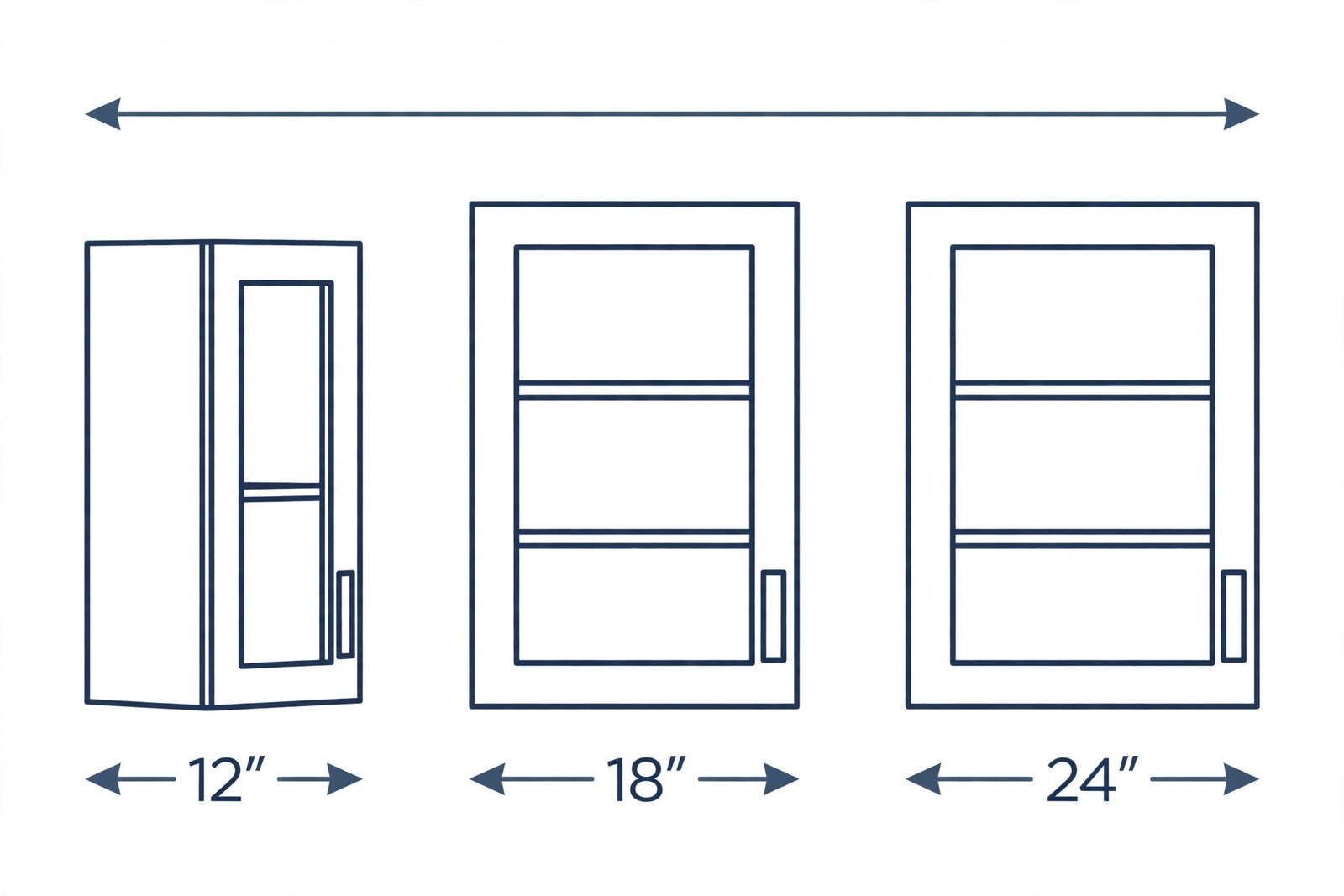
A 12-inch deep cabinet holds about half the volume of a 24-inch deep
cabinet of the same width and height. The table below is computed from the
interior dimensions: subtract 1.5 inches from the width for the two
3/4-inch sides, use 11 inches of interior depth, and subtract 1.5 inches
from the height for the top and bottom. Divide by 1,728 to get cubic feet.
| Cabinet (W x H) | Interior (W x D x H) | Usable volume, 12 in deep | Same size, 24 in deep |
|---|---|---|---|
| 30 x 30 in | 28.5 x 11 x 28.5 in | 5.17 cu ft | 10.81 cu ft |
| 30 x 36 in | 28.5 x 11 x 34.5 in | 6.26 cu ft | 13.09 cu ft |
| 36 x 30 in | 34.5 x 11 x 28.5 in | 6.26 cu ft | 13.09 cu ft |
| 36 x 36 in | 34.5 x 11 x 34.5 in | 7.58 cu ft | 15.85 cu ft |
| 36 x 42 in | 34.5 x 11 x 40.5 in | 8.89 cu ft | 18.59 cu ft |
The pattern is simple: doubling the depth doubles the volume, so a 12-inch
cabinet gives you 48 percent of the storage of a 24-inch cabinet. The
storage-frontage math says the same thing in a different unit. Kitchen
planners measure storage as width in inches times the number of shelves
times the depth in feet. A 36-inch wide wall cabinet with 2 shelves at 1
foot deep scores 72. The same cabinet at 2 feet deep scores 144. The
shallow cabinet is not a smaller version of the deep one. It is half the
storage, and you buy it for the space it saves, not the storage it holds.
What Fits in 12 Inches and What Does Not
Interior depth is 11 inches, not 12. The door, the frame, and the back
panel take the rest. Measure what you store against 11 inches.
Fits: dinner plates 10 to 11 inches across, stacked flat; soup cans 3
inches across, 3 cans deep in a row; cereal boxes 12 inches tall standing
upright if the shelf spacing allows; mugs 3.5 inches across; spice jars;
glasses; bowls up to 10 inches across; canned goods, jars, and boxed food
one item deep, so nothing hides behind anything else.
Does not fit: a 12-inch skillet, which needs 12 inches of flat depth
and only has 11; a stockpot 12 inches across; a stand mixer, which is about
14 inches deep; a large serving platter 14 to 16 inches across; a cookie
sheet 18 inches long; a full-size cutting board. These go in a 24-inch deep
base cabinet or a deep pantry, not in a 12-inch wall cabinet.
The one-row rule is the real advantage of the shallow depth. In a 24-inch
deep pantry, cans hide three rows deep and expire at the back. In a 12-inch
deep pantry, every can is visible. That is why a 12-inch tall pantry works
for food you use every week, even though it holds half the volume: you use
all of what it holds.
Where a 12-Inch Deep Cabinet Fits
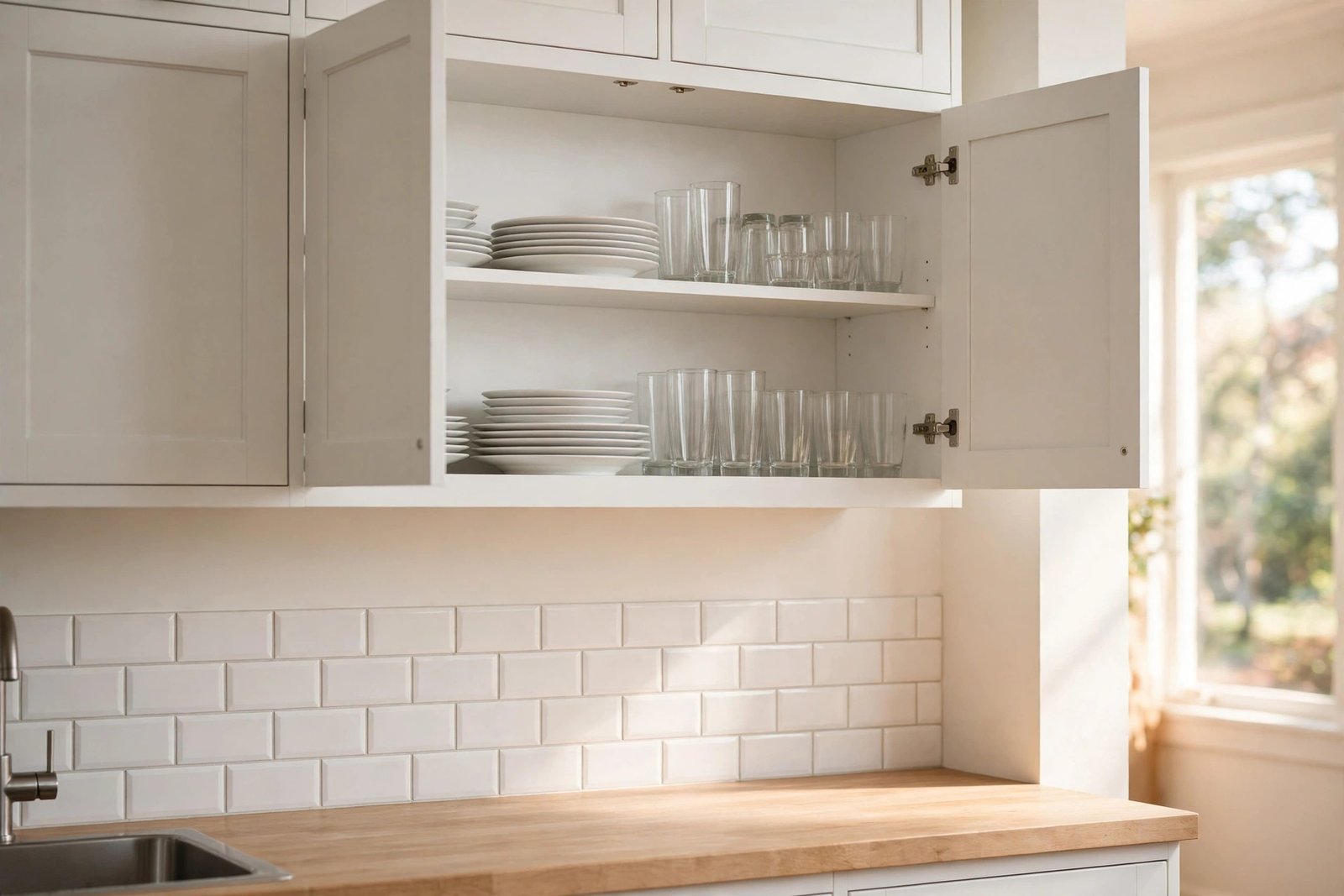
A 12-inch cabinet fits where a 24-inch cabinet would block the room. The
five spots that come up most:
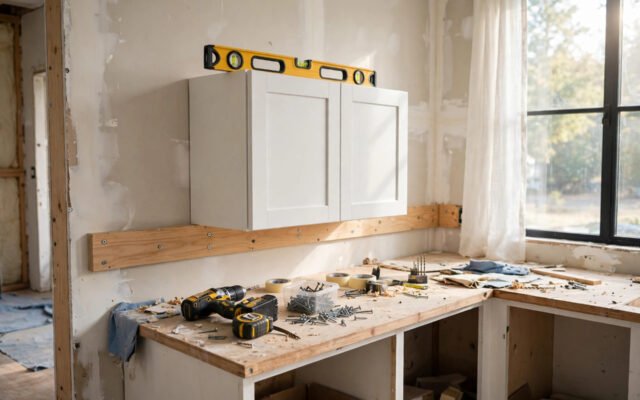
- Above the counter. This is the standard spot. Wall cabinets mount
with the bottom edge 54 inches off the floor, which is 36 inches of counter
plus an 18-inch gap. The 12-inch depth keeps the cabinet clear of your head
while you work at the counter. A deeper wall cabinet at 15 or 18 inches
holds bigger plates, but it also puts the bottom edge closer to your
forehead. Read the kitchen upper cabinet height
guide for the mounting numbers. - Narrow galley kitchens. When two runs face each other across a 36 to
42-inch aisle, a 24-inch deep cabinet on both sides leaves no room to pass.
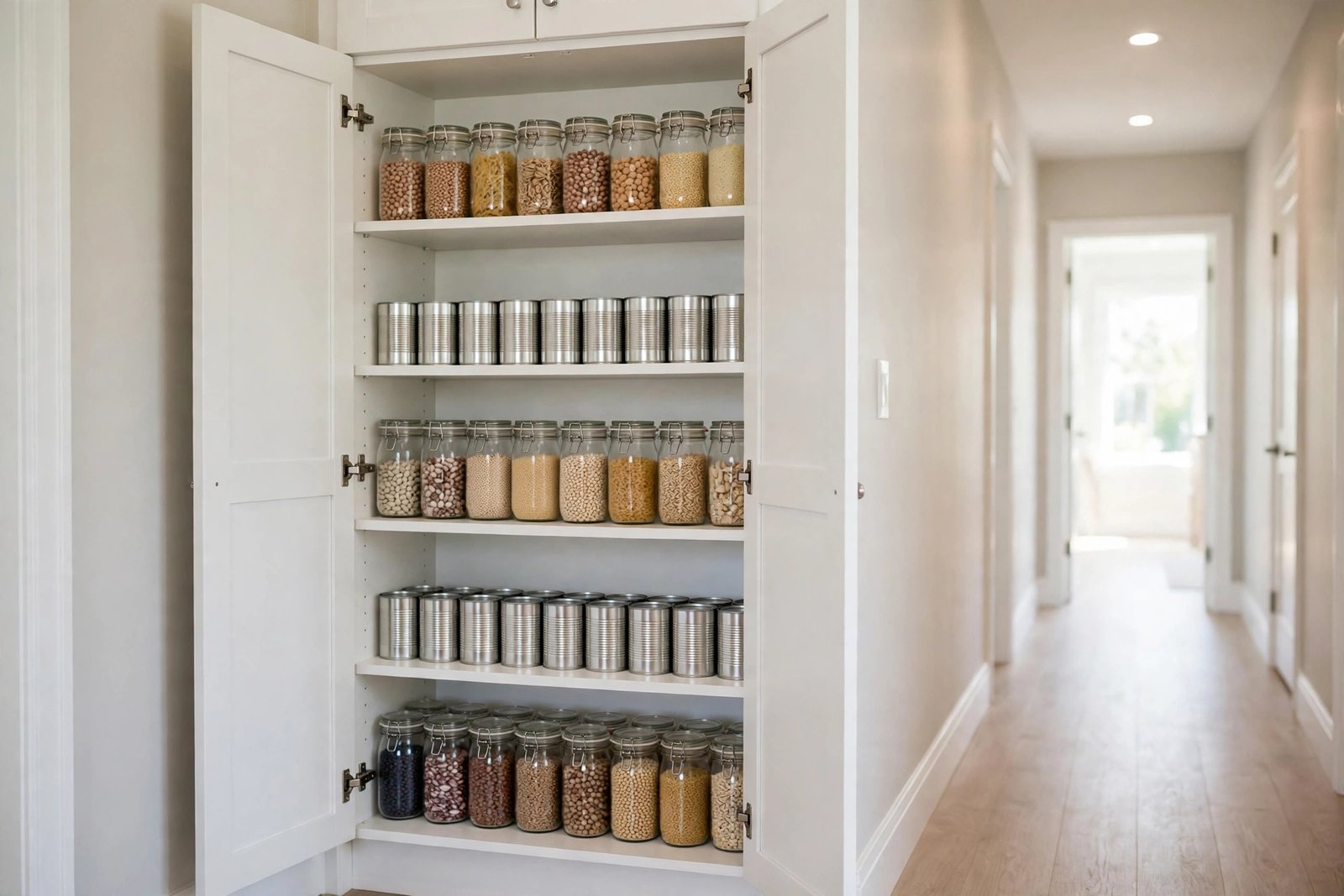
A 12-inch or 18-inch deep run on one side buys back 6 to 12 inches of aisle. - Hallways and dining nooks. A 12-inch deep tall pantry fits in a
hallway or at the end of a cabinet run where a 24-inch pantry would block
the walkway. It holds cans, jars, and boxed food in one row. - Under stairs and in laundry rooms. A 12-inch deep cabinet fits a
shallow alcove and holds detergent, cleaning supplies, and linens without
sticking out into the room. - Coffee stations and bars. A 12-inch deep base with a 13.5-inch top
holds a coffee maker, mugs, and beans, and it fits a wall that cannot take
a full 24-inch deep run.
Shallow Base Cabinets: 12 and 18 Inches Deep
Shallow bases exist, and they solve a different problem from shallow wall
cabinets. A 12-inch or 18-inch deep base cabinet fits a kitchen where a
full 24-inch deep run would block a door, a walkway, or a radiator. The
trade is the same as the wall cabinet: an 18-inch deep base holds 75 percent
of the volume of a 24-inch base, and a 12-inch deep base holds 50 percent.
A 12-inch deep base takes a 13 to 13.5-inch deep countertop, which is too
narrow for a normal work counter but fine for a coffee station, a bar, or a
hallway sideboard.
Three rules for shallow bases. First, never put a sink in a 12-inch deep
base: the sink basin alone is 16 to 18 inches front to back, and the
plumbing needs room behind it. Second, never put a cooktop in a shallow
base: the cooktop cutout needs the full 24-inch depth. Third, check the
drawer slides. A 12-inch deep base takes a 9-inch slide, and a 9-inch
drawer holds very little. Shallow bases work best as door cabinets, not
drawer bases. Read the 18-deep base cabinets
guide for the middle option, and the kitchen base cabinet dimensions
guide for the full size chart.
How to Measure for a 12-Inch Deep Cabinet in 4 Steps
Measure the space, not the old cabinet. The old cabinet may have been
ordered wrong, and copying it repeats the mistake.
- Measure the width of the opening in three places: top, middle, and
bottom. Use the smallest number. Walls are rarely straight, and a cabinet
ordered to the widest measurement will not fit at the narrowest point. - Measure the depth from the wall face to the front of the nearest
obstruction: a door swing, a window trim, a radiator, or the opposite run.
Subtract 1 inch for clearance. That is the deepest cabinet the space takes. - Measure the height from the floor to the ceiling, the soffit, or the
bottom of the next cabinet. For a wall cabinet, mark 54 inches off the
floor for the bottom edge and measure up from there: a 30-inch cabinet ends
at 84 inches, a 36-inch cabinet at 90 inches, and a 42-inch cabinet at 96
inches. - Check the depth against what you store. Put the widest item you plan to
store on a shelf and measure it front to back. If it is over 11 inches, it
will not fit inside a 12-inch deep cabinet, and you need the 15-inch or
18-inch depth instead.
Write all four numbers down before you order. A cabinet ordered 1 inch too
deep blocks a door. A cabinet ordered 1 inch too wide does not fit at all.
A 10-Foot Galley Wall, Laid Out in 12-Inch Cabinets
Here is a real 10-foot galley wall, laid out with 12-inch deep wall
cabinets. The wall is 120 inches long. A 30-inch range hood takes 30
inches. That leaves 90 inches for wall cabinets: a 36-inch cabinet, a
30-inch cabinet, and a 24-inch cabinet, all 36 inches tall and 12 inches
deep.
| Cabinet | Size (W x H x D) | Usable volume |
|---|---|---|
| Wall cabinet 1 | 36 x 36 x 12 in | 7.58 cu ft |
| Wall cabinet 2 | 30 x 36 x 12 in | 6.26 cu ft |
| Wall cabinet 3 | 24 x 36 x 12 in | 4.94 cu ft |
| Total wall storage | 90 in of cabinets | 18.78 cu ft |
The same 90 inches in 24-inch deep cabinets would hold 39.3 cubic feet,
more than double. The galley keeps the 12-inch depth anyway, because the
aisle is 42 inches wide and a 24-inch deep run on both sides would cut it
to 30 inches. The 18.8 cubic feet holds every plate, glass, and mug the
household owns, because plates and glasses are the items that fit in 11
inches of depth. The pots, the mixer, and the platters go in the 24-inch
deep base cabinets on the opposite run. That split is the whole point of
the shallow depth: put the flat, light items up high in the shallow
cabinets, and the deep, heavy items down low in the deep ones.
Which Depth Should You Choose? 4 Questions Decide
Four questions pick the depth. Answer them in order.
- Where does it go? Above a counter, the answer is 12 inches unless you
store oversized plates. In a hallway or a nook, the answer is 12 inches
because nothing deeper fits the space. In a pantry, the answer depends on
question 2. - What goes in it? Plates, glasses, cans, and jars: 12 inches. Platters,
mixers, and stockpots: 24 inches. If the widest item is 11 to 14 inches,
the 15-inch or 18-inch depth is the middle answer. - How wide is the aisle? Under 42 inches between runs, keep at least one
side shallow. Over 48 inches, depth is a storage choice, not a space
choice, and the 24-inch depth wins on volume. - How tall is the cabinet? A 42-inch tall cabinet at 12 inches deep holds
8.89 cubic feet, which beats a 30-inch tall cabinet at 24 inches deep on
volume per inch of wall. Height is the cheaper way to add storage when
depth is fixed.
If you answer “above the counter” and “plates and glasses”, buy the 12-inch
depth and stop deciding. If you answer “pantry” and “bulk packs”, buy the
24-inch depth with roll-out shelves.
4 Mistakes That Cost Money When You Order the Wrong Depth
Four mistakes cause most shallow-cabinet problems. All four are avoidable
if you measure the space and the contents before you order.
- Cabinet blocks a door or a walkway. A 24-inch deep pantry was ordered
for a hallway that only fits 12 inches, and the door hits it. Cause: depth
was never measured against the obstruction. Fix: reorder at 12 inches deep.
Cost: the wrong cabinet at $200 to $500 plus delivery, and the right cabinet
on top of it. - Plates do not fit. A 12-inch deep cabinet was ordered for oversized
14-inch dinner plates, and the door will not close. Cause: the plates were
never measured. Fix: move the plates to a 15-inch or 18-inch deep cabinet,
or replace the cabinet. Cost: $0 if caught before install, $200 to $500
for a replacement cabinet after. - Wall cabinet mounted too low. The bottom edge sits under 54 inches
off the floor, and the gap above the counter is under 18 inches. Small
appliances do not fit under it, and tall cooks hit their heads. Cause: the
54-inch mark was never drawn on the wall. Fix: remount the cabinet, patch
the old screw holes, and repaint. Cost: $0 in parts and 2 hours, plus paint. - Sink or cooktop ordered into a shallow base. A 12-inch deep base was
ordered for a sink run, and the basin does not fit. Cause: the sink basin
dimensions were never checked against the cabinet depth. Fix: reorder the
base at 24 inches deep. Cost: the wrong cabinet at $189 to $272 plus the
replacement, and a week of delay.
Pre-Order Checklist: 10 Boxes to Tick
Fill in every blank before you order. A blank you skip is a cabinet that
arrives the wrong size.
- Opening width (smallest of 3 measurements): ______ in
- Available depth (wall to nearest obstruction, minus 1 in): ______ in
- Cabinet depth ordered: ______ in
- Cabinet height: ______ in
- Bottom edge height off the floor (wall cabinet): ______ in
- Gap above the counter (18 in standard): ______ in
- Widest item to store (front to back): ______ in
- Cabinet type (wall / base / tall pantry): ______
- Door swing clearance checked: yes / no
- Number of shelves needed: ______
Check the widest item against 11 inches of interior depth one more time. A
12-inch cabinet that cannot hold your plates is a decoration, not storage.
12-Inch Deep Cabinet Questions: 6 Answers
How deep is a standard wall cabinet?
12 inches. Wall cabinets are 12 inches deep and come 30, 36, or 42 inches
tall. Deeper options at 15 and 18 inches exist for oversized plates and
platters, and 24-inch deep wall cabinets are used above a refrigerator or
an oven, where the depth bridges the appliance.
Can I use a 12-inch deep cabinet as a base cabinet?
Yes, for storage that fits 11 inches of interior depth, such as a coffee
station, a bar, or a hallway sideboard. Do not use one for a sink or a
cooktop: the basin and the cutout need the full 24-inch depth. A 12-inch
deep base takes a 13 to 13.5-inch deep countertop.
What fits in a 12-inch deep pantry?
Cans, jars, spice jars, cereal boxes, and boxed food, all in a single row
so nothing hides at the back. A 12-inch deep tall pantry is 84, 90, or 96
inches tall and 12 to 36 inches wide. It will not hold a stand mixer, a
stockpot, or bulk packs, which need a 24-inch deep pantry with roll-out
shelves.
How high do you mount a 12-inch deep wall cabinet?
With the bottom edge 54 inches off the floor, which leaves an 18-inch gap
above a standard 36-inch high countertop. Mark the 54-inch line on the wall
before you drill. A 30-inch tall cabinet then ends at 84 inches, a 36-inch
cabinet at 90 inches, and a 42-inch cabinet at 96 inches.
Are 12-inch deep base cabinets a good idea?
In the right spot, yes. They fit narrow galleys, hallways, and walls that
cannot take a 24-inch deep run, and they hold half the volume of a full
base. They are a bad idea as a main work counter, because a 13-inch deep
countertop is too narrow to prep on, and as a drawer base, because a
9-inch slide holds very little.
Should I choose 12, 15, or 18 inches for a wall cabinet?
12 inches if you store standard plates and glasses and want the most head
room. 15 inches if your plates run 12 to 13 inches across. 18 inches if
you store large platters or serving bowls. Each step up adds about 25
percent more volume and takes 3 to 6 inches of head room over the counter.