Choosing drawer hardware directly shapes your daily kitchen experience. In the debate between undermount vs side mount drawer slides, the contractor verdict is clear. Undermount slides are worth every penny for main kitchen drawers. In contrast, side mount slides belong strictly in utility rooms, workshops, or budget rental properties.
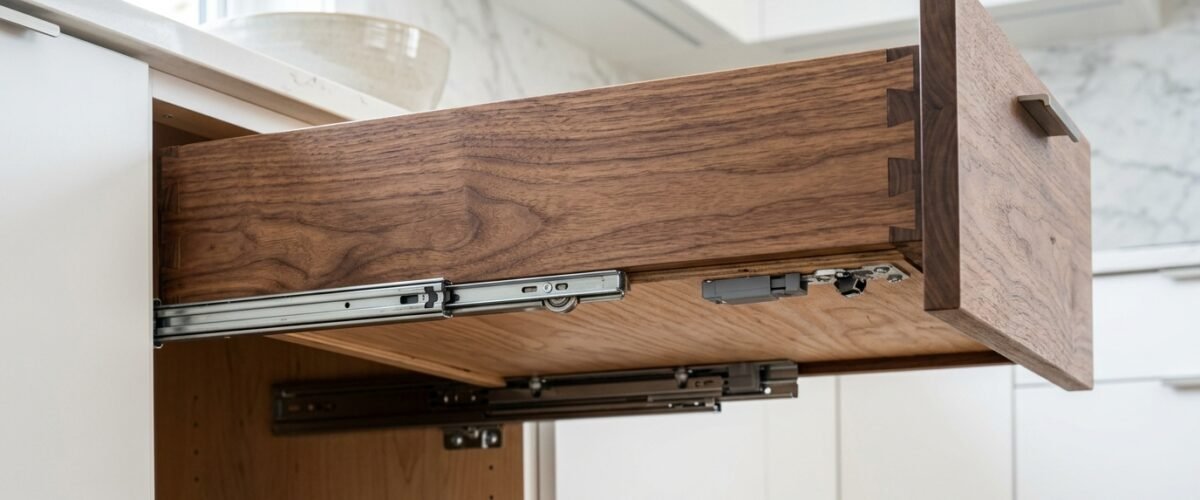
Undermount slides hide entirely beneath the drawer box, preserving full drawer width and preventing grease from fouling the mechanism. Conversely, side mount slides steal over one full inch of interior storage width and expose greasy steel tracks right where you reach for utensils. If you want smooth, silent operation that lasts twenty-five thousand cycles, undermount glides are the standard you should demand.
Quick Comparison: Undermount vs Side Mount Drawer Slides
Undermount slides provide complete mechanical concealment, superior load distribution, and tool-free face alignment. Meanwhile, side mount slides offer lower purchase costs and simpler DIY retrofit capabilities. Here is how both slide designs perform in real kitchen environments.
| Performance Factor | Undermount Drawer Slides | Side Mount Drawer Slides |
|---|---|---|
| Hardware Visibility | 100% concealed beneath the drawer box | Exposed steel rails visible on both drawer sides |
| Interior Width Loss | Zero width penalty; mounts under the bottom floor | Consumes 1.00 to 1.25 inches of interior width |
| Standard Weight Capacity | 75 to 100 lbs dynamic (125 lbs heavy-duty) | 50 to 75 lbs standard (100 lbs commercial) |
| Soft-Close Mechanism | Integrated fluid dampener inside enclosed steel channel | Add-on rear spring cylinder prone to snagging |
| Alignment Adjustability | 6-way tool-free adjustment via locking clips | Manual screw relocation in slotted mounting holes |
| ANSI/KCMA Cycle Rating | Easily passes 25,000 to 50,000 extension cycles | Typically rated for 10,000 to 25,000 cycles |
| Hardware Cost per Drawer | $28 to $45 per pair (e.g. Blum 563H) | $9 to $18 per pair (standard ball-bearing) |
The Width Penalty: How Side Mounts Steal Drawer Storage
Kitchen storage space is precious, especially in narrower cabinet banks. For example, when you install side mount slides on a standard 18-inch drawer base, each slide mechanism requires exactly 1/2 inch of clearance between the drawer box and the cabinet carcass wall. Because you need slides on both sides, the drawer box itself must be built a full 1.00 to 1.25 inches narrower than the cabinet opening.
In contrast, undermount slides attach directly underneath the drawer sub-floor. Consequently, the exterior width of the drawer box can extend almost entirely to the cabinet opening edge. Over a typical stack of four drawers, undermount hardware provides up to four extra inches of cumulative width across your storage zones. That difference allows you to store an extra row of spice jars, wide baking sheets, or larger utensil organizers that simply will not fit in side-mounted drawer boxes.
If you are planning deep cookware storage, drawer space efficiency becomes critical. We break down the exact usable dimensions in our guide on 3-drawer vs 2-drawer base cabinets.
Weight Capacity and Dynamic Loading: ANSI/KCMA Testing
Drawer slides endure aggressive dynamic forces every time someone pulls open a drawer laden with cast-iron skillets. In laboratory evaluations, the Kitchen Cabinet Manufacturers Association applies rigorous standards through ANSI/KCMA A161.1 testing. This protocol loads drawers to 15 pounds per square foot and cycles them open and shut 25,000 times without structural failure or binding.
Under heavy loading, undermount slides excel because the drawer box rests directly on top of heavy-gauge steel runner flanges. For instance, the industry-standard Blum Tandem Plus 563H slide carries a 100-pound static load and a 75-pound dynamic rating. Even when fully loaded with heavy ceramic tableware, the dual rack-and-pinion synchronization keeps both sides extending at the exact same speed.
Conversely, side mount slides support the drawer weight solely through small lateral screws driven horizontally into the drawer box sides. Over years of repeated slamming, those side screws experience continuous shear stress that gradually strips the wood holes, causing the drawer front to droop and drag across the lower face frame.
Hardware Anatomy: Ball Bearings vs Concealed Carriages
The mechanical difference between these two slide styles explains their divergent lifespans. Side mount slides rely on rows of small steel ball bearings rolling inside open stamped-steel channels. To keep the bearings moving, manufacturers coat them in lithium grease. Unfortunately, this exposed grease acts as a magnet for spilled flour, bread crumbs, and kitchen dust.
As kitchen debris mixes into the grease, it creates an abrasive grinding compound. Within three to five years, the bearings begin to chatter, stick, and squeak when pulled. Furthermore, if you accidentally brush your fingers along the side of an extended drawer, you will transfer sticky black grease onto your hands or clothing.
Undermount slides eliminate this failure completely. Their synthetic roller carriages and dampening cylinders remain completely shielded inside inverted heavy-gauge steel profiles beneath the drawer box. Dust, crumbs, and liquids cannot reach the running gear. As a result, the glide motion remains whisper-quiet and silky smooth for the entire life of your kitchen.
The Showroom Drawer Rack and Deflection Test
When you visit a kitchen showroom or inspect cabinet samples, you can easily evaluate drawer slide quality using a fast physical test. Do not just pull the drawer open and admire the soft-close feature. Instead, test how the hardware responds to realistic torsional stress.
The Corner Deflection Rack Test
Pull the drawer out to full extension. Next, place your hand firmly on one front corner of the drawer box and apply approximately 15 to 20 pounds of downward and sideways diagonal pressure. Observe what happens to the drawer track.
With quality undermount slides, the drawer box remains rigid, level, and true with virtually zero lateral wiggle. With low-cost side mount slides, the extended drawer will twist sideways, deflect downward by half an inch, and squeak loudly under load. If you release the corner and attempt to push the drawer shut, a cheap side mount slide will bind against the cabinet frame rather than closing smoothly.
Installation and Tool-Free 6-Way Adjustment
Aligning drawer fronts is notoriously time-consuming during cabinet installation. When walls and floors are out of square, every drawer front requires precise calibration to achieve consistent 1/8-inch reveal gaps between doors and drawers. Here, undermount hardware saves hours of frustrating labor.
Premium undermount slides utilize front locking devices, such as Blum T51 locking clips, fastened to the underside of the drawer. These clips offer tool-free 6-way adjustment. With a simple turn of your thumb against the orange adjustment levers, you can adjust vertical height by +/- 3mm, lateral side-to-side alignment by +/- 1.5mm, and drawer tilt depth by +/- 2mm. You never have to unscrew the drawer front or move a cabinet bracket to fix an uneven gap.
In contrast, adjusting a side mount slide requires loosening mounting screws inside the dark cabinet carcass, shifting the metal rail manually by a millimeter, and re-tightening the screw into chewed-up wood fibers. If you are comparing drawer convenience to traditional hinged cabinets, read our detailed analysis on drawer base cabinets vs door cabinets.
Cost Breakdown: Per Drawer and Full Kitchen Budget
While undermount slides deliver superior performance, they do require a higher upfront investment. In modern cabinet pricing, an undermount upgrade adds $20 to $30 per drawer box over standard side mount hardware. Here is a realistic cost comparison for an average kitchen featuring 12 drawers.
| Hardware Tier & Specification | Pair Cost (Hardware Only) | Full 12-Drawer Kitchen | Warranty & Durability |
|---|---|---|---|
| Standard Ball-Bearing Side Mount (Zinc) | $8 to $14 | $100 to $170 | 1 to 3 Years (50 lb capacity) |
| Soft-Close Side Mount (Heavy Gauge) | $16 to $24 | $190 to $290 | 5 Years (75 lb capacity) |
| Premium Undermount (Blum Tandem Plus 563H) | $28 to $38 | $340 to $460 | Lifetime Warranty (100 lb capacity) |
| Heavy-Duty Undermount (Blum Movento / Dynapro) | $42 to $58 | $500 to $700 | Lifetime Warranty (125 lb capacity) |
On a kitchen remodel budget totaling $15,000 to $30,000, spending an extra $250 across all twelve drawer banks represents less than 1.5% of your total project spend. That small investment eliminates sticky drawers and stripped mounting holes for the next two decades. For a broader overview of cabinet pricing tiers, see our guide on how much kitchen cabinets cost.
Decision Guide: When Side Mounts Still Make Sense
Although undermount slides are the undisputed winner for residential kitchen drawers, side mount slides still have practical applications in home improvement. Here is an objective contractor scenario guide to help you decide where to spend your hardware budget.
- Choose undermount slides for: All main kitchen utensil drawers, deep pots-and-pans drawer stacks, trash pull-out cabinets, and luxury bathroom vanities where smooth aesthetics and maximum width matter.
- Choose side mount slides for: Garage storage cabinets, workshop tool drawers, basement pantry storage, and rental property renovations where minimizing upfront capital expenditure is the primary goal.
- Choose heavy-duty commercial side mounts for: Extra-deep 30-inch pantry pull-outs requiring 250-pound to 500-pound load ratings where undermount slides cannot support the extreme cantilevered weight. If you are adding specialty slide-outs, see our review of roll-out shelf inserts for base cabinets.
Common Mistakes When Buying Drawer Slides
Ordering cabinet hardware without checking precise box dimensions leads to costly returns and installation delays. Avoid these four common slide-purchasing traps.
- Building drawer boxes before buying slides: Undermount slides require precise drawer sub-floor recesses (typically 1/2 inch) and exact 5/8-inch drawer box side thicknesses. Always purchase your slides before building or ordering drawer boxes.
- Buying 3/4 extension instead of full extension: Partial-extension slides trap the rear three inches of your drawer inside the dark cabinet box. Always specify 100% full-extension slides so you can reach items in the back easily.
- Ignoring side clearance tolerances: Side mount slides require precisely 0.50 inches of clearance on each side. If your opening is 1/16 of an inch too tight, the slide will bind and freeze during operation.
- Skipping rear mounting brackets in face-frame cabinets: In face-frame cabinets, undermount slides need rear metal mounting brackets to secure the back of the track to the rear wall. Make sure your kit includes these brackets.
Frequently Asked Questions
Are undermount drawer slides worth the extra money?
Yes, undermount slides are well worth the extra $20 to $30 per drawer in a kitchen. They provide full drawer width, conceal greasy ball bearings, and feature tool-free 6-way alignment clips that make leveling effortless.
Do undermount drawer slides take away drawer depth?
No, undermount slides do not reduce usable drawer height. They mount under the drawer floor in the dead space above the face frame, preserving vertical storage while maximizing interior width.
Can you replace side mount slides with undermount slides?
You can retrofit undermount slides, but you will usually need to build or buy new drawer boxes. Undermount slides require specific side thicknesses and bottom clearance notches that side-mounted boxes lack.
Why do side mount drawer slides get sticky?
Side mount slides expose lubricated steel ball bearings to kitchen crumbs, dust, and grease. Over time, this debris gums up the lubricant, causing the bearings to drag and bind.
What is the best brand of undermount drawer slides?
Blum is widely considered the industry benchmark for undermount drawer slides, particularly their Tandem Plus 563 series. Grass Dynapro and Hettich Actro also offer excellent commercial-grade performance.