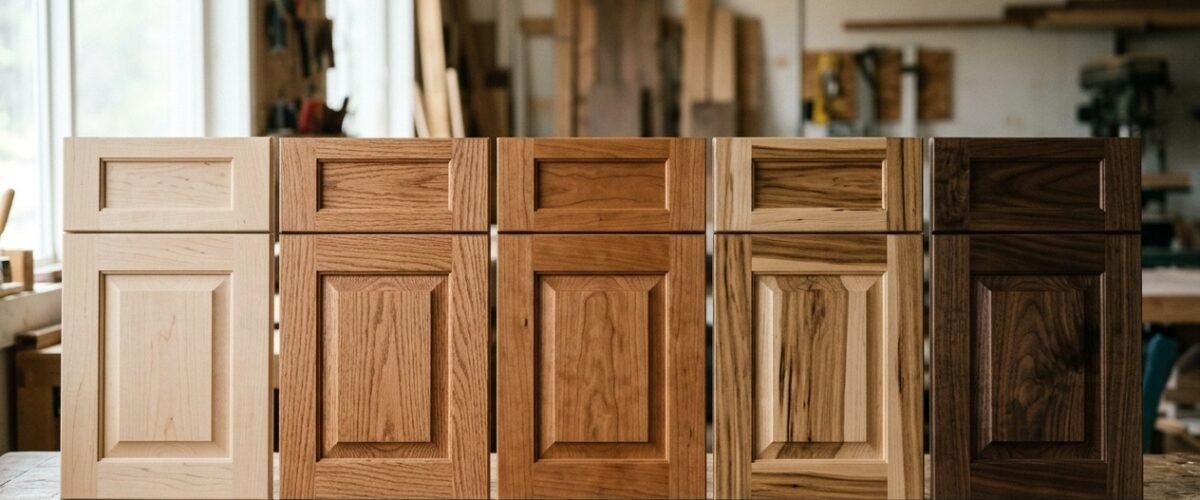
Hard maple is the best all-around wood for kitchen cabinets when painting, red oak is the best value for staining, and white oak is the fastest growing species for natural and wire-brushed finishes. Specifically, kitchen cabinet wood types directly affect the appearance, painting quality, and long-term durability of your investment. Because each species has distinct grain character, hardness, and cost, choosing the right material is essential. Therefore, understanding the differences between maple, oak, cherry, hickory, and birch helps you make the best decision for your home remodeling project.
Hard Maple Kitchen Cabinets
Maple Grain and Appearance
Maple features a closed, tight grain with minimal figure. Consequently, the color ranges from creamy white to pale tan across most boards. Furthermore, it occasionally shows a slight chatoyance in curly or quilted cuts, which adds visual depth. Ultimately, this species offers the most uniform grain of all domestic cabinet woods. For example, it makes a perfectly smooth, consistent base for any painted finish.
Maple Hardness and Durability
Maple boasts an impressive Janka hardness rating of 1,450 lbf. Because of this high density, it is highly resistant to dents and scratches in busy households. Also, it holds joinery securely, ensuring cabinets last for decades. Likewise, the wood stays remarkably stable through seasonal humidity changes in the home. In short, it is one of the most durable domestic hardwoods for cabinet applications.
Best Uses for Maple Cabinets
Maple is definitely the best species for white kitchen cabinets and smooth painted finishes. Since it accepts primer evenly, there is absolutely no grain telegraphing through the final paint layer. In addition, it is frequently used in natural or light stain finishes to showcase its subtle beauty. However, avoid dark stains on maple because blotching occurs without a proper pre-conditioner.
Maple Cabinet Cost
Raw maple lumber costs between 6 and 12 dollars per board foot. Also, face frame and door material add 80 to 180 dollars per door. Ultimately, a fully installed maple kitchen cabinets remodel costs between 8,000 and 20,000 dollars depending on door style and chosen finish.
Red Oak Kitchen Cabinets
Oak Grain and Appearance
Oak exhibits an open, coarse grain with a highly visible, strong linear pattern. Specifically, the base color is reddish tan with distinctive pink undertones. Furthermore, prominent medullary ray flecks appear when the wood is quarter-sawn, adding unique character. Naturally, this is the most recognizable grain pattern in American kitchens from the 1980s through the early 2000s.
Oak Hardness and Durability
Red oak possesses a strong Janka hardness of 1,290 lbf. Consequently, it is a very durable and reliable material for busy kitchens. Specifically, it is highly resistant to everyday wear and seasonal movement. However, the open grain makes painting difficult because brush and roller texture always shows through topcoats.
Best Uses for Oak Cabinets
Oak is undeniably best for stained natural finishes where the rich grain pattern is an asset. For instance, medium to dark stains work exceptionally well on this porous wood. On the other hand, it is not recommended for painted cabinets unless the grain is filled meticulously with grain filler before priming. Also, it works beautifully in a natural clear coat for a light, airy Scandinavian look.
White Oak vs Red Oak for Cabinets
White oak has a Janka hardness of 1,360 lbf, a more neutral gray-tan color, and much less pink undertone. Furthermore, it is incredibly fashionable in 2026, though it certainly comes at a significantly higher price point. Meanwhile, red oak offers lower cost, more warm pink tones, and more pronounced grain figure. Ultimately, white oak perfectly suits modern and transitional styles, while red oak strongly suits traditional and rustic kitchens.
Oak Cabinet Cost
Red oak generally costs 4 to 8 dollars per board foot. Conversely, premium white oak costs 6 to 12 dollars per board foot. In short, a fully installed oak cabinet kitchen costs between 6,000 and 18,000 dollars depending on species and finish complexity. You can learn more about finishing options in our comprehensive guide to kitchen cabinet stain.
Cherry Kitchen Cabinets
Cherry Grain and Appearance
Cherry presents a fine, straight grain with a remarkably smooth texture. Specifically, it has a warm reddish-brown color that deepens significantly with UV exposure over the first 6 to 12 months. Indeed, this gorgeous natural patina is the defining characteristic of cherry wood. Furthermore, the heartwood is significantly richer and darker in color than the lighter sapwood.
Cherry Hardness and Durability
Cherry has a moderate Janka hardness of 950 lbf. Therefore, it is somewhat softer than maple and oak. As a result, it is slightly more susceptible to denting in high-traffic kitchens. Nevertheless, cherry is still perfectly adequate for cabinet boxes and doors in normal household use.
Finishing Cherry Cabinets
For beautifully stained cherry, use a gel stain to strictly control blotching and thoroughly even out sapwood color variation. Meanwhile, for stunning natural cherry, apply a quality UV-inhibiting topcoat to significantly slow the natural color shift. On the other hand, painted cherry is almost never commonly used because the stunning natural color and figure are the primary value of the species. To see more cabinet alternatives, check out the wide variety of options at Home Depot.
Cherry Cabinet Cost
Cherry lumber typically costs 8 to 15 dollars per board foot. Consequently, it is undeniably one of the more expensive domestic wood species available. Ultimately, a fully installed, luxurious cherry kitchen costs anywhere between 12,000 and 30,000 dollars. This premium species is very frequently featured in a high-end kitchen cabinet makeover.
Hickory Kitchen Cabinets
Hickory Grain and Appearance
Hickory features dramatic, eye-catching variation between light cream sapwood and dark reddish-brown heartwood within the exact same board. In fact, it has absolutely the most distinctive and highly rustic grain pattern of any domestic cabinet species. As a result, no two hickory kitchens will ever look exactly alike.
Hickory Hardness and Durability
Hickory boasts an incredible Janka hardness of 1,820 lbf. Specifically, it is unequivocally the hardest domestic cabinet wood widely available today. Consequently, it is extremely resistant to deep dents, sharp scratches, and heavy daily use. Therefore, it is easily the best choice for high-traffic kitchens and bustling homes with energetic children and pets.
Best Uses for Hickory Cabinets
Hickory is absolutely ideal for rustic, farmhouse, and cozy country kitchen styles. For example, natural or light stain finishes beautifully showcase the incredible color variation. However, painted hickory is highly unusual and strongly not recommended because the dramatic, heavy grain reads clearly through paint. Also, very dark stains tend to unfortunately obscure the beautiful characteristic figure. It is truly a staple in classic farmhouse kitchen cabinets.
Hickory Cabinet Cost
Hickory raw material reasonably costs 3 to 7 dollars per board foot. Although it has a notably lower raw material cost, it is significantly more difficult to machine due to its extreme hardness. Ultimately, a beautifully fully installed hickory kitchen usually costs between 7,000 and 16,000 dollars.
Birch Kitchen Cabinets
Birch Grain and Appearance
Birch has a fine, fairly straight grain somewhat similar to maple but with a slightly more pronounced figure. Specifically, it features a pleasant pale yellowish-white color. However, it is decidedly less uniform than maple, frequently showing noticeably more color variation across different boards. Because of this variation, it is a very common species for hidden plywood cabinet boxes.
Birch Hardness and Durability
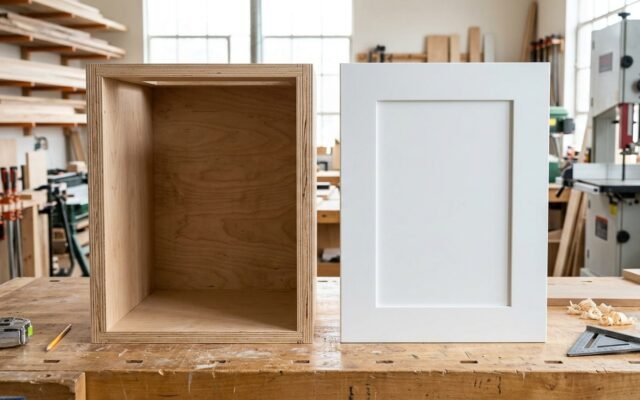
Birch offers a very solid Janka hardness of 1,260 lbf. Therefore, it is highly comparable to red oak in overall density and strength. Consequently, it is perfectly adequate for sturdy face frames and durable door frames. In addition, strong birch plywood is undoubtedly the most common material for building cabinet box carcasses across the entire industry.
Best Uses for Birch Cabinets
Birch solid wood for face frames and door frames in painted cabinets is a highly cost-effective alternative to expensive maple. Furthermore, birch veneer plywood is widely considered the industry standard for constructing cabinet boxes. While it is not quite as perfectly smooth as maple for clear or paint finishes, it definitely remains perfectly acceptable for most applications. Learn more about excellent kitchen cabinet plywood options.
Birch Cabinet Cost
Solid birch lumber costs an affordable 3 to 6 dollars per board foot. Meanwhile, sturdy birch plywood costs approximately 60 to 90 dollars per standard 4×8 sheet. As a result, it consistently provides a much lower cost than maple or oak for comparable cabinet quality. You can easily browse unfinished birch parts right now on Amazon.
Other Wood Species for Kitchen Cabinets
Pine Kitchen Cabinets
Knotty pine is absolutely ideal for warm rustic and traditional farmhouse kitchens. However, with a very low Janka hardness of 870 lbf, it is definitely the softest of the common cabinet species. Consequently, it dents quite easily under normal use. Therefore, it is highly best for low-traffic or purely decorative cabinet applications. Clear pine costs 3 to 5 dollars per board foot, while knotty pine costs 2 to 4 dollars.
Walnut Kitchen Cabinets
Walnut features a moderate Janka hardness of 1,010 lbf. Specifically, it boasts a stunning dark chocolate brown color with beautiful straight to wavy grain. Ultimately, it is undeniably the most premium domestic cabinet wood heavily favored in 2026. Furthermore, natural walnut with a hand-rubbed oil or durable hardwax finish is currently the dominant premium kitchen trend. The cost is 8 to 20 dollars per board foot, easily leading to a full kitchen cost of 20,000 to 50,000 dollars.
Alder Kitchen Cabinets
Alder has a very low Janka hardness of 590 lbf. Therefore, it is exceptionally soft. Specifically, it has a pleasant pale tan color with a very subtle grain. It is frequently commonly found in cozy Southwestern and charming cottage kitchens. Furthermore, it takes stain and paint very well and has a significantly lower cost than maple or oak. Because of its extreme softness, it is strongly best in low-traffic applications, affordably costing 3 to 6 dollars per board foot.
MDF Cabinet Doors
MDF is technically not a real wood species, but it is unequivocally the most common door material used in painted cabinets today. Specifically, medium-density fiberboard has absolutely no grain and consequently takes paint perfectly smoothly. For instance, it is widely used for center panels in shaker doors and for sleek full slab doors. However, it definitely does not tolerate heavy moisture well. It is an absolute staple in modern shaker kitchen cabinets.
Wood Species Comparison Table
| Species | Janka Hardness | Grain | Best Finish | Cost per BF | Best For |
|---|---|---|---|---|---|
| Hard Maple | 1,450 | Closed, uniform | Paint, clear | $6 to $12 | Painted cabinets |
| Red Oak | 1,290 | Open, coarse | Stain | $4 to $8 | Traditional kitchens |
| White Oak | 1,360 | Open, linear | Natural, stain | $6 to $12 | Modern kitchens |
| Cherry | 950 | Fine, smooth | Natural, stain | $8 to $15 | Rich wood tones |
| Hickory | 1,820 | Distinctive, rustic | Natural | $3 to $7 | High-traffic kitchens |
| Birch | 1,260 | Fine, slightly figured | Paint, stain | $3 to $6 | Budget cabinets |
| Walnut | 1,010 | Straight to wavy | Natural oil | $8 to $20 | Premium kitchens |
| Pine | 870 | Knotty or clear | Stain, natural | $2 to $5 | Rustic kitchens |
| Alder | 590 | Subtle | Stain, paint | $3 to $6 | Southwestern style |
| MDF | N/A | No grain | Paint | Varies | Painted doors |
How to Choose the Right Wood for Your Kitchen Cabinets
Choosing for Painted Cabinets
Hard maple or birch reliably offer the most perfectly paint-ready surface. In addition, utilizing MDF center panels on shaker doors definitively eliminates annoying grain telegraphing entirely. Therefore, these combinations are absolutely the best choices for a truly flawless finish. Conversely, you should completely avoid red oak and hickory for painted applications. See our detailed guide on amazing kitchen cabinet paint colors and how to paint kitchen cabinets.
Choosing for Stained Cabinets
Red oak, white oak, cherry, hickory, and beautiful walnut all take stain incredibly very well. Specifically, each distinct species has a highly distinctive color result. For example, traditional oak provides the absolute most uniform stain color. Meanwhile, elegant cherry and luxurious walnut provide the very richest natural tones available. Browse beautiful stained options today on Wayfair.
Choosing for Natural or Oil Finishes
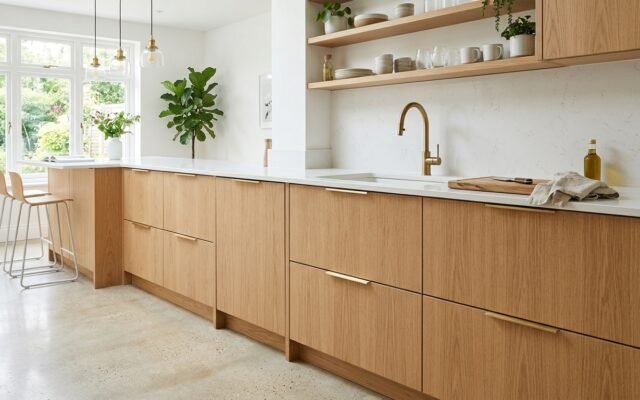
White oak, gorgeous walnut, and clear maple finished in a hardwax oil or penetrating Danish oil finish are definitely the leading choices for 2026 kitchens. In particular, beautifully wire-brushed white oak easily gives a lightly textured surface that miraculously hides oily fingerprints and minor scratches perfectly.
Choosing for Budget Kitchens
Birch plywood boxes thoughtfully combined with birch or soft maple face frames are unequivocally the absolute best overall value combination. Furthermore, smartly pairing them with affordable MDF shaker door panels easily keeps costs down significantly. Ultimately, the total cabinet material cost savings versus all-maple construction is reliably roughly 20 to 30 percent.
FAQ
What is the best wood for kitchen cabinets?
Hard maple is definitely best for smooth painted cabinets. Meanwhile, beautiful white oak is highly ideal for clear natural finishes. Also, red oak excels wonderfully in stained traditional kitchens. Finally, luxurious walnut is undoubtedly the top choice for premium natural wood kitchens.
Is oak or maple better for kitchen cabinets?
Maple is absolutely better for painted finishes mostly because of its tight, perfectly paintable grain. On the other hand, classic oak is decidedly better for stained natural finishes mostly because of its highly distinctive grain character and much lower cost.
What wood is used for cheap kitchen cabinets?
Builders typically commonly use affordable birch plywood boxes combined with inexpensive pine or poplar face frames. In addition, they frequently use cheap MDF door panels. Consequently, these smart combinations easily reduce material cost by 20 to 40 percent compared to premium all-maple construction.
What is the hardest wood for kitchen cabinets?
Hickory is unequivocally the hardest at an impressive 1,820 Janka. Next, it is closely followed by hard maple at a very strong 1,450 Janka. Therefore, tough hickory is truly the absolute best choice for maximum durability in busy high-traffic kitchens.