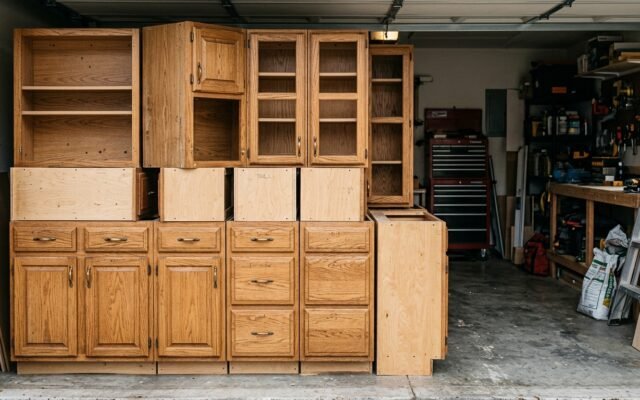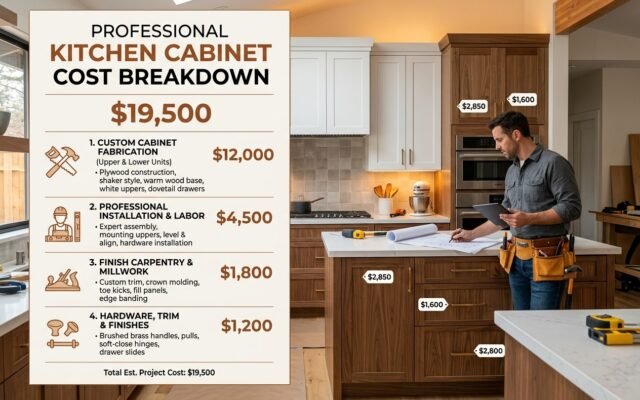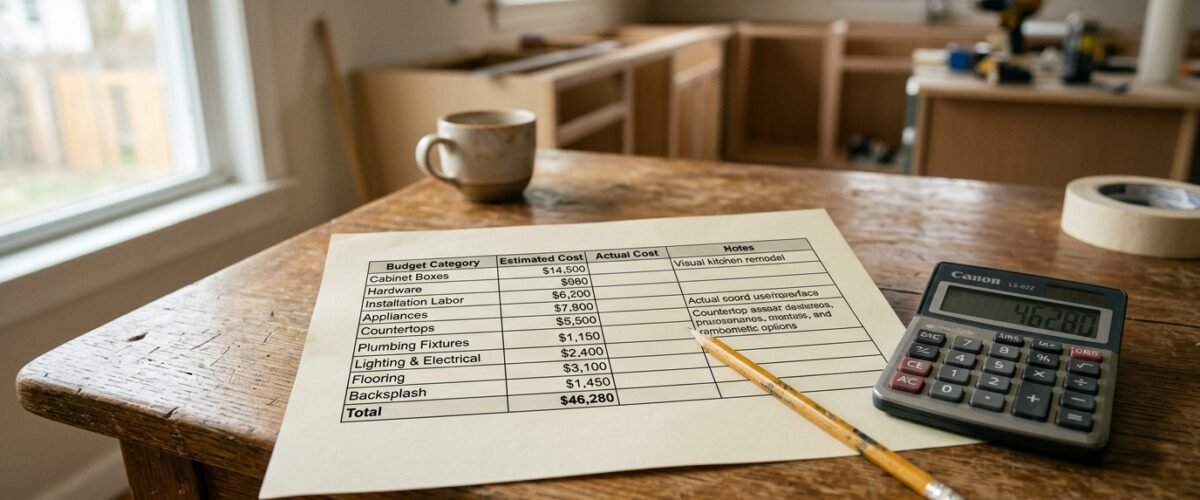
A standard 10×10 kitchen cabinet package costs $4,200 to $18,000 depending on the cabinet tier, your wall configuration, and how you handle installation. However, the total number alone tells you almost nothing useful. What matters is how you split that budget across six distinct cost categories — because misallocating even one of them is how kitchens end up with beautiful door styles on boxes that fail in eight years.
This planner gives you exact percentage targets for each cost bucket, a tier comparison table, and the specific line items that move your number up or down.
The Six Budget Categories
| Category | Budget Share | Notes |
|---|---|---|
| Cabinet boxes (carcasses) | 45–55% | The structural core — never cut here |
| Door and drawer fronts | 15–20% | Style is visible, but box quality lasts |
| Hardware (hinges, slides, pulls) | 8–12% | Blum slides add $400–$700 to a 10×10 and are worth every dollar |
| Installation labor | 18–25% | Varies sharply by region and layout complexity |
| Countertops (separate trade) | Budget separately | Do not bundle — always get independent quotes |
| Delivery and freight | 3–6% | Residential LTL + liftgate; verify itemized |
The single most common budget mistake is inverting categories 1 and 2 — spending lavishly on door profiles while accepting particleboard boxes to stay under budget. Because the doors are what your guests see and the boxes are what holds your countertops for 25 years, that trade-off is exactly backwards.
Price by Cabinet Tier: What a 10×10 Kitchen Actually Costs
A 10×10 kitchen is a standard measurement the industry uses to compare pricing across brands and tiers. It includes a total of 12 cabinets: 5 base units and 7 wall units covering 20 linear feet of cabinet run.
| Tier | Example Brand | Box Material | 10×10 Material Cost | Installed Cost (incl. labor) |
|---|---|---|---|---|
| Budget stock | Hampton Bay | Particleboard | $840–$1,680 | $2,700–$4,200 |
| Mid stock/RTA | Home Decorators, Lily Ann | Plywood | $2,600–$4,400 | $5,200–$7,800 |
| Semi-custom | KraftMaid, Thomasville | Plywood | $6,200–$9,800 | $10,500–$16,000 |
| Full custom | Local millwork | Solid wood/plywood | $14,000–$28,000 | $22,000–$45,000 |
These figures cover boxes, doors, and basic hardware only. They do not include countertops, backsplash, plumbing rough-in changes, or permit fees.
What Moves Your Number Up
Layout complexity. A straight galley run with zero corners costs the least to install. Every inside corner adds a blind corner or lazy susan, which adds $300 to $600 in specialty cabinet cost plus additional installation time. Specifically, L-shaped layouts average 15% more in install labor than straight runs, while U-shaped kitchens add 25% to 35%.
Ceiling height. Standard cabinets top out at 42 inches. Kitchens with 9-foot or 10-foot ceilings require either a filler soffit or stacked upper cabinets. Stacked uppers add $1,200 to $3,400 in materials.
Island addition. A freestanding kitchen island using base cabinets adds $900 to $4,500 depending on size and whether you need finished end panels on all four sides.
Specialty cabinets. Pull-out trash units, blind corner solutions, drawer base replacements, and appliance garages each cost $180 to $600 more than standard base cabinets. Furthermore, your carpenter must spend extra time fitting each specialty unit.
Sink base and dishwasher panel. The sink base cabinet itself costs 20% to 35% more than a standard base unit because of the open floor construction. In addition, most integrated dishwashers require a side panel that runs $65 to $120 separately.
What Moves Your Number Down
RTA (ready-to-assemble) vs. pre-assembled. All-plywood RTA lines from suppliers like Lily Ann Cabinets or The RTA Store deliver the same structural core as assembled semi-custom at 25% to 40% less cost. The trade-off is that you spend 6 to 12 hours assembling the boxes yourself before the installer arrives.
Holiday sale timing. Home Depot runs 20% to 30% off cabinet promotions during Presidents’ Day (February), Memorial Day (May), Labor Day (September), and Black Friday (November). Buying KraftMaid at a 20% discount during Labor Day brings the material cost to within 10% of buying direct RTA.
Skipping the showroom. Independent kitchen design studios mark up cabinets 15% to 30% above factory-direct pricing. While their design service has value, for straightforward rectangular kitchens, a direct-to-consumer RTA order with a free online CAD layout eliminates that markup entirely.
Reusing existing rough-ins. If your new cabinet layout matches your old one exactly, you avoid plumber and electrician charges to relocate sink drains, gas lines, or circuit outlets. Even minor layout changes can add $400 to $1,800 in mechanical trade work.
The Hardware Budget: Do Not Cut Here Either
Hardware is the highest-ROI line item in any cabinet budget because slides and hinges determine daily usability for the entire 20-year cabinet life.
| Hardware Component | Budget Option | Mid-Range | Premium (Blum) |
|---|---|---|---|
| Drawer slides (per drawer) | $6–$12 generic side roller | $18–$28 soft-close undermount | $42–$68 Blum Tandem 563H |
| Cabinet hinges (per door) | $2–$4 basic overlay | $5–$8 soft-close overlay | $9–$14 Blum CLIP top Blumotion |
| Door/drawer pulls (each) | $3–$8 bar pull | $12–$25 solid brass | $35–$90 custom forged |
For a 10×10 kitchen with 12 cabinet doors and 8 drawers, upgrading from generic slides to Blum Tandem across all drawers costs roughly $350 to $450 extra. Over 20 years of daily use, that works out to about $20 per year — a non-issue compared to replacing a stripped $12 slide in year 3.
Installation Labor: What to Expect by Region
| Region | Per-Cabinet Install Rate | Full 10×10 Labor |
|---|---|---|
| Southeast / Midwest | $75–$120 | $900–$1,440 |
| Northeast / Mid-Atlantic | $110–$160 | $1,320–$1,920 |
| California / Pacific Northwest | $140–$220 | $1,680–$2,640 |
| Major metro (NYC, LA, SF) | $200–$350 | $2,400–$4,200 |
These rates apply to straightforward in-kind replacements. Projects requiring wall modifications, soffit removal, or electrical relocation carry separate trade labor costs on top of cabinetry installation.
How to Set a Realistic Budget in Five Steps
Step 1 — Measure your linear footage first. Count every linear foot of cabinet run along your walls. Base cabinets and wall cabinets are typically priced separately, so measure each independently.
Step 2 — Pick your tier based on what you can afford per linear foot. Budget stock runs $70 to $140 per linear foot. All-plywood RTA runs $130 to $220. Semi-custom runs $300 to $550.
Step 3 — Add 20% contingency. Every kitchen remodel encounters something unexpected — a warped wall stud, an out-of-square floor, a plumbing chase that requires a custom-depth cabinet. A 20% contingency buffer prevents a single surprise from blowing your total budget.
Step 4 — Get three independent quotes. Price variance between dealers on identical cabinets can reach 35%. Because most of that variance hides in freight markups, inflated filler strip counts, and missing end panels, you need at least three itemized quotes to establish a fair market benchmark.
Step 5 — Protect the box budget last. If something has to give, cut door profile complexity or pulls before you cut box quality. A simpler shaker door in plywood will outlast an ornate raised panel in particleboard every time.
Frequently Asked Questions
How much should I spend on kitchen cabinets vs. my total remodel budget? Industry guidelines suggest allocating 30% to 40% of your total kitchen remodel budget to cabinetry. For example, in a $30,000 kitchen remodel, a $9,000 to $12,000 cabinet budget is standard. However, in a budget-tier remodel under $15,000, cabinetry often absorbs 50% to 60% of total cost because plumbing and electrical work is minimal.
Should I include countertops in my cabinet budget? No. Always budget countertops separately and get independent fabricator quotes. Cabinet dealers who bundle countertops into a package price are hiding fabricator markups. In contrast, a standalone quote from a stone yard gives you accurate cost control over both trades independently.
What is the cheapest way to get an all-plywood kitchen? Buy an all-plywood RTA line direct from Lily Ann Cabinets, The RTA Store, or Cabinet Joint, assemble the boxes yourself before the installer arrives, and book a local finish carpenter for installation only. Specifically, this approach costs 30% to 45% less than buying pre-assembled semi-custom cabinets from a showroom while delivering the same structural carcass quality.
Do I need to tip or pay a separate fee for cabinet delivery? No. Delivery fees cover freight, residential surcharge, and hydraulic liftgate service to your curb. However, most residential deliveries are curb-drop only — the driver rolls pallets to your driveway, not into your home. Therefore, plan to have two people available on delivery day to carry boxes inside.
How long does a kitchen cabinet installation take? A standard 10×10 kitchen cabinet installation takes 1 to 3 days for an experienced two-person crew. Complex layouts with islands, corner units, and specialty pull-outs extend that timeline to 3 to 5 days. Furthermore, countertop templating must follow cabinet installation by at least 24 hours, which delays the full kitchen completion by 5 to 10 additional business days for fabrication.