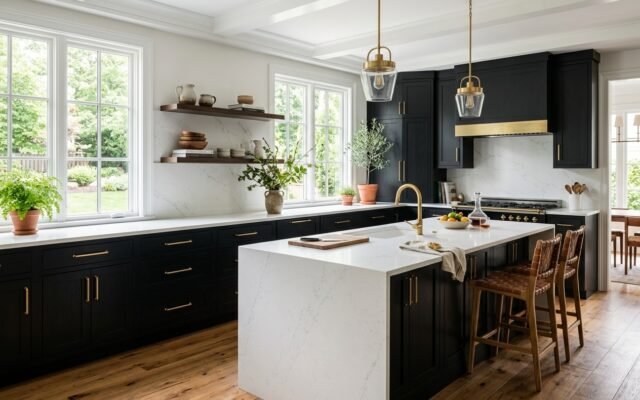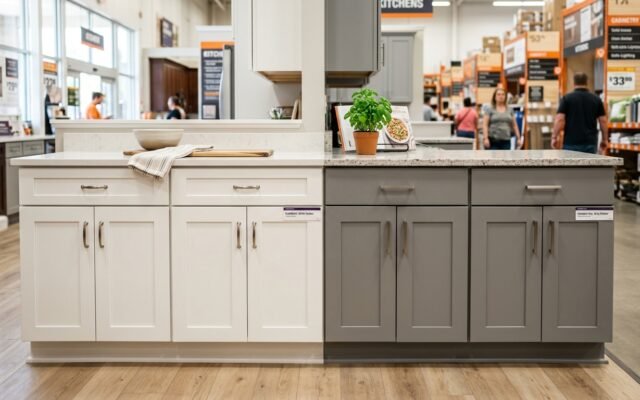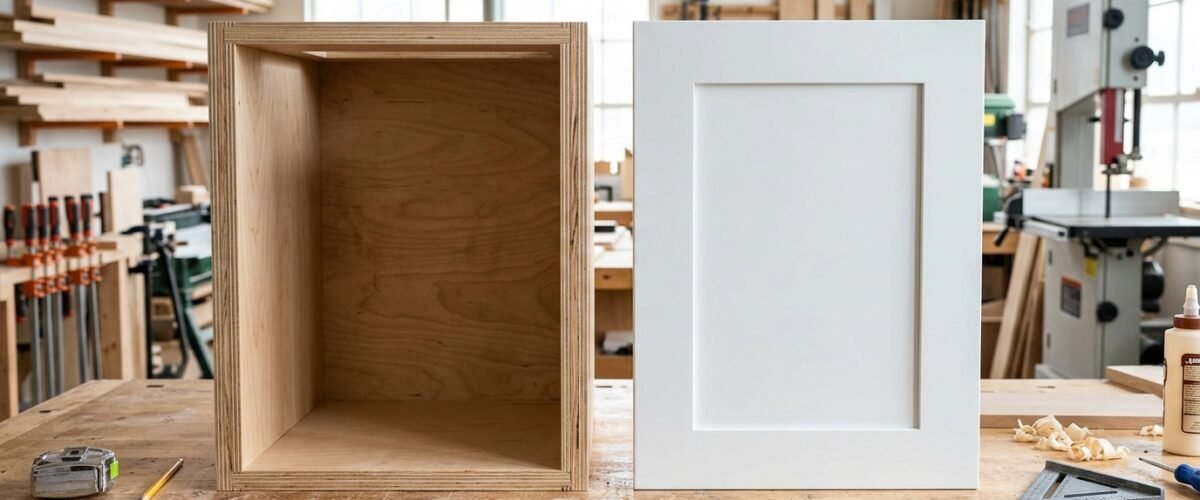
The smartest cabinet builders do not choose between MDF and plywood. Instead, they use both in the same kitchen. When evaluating mdf vs plywood cabinets, the golden rule is simple: choose plywood for the structural cabinet boxes, and choose high-density MDF for painted cabinet doors and drawer fronts.
Plywood provides cross-grain dimensional strength and holds fasteners under heavy countertop loads. In contrast, medium-density fiberboard (MDF) offers a glass-smooth surface that will never shrink, expand, or crack painted finish seams. If you understand where each material performs best, you will avoid expensive remodeling regrets and get cabinets that last twenty years.
Quick Comparison: MDF vs Plywood Cabinets
Plywood delivers superior tensile strength and water tolerance for cabinet carcasses. Meanwhile, MDF provides an ultra-stable core that prevents paint lines from fracturing during seasonal humidity swings. Here is how both materials compare across critical performance metrics.
| Performance Factor | Plywood Cabinet Construction | MDF Cabinet Construction |
|---|---|---|
| Primary Application | Cabinet box sides, backs, bottoms, and structural shelves | Painted cabinet doors, drawer fronts, and center panels |
| Tensile Strength | High; cross-laminated veneer layers resist sagging | Moderate; dense engineered wood fibers lack grain direction |
| Screw Holding Capacity | Exceptional; wood grain grips threads securely | Moderate; requires specialized coarse-thread wood screws |
| Moisture Swelling Risk | Low to moderate; dries out without total structural failure | High; absorbs water quickly and swells irreversibly if unsealed |
| Paint Finish Quality | Shows telegraphing wood grain; seams can shift with weather | Glass-smooth factory finish with zero grain telegraphing |
| ANSI/KCMA A161.1 Rating | Exceeds 500 lb static shelf load easily with 3/4-inch core | Meets standard on shelves but requires center support spans |
| Average Cost (30-Inch Base B30) | $220 to $340 per assembled cabinet box | $150 to $220 per assembled cabinet box |
Box Construction: Why Plywood Wins for Carcasses
Cabinet boxes carry massive weight every single day. For instance, a 30-inch quartz countertop slab weighs between 18 and 22 pounds per square foot. When you add cast-iron cookware, heavy dish stacks, and countertop appliances, your base cabinet carcass must hold hundreds of pounds without flexing.
Plywood is built from odd-numbered thin wood veneers glued together at alternating 90-degree grain angles. Because of this cross-grain structure, plywood expands and contracts uniformly in all directions. Furthermore, the alternating wood plies grip standard #8 cabinet installation screws with immense holding power. When you anchor base cabinets into wall studs, plywood backs will never pull free under load.
If you choose MDF for base cabinet side panels, you introduce structural vulnerability. While MDF is very dense, it has no natural wood grain. Consequently, standard fasteners can strip the core during aggressive drawer movements. For long-term carcass durability, contractors always choose 1/2-inch or 3/4-inch cabinet-grade plywood boxes over fiberboard. For more details on structural layouts, check our guide to kitchen base cabinet types.
Door Panels: Why MDF Beats Plywood for Painted Finishes
While plywood dominates box construction, MDF is the superior choice for painted cabinet doors. Solid wood and plywood doors expand across their grain when summer humidity rises. Then, when winter heating dries the indoor air, the wood shrinks. This natural movement inevitably breaks the paint film along frame joints, creating unsightly hairline cracks known in the trade as “spider cracking.”
In contrast, MDF has no grain direction. Because it consists of pressurized wood fibers and resin, it remains dimensionally stable through extreme climate changes. As a result, premium cabinet manufacturers route 1-piece Shaker door profiles directly out of solid MDF panels. This eliminates five-piece corner seams entirely, so your factory painted finish stays flawless for decades.
Additionally, plywood doors present finish challenges. Even high-grade maple plywood contains subtle surface grain telegraphing that shows through glossy enamel paint. Therefore, if you plan to install smooth painted cabinets in white, navy, or sage green, specify solid MDF door panels with high-durability conversion varnish.
Structural Integrity: ANSI/KCMA A161.1 Weight Standards
Professional cabinet performance is governed by strict industry testing. Specifically, the Kitchen Cabinet Manufacturers Association sets the standard through ANSI/KCMA A161.1 certification. This standard requires cabinet shelves to support 15 pounds per square foot, totaling up to 500 pounds, without deflecting more than 1/16 of an inch per linear foot.
Plywood shelves consistently pass this test because the longitudinal wood fibers bridge wide spans effortlessly. For example, a 3/4-inch plywood shelf spanning 36 inches under a stack of stoneware plates will hold its shape indefinitely. Conversely, an MDF shelf spanning the same 36 inches without solid wood edge banding will slowly bow downward over two to three years.
Furthermore, the ANSI/KCMA standard mandates 25,000 cycles on drawer slides with full 15-pound loads. High-grade undermount slides like Blum Tandem Plus 563H hardware anchor securely into 1/2-inch plywood box sides. In MDF boxes, repeated drawer slamming can loosen mounting screws unless the manufacturer installs metal threaded dowel inserts.
Moisture Resistance and Water Damage Limits
Plumbing leaks beneath kitchen sinks represent the most common cause of cabinet replacement. When comparing mdf vs plywood cabinets under sink bases, moisture tolerance is the deciding factor. While no wood product is completely waterproof, plywood survives plumbing emergencies significantly better than fiberboard.
When plywood gets soaked from a leaking P-trap, the exterior veneer plies may swell slightly. However, because exterior-grade waterproof glue bonds the layers, the core maintains its structural strength once dried. You can clean up the leak, run a dehumidifier, and keep the original cabinet box intact.
MDF behaves very differently when exposed to standing water. Because the core consists of compressed wood dust, it acts like a dense sponge. Once water penetrates an unsealed edge, MDF swells to twice its original thickness and crumbles into loose pulp. This swelling is permanent and cannot be repaired. Therefore, you should always insist on a plywood carcass for your sink base cabinet, even if you choose MDF doors throughout the rest of the kitchen.
The Showroom Thumb and Fastener Test
You do not need an engineering degree to evaluate cabinet quality in a showroom. Instead, use these two simple physical tests on display models to verify whether you are inspecting genuine plywood or cheap composite core.
1. The Back Panel Thumb Test
Open the base cabinet door and reach all the way to the rear center wall. Press firmly against the back panel with your thumb. If the back panel flexes or bows away from you, the builder used 1/8-inch hardboard captured in a picture-frame slot. Quality mdf vs plywood cabinets will feature a solid 1/2-inch structural plywood back panel that stays rigid under firm hand pressure.
2. The Corner Fastener Check
Look inside the top rear corners of the cabinet box. Premium plywood cabinets feature 1/2-inch full-depth routed dado grooves bonded with wood glue and pocket screws. In contrast, low-cost composite boxes rely on plastic corner braces and cam locks to hold the panels together. Plastic corner gussets indicate entry-level construction that will loosen over time under heavy stone countertops.
Cost Comparison: Per Cabinet and Full Kitchen
Pricing plays a major role in every homeowner’s material selection. In general, all-plywood cabinet construction adds an 8% to 15% price premium over MDF or particleboard alternatives. Here is a realistic component price breakdown for a standard 10×10 kitchen layout containing 12 cabinets.
| Cabinet Tier & Material Spec | Single Base B30 Cost | 10×10 Kitchen (12 Boxes) | Estimated Lifespan |
|---|---|---|---|
| Stock Composite (Particleboard / MDF) | $130 to $190 | $2,200 to $3,400 | 7 to 10 Years |
| Mid-Range Hybrid (Plywood Box / MDF Doors) | $210 to $290 | $3,800 to $5,600 | 15 to 20 Years |
| All-Plywood Semi-Custom | $320 to $450 | $5,800 to $8,400 | 25+ Years |
| Custom Hardwood & Baltic Birch Plywood | $550 to $850 | $10,000 to $18,000 | 30+ Years |
As the table illustrates, spending an extra $1,200 to upgrade from all-MDF boxes to a hybrid plywood carcass specification nearly doubles the working lifespan of your kitchen. To evaluate full renovation budgets, consult our guide on how much kitchen cabinets cost.
The Contractor Hybrid Verdict: How to Spec Both Materials
If you want the most durable kitchen possible without overspending, do not buy an all-plywood or all-MDF cabinet line. Instead, order a hybrid specification from your cabinet supplier. This approach gives you the exact strengths of both materials without their corresponding weaknesses.
First, specify 1/2-inch or 3/4-inch plywood boxes for all base cabinets and sink units. This guarantees structural screw holding and protects against plumbing leaks. Second, specify solid 3/4-inch MDF panels for all painted doors and drawer fronts. This prevents joint cracking and ensures a showroom-smooth paint finish. Third, verify that all shelves wider than 30 inches feature 3/4-inch plywood with solid hardwood edge banding to stop sagging.
By pairing plywood carcasses with MDF doors, you spend your budget where structural forces demand strength. Simultaneously, you achieve the smoothest painted aesthetic that remains crack-free through summer humidity and winter heating.
Common Mistakes When Choosing Cabinet Box Materials
Homeowners often make costly assumptions when shopping for new cabinets. Watch out for these three frequent errors before signing a purchase contract.
- Assuming solid wood is best for doors: Solid wood expands across the grain, causing painted joints to crack within two seasons. High-density MDF is vastly superior for painted finishes.
- Buying MDF sink base cabinets: A minor plumbing drip will permanently swell an MDF sink bottom within 48 hours. Always upgrade the sink base to structural plywood.
- Confusing particleboard with high-density MDF: Low-grade particleboard uses coarse wood chips that crumble easily. Premium MDF uses fine pressurized wood fibers that hold fasteners much better.
- Skipping back panel thickness checks: Never accept a 1/8-inch cardboard or hardboard back panel. Demand at least 1/2-inch plywood to anchor securely to wall studs. Review standard cabinet depths in our kitchen base cabinet dimensions chart.
Frequently Asked Questions
Are MDF cabinets cheaper than plywood cabinets?
Yes, MDF cabinets typically cost 10% to 20% less than plywood cabinets. Fiberboard manufacturing uses recycled wood fibers and synthetic resins, which lowers raw material costs compared to multi-layered wood veneers.
Can you screw directly into MDF cabinet boxes?
You can screw into MDF, but you must drill pilot holes first. Screwing directly into un-drilled MDF causes the dense fibers to split and mushroom, which weakens the joint significantly.
Is plywood better than MDF for kitchen base cabinets?
Plywood is distinctly better for base cabinet boxes because it holds heavy countertop loads and resists plumbing leaks. However, MDF is better for painted doors because it prevents paint seam cracking.
Does plywood off-gas more chemicals than MDF?
Modern cabinet-grade plywood and MDF both comply with EPA TSCA Title VI formaldehyde emission limits. Plywood generally contains less resin by volume than dense MDF fiberboards.
What is the best cabinet material for humid climates?
In high-humidity coastal regions, marine or exterior-grade plywood boxes paired with MDF doors provide the best defense against swelling, warping, and finish cracking.