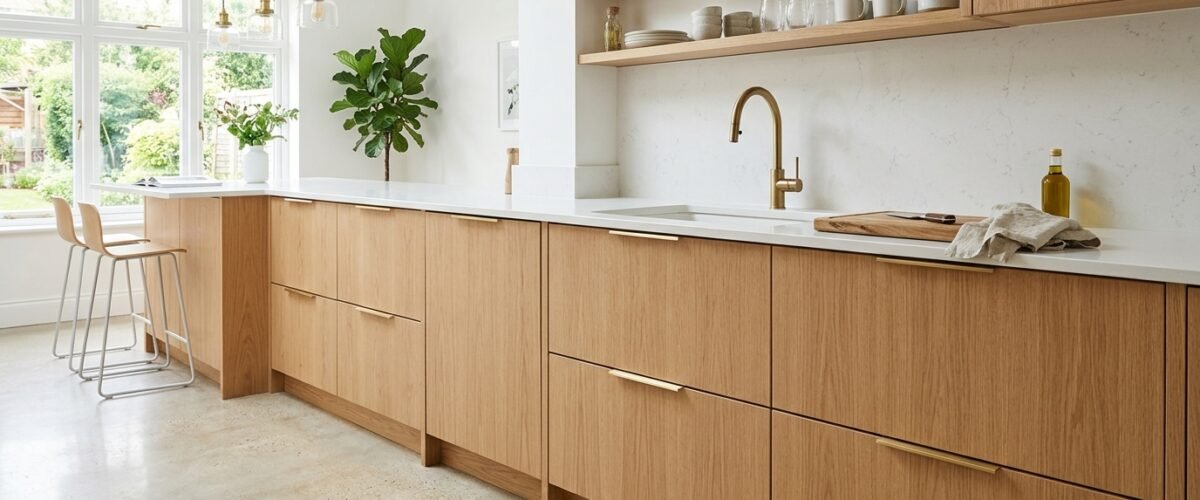
White oak kitchen cabinets have become the premier cabinet choice in residential remodels because white oak offers a dense 1360 Janka hardness rating, closed cellular pores that resist moisture, and a calm, straight grain pattern when rift sawn. Unlike red oak, which has open vascular rays that absorb water and read pink or orange, white oak delivers neutral wheat and champagne undertones that do not date your kitchen.
The single biggest mistake homeowners make with white oak is using standard oil-based polyurethane topcoats. White oak contains high levels of natural tannins. When oil finishes hit these tannins, they amber within six months, turning expensive rift-sawn wood into a golden-orange 1990s nightmare. To preserve the raw, organic aesthetic of white oak, you must use non-yellowing two-component waterborne conversion varnishes or specialized hardwax oils.
White Oak vs. Red Oak: The Structural Difference
While red oak and white oak sound like simple color variations of the same tree, their cellular biology is completely different:
| Property | White Oak (Quercus alba) | Red Oak (Quercus rubra) | Job-Site Significance |
|---|---|---|---|
| Janka Hardness | 1,360 lbf | 1,290 lbf | White oak resists dents from dropped pots and cast iron |
| Cellular Structure | Tyloses-plugged pores | Open capillary tubes | White oak is water-impermeable; red oak rots near sinks |
| Grain Aesthetic | Tight, linear, modern | Prominent cathedral arches | White oak suits modern slab and skinny shaker doors |
| Natural Tone | Wheat, khaki, olive-gold | Pink, salmon, honey-red | White oak accepts modern neutral stains without bleaching |
| Price Premium | 20% to 35% higher | Base commodity tier | Higher milling demand and stricter export grading |
Look at the end-grain of an unsealed cabinet door. Red oak has open pores that look like tiny drinking straws. If plumbing leaks beneath your sink base cabinet, red oak draws water up through capillary action, turning black with mold within weeks. White oak pores are plugged with tyloses — a crystalline organic growth that makes the wood naturally water-tight. Boatbuilders have used white oak for ship hulls for centuries for this exact reason.
Plain Sawn vs. Quarter Sawn vs. Rift Sawn
The way a sawmill cuts a white oak log determines whether your cabinet doors look rustic or ultra-modern:
- Plain Sawn (Flat Sawn): The log is sliced tangentially to the growth rings. This produces classic broad “cathedral” arches across the cabinet face. It is the most economical cut but has the highest rate of seasonal expansion across the door width.
- Quarter Sawn: The log is quartered and cut at a 60 to 90-degree angle to the rings. This creates straight vertical lines accompanied by “medullary ray flecks” — ribbon-like shimmering flakes across the board. It is exceptionally stable and classic in Craftsman cabinetry.
- Rift Sawn (The Modern Standard): The log is milled at a strict 30 to 60-degree angle to the growth rings. This eliminates ray flecks entirely, leaving a perfectly uniform, pencil-straight vertical grain pattern. Rift-sawn white oak is the gold standard for high-end slab doors and skinny-rail shaker cabinets.
Finishes That Prevent Yellowing (Tannin Control)
White oak contains gallic and ellagic acids (tannins) that react violently to moisture, ammonia, and solvent-based chemicals. To maintain the pale, Scandinavian blonde look without yellowing, cabinet shops use three specific coating chemistries:
- 2-Part Waterborne Conversion Varnish: Professional architectural millwork brands like Milesi or Renner produce two-component (2K) polyurethane varnishes with added UV blockers. They cure chemically, resist water and red wine, and add zero amber tint to the raw wood.
- Hardwax Oils with White Pigment: Products like Rubio Monocoat Oil Plus 2C in “Super White” or “White 5%” neutralize the natural darkening effect that occurs when raw wood is wetted. It creates a dead-matte, tactile finish that you can spot-repair with a buffing pad.
- Pre-Color Tannin Bleach: If you want an ultra-pale driftwood tone, shops apply a wood bleach (sodium hydroxide and hydrogen peroxide) or a reactive tannin blocker before sealing to prevent tannins from bleeding through topcoats.
White Oak Cabinet Cost Breakdown
Because rift-sawn lumber generates more sawmill waste than plain-sawn oak, white oak carries a price premium over painted maple or MDF:
| Cabinet Tier | Cost per Linear Foot | Typical 10×10 Kitchen | Construction Standard |
|---|---|---|---|
| Stock RTA White Oak | $180 – $320 | $3,600 – $6,500 | Plywood carcass, plain-sawn oak veneer doors |
| Semi-Custom Factory | $350 – $650 | $7,500 – $13,500 | Solid wood face frame, rift-sawn veneer flat panels |
| Full Custom Millwork | $700 – $1,400 | $14,000 – $28,000+ | Continuous grain-matched rift white oak slab doors |
Best Base Cabinet Configurations for White Oak
White oak has prominent vertical visual texture. Large drawer stacks show off horizontal continuous grain matching better than narrow single-door cabinets.
When designing your perimeter layout, group 30-inch and 36-inch 3-drawer base cabinets together. A master cabinetmaker will cut the top, middle, and bottom drawer fronts from a single continuous flitch of rift-sawn veneer. This means the wood grain flows uninterrupted from the countertop down to the toe kick, transforming your base cabinetry into a piece of architectural furniture.
For high-traffic zones around your prep triangle, integrate heavy-duty pull-outs, such as a double 35-quart trash bin cabinet and heavy-duty blind corner cloud organizers. For layout clearance rules near windows, review our guide on kitchen cabinets next to a window to avoid clashing beautiful oak side panels with window trim.
Countertop & Hardware Pairings
White oak pairs best with stone and hardware finishes that balance its earthy wheat undertones:
- Countertops: Pair white oak with Calacatta Gold quartz, Taj Mahal quartzite, or matte charcoal soapstone. Detailed palette rules can be found in our kitchen cabinet and countertop color combinations guide.
- Cabinet Hardware: Brushed champagne bronze, satin brass, and matte black edge-pulls provide the cleanest contrast. Avoid shiny yellow polished brass, which clashes with the natural muted grain of raw oak.
The Showroom Wood Inspection Test
Many budget cabinet retailers sell “white oak style” cabinets that are actually printed photographic paper foil wrapped over particleboard. Before ordering, perform these three tests in the showroom:
- The Grain Texture Check: Drag your fingernail lightly across the cabinet door. Real rift-sawn white oak has a microscopic open grain texture that you can feel. Paper foil and low-grade laminate feel uniformly slick and plastic.
- The Edge-Banding Seam Test: Look at the top and bottom corners of a slab drawer front. Premium cabinets use 1mm or 2mm thick real wood edge banding that is stained and beveled to match. Cheap imports use thin 0.5mm PVC tape that peels with your fingernail.
- The Back-of-Door Inspection: Open the cabinet door and inspect the interior face. Quality manufacturers use matching rift-sawn oak veneer on both sides of the panel to balance moisture tension and prevent warping. If the back of the door is plain white melamine, the door will bow within two heating seasons.
Frequently Asked Questions
Why are white oak kitchen cabinets more expensive than maple?
White oak logs are in high global demand for wine barrels, flooring, and architectural millwork. In addition, milling rift-sawn white oak produces up to 50% more lumber waste than plain-sawn milling, driving raw material costs up.
Do white oak kitchen cabinets turn yellow over time?
White oak will turn yellow only if sealed with traditional solvent-based or oil-based polyurethanes. Using a non-yellowing 2-part waterborne conversion varnish with UV stabilizers keeps the wood in its natural, pale wheat state permanently.
What is the difference between rift-sawn and plain-sawn white oak?
Plain-sawn white oak features traditional rounded cathedral arches. Rift-sawn white oak is milled at a 45-degree angle to produce a tight, pencil-straight linear grain with no arches or flecks, making it the preferred choice for modern kitchens.
Are white oak cabinets durable around kitchen sinks?
Yes. White oak has closed cellular pores packed with tyloses that block liquid absorption. It resists water damage significantly better than red oak, pine, or birch.
What flooring looks best with white oak cabinets?
White oak cabinets look best with flooring that is either two shades lighter or two shades darker than the cabinets, or natural stone like large-format limestone and slate tiles. Avoid matching the exact same wood stain on both cabinets and floors, which makes a room feel like a monotone wooden box.