If you’re shopping painted kitchen cabinets, maple is the answer : its tight, nearly pore-free grain takes primer and topcoat like no other domestic hardwood, and it has been the industry default for painted door frames for two decades. That said, the right wood depends on your finish goals, your budget, and what your dealer actually stocks. This guide breaks down maple kitchen cabinets head-to-head against red oak and cherry so you can walk into any showroom with a clear decision already made.
Quick Comparison Table
Here are the three most common hardwood species you’ll see in cabinet shops, side by side. Numbers come from the Wood Database and NHLA lumber grading guidelines.
| Wood Species | Janka Hardness | Grain Pattern | Paint Performance | Stain Performance | Cost / Linear Ft* | Best For |
|---|---|---|---|---|---|---|
| Hard Maple | 1,450 lbf | Very fine, closed pore | ⭐⭐⭐⭐⭐ Excellent | ⭐⭐⭐ Fair (blotch risk) | $8 to $14 | Painted cabinets, contemporary |
| Red Oak | 1,290 lbf | Open pore, pronounced ray fleck | ⭐⭐ Poor (grain telegraphs) | ⭐⭐⭐⭐⭐ Excellent | $6 to $10 | Stained traditional kitchens |
| Cherry | 950 lbf | Fine, occasional figure | ⭐⭐⭐ Moderate (resin issues) | ⭐⭐⭐⭐ Good (ages beautifully) | $12 to $18 | Natural stain, warm traditional |
*Door frame + box material combined, mid-grade cabinet lines. Regional pricing varies.
Why Maple Wins for Painted Cabinets
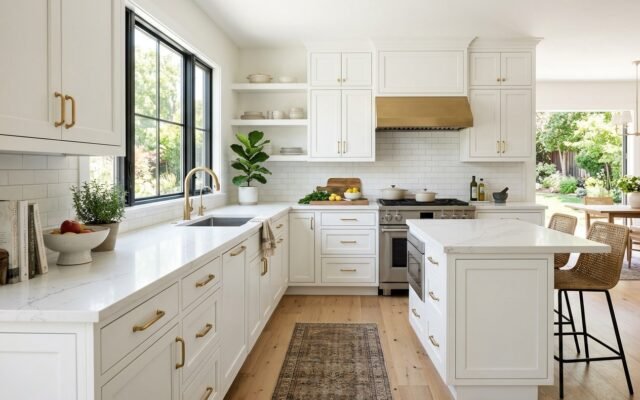
Walk into any high-volume cabinet shop and ask which wood they use for their painted lines. Nine times out of ten the answer is hard maple (Acer saccharum). The reason is purely mechanical: maple’s pores are so small they are effectively invisible to the naked eye. When you lay down a coat of primer, it sits on the surface rather than soaking into open channels. That gives painters a flat foundation that sands to a near-lacquer smoothness without needing grain filler.
The Showroom Test
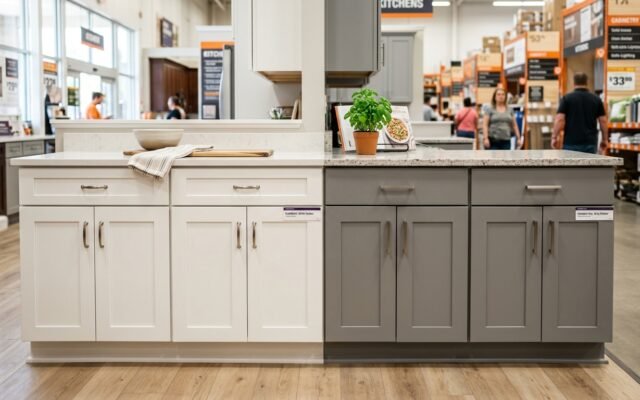
Next time you’re comparing samples in a showroom or dealer display, try this. Run your fingernail across the face frame. Hard maple has virtually zero grain texture : it feels close to MDF under primer. Oak telegraphs grain through three coats of paint. You’ll feel the subtle ridges even on a finished door pulled from a display. On cherry you may feel small resinous irregularities, especially near knots or heartwood transitions. Maple is the only species where that test comes back smooth every time.
For projects where the box material matters as much as the face frame, see our breakdown of MDF vs plywood cabinet boxes : the substrate choice affects paint performance almost as much as the face species.
Hardness Advantage
At 1,450 lbf on the Janka scale, hard maple is meaningfully tougher than either competitor in this guide. That matters in a kitchen: cabinet door edges, face frame corners, and drawer fronts take daily impact from rings, pots, and careless elbow bumps. Maple holds its edges cleanly for years. Cherry, at 950 lbf, is noticeably softer : you can dent it with a ring drop on a bad day. If you want a broader look at durability-to-cost ratios across all common species, the full rundown is in our best wood for kitchen cabinets comparison.
Maple vs Oak
Red oak was the dominant cabinet wood in North America from roughly 1975 through the early 2000s. Plenty of kitchens still have it, and it’s easy to source. Here’s where each wood wins.
Oak Wins: Stain Depth and Cost
Oak’s open pore structure : the very thing that kills it for painted cabinets : is what makes it exceptional for stain work. Pigment soaks into the ray flecks and pores and creates rich, multi-dimensional color variation that maple cannot replicate without gel stain and a lot of extra labor. If your kitchen design calls for an espresso, medium walnut, or golden honey stain, oak will deliver that depth for $2 to $4 less per linear foot than maple.
Oak is also slightly softer (1,290 lbf) but that gap barely matters in everyday kitchen use. The bigger long-term issue with red oak in kitchens is moisture sensitivity : its open pores can absorb steam and humidity faster than maple’s closed grain, which can cause subtle swelling at joints over 10+ years in a high-moisture kitchen without adequate ventilation.
Maple Wins: Paint, Moisture Resistance, Longevity
For white, off-white, soft grey, or any light painted finish, there is no contest. Maple will deliver a smoother, more uniform coat with fewer sanding passes between coats. Professional finish carpenters and cabinet painters consistently quote maple as requiring 20 to 30% less labor to achieve a furniture-grade painted finish versus oak. Over a full kitchen project, that labor difference can offset maple’s higher material cost entirely.
If you’re specifically drawn to an open-grain aesthetic but want the cleaner look of modern design, white oak kitchen cabinets offer a middle path : more character than hard maple, better paint adhesion than red oak due to tyloses filling the pores.
Maple vs Cherry
Cherry is the prestige pick in traditional cabinetry. It’s also the most misunderstood. Here’s how it actually stacks up against maple.
Cherry’s Case: Natural Beauty and Warmth
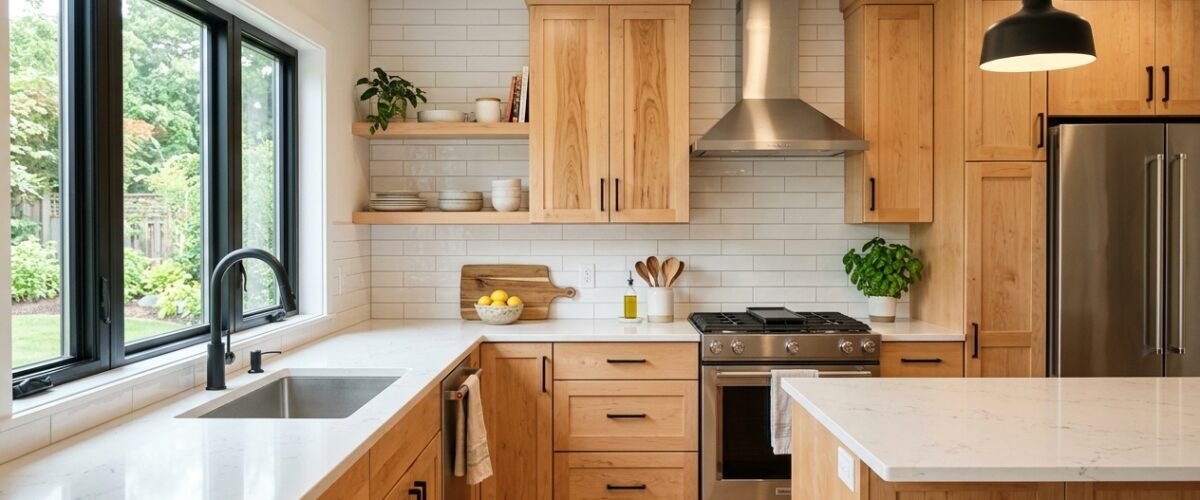
American black cherry (Prunus serotina) darkens dramatically with UV exposure over the first two to five years : it shifts from a pale pinkish tan toward a deep, rich reddish-brown that is genuinely stunning in traditional or transitional kitchens. No stain achieves that depth organically. For clients who want natural wood cabinetry with maximum warmth, cherry delivers something maple simply cannot.
Cherry also machines cleanly : it has a fine, consistent grain without the blotching problems you’ll read about below : and it takes oil-based stains well without the wild variation that hard maple shows.
Maple’s Case: Hardness, Paint, and Price
Cherry’s 950 lbf Janka rating puts it in the softer end of hardwood cabinetry. It will accumulate small dents and dings faster than maple, particularly on exposed face frame corners near high-traffic areas like the dishwasher pullout or base cabinet beside the range. For families with young children or clients who tend to be hard on kitchens, maple’s extra 500 lbf of hardness translates to a noticeably tougher cabinet over a 15-to-20-year lifespan.
Cherry’s premium pricing : $12 to $18 per linear foot versus maple’s $8 to $14 : reflects its slower growth rate and lower yield from lumber cuts. If budget is a real constraint and the client doesn’t specifically need cherry’s aging character, maple in a warm stain with a glaze finish gets you 80% of the visual result at a meaningfully lower cost.
Finish decisions for either species should always account for your countertop material. Our guide on cabinet and countertop color combinations covers which wood tones pair best with quartz, granite, and butcher block surfaces.
Natural Maple Stain Pitfalls (Blotching)
This is the section most spec sheets leave out. Maple’s tight grain : the same quality that makes it exceptional for paint : creates problems when you try to stain it naturally. The inconsistent density across maple’s growth rings means that pigmented stains absorb unevenly. You get dark splotchy patches next to near-white sections on the same board. The industry term for this is blotching, and it can make a natural-stained maple cabinet look like a mistake rather than a design choice.
How to Handle It
Professional finishers working with stained maple use one of three approaches:
- Pre-conditioner: A wash coat of diluted dewaxed shellac or commercial wood conditioner applied before staining partially fills the denser grain sections, evening out absorption. It doesn’t eliminate blotching : it reduces it to acceptable levels.
- Gel stain: Gel stains sit on the surface rather than penetrating, so they bypass the uneven absorption problem almost entirely. The tradeoff is less depth and a slightly plastic look in very light stain colors.
- Toning: A tinted topcoat (sometimes called a toner) applied over a clear sealer coat lets the finisher control color without relying on wood penetration at all. This is the method most cabinet shops use for production-stained maple lines.
If a dealer is showing you stained maple samples and they look perfectly even, ask specifically how the finish was applied. If the answer is gel stain or toner, that’s fine : just understand you’re not seeing the natural wood grain the way you would in a quality stained oak or cherry cabinet.
Bottom line: If you love maple but want a natural wood look, choose a clear finish or a very light transparent topcoat. If you want a medium or dark stain, oak or cherry will give you more predictable, professional results without extra finishing steps.
What to Ask Your Dealer
Most showrooms stock door samples, not full cabinet runs. Here are five questions that will tell you more than any brochure.
- “Is this hard maple or soft maple?” Hard maple (1,450 lbf) and soft maple (700 to 900 lbf) look nearly identical but perform very differently. Soft maple is cheaper and fine for painted cabinets, but it dents more like cherry. Some shops use soft maple in painted lines without disclosing it. Ask directly.
- “What primer system do you use on painted doors?” A quality painted maple cabinet should have a catalyzed or conversion varnish primer, not a water-based wall paint primer. The answer tells you whether the shop is building production cabinets or quality ones.
- “Can I see a door with three coats of paint, not just the factory sample?” Factory samples are perfect. Field conditions aren’t. Ask to see an installed job or a door after a primer-sand-paint-sand-topcoat cycle : that’s what you’ll actually get.
- “Is the box plywood or particleboard?” The face material and the box are separate decisions. A maple face frame on a particleboard box is a different product from maple doors on a plywood box. Know what you’re buying. Compare the two in our MDF vs plywood cabinet boxes breakdown.
- “What’s the wood movement allowance in your panel construction?” Solid maple panels expand and contract more than oak across their width. Quality cabinet makers account for this with floating panel construction. If they look puzzled by the question, that’s information.
Frequently Asked Questions
Are maple kitchen cabinets durable?
Yes. Hard maple scores 1,450 lbf on the Janka hardness scale, which puts it above red oak (1,290 lbf) and well above cherry (950 lbf). In everyday kitchen use, that difference shows up in edge durability on face frames and drawer fronts. Maple handles daily impact from pots, dishes, and utensils without the surface checking or edge denting that softer species develop over time.
Do maple cabinets yellow over time?
Natural maple does amber slightly with age, more noticeably in areas with direct sunlight exposure. This is a characteristic of the wood’s natural tannins reacting to UV light. In painted maple cabinets, yellowing is almost entirely a paint issue : oil-based topcoats yellow more than water-based or conversion varnish finishes. If you’re choosing a white or off-white painted maple cabinet, specify a waterborne conversion varnish topcoat to minimize long-term yellowing.
Is maple or oak better for kitchen cabinets?
It depends on the finish. For painted cabinets, maple is better in every measurable way : tighter grain, smoother paint surface, less finishing labor. For stained cabinets with rich, traditional wood tones, oak outperforms maple because its open pore structure absorbs stain more evenly and creates deeper visual depth. Most professional cabinet designers spec maple for painted lines and oak or cherry for natural stained lines.
Can you stain maple cabinets dark?
You can, but it requires extra preparation steps to avoid blotching. A pre-conditioner or gel stain is typically required on bare maple before applying a medium or dark pigmented stain. Some shops use a toner system : a tinted topcoat over a sealed surface : to achieve dark colors on maple without penetrating the grain at all. The result can look excellent, but it’s different from the natural stained look you’d get from oak or walnut.
How much do maple kitchen cabinets cost compared to oak and cherry?
In semi-custom and custom cabinet lines, hard maple typically runs $8 to $14 per linear foot for combined door and box material, compared to $6 to $10 for red oak and $12 to $18 for cherry. The cost gap between maple and oak narrows significantly once you factor in finishing labor : maple requires fewer coats and less sanding on painted jobs, which reduces the total installed cost. Cherry’s premium reflects its slower timber growth and higher-grade yield requirements from the lumber mill.