When a cabinet salesperson tells you a line is “solid wood,” they almost certainly mean solid wood doors and face frames sitting on a plywood box : and that is actually the right way to build them. A true all-solid-wood box warps, cracks, and fails humidity cycling in ways a plywood box simply does not. Understanding that distinction before you shop will save you from paying a premium for something that performs worse.
Quick Comparison Table
This table covers the three construction types you will actually encounter at a showroom or on a spec sheet. Use it as a fast filter before you dig deeper.
| Construction Type | Door Material | Box Material | Moisture Resistance | Price Range (per linear ft.) | Best For |
|---|---|---|---|---|---|
| “Solid Wood” Cabinet | Solid wood stiles & rails with raised panel | Plywood (typically ½″ or ¾″) | Good : plywood box resists racking | $200 to $550 | Most kitchens; best value-to-durability ratio |
| All-Solid-Wood Box | Solid wood | Solid wood panels (glued-up) | Poor : fails KCMA humidity cycling test | $400 to $900+ | Specialty furniture pieces, climate-controlled spaces |
| MDF / Particleboard Box | MDF, thermofoil, or laminate | Particleboard or MDF | Poor : swells on water contact | $80 to $200 | Budget builds, painted finishes, low-humidity climates |
For a deeper dive on the box material side of that equation, read our guide on MDF vs plywood for cabinet boxes.
What “Solid Wood” Actually Means
The phrase “solid wood kitchen cabinets” has no legal definition in U.S. cabinetry. Cabinet manufacturers can call a product solid wood as long as the visible parts : doors, drawer fronts, and face frames : are made from milled lumber rather than an engineered sheet. The box itself, which is the structural carcass holding everything together, can be plywood, particleboard, or MDF, and the marketing will still read “solid wood.”
That is not necessarily deceptive. It is, however, exactly how the industry is structured. The ANSI/KCMA A161.1 performance standard : the benchmark most cabinet brands cite for durability : actually requires cabinet boxes to survive a humidity cycling test that solid-wood panels routinely fail. Solid wood expands and contracts with seasonal humidity swings. A glued-up solid-wood panel large enough to form a cabinet side will eventually check, warp, or push joints apart. Plywood, by contrast, has alternating cross-grain plies that largely cancel each other’s movement, which is why a ¾″ Baltic birch plywood box outlasts a solid-wood one in a real kitchen environment.
The takeaway: when you see “solid wood kitchen cabinets” on a spec sheet, ask which parts are solid wood. Doors? Good. Face frames? Good. Box sides, bottom, and shelves? Those should be plywood : and if they are, that is actually a mark of quality, not a compromise.
Door vs. Box Material Explained
The Door
Cabinet doors are where solid wood shines. A five-piece door : two stiles, two rails, and a floating center panel : allows the panel to move seasonally without splitting because it floats in a groove rather than being glued. That traditional joinery has worked for centuries and holds up well in kitchens. The face frame, typically 1½″ solid-wood rails and stiles glued and stapled to the front of the box, adds rigidity and provides a reveal that defines the classic American framed cabinet look.
The Box
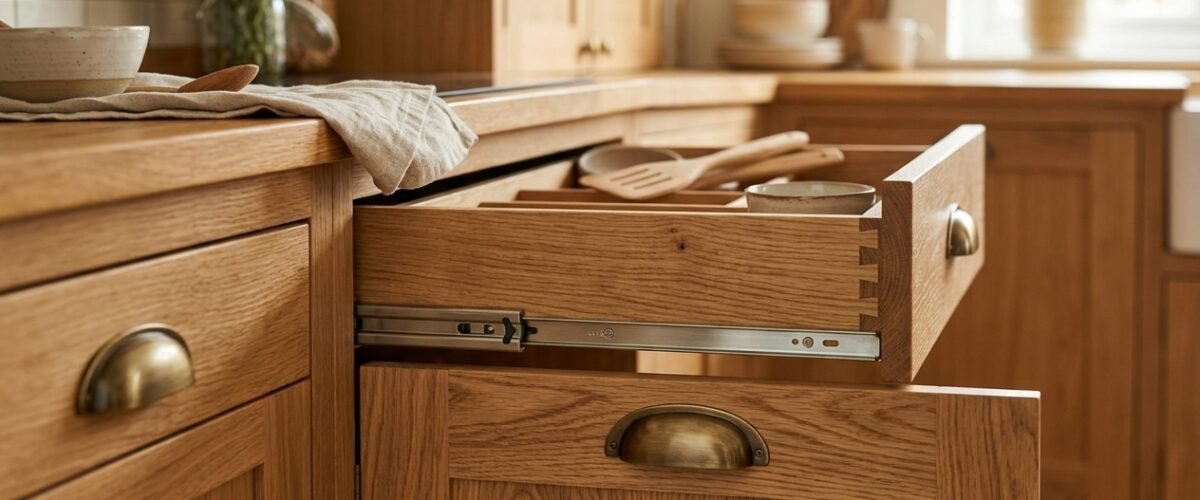
The box is where plywood wins every time. A properly built cabinet box uses ½″ or ¾″ hardwood-veneer plywood for the sides, top, bottom, and back. The plies run in alternating directions, giving the panel dimensional stability across width and length. Dovetailed or doweled solid-wood drawer boxes ride on full-extension, soft-close undermount slides and last decades of daily use.
The Showroom Test
You do not need a tape measure to tell what a box is made of. Open a drawer and look at the box sides:
- Horizontal grain running the length of the side panel + dovetail or dado corner joints → solid wood box
- Vertical striping or subtle layered lines at the edge → plywood (you’re seeing the plies)
- Uniform texture, no visible grain, possibly a paper or vinyl wrap at the edge → MDF or particleboard
At the back corner of the box, check the staple pattern and whether the bottom panel sits in a dado or just gets glued and stapled. A dado-captured bottom panel is a mark of a cabinet that was engineered to last; a butt-jointed bottom is a sign of price-point construction regardless of what the door is made of.
Best Wood Species for Cabinet Doors
Not all solid wood performs equally in cabinet applications. Janka hardness : a measure of the force required to embed a steel ball halfway into a wood surface : correlates closely with how well a door resists dents, scratches, and finish wear. Here are the species you will most commonly encounter, ranked by hardness. For a broader look at how these compare across the full kitchen, see our guide to the best wood species for kitchen cabinets.
| Species | Janka Rating (lbf) | Grain Character | Paint / Stain | Typical Cost | Notes |
|---|---|---|---|---|---|
| Hard Maple | 1,450 | Fine, consistent, minimal figure | Excellent for paint; stain can blotch | $$ | The industry workhorse; holds detail well on router profiles |
| Red Oak | 1,290 | Open, pronounced ray fleck | Takes stain readily; paint shows grain telegraphing | $ | Classic American kitchen look; widely available |
| Alder | 590 | Tight, subtle; knots on rustic grades | Excellent for paint and stain | $$ | Softer but very stable; popular in Pacific Northwest and Shaker styles |
| Poplar | 540 | Fine; greenish streaks common | Paint only : stain reveals color variation | $ | Budget paint-grade option; not suitable for natural or stained finishes |
Hard maple (Janka 1,450) is the most common choice for painted cabinets at the semi-custom and custom level because the tight, consistent grain gives finishers a near-perfect surface. Red oak (1,290) dominated the market for decades and still makes an excellent stained door, though the open grain telegraphs through paint. Alder (590) and poplar (540) are softer : a dropped cast-iron pan can dent them : but both are dimensionally stable, readily available, and cost-effective for painted finishes where the grain will not be visible anyway.
If maple is on your short list, our dedicated article on maple kitchen cabinets covers paint color pairings, finishing tips, and what to watch for in specs.
When to Choose Solid Wood vs. Plywood Box
Choose Solid Wood Doors + Plywood Box When:
- You want a traditional stained or painted look with real wood grain on the doors
- You are building a full kitchen in a climate with seasonal humidity swings above 20 percentage points
- You want to sand and refinish the doors in 15 to 20 years rather than replace the whole cabinet
- You are ordering semi-custom or custom cabinets and have the budget to spec quality hardware
Choose Thermofoil or Laminate Doors + Plywood Box When:
- You want a dead-flat, modern slab door with no visible grain
- You are in a high-humidity kitchen (near dishwasher, over sink) and prefer a fully sealed door surface
- Budget is tight : laminate doors on a plywood box can be a very durable combination at a lower price point
Avoid Particleboard Boxes Regardless of Door Material
Particleboard is not inherently a bad material : it is the substrate of choice for flat-pack furniture for good reason : but it has two weaknesses that hurt in kitchens: it does not hold screws as well as plywood over repeated removal and replacement cycles, and it swells permanently when wet. Under-sink cabinets, dishwasher-adjacent boxes, and base cabinets near the refrigerator ice maker are where particleboard boxes fail earliest. If a spec sheet lists “wood product” or “engineered wood” for the box without specifying plywood, ask for clarification before signing an order.
Not sure whether stock, semi-custom, or custom is the right tier for your budget? Our guide on stock vs semi-custom vs custom cabinets breaks down exactly where you get more and where you’re just paying for the name.
Brands That Do It Right
The following brands are known for consistently pairing solid wood doors and face frames with plywood boxes across their mainstream lines. Verify specs on the specific line you are ordering : most brands offer multiple construction tiers.
- KraftMaid (Cabinetworks Group): ½″ and ¾″ plywood boxes standard on most lines; solid wood face frames and five-piece doors in maple, cherry, oak, and alder. Their Vantage line uses dovetail drawer boxes as standard.
- Medallion Cabinetry: All-plywood box construction with solid wood face frames across Gold and Platinum tiers; soft-close Blum hardware standard on Platinum.
- Fabuwood: Strong value play : plywood box with solid wood face frame on Allure and Nexus lines; dovetail drawers standard.
- Wellborn Cabinet: Alabama-made with ½″ plywood sides and backs; solid wood doors available in maple, oak, cherry, and alder. Good regional availability in the Southeast.
- CliqStudios: Direct-to-consumer with plywood box construction and solid wood doors; ships flat and assembles on site; solid option for the serious DIY installer.
At the stock end of the market, IKEA’s SEKTION system uses a particleboard box but pairs it with a robust cam-lock system and separate solid wood or foil door fronts from Shaker to slab profiles. The box is weaker than plywood, but the hardware and hinges are very good. It is a reasonable choice if budget is the top constraint.
Frequently Asked Questions
Are solid wood kitchen cabinets worth the extra cost?
For the doors, yes : solid wood doors can be sanded and refinished in place, and they hold painted and stained finishes better than MDF over the long term. For the box, no : a plywood box is structurally superior to a solid-wood box and costs less to manufacture. Pay for solid wood where it matters (doors and face frames) and specify plywood for the box.
How do I know if a cabinet box is plywood or particleboard without tearing it apart?
Look at an exposed edge : a shelf edge or the cut edge at the back of the box. Plywood shows alternating grain layers; particleboard shows uniform compressed wood fiber that looks like a dense, gritty texture with no visible layers. You can also check the spec sheet, which should call out “½″ plywood sides” or “¾″ plywood bottom” explicitly.
What is the most durable wood for kitchen cabinet doors?
Hard maple at Janka 1,450 is the most durable commonly available species for cabinet doors. It resists dents, holds routed detail well, and gives finishers an excellent base for painted or glazed finishes. Cherry (Janka 950) and red oak (1,290) are close behind and take stain better if you want a natural or wood-toned finish.
Do solid wood cabinet doors warp over time?
They can, particularly if the finish is not properly applied on both sides of the door (which equalizes moisture absorption) or if the kitchen sees extreme humidity swings. A well-built five-piece door with a floating panel and finish applied to all six faces will be far more stable than a flat slab of solid wood. Most warping issues trace back to finishing shortcuts, not the wood itself.
Is alder a good choice for kitchen cabinet doors?
Alder is a solid choice if you are painting or want a warm, rustic stained finish. At Janka 590 it is softer than maple or oak, so it will show dings from heavy daily use over time. However, it is very dimensionally stable, machines cleanly, and costs less than cherry while offering a similar warm tone in stained applications. It is particularly common in Shaker-style semi-custom lines at the $250 to $400 per linear foot price point.