Kitchen cabinet door styles determine the visual character of your entire kitchen. Shaker is the bestselling style for a reason: it works across modern, transitional, and farmhouse designs without committing to a single decade. However, it is not always the right pick. Your countertop material, hardware finish, and kitchen square footage should drive the choice. Here is how the six main door styles stack up on cost, durability, and day-to-day maintenance.
Quick Comparison: Kitchen Cabinet Door Styles at a Glance
The table below summarizes the six most common kitchen cabinet door styles. All price ranges reflect full overlay MDF or solid wood doors from semi-custom manufacturers, not big-box RTAs.
| Door Style | Design Era | Material Options | Cost Per Door | Cleaning Difficulty | Best Kitchen Match |
|---|---|---|---|---|---|
| Shaker | Timeless / Transitional | Solid wood, MDF, thermofoil | $60 to $180 | Moderate (inside frame groove) | Modern farmhouse, transitional, Scandinavian |
| Flat Panel (Slab) | Contemporary / Modern | MDF, HDF, acrylic, laminate | $45 to $160 | Easy (no grooves) | European minimalist, handleless kitchens |
| Raised Panel | Traditional / Colonial | Solid wood, MDF | $80 to $240 | Difficult (multiple shadow lines) | Colonial, Victorian, formal traditional |
| Beadboard | Cottage / Farmhouse | Solid wood, MDF panel | $65 to $190 | Moderate (vertical grooves) | Coastal cottage, country farmhouse |
| Cathedral (Arch Top) | Ornate Traditional | Solid wood only | $120 to $320 | Difficult (curved rails, coped joints) | Tuscan, Mediterranean, ornate Victorian |
| Mullion / Glass Front | Mixed / Display | Wood frame + glass insert | $140 to $400 | High (glass shows smudges) | French country, transitional display uppers |
1. Shaker Style Kitchen Cabinet Doors
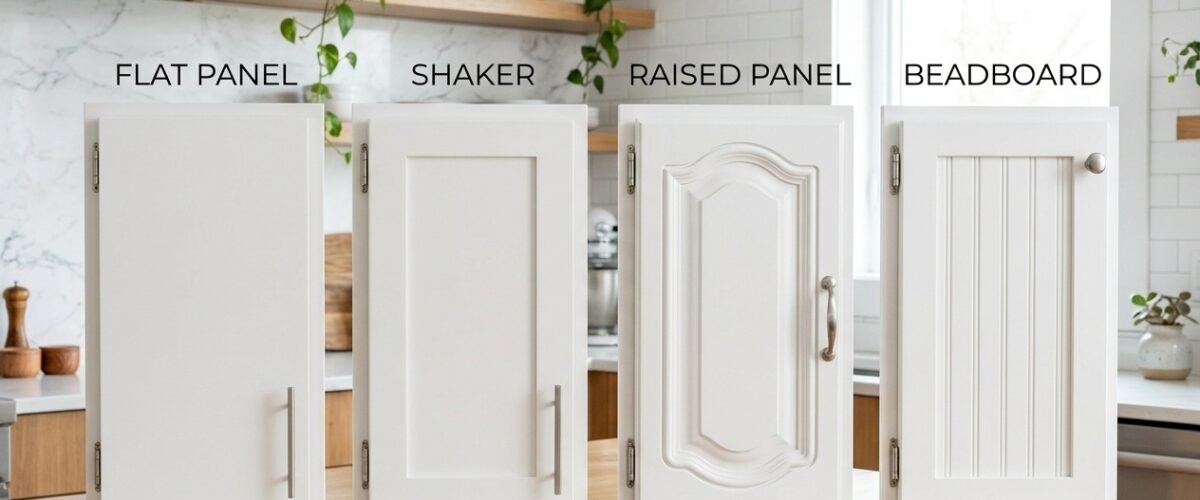
Shaker doors are the default choice for good reason. The five-piece frame-and-panel construction originated with the Shaker religious community in the 1700s, and the style has never fallen out of fashion because it lacks ornament that could feel dated ten years from now.
A standard shaker door consists of four perimeter rail and stile members surrounding a recessed center panel. The interior corner where the stile meets the panel creates a shallow 90-degree groove. Consequently, this groove traps cooking grease over time. Wipe down shaker fronts weekly with a microfiber cloth and a diluted dish soap solution. In particular, pay attention to the lower rail nearest the countertop, where grease splatter accumulates fastest.
For painted finishes, MDF shaker doors are superior to solid wood. Because MDF expands and contracts uniformly, painted joints do not crack at the seams over seasonal humidity changes. In contrast, solid wood shaker doors painted white frequently show hairline cracks at the panel joint within two to three years in humid climates.
Learn more about MDF vs plywood cabinet boxes before choosing your box material alongside your door style.
2. Flat Panel (Slab) Kitchen Cabinet Doors
Flat panel doors have a single uninterrupted surface with no applied molding, routed profiles, or raised edges. They are the cleanest kitchen cabinet door style to maintain because there is no crevice for grease to collect. A flat slab wipes clean in a single pass.
Consequently, flat panel doors dominate contemporary European-style kitchens. Specifically, handleless push-to-open systems and integrated pulls require a completely smooth door face, which makes slab doors the only viable choice for those designs.
Material selection matters significantly for flat panels. High-gloss acrylic slab doors show fingerprints constantly and scratch easily under normal kitchen use. Instead, opt for matte lacquer or textured laminate finishes. These resist fingerprints and minor surface abrasion far better than acrylic alternatives.
For a full breakdown of how flat panel compares against shaker in terms of design impact, see our guide on shaker vs flat front slab cabinets.
3. Raised Panel Kitchen Cabinet Doors
Raised panel doors feature a center panel that sits above the surrounding frame, creating a three-dimensional shadow line. This is the defining door style of traditional American kitchens built between 1970 and 2010. In formal colonial and Victorian homes, raised panel cabinetry still looks architecturally appropriate.
However, raised panel doors are the most difficult kitchen cabinet door style to clean. The shadow lines create four interior corners where grease and dust build up. Cleaning these corners requires a toothbrush or detail brush rather than a simple wipe-down. Therefore, if you cook frequently, raised panel doors demand more maintenance time than any other style on this list.
Cost-wise, raised panel solid wood doors run $80 to $240 each. The router profile on the panel edge and the cope-and-stick joinery of the stile and rail joints require more mill time than shaker construction, which also drives cost higher.
4. Beadboard Kitchen Cabinet Doors
Beadboard doors feature a series of narrow vertical tongue-and-groove panels with small rounded beads at each joint. This texture originated in New England coastal architecture and remains the signature look for cottage, Cape Cod, and farmhouse-style kitchens.
In addition, beadboard pairs exceptionally well with open shelving and apron-front sinks. The vertical lines draw the eye upward, which makes standard eight-foot ceiling kitchens feel slightly taller. For this reason, designers frequently specify beadboard on island base cabinets while using shaker on the perimeter run.
Cleaning beadboard doors requires specific attention because the vertical bead grooves collect grease similarly to shaker profiles. However, because the beads run vertically, drips clear naturally by gravity. A soft-bristle brush applied vertically cleans all bead channels simultaneously.
5. Cathedral (Arch Top) Kitchen Cabinet Doors
Cathedral doors replace the straight horizontal top rail with a curved arch. The arch can be a gentle radius or a full Gothic point depending on the intended style. Because the curved rail requires a solid wood species with stable grain, cathedral doors are available only in real wood. MDF cannot hold the curved rail shape under normal kitchen moisture exposure.
Specifically, arch-top doors suit Tuscan, Mediterranean, and ornate Victorian kitchens where strong architectural detail is expected throughout the space. However, they look out of place in contemporary kitchens, transitional remodels, or any kitchen using undermount sinks and linear hardware.
Cathedral doors cost $120 to $320 each because the curved coping process requires CNC shaping and hand-sanding. As a result, lead times from semi-custom manufacturers run four to eight weeks longer than standard profiles.
6. Mullion and Glass Front Kitchen Cabinet Doors
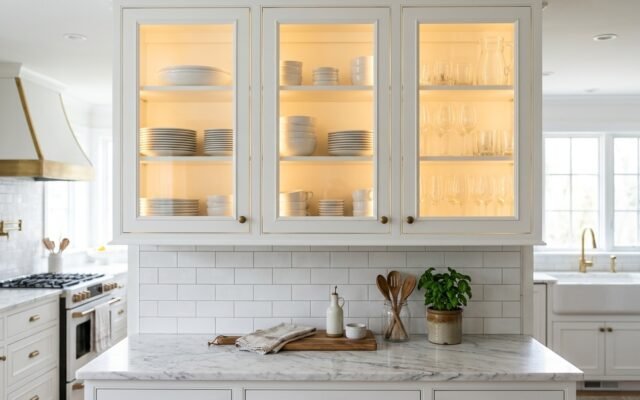
Mullion doors divide the door face into grid sections using thin wood or metal bars. Glass panels fill each section. This style is common on upper display cabinets in French country, traditional transitional, and English cottage kitchens.
Glass front doors require the most ongoing maintenance of all kitchen cabinet door styles. Because the glass shows fingerprints, grease film, and water spots quickly, plan for regular cleaning. In addition, the interior box must match the exterior door finish since the contents sit fully visible behind the glass. For a complete breakdown of glass types, lighting requirements, and costs, review our guide on glass front kitchen cabinets.
Which Kitchen Cabinet Door Style Should You Choose?
Match your door style to your kitchen architecture and your realistic cleaning schedule. The table below provides a decision shortcut.
| Your Kitchen Style | Best Door Style | Avoid |
|---|---|---|
| Modern / Minimalist | Flat Panel (Slab) | Raised Panel, Cathedral |
| Transitional / Neutral | Shaker | Cathedral, Beadboard |
| Farmhouse / Cottage | Shaker or Beadboard | Flat Panel, Cathedral |
| Traditional / Colonial | Raised Panel | Flat Panel |
| Display Uppers | Mullion with Glass | Flat Panel, Beadboard |
Before finalizing your door style, consider how your choice interacts with your countertop and paint selection. Our guide on cabinet and countertop color combinations walks through which combinations work across all six door profiles.
Frequently Asked Questions
What is the most popular kitchen cabinet door style?
Shaker is the most popular kitchen cabinet door style in North America. It accounts for approximately 65% of semi-custom cabinet orders and has held that position for over a decade because the five-piece frame works across modern, transitional, and farmhouse aesthetics.
Are flat panel cabinet doors cheaper than shaker?
Yes, flat panel slab doors are typically 10% to 25% less expensive than shaker doors of the same width and material. Because flat panel construction uses a single board rather than five assembled pieces, manufacturing time is shorter and material waste is lower.
Which cabinet door style is easiest to clean?
Flat panel slab doors in a matte finish are the easiest to clean. There are no grooves, joints, or shadow lines to trap grease. A single pass with a damp microfiber cloth cleans the entire surface in seconds.
Can you mix cabinet door styles in one kitchen?
Yes, mixing door styles is a deliberate design strategy. A common approach uses shaker doors on all perimeter cabinets and flat panel on the island, or shaker on base cabinets with mullion glass inserts on upper display cabinets. Keep the same hardware finish across both styles to maintain visual unity.
How long do MDF cabinet doors last?
MDF cabinet doors last 10 to 20 years under normal residential use when properly sealed and finished. Painted MDF outperforms solid wood in humid kitchens because it does not expand and contract with seasonal moisture changes that cause painted joints to crack.