Kitchen cabinet plywood is the structural foundation of quality cabinetry. Choosing the right grade, species, and thickness determines whether your boxes last ten years or fifty. Furniture-grade birch and Baltic birch plywood dominate custom cabinetry because of their void-free cores and superior screw-holding strength. When building cabinets, your sheet goods must support heavy countertops, resist moisture around sinks, and hold door hinges securely.
Most professional cabinet makers rely on three-quarter inch hardwood plywood for cabinet carcass construction. Particleboard and fiberboard save money upfront, but they fail under heavy loads or water exposure. In this guide, you will learn the exact plywood grades, sheet thicknesses, and wood species required for durable kitchen cabinets.
Why Plywood Beats Particleboard for Cabinet Boxes
Screw Holding Strength
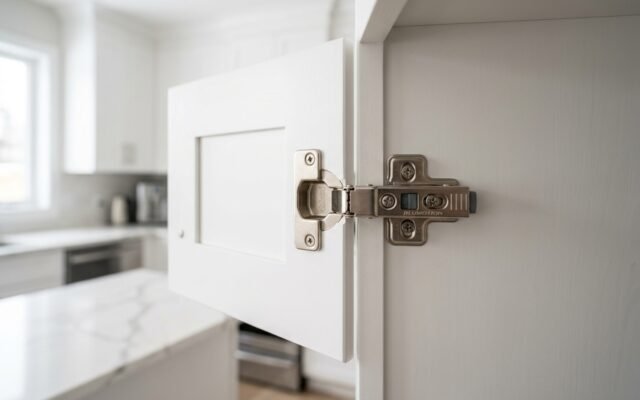
Screw holding strength represents the most critical mechanical difference between plywood and particleboard. Specifically, plywood holds screws 40 to 60 percent more securely than particleboard because cross-laminated wood fibers grip threaded fasteners from multiple grain directions. Alternating grain layers clamp down firmly on the threads, resisting pull-out forces and dynamic vibration.
Particleboard, on the other hand, consists of compressed wood chips bonded with synthetic resin. Because it lacks continuous wood grain, threaded screws easily crush the internal core during assembly. Consequently, cabinet doors sag over time as hinge screws strip their holes. Repeated adjustments quickly destroy the soft core. For reliable kitchen cabinet boxes that keep door alignment true, plywood is essential.
Moisture Resistance
Moisture resistance is another major reason professional shops avoid particleboard in wet kitchen zones. Furniture plywood uses waterproof glues between plies, allowing the panel to survive minor plumbing leaks without permanent swelling. When plywood gets wet, cross-banded veneers restrain excessive expansion. Once dry, plywood panels return to their original dimensions.
Particleboard behaves very differently when exposed to water. Specifically, loose wood chips absorb moisture rapidly through capillary action. The panel edges swell irreversibly, often expanding by 30 to 50 percent in thickness within hours. In fact, water damaged particleboard crumbles and cannot be repaired. Hardwood plywood offers vital insurance against water leaks near kitchen sinks.
Weight Capacity
Weight capacity determines how much heavy cookware your cabinet shelves can carry before sagging. Three-quarter inch birch plywood carries shelf loads of 40 to 80 pounds per linear foot without deflection. The continuous fibers in each hardwood veneer layer distribute downward forces efficiently across the cabinet span.
Comparable particleboard shelves sag visibly under heavy ceramic dishware stacks within two to three years. In particular, spans exceeding 30 inches show permanent downward bow under heavy loads. Therefore, quality builders always specify three-quarter inch hardwood plywood for wide pantry spans.
Long-Term Stability
Long-term dimensional stability keeps cabinet face frames tight and drawer reveals parallel. Plywood panels experience less seasonal expansion and contraction than solid wood or particleboard because alternating plies counteract each other. When relative humidity rises, one veneer layer expands while the perpendicular layer restrains movement.
This dimensional stability prevents joint failures where cabinet sides join face frames. In addition, you can review different kitchen cabinet wood types to match exterior face frames with internal plywood box veneers. Ultimately, plywood provides the rigid stability that European concealed hinges demand.
Best Plywood Species for Kitchen Cabinets
Birch Plywood for Cabinet Boxes
Domestic birch plywood is the most widely used domestic plywood species for kitchen cabinets across North America. Birch features a fine, even grain with tight pores that produces an exceptionally smooth surface. Because birch sands easily, it accepts primer and paint cleanly without telegraphing rough texture.
Standard domestic birch typically uses a veneer core made of softer woods like poplar or fir. Although domestic birch panels are strong, they occasionally contain minor voids in their inner plies. Nevertheless, cabinet shops favor domestic birch because it balances structural strength, clean machinability, and affordable sheet pricing. You can also check current prices on Amazon for cabinet-grade birch panels.
Baltic Birch Plywood
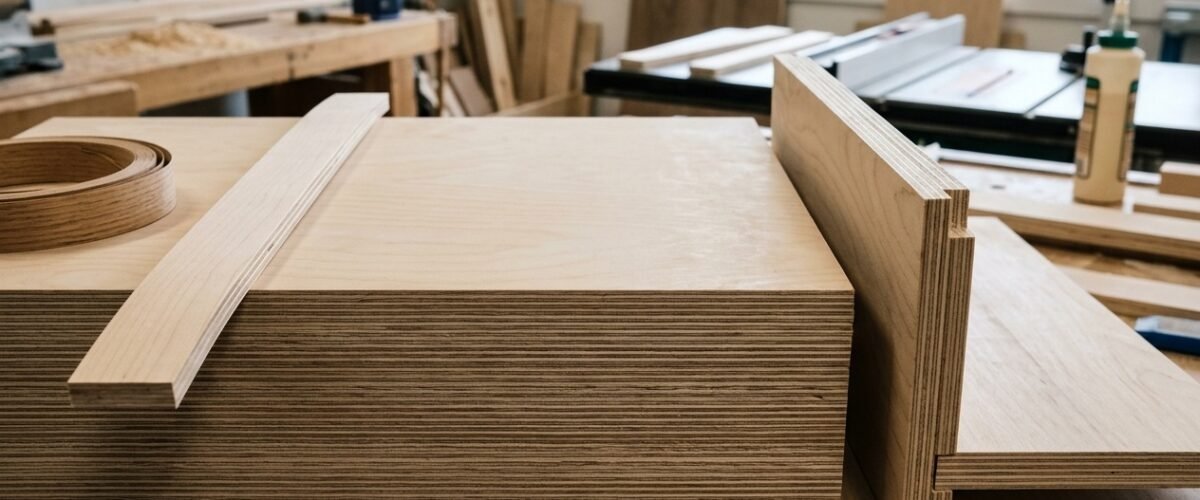
Baltic birch plywood is widely recognized by master woodworkers as the gold standard for cabinet construction. Imported from Scandinavia and Russia, Baltic birch features all-birch void-free plies throughout its core. Each veneer layer is uniform birch measuring approximately 1.5 millimeters thick, creating an ultra-dense panel with up to thirteen plies in a three-quarter inch sheet.
Because there are zero internal core voids, Baltic birch provides exceptional screw edge holding and razor-sharp machining edges. Baltic birch comes in square 5×5 foot sheets in thicknesses from 6mm to 30mm. Although slightly more expensive than domestic birch, its remarkable stiffness makes it significantly stronger for drawer boxes.
Maple Plywood for Cabinet Boxes
Maple plywood provides another premium hardwood option for high-end kitchen cabinet interiors. Maple possesses a harder grain than birch, which provides excellent resistance to denting on shelf surfaces. Consequently, prefinished maple plywood with a factory UV cured clear coat is the industry standard for interior cabinet carcasses.
Maple plywood paints well and costs similarly to premium birch. In addition, maple is often chosen for painted kitchen cabinets when a denser surface is preferred. It matches beautifully with a solid hardwood kitchen cabinet face frame. When homeowners want a bright interior that wipes clean effortlessly, prefinished maple plywood is ideal.
MDF Core Plywood Panels
MDF core plywood panels combine the best visual surface qualities of fiberboard with genuine hardwood face veneers. Unlike veneer core panels that follow natural wood grain irregularities, the MDF center core provides a dead-flat surface free of telegraphing grain for painted cabinet doors and drawer faces.
However, edge fastening in MDF cores is weaker than all-wood plywood. In particular, screws driven into the edge of MDF core panels can split the core if pilot holes are not drilled properly. While MDF panels appear in budget ready to assemble kitchen cabinets, structural sides require veneer core plywood.
Plywood Grades Explained for Cabinet Use
A-A and A-B Graded Face Panels
Plywood face grades follow standardized grading systems established by the Hardwood Plywood and Veneer Association. An A face is sanded smooth with no open knots or voids. The veneer exhibits uniform color, making the surface virtually flawless.
A-A graded panels have matching A-grade faces on both sides, making them ideal for exposed divider partitions and open upper shelving. In contrast, A-B graded panels have one A face and one B face with minor repairs. Cabinet makers use A-A or A-B for visible interior sides, facing the A grade inward.
B-B and Shop Grade Plywood
B-B graded plywood allows small patches and pin knots on both faces. While B-B panels may not look uniform enough for clear-finished luxury cabinets, they provide full structural integrity. Therefore, builders often use B-B sheets for concealed structural stretchers, toe kicks, and hidden corner blocks.
Shop grade or cabinet grade plywood falls between B-B and A-B quality and is commonly sold at lumber yards specifically for cabinetry at reduced prices. Specifically, shop grade panels contain minor edge defects. Clever builders cut around these flaws to save 20 to 30 percent. You can also browse options at Home Depot to compare sheet availability.
Hardwood Plywood vs Softwood Plywood
Understanding the difference between hardwood plywood and softwood plywood prevents costly building errors. Hardwood face plywood uses maple, birch, or oak veneers on a softwood or mixed core. In contrast, softwood plywood uses pine or fir faces and cores.
Softwood plywood is engineered for home framing, not cabinetry. Because softwood panels contain pitch pockets and open knotholes, they cannot produce smooth cabinet boxes. Furthermore, softwood veneers splinter during table saw cuts. Therefore, you must specify hardwood face plywood for cabinet interiors.
Formaldehyde Emissions and CARB Compliance
Indoor air quality is an important consideration when selecting sheet materials for home interiors. In the past, traditional plywood manufacturing used urea-formaldehyde adhesives that released hazardous fumes inside homes. Today, strict environmental regulations protect homeowners from dangerous off-gassing.
California Air Resources Board Phase 2 compliant plywood emits 0.05 parts per million or less formaldehyde. In addition, the federal Toxic Substances Control Act enforces identical standards nationwide. When buying sheet goods, always look for CARB P2 or TSCA Title VI stamps on panels used inside enclosed kitchen cabinets. Choosing certified panels ensures your kitchen cabinets remain safe, healthy, and odorless.
Standard Plywood Thickness for Cabinet Applications
Three-Quarter Inch for Sides, Bottoms, and Shelves
Three-quarter inch (18mm to 19mm) plywood is the quality standard for cabinet box sides, bottoms, and adjustable shelves. This thickness provides the rigidity needed to support countertops and heavy cookware without deflection. In addition, three-quarter inch panels provide ample wood thickness for deep dado joints, pocket screws, and blind dowel joinery.
Furthermore, three-quarter inch plywood gives adjustable shelf pins firm, wobble-free support. When cabinet shelves carry stacks of heavy ceramic plates, this thickness prevents noticeable middle deflection across standard spans up to 36 inches. If you want cabinets that feel rock-solid for decades, never compromise on three-quarter inch box panels.
Half-Inch for Cabinet Backs and Drawer Boxes
Half-inch (12mm) plywood is adequate for hanging cabinet backs and secondary interior panels not subject to heavy loads. When grooved into side panel dados, a half-inch back squares the entire carcass during assembly. Because half-inch plywood resists diagonal racking forces, it keeps tall utility cabinets straight and true.
In addition, five-eighths inch works as a compromise for drawer box sides in heavy-duty pull-out applications. Half-inch birch is also widely used for dovetailed drawer sides because it creates lightweight, durable drawers that do not strain drawer slide mechanisms. Review standard kitchen base cabinet dimensions to calculate exact cut lists.
One-Quarter Inch for Decorative Backs
One-quarter inch (6mm) plywood or hardboard is the standard for decorative back panels on display cabinets and open shelving units. For example, display cabinets with glass doors often use one-quarter inch beadboard or prefinished hardwood plywood panels set into rear rabbets. This thin sheet material encloses the cabinet interior without adding unnecessary weight.
However, one-quarter inch plywood is not suitable for structural hanging or load-bearing applications. Because screws pull through quarter-inch veneer, you must never drive hanging screws through thin back panels. Instead, cabinets with thin backs require solid hardwood hanging cleats.
When to Use Three-Quarter Inch Backs
Commercial cabinet shops and luxury builders frequently build frameless European cabinets with full three-quarter inch back panels. Specifically, cabinet runs over 48 inches wide and upper cabinets being attached to wall studs through the back panel benefit from three-quarter inch back construction. This thickness provides a strong screw anchor directly into the panel.
Using three-quarter inch backs also simplifies kitchen cabinet installation on uneven drywall. You can drive installation screws anywhere through the back panel directly into studs. Although heavier, it produces an indestructible cabinet box. You can also compare pre-built cabinets on Wayfair to examine commercial back styles.
Buying Kitchen Cabinet Plywood
Where to Buy Cabinet-Grade Plywood
Finding high-quality cabinet plywood requires knowing where professional woodworkers shop. Local hardwood dealers stock domestic birch and maple plywood in A-B and shop grade. These specialized suppliers store sheet goods flat in climate-controlled warehouses, which prevents warping and moisture damage.
Big box stores carry lower-grade birch plywood with thin face veneers that easily sand through. For premium Baltic birch, online lumber vendors like Woodcraft, Rockler, and Ocooch Hardwoods ship Baltic birch nationwide directly to your shop.
Sheet Sizes and Cutting Yields
Standard American plywood sheets measure 4×8 feet, which provides 32 square feet of usable material. Baltic birch is sold in 5×5 foot sheets measuring approximately 1525mm by 1525mm. Understanding these sheet dimensions is critical for maximizing cutting yields and minimizing expensive scrap.
For example, a single 4×8 sheet cut efficiently yields two 16-inch-wide by 96-inch-tall cabinet side panels and one 21-inch base panel bottom. Planning cuts with nesting software allows you to build multiple kitchen cabinet box construction components efficiently. Always calculate blade kerf before ripping.
Price Ranges by Grade and Species
Plywood pricing varies based on wood species, core construction, panel grade, and regional lumber availability. Domestic birch shop grade costs $40 to $65 per sheet, making it an excellent budget option for interior carcasses. A-B domestic birch costs $55 to $80 per sheet.
Baltic birch B-BB costs $70 to $110 per 5×5 sheet. Maple plywood A-B costs $65 to $90 per sheet. Prefinished maple panels with factory clear coats cost slightly more per sheet, but they save hours of finishing labor.
Plywood vs Particleboard vs MDF Comparison Table
Core Material Performance Comparison
Choosing the best cabinet box core material requires balancing strength, moisture tolerance, weight, and overall budget. The following comparison table summarizes the critical physical properties and typical costs for popular cabinet materials:
| Material | Screw Holding | Moisture Resistance | Shelf Strength | Cost per Sheet | Best Cabinet Use |
|---|---|---|---|---|---|
| Baltic Birch Plywood | Excellent | Very Good | Outstanding | $70 to $110 | Box sides, shelves, drawers |
| Domestic Birch Plywood | Very Good | Good | Very Good | $40 to $80 | Box sides and shelves |
| Maple Plywood | Very Good | Good | Very Good | $65 to $90 | Painted box sides |
| MDF Core Panel | Fair at edges | Poor | Good | $55 to $85 | Flat painted door faces |
| Furniture Board / Particleboard | Poor | Poor | Moderate | $25 to $45 | Budget stock cabinet boxes |
Material Selection Summary
As the table demonstrates, Baltic birch and domestic birch provide the best performance for structural cabinet components. While particleboard costs less upfront, its poor screw holding makes it risky. Therefore, investing in three-quarter inch hardwood plywood ensures your cabinets remain durable and stable.
FAQ
What plywood do cabinet makers use?
Most professional cabinet shops use three-quarter inch Baltic birch or domestic birch A-B plywood for box sides, bottoms, and shelves. Drawer boxes often use half-inch or five-eighths inch birch plywood. In addition, many custom shops specify prefinished maple plywood because the factory clear coat saves finishing time.
Is Baltic birch worth it for kitchen cabinets?
Yes, Baltic birch is worth the price premium for high-use kitchens. The void-free all-birch plies provide superior screw holding at hinges and drawer slides. Furthermore, its extreme dimensional stability prevents warping in humid kitchen environments, delivering unmatched longevity.
Can I use construction plywood for cabinets?
Construction-grade pine or fir plywood works in utility cabinets, but it is unsuitable for kitchen cabinetry. Rough grain, voids, and pitch pockets prevent smooth finishing. In addition, construction sheets often warp, making accurate cabinet joinery impossible.
How thick should kitchen cabinet shelves be?
Three-quarter inch plywood provides optimal shelf rigidity for spans up to 36 inches. Spans wider than 36 inches benefit from a one-inch solid wood front edge stiffener to prevent sag. Never use half-inch plywood for wide cabinet shelves.