Cabinet installation labor runs $75 to $350 per cabinet for a standard residential kitchen. For a full 10×10 layout with 12 units, that puts total install labor at $900 to $4,200 before layout modifications, demolition, or old cabinet removal. The number varies primarily by region, crew size, and how complex your wall configuration is.
Labor is the cost most homeowners underestimate. Material budgets get researched obsessively, yet the labor line gets a rough guess. Here is what actually drives the number, regional benchmarks by city tier, and the specific tasks that add charges you may not expect.
Labor Cost by Region
Regional labor markets drive the spread from $75 to $350 per cabinet more than any other single factor. A skilled cabinet installer in the Mississippi Delta earns $45 to $65 per hour. However, that same skill set in San Francisco commands $110 to $180 per hour, because Bay Area cost of living pulls every trade rate upward.
| Region | Per-Cabinet Rate | Full 10×10 Labor (12 units) |
|---|---|---|
| Rural Southeast / Midwest | $75–$120 | $900–$1,440 |
| Mid-Atlantic / Carolinas | $100–$150 | $1,200–$1,800 |
| Northeast (excl. NYC) | $120–$175 | $1,440–$2,100 |
| Texas metro (DFW, Houston) | $95–$145 | $1,140–$1,740 |
| California (excl. Bay Area) | $130–$200 | $1,560–$2,400 |
| Pacific Northwest (Seattle, Portland) | $140–$225 | $1,680–$2,700 |
| Major metro: NYC, LA, SF, Boston | $200–$350 | $2,400–$4,200 |
These rates assume a two-person crew doing a standard in-kind replacement: cabinets in, cabinets level, doors adjusted. They do not include demolition, countertops, or appliance reconnection — those are separate line items entirely.
What Is Included in the Base Install Rate
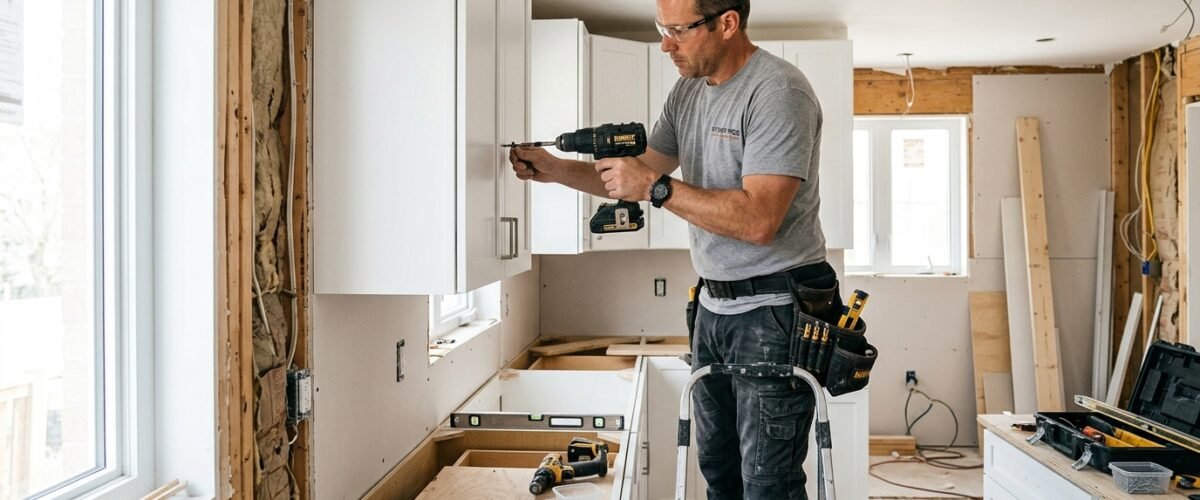
The base rate covers the mechanical work of getting cabinets from the floor onto the walls and anchored correctly. Specifically, a standard cabinet installation includes the following tasks.
First, the crew lays out the cabinet run with a laser level. Then, they find the floor’s high point so every cabinet sits at the same height, because uneven floors cause misaligned doors and countertop gaps when left unchecked. Next, they shim and scribe base cabinets to an out-of-plumb wall. After that, they hang wall cabinets into wall studs using 3-inch cabinet screws. Finally, they join adjacent boxes at the face frames and adjust every door and drawer front to within 1/16-inch alignment tolerance.
What is not included: any task touching your structure, plumbing, electrical, or appliances. Pull a permit if your layout changes. Get a plumber for any drain or supply relocation, because that work requires a separate license in most states.
What Costs Extra Beyond the Base Rate
Almost every kitchen has at least one of these add-ons. Budget for them before you start, so you are not surprised on installation morning.
Filler strip and scribe molding fitting. Custom trimming and scribing to an out-of-plumb wall takes 30 to 90 minutes per location. Most installers charge $65 to $125 per hour for this carpentry beyond the base rate. Because a kitchen with four scribe locations adds $130 to $375 in trim labor, verify how many locations your layout has before signing an estimate.
Crown molding installation. Installing crown molding on cabinet uppers requires compound miter cuts at every inside and outside corner. Labor runs $8 to $15 per linear foot. For example, a standard kitchen with 20 linear feet of uppers adds $160 to $300.
Under-cabinet lighting rough-in. If your installer is running wire channels or setting LED puck lighting during the cabinet phase, expect $85 to $150 per hour for that electrical work, billed separately from cabinet rates.
Island base assembly. A freestanding island with finished end panels on multiple sides takes 3 to 5 hours for a two-person crew. At $100 to $160 per crew hour, that adds $300 to $800 on top of the per-cabinet rate.
Appliance pull-outs and specialty inserts. Lazy susans, pull-out trash units, and drawer organizer inserts require precise fitting. Installers charge $45 to $90 per specialty unit beyond the standard rate, because each one needs individual adjustment after the surrounding boxes are set.
Old Cabinet Removal: The Bill Before the Bill
Removing existing cabinets before new ones arrive costs $300 to $800 for a standard 10×10 kitchen. The range depends on how the original cabinets were attached and whether you want them hauled away.
Cabinets attached with screws through the face frame come out in 20 to 40 minutes per unit. However, cabinets nailed in place, glued down, or mounted through tile backsplash take longer and increase the risk of drywall damage. Patching walls after removal adds $150 to $350 in separate drywall work.
If you want the installer to haul the old cabinets away, add $150 to $400 for junk removal on top of the demo labor. You can avoid that charge entirely by doing your own demo. Pull doors and drawer faces first, then remove uppers before bases. A careful two-person demo of a 12-cabinet kitchen takes 3 to 4 hours. Then load everything into a rented box truck and drop it at a transfer station — typical fee is $60 to $120 per load.
How to Get an Accurate Labor Estimate
Get three written quotes before hiring. Verbal estimates expand once the job starts. A written quote for a defined scope locks in the number.
When contacting installers, provide these specifics in writing: the number of base and wall cabinets by unit type, whether old cabinet removal is included, the cabinet brand (RTA assembly prep takes extra time), and the delivery date. That last point matters because installers who handle RTA boxes need a staging day before hanging begins.
Ask each installer directly: “Is filler strip fitting and scribe molding included in your rate, or billed hourly on top?” and “How do you handle wall damage found behind old cabinets?” The answers tell you whether you have a transparent contractor or one building buffer into a low-ball quote.
The best validation is a site visit before the quote. Any installer who quotes without walking your kitchen is guessing. Wall conditions, floor levelness, and stud spacing vary enough that a 10-minute site visit prevents a $500 to $1,200 scope surprise on installation day.
What to Watch For When Hiring
Unlicensed residential carpenters. Cabinet installation does not require a contractor’s license in most states. However, complex kitchen work often overlaps electrical, plumbing, and structural scope that does. Verify that anyone reconnecting a dishwasher or modifying under-sink plumbing holds the appropriate license.
Day-rate pricing without a scope definition. A quote of “$600 per day” sounds reasonable until the job takes four days for a kitchen the installer knew was complex. Instead, require per-unit or per-room pricing with a defined scope. Time-and-materials billing transfers schedule risk entirely to you.
No written warranty on workmanship. Door alignment, drawer slide adjustment, and cabinet level are workmanship items. A reputable installer warrants them for at least 90 days. If a drawer goes out of adjustment within a week, that is a defect — the installer comes back at no charge. Get this in writing before work begins, because verbal promises are worthless when something shifts after install.
Frequently Asked Questions
How long does it take to install kitchen cabinets? A two-person crew installs a standard 10×10 kitchen in 1 to 2 days. Complex layouts with islands, corner specialty units, or extensive scribing take 3 to 4 days. Wall cabinet hanging goes faster than base cabinets, because bases require floor leveling, shimming, and toe kick fitting that slow the pace significantly.
Can I install kitchen cabinets myself to save money? Yes, if you own a drill, a laser level, a stud finder, and 2 to 3 weekend days. Self-installation on a standard RTA or pre-assembled run is achievable for a capable DIYer. The most common mistake is not finding the floor’s high point before setting the first base cabinet, because that error compounds across the entire run.
Do cabinet installers supply the hardware, or do I buy it separately? Installers typically supply nothing beyond their own tools. Cabinet boxes arrive with manufacturer-included hinges and slides. Pulls, knobs, and any upgraded hardware are homeowner-purchased and given to the installer at the job site. Always verify this before assuming anything is included in the quote.
What is the difference between a cabinet installer and a general contractor? A dedicated cabinet installer is a finish carpenter who specializes in cabinet work. They are typically faster and cheaper than a general contractor for cabinet-only scopes. A general contractor manages the whole project and marks up each subcontractor’s rate by 15 to 25%, because that markup covers coordination, insurance, and schedule management.
How do I know if cabinet installation is done correctly? Open every door and every drawer. Doors must close flush with the face frame, with no daylight gap larger than 1/16 inch at center. Drawers must extend fully, close flush, and stay centered in their opening. Every cabinet box must be level front-to-back and side-to-side. If any of these fail, the installer has unfinished work.