Choosing the right wood species for your kitchen cabinets determines your upfront material cost, resistance to everyday dents and moisture, and how well your finish holds up over twenty years of cooking. Hard maple and white oak lead the market in structural durability and finish versatility, while species like cherry, hickory, birch, poplar, and engineered MDF offer distinct advantages depending on your staining goals, grain preferences, and budget limits.
Every wood species responds differently to kitchen humidity swings, cooking grease, and hardware fasteners. Here is the direct side-by-side comparison contractors and custom cabinetmakers use to balance durability, grain aesthetics, and real-world costs per linear foot.
Quick Comparison: Cabinet Wood Species & Materials Compared
This comparison table evaluates seven primary cabinet hardwoods and engineered core materials across hardness, pricing, finishing suitability, and moisture resistance.
| Species / Material | Janka Hardness | Cost per Linear Foot | Best Use Case | Paint or Stain | Moisture Resistance |
|---|---|---|---|---|---|
| Hard Maple | 1,450 lbf | $180 – $380 | High-traffic family kitchens, painted Shaker doors | Paint or subtle stain | Moderate |
| White Oak | 1,360 lbf | $220 – $480 | Modern rift-sawn, organic transitional kitchens | Clear coat, natural stain | High (closed tyloses) |
| Red Oak | 1,290 lbf | $140 – $300 | Traditional stained cabinets, durable budget hardwood | Medium to dark stain | Moderate (open pores) |
| Cherry Wood | 950 lbf | $220 – $460 | Warm luxury kitchens, fine furniture cabinetry | Natural clear, warm stain | Moderate |
| Birch | 1,260 lbf | $130 – $260 | Budget custom builds, durable hardwood box cores | Paint, light stain with sealer | Moderate |
| Hickory | 1,820 lbf | $190 – $400 | Rustic farmhouse, mountain homes, heavy-duty durability | Natural clear coat | Moderate to High |
| Poplar | 540 lbf | $110 – $220 | Budget painted face frames, interior moldings | Paint only | Low |
| MDF (High-Density Core) | Engineered | $120 – $240 | Glass-smooth painted cabinet doors, zero seasonal joint cracking | Paint only | Low to Moderate (requires sealed edges) |
1. Hard Maple: The Industry Standard for Painted and Stained Cabinets
Hard maple (Acer saccharum), often called sugar maple, is the single most widely specified hardwood in the American cabinetry industry. With a Janka hardness rating of 1,450 pounds-force (lbf), hard maple provides exceptional resistance to impact dents from dropped pots, heavy cast iron skillets, and kicking along the toe kick base.
Maple features a fine, closed grain structure with uniform density and minimal color variation between heartwood and sapwood. Because it lacks open grain pores, hard maple takes factory conversion varnish enamel and polyurethane paints exceptionally well. Paint cures to a glass-smooth finish without the wood grain telegraphing through the surface coating, making maple the premier choice for painted Shaker doors and face frames.
When staining maple, professional cabinetmakers apply a pre-stain wood conditioner. Because maple density varies microscopically across the board face, dark pigment stains can absorb unevenly and appear blotchy without proper sealing. Maple looks best under factory clear coats, warm honey glazes, or solid enamel paints. Costs range from $180 to $380 per linear foot installed.
In high-traffic family kitchens where children, pets, and frequent cooking create daily impact risks, hard maple provides the structural resilience needed to prevent corner chipping on door edges and face frame stiles.
2. White Oak vs Red Oak: Distinct Grain Character and Moisture Durability
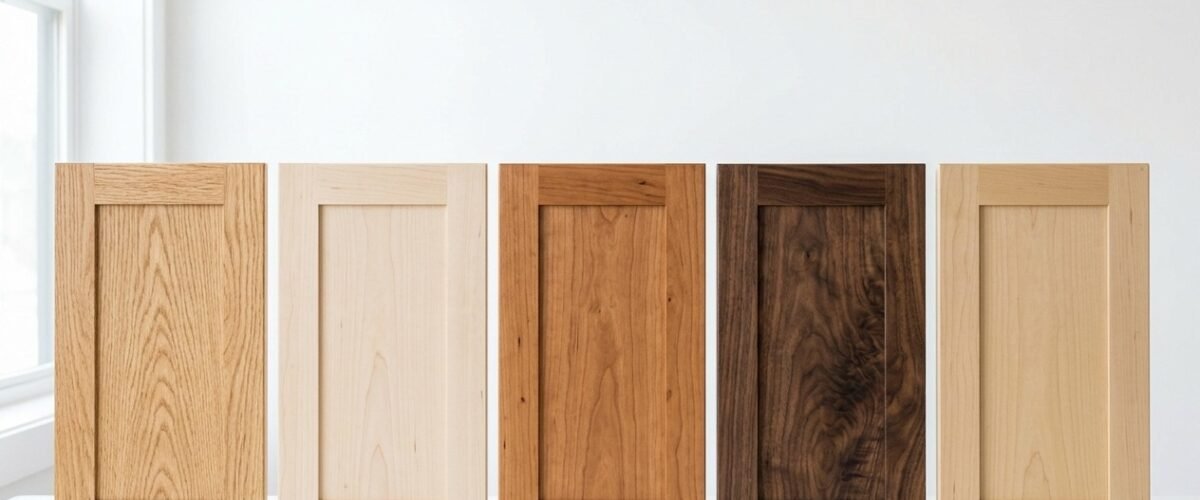
Oak has undergone a massive resurgence in modern kitchen architecture, moving away from 1990s honey-oak cathedral styles toward sleek quarter-sawn and rift-sawn cuts that showcase straight, linear grain patterns. When choosing oak, you must distinguish between white oak and red oak.
White oak (1,360 Janka) features a light tan-to-olive hue and a closed cellular anatomy. The wood pores in white oak are naturally plugged with micro-crystalline structures called tyloses, which make the wood exceptionally resistant to water absorption, rot, and fungal decay. This natural water resistance makes white oak an outstanding choice for sink base cabinets, kitchen islands, and high-humidity environments.
Red oak (1,290 Janka) features a warm pinkish-red undertone and open, porous vascular tubes. While slightly less expensive than white oak, red oak readily absorbs stains and creates pronounced, high-contrast cathedral grain arches. White oak costs between $220 and $480 per linear foot, while red oak runs $140 to $300 per linear foot. Compare how natural oak finishes pair with modern door profiles in our guide to Shaker vs flat-front slab cabinets.
When applying a cerused or wire-brushed finish, white oak provides deep, crisp textural contrast when a light glaze is rubbed into the linear grain grooves, creating an organic modern design aesthetic.
3. Cherry Wood: Natural Patina and Luxury Furniture Elegance
American black cherry (Prunus serotina) is celebrated for its smooth satin texture, subtle flowing grain lines, and natural warmth. With a Janka hardness rating of 950 lbf, cherry is moderately softer than hard maple and oak, meaning it requires reasonable care to avoid deep gouges from heavy impacts.
The defining characteristic of cherry cabinetry is its natural photo-reactive aging process. When first milled, raw cherry lumber displays a soft pinkish-golden tone with occasional green mineral streaks and small gum pockets. Upon exposure to ambient indoor light and UV rays, cherry oxidizes and darkens naturally into a deep, lustrous reddish-brown patina over the course of 6 to 12 months.
Cherry finishes best with clear conversion varnish, natural Danish oils, or warm amber stains that highlight its internal depth. Never paint over quality cherry wood; painting conceals the natural patina that homeowners pay a premium to acquire. Cherry cabinetry typically costs between $220 and $460 per linear foot.
Because cherry darkens rapidly during its first six months in a sunlit kitchen, avoid leaving decorative items or cutting boards resting on cabinet doors or countertops for extended periods to prevent uneven shadowing in the developing wood tone.
4. Birch: The Cost-Effective Hardwood Alternative to Maple
Yellow birch (Betula alleghaniensis) offers structural performance that closely parallels hard maple at a 20% to 30% lower lumber cost. With a Janka rating of 1,260 lbf, birch provides excellent dent resistance, holding cabinet mounting screws and hardware fasteners securely over decades of use.
Birch features a light yellowish-white sapwood paired with a darker reddish-brown heartwood. Because of its excellent strength-to-weight ratio and dimensional stability, birch is the premier material used for multi-ply cabinet box plywood cores and solid hardwood dovetail drawer sides throughout the cabinet industry.
Like maple, birch requires a sanding sealer or wood conditioner before applying dark stains to prevent blotching. Birch is an outstanding choice for budget-conscious homeowners who want real solid hardwood durability without paying top-tier maple prices. Costs range from $130 to $260 per linear foot. If you are considering buying raw cabinets to finish yourself, explore our breakdown of unfinished kitchen base cabinets for pricing and preparation tips.
Birch plywood boxes combined with solid maple face frames represent one of the smartest value engineering strategies in modern kitchen remodeling, giving you a rock-solid cabinet shell at a fraction of full-hardwood construction costs.
5. MDF (Medium-Density Fiberboard): The Premier Painted Door Material
Medium-density fiberboard (MDF) is an engineered wood product manufactured by breaking down hardwood and softwood residuals into fine wood fibers, combining them with synthetic resin binders, and compressing them under intense heat and pressure into dense, flat panels.
While solid wood is essential for cabinet face frames and drawer boxes, high-density MDF is superior to solid wood for one-piece painted cabinet doors and five-piece recessed door center panels. Solid wood naturally expands across its grain during humid summer months and contracts during dry winter heating seasons. This constant seasonal movement causes hairline cracks in the paint finish along the joints where door stiles meet rails.
Because MDF is an isotropic engineered material with no grain orientation, it remains dimensionally stable regardless of seasonal humidity changes. Paint applied to high-density MDF cures to an ultra-smooth, flawless finish that will not crack along frame seams. However, raw unsealed MDF absorbs moisture rapidly if exposed to standing water, so all panel edges must be completely sealed with primer and enamel paint during fabrication. MDF doors cost $120 to $240 per linear foot.
For modern slab-door kitchens, high-density moisture-resistant MDF laminated with thermal-fused melamine or high-pressure laminate provides a sleek, warp-free surface that resists scratches and everyday kitchen stains.
6. Hickory: Extreme Hardness and Bold Rustic Character
Hickory (Carya ovata) is the hardest commercially harvested North American hardwood used in cabinet making, boasting a massive Janka hardness rating of 1,820 lbf. It is virtually immune to everyday dents, dings, pet scratches, and heavy cookware impacts.
Hickory is instantly recognizable by its dramatic, high-contrast coloration. A single door panel can display bright creamy white sapwood running directly alongside dark chocolate brown heartwood, interspersed with bold mineral streaks, bird pecks, and prominent grain waves. Because of its incredible density, hickory is difficult to cut and machine, requiring carbide-tipped tooling and slower feed rates in the cabinet shop.
Hickory looks best under clear protective topcoats or light natural stains that celebrate its wild rustic character. It is an optimal wood species for log homes, mountain cabins, modern rustic farmhouses, and active households that demand maximum structural toughness. Costs run from $190 to $400 per linear foot.
Because hickory exhibits high seasonal movement when subjected to extreme humidity swings, installers must leave adequate expansion gaps around cabinet frames in unconditioned or seasonally occupied homes.
7. Poplar: The Budget Paint-Grade Hardwood
Yellow poplar (Liriodendron tulipifera), also known as tulipwood, is a fast-growing, lightweight hardwood widely used for budget-friendly cabinet face frames, interior drawer components, and architectural moldings.
With a Janka hardness rating of just 540 lbf, poplar is the softest hardwood used in cabinetry. It dents relatively easily under moderate impact and should not be used for heavy-traffic base cabinet doors. Poplar lumber displays pronounced green, gray, and purple color streaks across its grain, making it unsuitable for clear stains or natural finishes. However, its smooth, closed grain absorbs primer and paint cleanly, making it a reliable, low-cost choice for painted cabinet face frames when paired with MDF door panels. Costs range from $110 to $220 per linear foot.
If you choose poplar for budget cabinet framing, specify a hard polyurethane enamel topcoat or catalyzed conversion varnish to add surface toughness against everyday kitchen dings.
Understanding Janka Hardness and Real-World Kitchen Wear
The Janka hardness test measures the force required to embed a 0.444-inch (11.28 mm) steel ball halfway into a piece of wood. In a real-world kitchen, Janka hardness translates directly to how well your cabinet doors and drawer fronts resist impact damage.
Here is how Janka ratings play out during everyday cooking activities:
- Under 600 lbf (Poplar, Pine): Easily dents from a dropped fork, heavy spice jar, or vacuum cleaner nozzle bumping the base.
- 900 to 1,100 lbf (Cherry, Soft Maple): Moderately resistant to everyday wear; small dings may occur from heavy pot impacts but light daily handling leaves no mark.
- 1,200 to 1,500 lbf (Hard Maple, Oak, Birch): High impact resistance; will withstand dropped canned goods, heavy cookware bumps, and active household use with zero noticeable denting.
- Over 1,800 lbf (Hickory): Extreme industrial-grade toughness; virtually impossible to dent without deliberate, concentrated mechanical force.
How to Select the Right Cabinet Wood Species for Your Remodel
Selecting the right cabinet material comes down to matching your intended finish, household lifestyle, and remodeling budget.
Follow these contractor selection rules:
- For Solid Painted Finishes: Choose hard maple face frames paired with high-density MDF door center panels. This combination delivers maximum frame strength while eliminating paint seam cracking.
- For Natural Wood and Light Stains: Choose rift-sawn or quarter-sawn white oak for modern organic kitchens, or hard maple for clean, subtle warmth.
- For Rich Luxury Stains: Choose American black cherry for fine furniture quality and a deep natural patina over time.
- For Maximum Budget Value: Choose birch hardwood or paint-grade poplar with MDF doors to reduce total material costs by 25% without sacrificing daily function.
- For High-Impact Durability: Choose hickory or hard maple if you have active children, large pets, or heavy daily cooking routines.
Related Guides
- Shaker vs Flat-Front Slab Cabinets: 2026 Design Showdown
- Unfinished Kitchen Base Cabinets: What You Get, What to Paint, and What to Avoid
- Top 10 Kitchen Cabinet Color Trends Dominating 2026
Frequently Asked Questions About Kitchen Cabinet Wood Species
What is the most durable wood species for kitchen base cabinets?
Hickory is the most durable North American cabinet wood with a Janka hardness rating of 1,820 lbf, followed closely by hard maple at 1,450 lbf and white oak at 1,360 lbf. All three resist heavy impact dents and hold fasteners securely.
Is MDF better than solid wood for painted kitchen cabinets?
Yes, for door panels. High-density MDF does not expand or contract with seasonal humidity swings, which prevents hairline paint cracking at frame joints. Solid wood remains the preferred material for structural face frames and drawer boxes.
Why does cherry wood change color after installation?
Cherry contains natural photo-reactive compounds that oxidize when exposed to natural light and ambient oxygen. Raw cherry darkens from a pale pinkish-gold into a rich reddish-amber patina within 6 to 12 months after installation.
What is the difference between white oak and red oak for cabinets?
White oak has a tighter linear grain with closed internal pores (tyloses) that resist water absorption, giving it a modern tan tone. Red oak has open pores, pinkish undertones, and pronounced cathedral grain patterns that absorb dark stains deeply.