The average homeowner saves $2,000 to $6,000 on a kitchen cabinet project without touching the structural quality of the boxes. The savings come from purchasing strategy, not from cutting corners on plywood or drawer hardware. When you cheap out on the box, you buy the kitchen twice.
This guide gives you seven concrete moves in the order you should make them. Start with the move that saves the most money.
Skill level: No prior knowledge needed. Time: 2 to 3 hours of research before you order.
What You Will Need
- Tape measure and room dimensions on paper (linear feet of base run and wall run measured separately)
- Three written competitive quotes before executing any of these steps
- An itemized Bill of Materials from each dealer so you can compare line by line
- A calendar showing your installation date, so you can work backwards to your order deadline
Step 1: Buy All-Plywood RTA Instead of Pre-Assembled
RTA cabinets with 1/2-inch birch plywood boxes cost 25% to 40% less than structurally identical pre-assembled semi-custom lines. For a 10×10 kitchen, that gap runs $3,000 to $5,000. The only thing you give up is factory assembly time — and that assembly takes 6 to 8 hours for a full kitchen, because base cabinets average 15 to 25 minutes each.
Suppliers like Lily Ann Cabinets, The RTA Store, and Cabinet Joint ship the same plywood carcass, dovetail drawer boxes, and Blum-equivalent soft-close slides that semi-custom assembled lines carry. The check that confirms you are comparing correctly: ask every dealer for a written material specification sheet. It must state “1/2-inch plywood carcass sides, bottom, and back.” If it says “furniture board” or “engineered wood panel,” it is particleboard — and that is not the same structural product regardless of price.
Success check: Your RTA order has a written spec sheet confirming 1/2-inch plywood on all structural carcass surfaces. Not furniture board. Plywood.
Step 2: Buy During the Right Sale Window
Home Depot marks KraftMaid and Thomasville down 20% to 30% four times a year: Presidents’ Day (February), Memorial Day (May), Labor Day (September), and Black Friday (November). A 20% discount on a $9,000 KraftMaid order saves $1,800 in a single purchase. That is real money, not a coupon strategy.
Set a calendar reminder 10 days before each window. Use that lead time to finalize your layout, verify your BOM, and book your installer. When the sale opens, you can order immediately rather than rushing design decisions under time pressure.
The same logic applies to independent dealers, because most track quarterly sales targets. End of Q1 (late March) and end of Q3 (late September) are when showrooms push hardest to close numbers. Request quotes in the final two weeks of each quarter and ask directly whether any promotions are available. You will not always get a discount, but you will never get one you did not ask for.
Success check: Your order date aligns with a documented sale window, and your installer is booked 4 to 8 weeks after the order date to match typical lead times.
Step 3: Eliminate Unnecessary Filler Strips
A standard filler strip costs $50 to $95. When your quote shows eight filler strips, that is $400 to $760 in trim pieces — and a well-designed layout using 1-inch semi-custom sizing likely needs half that many.
Filler strips close gaps where a cabinet run meets a wall, appliance, or door casing. A standard 10×10 kitchen requires two to four fillers. If your quote shows six or more, the designer used fixed 3-inch modular stock cabinets in a space that needs 1-inch sizing adjustments. The fix is a redesign, not acceptance of the excess trim.
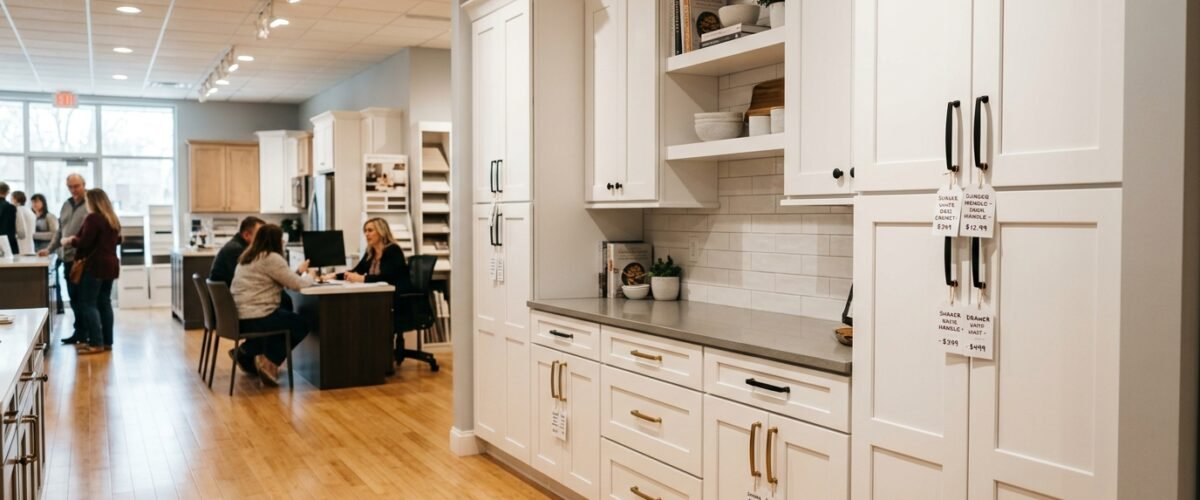
In the showroom, ask: “Can you show me this layout with 1-inch width modifications to reduce filler strips?” Any dealer who refuses to redesign is selling you the easiest version of the project for them, because a proper redesign takes 30 minutes and costs them nothing. The redesign saves you $300 to $550 in material and 2 to 4 hours of carpentry labor.
Success check: Your BOM shows two to four filler strips maximum for a rectangular 10×10 kitchen. If it shows more, ask the designer to justify each one with a specific wall measurement before you sign.
Step 4: Source Finished End Panels from a Lumber Yard
Finished end panels cost $65 to $120 each at a cabinet dealer. However, the same panel is 3/4-inch paint-grade maple plywood from a local lumber yard, cut to size, primed, and painted to match your cabinet color. Material cost: $18 to $35 at the lumber yard versus $65 to $120 at the dealer. Your painter applies the finish coat because they are already on-site spraying your door fronts.
This works specifically for painted cabinets. Stained wood cabinets need species-matched veneer panels so the grain and color match the face frame — in that case, buy from the dealer, because a mismatch on an exposed panel end is hard to fix after installation.
Success check: You have counted every exposed cabinet end in your layout and compared the dealer’s panel price against cut-to-size cabinet-grade plywood from a local lumber supplier.
Step 5: Buy Standard Pulls in Bulk, Upgrade Slides Only
A bar pull that costs $28 at a cabinet showroom costs $6 to $9 from a hardware wholesale supplier. For a kitchen with 20 door and drawer fronts, switching from showroom-priced to wholesale-priced pulls saves $240 to $380 without touching any structural component. Amerock, Top Knobs, and Hickory Hardware sell direct at these rates.
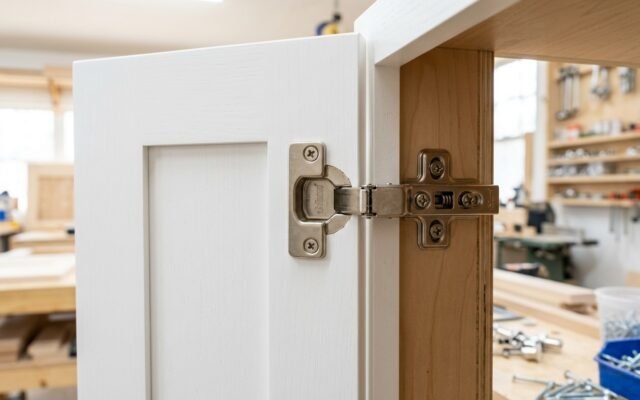
Drawer slides are the opposite case entirely. Do not cut here. Blum Tandem Plus 563H slides at $42 to $58 per drawer pair run for 100,000 cycles at 100-pound static load and include six-way tool-free adjustment cams. Unbranded $8 slides strip threads under cast iron pan weight within 18 months. In a kitchen you plan to keep for 20 years, the slide upgrade costs roughly $20 per year. Skip it and you spend a Saturday dismantling a stripped drawer base at year 2 — and the replacement labor costs more than the upgrade would have.
Success check: Every drawer has Blum Tandem, Blum Movento, or Grass Dynapro slides. Door pulls are sourced at wholesale price, not showroom markup.
Step 6: Skip the Showroom Countertop Package
Cabinet dealers who sell countertops include a 25% to 40% fabrication markup in the bundle. You do not see it itemized, because it sits inside the package total. However, when you get a separate stone yard quote for the same slab, that markup becomes visible.
Get a standalone countertop quote from two or three independent fabricators. Bring your cabinet layout dimensions and your target material. Base-rate 3cm quartz fabrication and installation runs $55 to $95 per square foot from a fabricator. Through a dealer package, the same slab costs $80 to $130 per square foot for identical material and identical installation.
A standard 10×10 kitchen has roughly 30 square feet of countertop. At a $25 per square foot markup, the dealer earns $750 on your countertops. Going direct saves you that $750 with a 20-minute phone call.
Success check: Your countertop quote comes from a stone yard or independent fabricator, not bundled into your cabinet dealer’s total. Both quotes are line-itemed so you can compare material and labor separately.
Step 7: Do Your Own Demo and Debris Removal
Cabinet removal runs $300 to $800 for a 10×10 kitchen when you hire it out. Debris hauling adds $150 to $400. You can eliminate both charges with a weekend afternoon and a rented box truck — because the demo itself is not technically complex.
The sequence: remove all doors and drawers first, since they account for most of the weight and awkwardness. Pull the uppers before the bases. Have a helper inside the cabinet to catch each upper unit as the last screw comes out. Bases come out after the uppers. Disconnect the sink base last, after your plumber caps the water supply.
You need a #2 Phillips bit, a drill, a pry bar, and a helper. Haul debris to your local transfer station — typical fee is $60 to $120 per truckload. Or call a junk hauler for $100 to $200 per load pickup, because some markets have competitive removal services that undercut transfer station rates.
Success check: You have arranged your own demo day at least one week before install day, so you have time to patch wall damage before cabinets arrive.
Common Mistakes That Cost More Than They Save
Cutting box quality to stay under budget. A Hampton Bay particleboard sink base at $140 saves $90 over the Home Decorators Collection plywood equivalent. When the particleboard swells from dishwasher steam in year 4 and needs full replacement, the repair runs $400 to $700 including labor. You paid $310 net for four years of inferior construction.
Mixing brands to save on one tier. Buying wall cabinets from a different brand than your base cabinets creates face frame depth and door overlay mismatches at every joint. The filler cost to correct those seams usually exceeds the savings from mixing brands.
Ordering without measuring the installed floor height. If your floor is not level, the high point determines where your base cabinet run begins. Discover this after ordering and you need a custom-height filler to reconcile the floor rise — that unplanned trim work costs $200 to $500.
Frequently Asked Questions
What is the single biggest way to save money on kitchen cabinets? Buy all-plywood RTA from a direct supplier instead of pre-assembled semi-custom from a showroom. For a 10×10 kitchen at equivalent structural spec, RTA saves $3,000 to $5,000. Assembly takes 6 to 8 hours. That is the highest return per hour of any move on this list.
Are cheap kitchen cabinets worth it? Cheap stock cabinets with particleboard boxes work in rental properties where you need a 7-year lifespan. In a primary home, particleboard sink bases swell and fail. The minimum acceptable spec for a primary kitchen is 1/2-inch plywood carcass with a structural back panel. At Home Depot, that means Home Decorators Collection or better. Online, Lily Ann Cabinets and Cabinet Joint both meet this standard at lower prices.
Can I save money by painting my own cabinet doors? Yes, if you have an HVLP spray gun or a quality brush-and-roll setup. Professional spray finishing on cabinet doors runs $35 to $65 per door. Doing it yourself with Benjamin Moore Advance alkyd saves $500 to $1,200 on a standard kitchen. The trade-off is 12 to 18 hours of prep, painting, and cure time spread across a weekend.
How much does buying during a sale actually save? Home Depot’s semi-annual cabinet sales at 20% to 30% off save $1,200 to $2,700 on a typical 10×10 KraftMaid or Thomasville material order. The key is having your layout finalized before the sale opens, so you can order on day one without rushing decisions.
Is it worth buying open-box or scratch-and-dent cabinets? Sometimes. Inspect every box before accepting it. Particleboard boxes with moisture-swollen panels are not repairable. Plywood boxes with minor cosmetic scratches on sides that will be covered by adjacent cabinets are fine. Never accept a damaged sink base or a box whose structural back panel has been punctured, because those failures are structural.