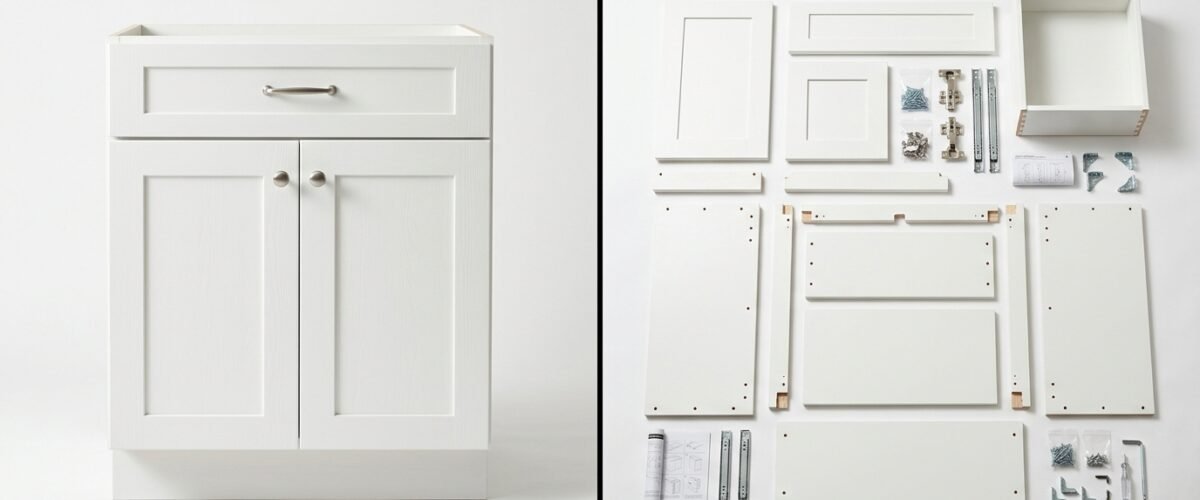
Pre-assembled cabinets cost 25% to 40% more than structurally identical RTA (ready-to-assemble) boxes from the same manufacturer. That premium buys you one thing: someone else’s labor during factory assembly. It does not buy you better plywood, stronger joinery, or superior hardware — because the same specification sheet covers both product lines at most cabinet brands.
Whether the premium is worth it depends on your available time, your tool confidence, and how many boxes your kitchen requires. Here is the honest breakdown.
Quick Comparison
| Factor | Pre-Assembled | RTA |
|---|---|---|
| Average cost premium | 0% baseline | 25–40% cheaper |
| Assembly time (per box) | None required | 15–25 min (base); 10–15 min (wall) |
| Box material (same brand) | Identical plywood spec | Identical plywood spec |
| Freight damage risk | Low — ships assembled | Low — ships flat, fewer stress points |
| Available finish options | Full catalog | Usually same catalog |
| Lead time | 3–8 weeks (semi-custom) | 3–8 weeks (semi-custom) or in-stock |
| Who saves more money | Time-constrained buyers | Anyone with 6–12 free hours |
What Pre-Assembled Cabinets Actually Cost You
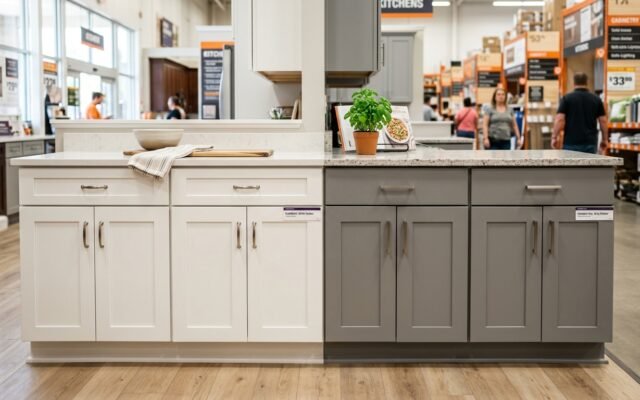
At Home Depot, a pre-assembled KraftMaid 30-inch base cabinet (B30) lists at $480 to $640. The same cabinet from an authorized KraftMaid dealer arrives assembled because KraftMaid builds semi-custom lines in the factory before shipping.
However, consider a comparable all-plywood RTA B30 from Lily Ann Cabinets. The box uses 1/2-inch birch plywood sides, 5/8-inch dovetail drawer box, and soft-close undermount slides — the same specification as mid-tier KraftMaid — and lists at $165 to $210 per unit. For a standard 10×10 kitchen, that gap compounds quickly.
| Kitchen Size | Pre-Assembled Semi-Custom | All-Plywood RTA | Savings with RTA |
|---|---|---|---|
| 10×10 (12 units) | $5,760–$7,680 | $1,980–$2,520 | $3,780–$5,160 |
| 15×15 (18 units) | $8,640–$11,520 | $2,970–$3,780 | $5,670–$7,740 |
| Full kitchen (24 units) | $11,520–$15,360 | $3,960–$5,040 | $7,560–$10,320 |
That is not a cosmetic difference. It is the equivalent of a full countertop package or a professional appliance suite.
What You Gain by Paying the Premium
No assembly time. A pre-assembled box arrives ready to hang. Consequently, your installer can begin hanging cabinets the morning delivery arrives. In contrast, an RTA order requires 6 to 12 hours of assembly before installation begins — usually done the day before or morning of the install.
Showroom and dealer support. Semi-custom pre-assembled lines like KraftMaid and Thomasville come with a dealer network that handles replacement parts locally. If transit damages a door front, you call the design desk and pick up the replacement within days. With direct RTA orders, you file a freight damage claim and wait.
Tighter quality control on visible components. Factory assembly of semi-custom lines happens under controlled conditions with jigs and automated clamps. While the wood spec is the same, the assembled box arrives with perfectly square corners and pre-set hinges. RTA assembly quality depends on the homeowner following the instructions carefully — and most do, but some do not.
What RTA Gives You That Assembled Cannot
Significantly lower freight damage risk on the carcass. An assembled cabinet ships as a rigid box that can rack under freight stress. In contrast, flat-pack RTA panels ship stacked with foam padding, so the individual components arrive without the structural stress that warps assembled units during LTL transit.
Faster access to plywood quality at budget price points. Most assembled budget lines (Hampton Bay, American Woodmark standard) default to particleboard. However, all-plywood RTA lines like Lily Ann, The RTA Store, and Cabinet Joint deliver 1/2-inch birch plywood at entry-level assembled pricing. Furthermore, you cannot buy plywood construction at the assembled budget price point at a big-box store. RTA is the only path to plywood under $220 per linear foot.
More control over assembly quality. When you assemble RTA boxes yourself, you apply extra PVA glue at every dado joint before clamping — something factory assembly lines skip because it slows throughput. As a result, your self-assembled RTA boxes can actually be stronger at the joints than factory-assembled equivalents if you take the time to glue during build.
When to Choose Pre-Assembled
Choose pre-assembled if any of the following conditions apply to your situation:
You are hiring an installer by the hour. If your carpenter charges $100 to $160 per hour, spending 10 hours assembling RTA boxes costs $1,000 to $1,600 in labor alone. In that case, the cost gap between assembled and RTA narrows considerably, and pre-assembled may actually cost less when you factor in combined labor.
Your kitchen has more than 20 cabinets. Above 20 units, the assembly time investment exceeds 15 to 20 hours. Therefore, for large kitchens, the time cost starts to rival the material savings.
You are replacing cabinets in a home you plan to sell within five years. Because buyers value visual quality equally with construction quality in appraisals, the showroom-brand recognition of KraftMaid or Thomasville can support a slightly higher resale price justification than an unfamiliar RTA brand.
You need 1-inch sizing modifications. Most RTA lines offer only standard 3-inch increment widths. If your kitchen layout requires 28-inch or 31-inch base units to avoid awkward filler strips, semi-custom assembled lines deliver those non-standard dimensions. Specifically, KraftMaid offers any width in 1-inch increments at no surcharge.
When to Choose RTA
Choose RTA in these situations:
Your timeline allows one dedicated assembly day. A standard 10×10 kitchen assembles in 6 to 8 hours for a careful homeowner with basic tools and the manufacturer’s instructions. If you can invest that single day, you save $3,000 to $5,000 on materials alone.
You want all-plywood construction under $220 per linear foot. This specification does not exist in assembled form at big-box stores at this price. RTA is the only way to get plywood carcasses on a tight budget.
You are comfortable with LTL freight receiving. RTA orders ship direct from manufacturer warehouses. While the delivery process requires coordinating a liftgate truck, most suppliers give you a delivery window and walk you through the receiving checklist.
You want maximum customization at the lowest cost. Some RTA suppliers like Cabinet Joint offer semi-custom modifications — non-standard widths, custom depths, specialty finishes — at RTA price points, which expands your design options significantly.
Which One Should You Buy?
| Your Situation | Best Choice |
|---|---|
| Tight budget, willing to spend one weekend assembling | RTA — identical plywood, 30–40% savings |
| Hiring an installer by the hour for a large kitchen | Pre-assembled — labor cost eliminates RTA savings |
| Need 1-inch custom sizing throughout | Pre-assembled semi-custom (KraftMaid/Thomasville) |
| Want plywood boxes under $200/linear foot | RTA only — assembled budget lines use particleboard |
| Selling home within 3 years | Pre-assembled — brand name supports resale value claim |
| Keeping home long-term, budget matters most | RTA all-plywood — best structural ROI for the money |
Frequently Asked Questions
Is RTA cabinet quality lower than pre-assembled? No, when comparing the same brand’s RTA and assembled product lines. Lily Ann Cabinets and Cabinet Joint ship identical 1/2-inch birch plywood, 5/8-inch dovetail drawer boxes, and Blum soft-close slides in both configurations. The box quality is the same. Only the assembly state differs at the time of delivery.
How long does it take to assemble RTA kitchen cabinets? A standard base cabinet takes 15 to 25 minutes per box. A wall cabinet takes 10 to 15 minutes. Therefore, a full 10×10 kitchen with 12 units takes approximately 6 to 8 hours working alone, or 3 to 4 hours with a helper. Specifically, drawer assembly adds another 10 minutes per pull-out.
Do RTA cabinets come with hardware? Most all-plywood RTA brands include hinges, mounting plates, and drawer slides in the box price. However, they typically exclude door pulls and knobs, which you source separately. Furthermore, hardware quality varies widely by RTA brand — always check whether the slides are undermount soft-close or basic side rollers before ordering.
Can a professional installer work with RTA cabinets? Yes. Most professional kitchen installers work with RTA regularly and charge the same per-cabinet installation rate as for pre-assembled units. In fact, some installers prefer pre-assembling RTA boxes themselves so they can verify square corners and glue joints before hanging.
What tools do I need to assemble RTA kitchen cabinets? You need a rubber mallet, a square, a power drill with a #2 Phillips bit, PVA wood glue, and bar clamps. Some brands also require a cam lock tool. The assembly process uses cam-and-dowel or dado-and-screw systems — both work well when you follow the manufacturer’s sequence precisely and allow the PVA glue to cure before moving assembled boxes.