On a typical 10×10 layout, the average homeowner overpays by $1,800 to $4,500 for kitchen cabinetry. However, this budget leak rarely happens because buyers choose luxury designer brands. Instead, homeowners lose money because they cannot decipher complex dealer pricing proposals.
In fact, cabinet retailers often rely on customer confusion. For example, dealers know that most consumers cannot distinguish between plywood and particleboard carcasses when both options carry similar price tags. Furthermore, aggressive salespeople use vague lump-sum quotes to conceal high delivery fees, omitted end panels, and cheap unbranded hardware substitutions. Fortunately, you can spot these seven warning signs before signing any contract.
Sign 1: You Received a Lump-Sum Quote
If your estimate simply states “Complete Kitchen Cabinet Package — $8,400” without individual part numbers, you did not receive a legitimate bid. Instead, the salesperson simply quoted the maximum figure they believe your budget can bear.
In contrast, an honest cabinet estimate breaks out every SKU line by line. Specifically, a transparent invoice lists each base unit by model number, every upper cabinet, all filler strips, finished skin panels, toe kick boards, and delivery access fees. When dealers conceal this data, they hide steep profit margins. For instance, they might charge $95 for an ordinary $35 filler board or mark up standard residential freight by 50%.
What to ask: “Please send me an itemized Bill of Materials with unit pricing for each individual SKU.” A reputable dealer will produce this spreadsheet immediately. Conversely, if the dealership refuses or claims their software cannot print itemized lists, you should walk away promptly.
Sign 2: “Soft-Close” Is Listed With No Brand Name
Today, dealers use “soft-close” as a generic marketing buzzword rather than a precise engineering specification. After all, any cheap slide with a basic hydraulic piston qualifies as soft-close, ranging from a $6 unbranded import to a $48 professional Blum Tandem Plus 563H glide.
However, real-world performance differs drastically between these hardware options. For example, an authentic Blum 563H carries a 100-pound static load capacity, allows six-way tool-free face adjustments, and survives over 100,000 continuous open-close cycles in testing. In contrast, an unbranded $6 slide binds under the weight of cast-iron pans, rattles within 18 months, and lacks any post-installation adjustment cams.
What to ask: Always demand the manufacturer name and exact model number in writing. Look for industry-proven hardware brands such as Blum (Tandem or Movento), Grass (Dynapro), or Hettich (Actro 5D). If the salesperson only promises “deluxe soft-close slides,” assume they plan to install bottom-tier generic hardware.
Sign 3: Semi-Custom Prices on a Particleboard Box
Frequently, showrooms charge $280 to $420 per linear foot for cabinets constructed entirely from 1/2-inch industrial particleboard. While that price point belongs in semi-custom plywood territory, dealerships justify the cost through flashy paint finishes, decorative glass doors, or national brand marketing.
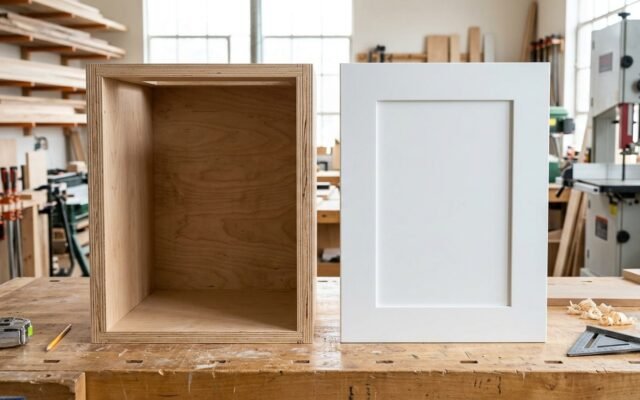
Unfortunately, particleboard possesses only 40% of the screw-holding strength of genuine multi-ply plywood. When supporting heavy 3cm quartz or granite countertops (which weigh 18 to 22 pounds per square foot), particleboard boxes equipped with thin 1/8-inch masonite back rails cannot anchor to wall studs with sufficient mechanical force. Over time, that structural weakness causes upper cabinets to sag and base joints to separate.
The showroom check: First, open a display cabinet door. Next, press your thumb firmly against the center of the rear panel with moderate force. While a 1/2-inch plywood panel stays rigid, a flimsy 1/8-inch hardboard back flexes noticeably under thumb pressure. Always test display models in person before accepting written specifications.
What to verify: Ensure the written specification sheet explicitly states “all-plywood construction” for box sides, bases, and structural back panels. If you see terms like “furniture board,” “engineered core,” or “high-density substrate,” the factory builds with particleboard.
Sign 4: More Than Four Filler Strips in a Standard Layout
Cabinet installers use filler strips to close narrow gaps between cabinet frames and adjacent walls or appliances. In a standard 10×10 L-shaped layout, an efficient design requires only two to four filler pieces in total.
However, if your proposal includes six, eight, or ten filler strips at $60 to $95 each, the designer likely made an expensive planning error. Specifically, they may have forced basic 3-inch modular stock units into the room rather than utilizing 1-inch semi-custom sizing options. Alternatively, the showroom might be using excess trim pieces to inflate overall margins.
The financial impact: By switching to a semi-custom line with 1-inch width flexibility, you can eliminate six unnecessary filler strips. Consequently, you save $300 to $550 in raw material charges along with several hours of costly trim carpentry labor.
What to ask: Ask your designer to pull up the CAD elevation view and explain the structural necessity of every filler strip. If a strip sits on an open wall with no obstructions, tell the designer to replace it with a properly sized cabinet box.
Sign 5: Finished End Panels Are Not Listed
Standard factory cabinet boxes leave exterior side panels unfinished, exposing raw industrial veneer or particleboard substrate. Therefore, whenever a cabinet run terminates in the open room—such as next to a freestanding refrigerator or at the end of a peninsula—you must install a color-matched finished end skin panel.
These decorative finished panels cost between $65 and $120 each. Unfortunately, disingenuous dealers intentionally omit end panels from initial estimates to make their headline quote appear cheaper. Then, when the boxes arrive on installation day, the dealership charges premium rush fees to supply the missing trim.
How to count them: Walk through your floor plan and count every cabinet side that faces outward into the room. For instance, check the exposed ends of your island, peninsula, and wall cabinet runs. Your itemized quote must include a finished end panel for every exposed corner.
Red flag: If an estimate includes crown molding, under-cabinet light rails, and decorative knobs—yet lists zero finished end panels—the salesperson deliberately underquoted your project to win your business.
Sign 6: Freight Is a Single Round Number
When shipping a complete kitchen cabinet order via Less-Than-Truckload (LTL) residential freight, actual logistics costs range from $280 to $480. Furthermore, carriers break this charge into a base mileage rate plus an $80 to $110 residential liftgate delivery surcharge.
However, if your invoice lists a flat “$700 delivery fee” or claims “free shipping” on an inflated merchandise total, the dealer is inflating freight margins. In fact, dealerships frequently add 40% surcharges on top of standard carrier rates.
What an honest freight quote looks like: “LTL freight for two pallets (1,250 lbs) from factory distribution center: $210. Residential curbside delivery fee: $85. Hydraulic liftgate service: $80. Total freight: $375.”
How to verify: Request the carrier name, pallet count, and freight class from your supplier. Then, verify that cost directly using online quote tools from major logistics carriers such as Estes Express, Saia, or R+L Carriers.
Sign 7: The Quote Used Approximated Measurements
Often, showroom designers draft initial quotes based on rough sketches or verbal room dimensions provided during your first visit. While quick ballpark estimates help establish initial budgets, you should never sign a binding purchase contract based on rough measurements.
Indeed, an error of just two inches along a main wall can prevent your refrigerator from fitting or leave an ugly gap next to your dishwasher. When these dimensional mismatches occur during installation, your carpenter must spend billable hours modifying carcasses in the field, often costing you $400 to $800 in extra job-site labor.
What to require: Always demand a comprehensive on-site laser field measurement before finalizing your cabinet contract. A professional kitchen designer will measure every wall at three separate heights, locate the floor’s high point with a six-foot level, and confirm all plumbing and electrical rough-in coordinates. If a dealer agrees to finalize your order without verifying site conditions, they are taking reckless risks with your money.
The Three Documents to Request Before Signing Any Cabinet Order
- Itemized Bill of Materials (BOM): This spreadsheet must display every SKU code, cabinet dimension, door swing orientation, and unit cost.
- Technical material specification sheet: This manufacturer document must verify core carcass materials, drawer box joinery, and slide hardware models by name.
- Itemized freight receipt: This invoice must list actual freight charges, residential delivery surcharges, and liftgate fees separately from your cabinetry merchandise.
Whenever a cabinet supplier provides these three records willingly, you can move forward with confidence. Conversely, if a dealership hesitates or refuses to disclose these details, protect your remodel budget and find an honest vendor.
Frequently Asked Questions
How much should kitchen cabinets cost for a standard 10×10 kitchen? For a 10×10 kitchen, all-plywood ready-to-assemble (RTA) lines cost between $2,800 and $4,500 in materials. Meanwhile, factory-assembled semi-custom lines such as KraftMaid average $6,200 to $9,800. Finally, full custom millwork runs from $13,000 to over $30,000 before labor.
Is paying for kitchen design services normal at cabinet showrooms? Yes, independent interior designers typically charge $150 to $500 for comprehensive in-home laser measurements and CAD layout renderings. While big-box stores offer free floor design, they rarely visit your home to verify actual wall conditions.
Can homeowners negotiate cabinet prices with local dealers? Yes, particularly on semi-custom and custom cabinet lines during the slow winter remodeling season (January through March). In fact, independent kitchen dealers usually have 8% to 15% in pricing flexibility on complete kitchen packages.
Why do cabinet estimates vary so dramatically between suppliers? Pricing variances usually stem from hidden exclusions rather than product quality differences. For example, one dealer might include delivery, finished end skins, and soft-close hardware, whereas a competitor excludes those essentials to advertise a lower base cost.
What is a reasonable liftgate fee for residential cabinet deliveries? Standard commercial freight carriers charge between $65 and $110 for residential hydraulic liftgate service. Therefore, if a cabinet supplier quotes more than $130 for liftgate offloading alone, they have added an unnecessary dealer markup.