A 24-inch base cabinet serves as the workhorse module in modern residential kitchen layouts. It balances a compact footprint with ample storage space and fits small kitchens cleanly. Whether you need dedicated cookware storage, a sorting center, or prep station support, this cabinet width fits standard counters cleanly. Pro remodelers frequently specify a 24-inch base cabinet next to ranges and prep sinks to maximize everyday workflow.
Also, choosing between a single full door, a drawer-over-door layout, or a multi-drawer stack dramatically alters how your kitchen functions. Standard outside dimensions measure 24 inches wide by 34.5 inches high, before the countertop. Next, add a standard 1.5-inch counter slab. As a result, the finished surface reaches 36 inches high.
Standard 24-Inch Base Cabinet Sizes and Clearances
Outer Box Width, Height, and Depth Specs
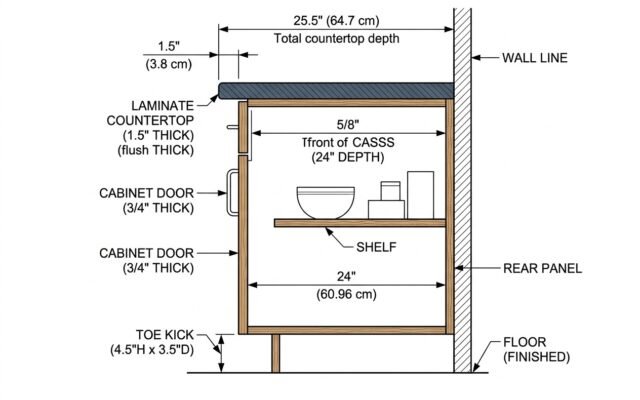
A standard cabinet box features an outside width of exactly 24 inches from side panel to side panel. Standard box height measures 34.5 inches from the floor to the top edge of the cabinet stretchers. Box depth measures 24 inches from the rear panel to the front face frame, which aligns with standard ranges.
As a result, installing a standard 1.5-inch thick quartz or granite counter produces an overall height of 36 inches. Counters also typically overhang the front face frame by 1.5 inches, creating a counter depth of 25.5 inches. This overhang shields cabinet doors from liquid spills.
Interior Usable Volume and Clearances
Interior dimensions inside a 24-inch base cabinet depend on the thickness of the box walls. For example, framed cabinets built with 0.5-inch plywood box sides provide about 22.5 inches of clear width. Frameless boxes with 3/4-inch panels offer the same 22.5 inches.
Moreover, the vertical clear opening below a standard top cutlery drawer typically measures 20 to 22 inches. This space fits Dutch ovens and stockpots quickly. Full door models yield 30 inches of vertical space for tall pantry goods.
Toe Kick Size and Comfort Recess
The integrated toe kick on a base cabinet measures 4 inches in vertical height and 3 inches in depth. This recess allows cooks to stand right against the counter without hitting their shoes. You can check standard height specs in our detailed guide on base cabinet height.
The toe kick cavity elevates the bottom cabinet shelf above floor level. This gap shields stored goods from mop water, and wood shims beneath the frame keep the box level.
Popular 24-Inch Base Cabinet Layouts
Single Door vs Double Door Layouts
Makers offer the 24-inch cabinet in both single door and double door styles. A single 24-inch door offers a clean look. Yet, opening a 24-inch door requires a full two-foot aisle clearance.
Yet, double 12-inch doors swing outward with only a 12-inch projection into traffic pathways. Thus, double doors excel in tight galley kitchens. Yet, framed boxes have a center stile that limits pan storage.
Drawer-Over-Door Cabinets
The drawer-over-door layout remains the top-selling design for a 24-inch base cabinet in American homes. This unit pairs a top drawer with a lower door. As a result, the drawer keeps prep tools within easy reach.
Yet, the lower section houses adjustable shelving or add-on slide-out chrome baskets. You gain rapid access to tools and bulk storage. Also, this layout matches nearby base cabinets cleanly.
Three-Drawer and Four-Drawer Base Stacks
Many modern kitchen designers replace standard door units with a dedicated drawer stack. A three-drawer cabinet box features one shallow top drawer and two deep 10-inch drawers beneath. These deep drawers glide out fully. Thus, you can grab heavy pans without bending down.
In comparison, four-drawer layouts provide specialized organization for linens, spices, and prep tools. Buyers seeking top organization often combine these units with a 4-drawer base cabinet for seamless utensil care. Ball bearing slides carry up to 100 pounds smoothly.
24-Inch Base Cabinet Sizing and Spec Comparison
Technical Sizes and Load Capacities
Comparing technical specs across different base cabinet models helps buyers select the sturdiest build. The table below outlines sizes, door layouts, and inner weight ratings across common box styles.
| Cabinet Style | outer Width x Height x Depth | Door / Drawer Setup | Clear Internal Width | Shelf Load Capacity |
|---|---|---|---|---|
| Single Door Base | 24 in x 34.5 in x 24 in | 1 Door (Reversible) | 22.5 inches | 75 lbs per shelf |
| Drawer Over Door | 24 in x 34.5 in x 24 in | 1 Top Drawer, 1 Lower Door | 22.5 inches | 65 lbs per shelf |
| Double Door Base | 24 in x 34.5 in x 24 in | 2 Butt Doors (No Center Stile) | 22.5 inches | 75 lbs per shelf |
| 3-Drawer Stack | 24 in x 34.5 in x 24 in | 1 Top, 2 Deep Drawers | 20.5 inches (Drawer Box) | 90 lbs per drawer |
| Sink Base Module | 24 in x 34.5 in x 24 in | False Front, 2 Doors, Open Top | 22.5 inches | Floor load only |
Industry Standards for Cabinet Build Quality
When shopping for cabinets, verify compliance with KCMA A161.1 performance standards. These standards test that shelves resist sagging under load. Following National Kitchen and Bath Association design standards also helps ensure safe aisle clearances around open cabinet doors.
Storage Add-Ons for a 24-Inch Base Cabinet
Roll-Out Trays and Pull-Out Drawers
Installing add-on roll-out trays transforms a standard 24-inch cabinet into a storage powerhouse. Deep cabinet interiors often turn dark and messy. With full-extension trays, all goods slide into the light.
Most 24-inch boxes fit two single roll-out shelves mounted on adjustable brackets inside the cabinet. You can tune shelf spacing to clear big stockpots. Pick dovetail joints for lasting strength.
Double Trash and Sorting Bin Pull-Outs
A 24-inch base cabinet offers the ideal interior footprint for an integrated waste and sorting center. Bottom slides hold two 35-quart bins side by side. Thus, household trash stays hidden behind a matching door.
Soft-closing undermount slides prevent the heavy bins from slamming into the cabinet face frame. Pick models with top lids and bag racks. Hidden trash keeps the kitchen clean and odor-free.
Tray Dividers and Upright Sheet Pan Racks
Baking sheets, muffin tins, and large cutting boards present tough storage tasks when stacked flat. A cabinet box equipped with upright chrome or plywood dividers solves this issue cleanly. By dividing the cabinet interior into upright slots, each pan stands upright on its own.
As a result, you can pull out a single cookie sheet without dislodging an entire stack of heavy cookware. Also, loose dividers let you change slot widths as your pan collection grows.
Box Materials and Build Quality Tiers
Solid Plywood vs Furniture Board
Box construction defines how long your 24-inch base cabinet will last under daily kitchen moisture and weight. Makers use 1/2-inch to 3/4-inch plywood or particleboard. Plywood holds screws tightly and resists water damage.
Particleboard boxes cost less upfront and have perfectly flat panel surfaces. But standing water makes particleboard swell. All-plywood boxes make the best long-term choice.
Framed vs Frameless European Box Styles
American framed construction features a solid hardwood 1.5-inch face frame attached to the front of the cabinet box. The face frame adds box strength and hinge support. Yet, it slightly narrows the clear tray opening.
Frameless boxes skip the front frame. Instead, thick 3/4-inch side panels yield full access to wide drawers. Modern kitchens often use frameless boxes for clean lines and maximum interior volume.
Drawer Box Joinery and Slide Mechanisms
Check the drawer box joinery before purchasing any base cabinet. Good drawer boxes use 5/8-inch maple sides with dovetail joints. Cheap boxes use stapled joints that fail.
Pairing quality dovetail boxes with smooth undermount slides keeps drawers working well under heavy kitchen loads. You can explore heavy-duty slide hardware options in our comprehensive guide to kitchen cabinet drawer slides. Undermount slides protect steel bearings from kitchen dust.
Layout Planning with a 24-Inch Base Cabinet
Placement Next to Ranges and Dishwashers
Strategic placement of a 24-inch cabinet improves prep efficiency and safety near cooking units. Placing a drawer stack next to your range keeps tools handy. Also, the 24-inch counter space holds hot pans safely.
Similarly, placing a 24 inch base cabinet between the kitchen sink and an under-counter dishwasher provides vital staging room. You can unload clean dishes right into drawers. Thus, you save steps while cleaning up.
Using a 24-Inch Base Cabinet in Kitchen Islands
Kitchen islands frequently add a cabinet box because standard island depths range from 24 to 36 inches. An island can pair a 24-inch drawer base with a 12-inch rear unit. This plan yields ample prep room and bar seating.
Moreover, a 24-inch base cabinet inside an island quickly houses specialized pull-out microwave drawers or wine refrigeration units. Also, check that electrical boxes do not block rear drawer slide paths.
Corner Transitions and Filler Needs
When placing a 24-inch cabinet perpendicular to an adjacent cabinet run, account for door swing clearances. Door handles stick out 1 to 2 inches from the frame. Without clearance, doors can strike corner handles.
Installing a 2-inch hardwood filler strip between the corner intersection and the cabinet face frame eliminates collisions entirely. Thus, check swing paths closely when planning L-shaped kitchen runs.
Installation Steps for a Base Cabinet
Locating Wall Studs and Floor High Points
Proper installation begins with finding the highest point of the kitchen subfloor using a six-foot spirit level or laser level. Mark a level line at 34.5 inches above the high floor spot, so all counter surfaces sit flat.
Next, use an electronic stud finder to find all wall stud locations behind the cabinet run. Mark stud spots with vertical lines on the wall. For leveling steps, see our guide on installing base cabinets.
Fastening to Adjacent Cabinets and Wall Anchors
Position your 24-inch base cabinet in line with the benchmark chalk line, using tapered wood shims beneath the toe kick to achieve level. Once level, clamp the face frame tightly to the adjacent cabinet using face frame clamps. Drill pilot holes and drive 2.5-inch screws to lock frames together.
Finally, drive 3-inch washer-head cabinet screws through the top and bottom rear mounting rails right into the wall studs. Never use drywall screws to hang boxes.
Door Hinge Adjustment and Alignment
After anchoring the cabinet box firmly, adjust the European concealed hinges to achieve even door gaps. Modern hinges have cam screws for quick adjustments. Aim for an even 1/8-inch reveal around door edges.
Make sure integrated soft-close dampers engage smoothly without bouncing off the face frame. Also, stick clear door pads to corners to stop closing clicks.
Comparing a 24-Inch Cabinet to Other Widths
24 Inch vs 18 Inch Base Cabinets
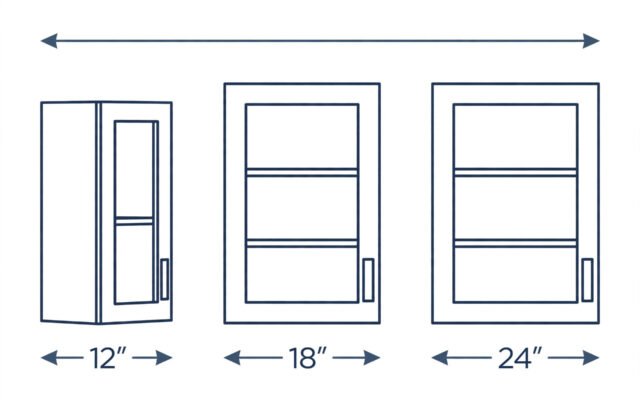
Choosing between an 18-inch and a 24-inch base cabinet comes down to available wall run length and storage objectives. An 18-inch unit fits small rooms, but it cannot hold dual trash bins or wide 12-inch pans.
A 24-inch cabinet box provides about one-third more internal volume. This extra width fits full cookware and twin bins. Thus, the 24-inch box offers much better utility.
24 Inch vs 30 Inch Base Cabinets
Comparing a 24-inch unit against a 30-inch cabinet involves balancing door scale against drawer organization. A 30-inch unit has wide drawers that get heavy. As a result, wide slides may sag under heavy pots.
On the other hand, a 24-inch base cabinet maintains good rigidity across its drawer bottoms and shelves. A 24-inch drawer stays light and glides smoothly. Also, pairing two 24-inch units looks great in large runs.
Cost Breakdown and Budget Factors
Stock vs Semi-Custom vs Custom Pricing Tiers
The purchase cost of a single base cabinet varies a lot based on the factory tier and materials. Stock boxes cost between $150 and $300. These budget boxes use particleboard and thin veneer.
Semi-custom plywood boxes cost $400 to $700. Custom hardwood units crafted by local shops cost over $900. Investing in mid-tier semi-custom cabinets offers the best balance of longevity and cost efficiency.
Hardware Upgrades and Storage Add-On Costs
Upgrading your base cabinet with premium hardware adds to the total project cost. Soft-close slides add $30 to $50 per drawer. Also, dual pull-out trash kits cost $120 to $250.
High-end solid wood roll-out trays with dovetail joinery add about $60 to $90 per shelf. While add-ons raise the initial cost, they make daily prep work faster.
Custom Upgrades and Specialty Features
Adding Interior LED Strip Lighting
Modern kitchen remodels frequently feature automated LED lighting inside base cabinets for nighttime visibility. Mount a low-voltage LED strip along the top front rail. Also, add magnetic door switches to turn on lights automatically.
This subtle upgrade eliminates dark corner shadows inside lower shelves and drawer boxes. Low-voltage LED systems generate virtually zero heat, protecting inner contents and finishes from thermal damage.
Installing In-Drawer Power Outlets
Transforming the top drawer of a 24-inch cabinet into a hidden charging station clears up kitchen counters. Drawer power kits feature folding cord arms behind the box. Thus, power wires never pinch or jam.
As a result, you can charge phones and tools out of sight. Pick kits with full safety listings (ETL or UL).
Door Styles and Visual Aesthetics
Shaker vs Flat Slab vs Raised Panel Doors
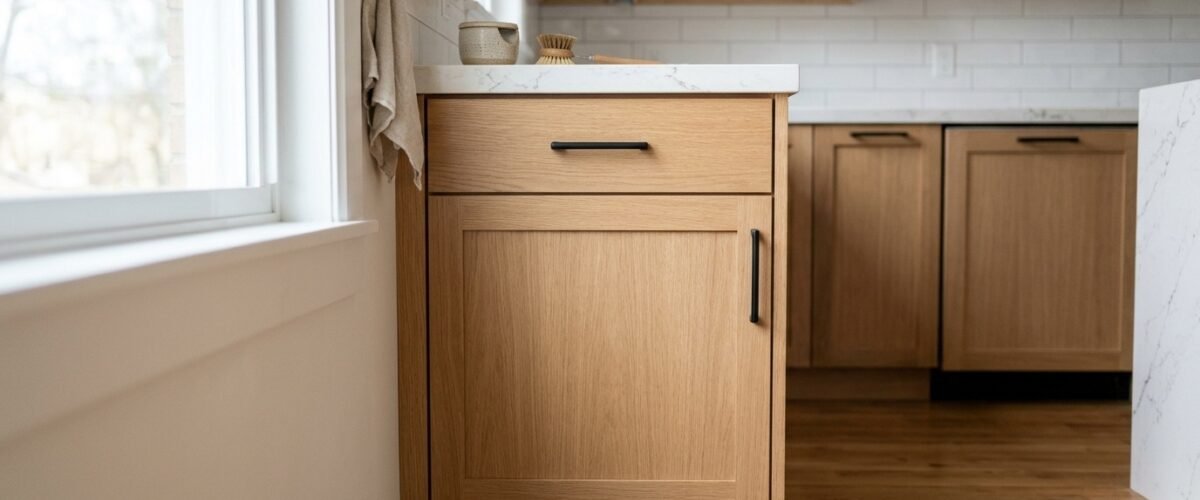
Selecting the right door style for a 24-inch base cabinet establishes the design tone of your entire kitchen. Timeless five-piece shaker doors feature a recessed center panel and crisp 2.25-inch stiles that match farmhouse, transitional, and craftsman homes. Shaker doors accept painted finishes and clear wood stains with equal beauty.
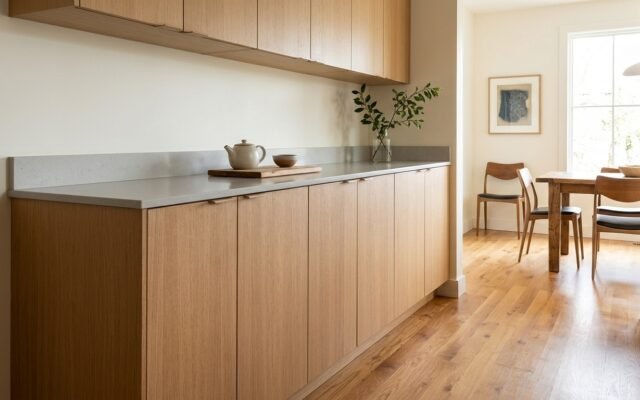
Yet, flat slab doors deliver a sleek, seamless look suited for modern European and mid-century designs. Continuous wood grain patterns running flat across slab drawer fronts create a custom furniture aesthetic. Classic raised panel doors add formal elegance to traditional kitchen designs.
Hardware Sizing and Placement Rules
Hardware scale makes a substantial difference on 24-inch wide cabinet doors and drawer fronts. For a single 24-inch door, specify a 5-inch to 7-inch pull or a 1.25-inch knob placed 2.5 inches from the upper door corner. Placing hardware too close to the edge crowds your knuckles during opening.
For wide 24-inch drawer fronts, install a single 6-inch to 8-inch pull centered flat across the drawer face. Alternatively, two smaller 4-inch pulls spaced evenly across the drawer front provide balanced leverage for heavy cookware. High-grade solid brass hardware ensures lasting durability and tactile satisfaction.
Eco-Friendly and Low-VOC Cabinet Standards
CARB Phase 2 and TSCA Title VI Certified Boxes
Modern buyers increasingly prioritize indoor air quality by specifying eco-friendly cabinet parts. Always look for CARB Phase 2 and EPA TSCA Title VI certifications when shopping for cabinetry. These standards limit formaldehyde emissions from plywood and composite cores to less than 0.05 parts per million.
As a result, certified cabinets prevent toxic off-gassing inside enclosed residential kitchens. Low-emission glues and soy-based adhesive resins protect your family from volatile organic compounds during daily meal preparation. Pro builders consistently choose certified parts for healthy living environments.
Waterborne Sealers and Sustainable Plywood Cores
Eco-conscious cabinet makers use waterborne conversion varnishes and UV-cured topcoats instead of solvent-based lacquers. These waterborne finishes release minimal odors during application and cure into rock-hard protective shields. UV-cured finishes resist household food acids, coffee stains, and grease splatters quickly.
Also, sustainable plywood cores sourced from FSC-certified forestry operations ensure responsible timber harvesting. Choosing rapidly renewable birch or domestic maple protects real forest habitats while delivering top-tier stability. Investing in sustainable parts ensures both environmental responsibility and heirloom build quality.
Care and Maintenance Guidelines
Cleaning Wood and Laminate Surfaces
Preserving the finish on your cabinet box requires gentle cleaning habits and prompt spill care. Wipe door surfaces with a soft damp cloth and mild soap. Also, avoid harsh scrub pads or cleaners that damage clear topcoats.
Also, immediately dry any water drips along the bottom edge of the cabinet door. Standing water can seep into edge seams. As a result, veneers or laminate edges may peel over time.
Drawer Slide Lubrication and Hardware Tightening
First, check drawer slides each year to clear out dust and crumbs. Next, spray dry silicone lube along the tracks to restore smooth gliding. Never use heavy automotive grease on residential cabinet slides.
Finally, check the mounting screws on handles and hinges. Daily use can loosen screws over time. Tightening these screws with a manual handheld screwdriver prevents stripped screw holes and misaligned doors.
Frequently Asked Questions About 24 Inch Base Cabinets
Can a 24-inch base cabinet support a kitchen sink?
Yes, a base cabinet can support a small kitchen sink, bar sink, or compact prep basin. Yet, the outer rim of the sink basin must not exceed 21 to 22 inches in total width to clear the inner cabinet side walls. Also, pick a dedicated sink base model with an open top frame to clear the trap.
How many roll-out trays can fit inside a 24-inch base cabinet?
Most standard 24-inch base cabinets comfortably fit two adjustable roll-out trays. This setup leaves about 8 to 10 inches of upright clearance above each tray for cookware and pantry goods. In full-height door models without a top cutlery drawer, you can install up to three roll-out trays for specialized pantry storage.
What is the difference between a 24-inch base cabinet and a 24-inch pantry cabinet?
A 24-inch base cabinet stands 34.5 inches tall and supports a standard kitchen counter. Yet, a 24-inch tall pantry cabinet measures 84, 90, or 96 inches in height and extends up to the ceiling line. While both share the same 24-inch width, pantry cabinets provide floor-to-ceiling upright shelving for bulk food storage.
Do I need a filler strip next to a 24-inch base cabinet?
You need a filler strip if the box sits against a wall. A 2-inch filler lets doors open past 90 degrees without handle strikes. Yet, filler strips are not required when joining the cabinet to identical adjacent base units along a straight wall.
Editorial Note: This guide was researched and written by David Miller, founder of Kitchen Base Cabinets, and reviewed by Editorial Lead Marcus Vance. Prices are typical national ranges, not quotes — confirm locally before you buy.