Frameless vs Framed Kitchen Base Cabinets: Storage, Style and Price Compared
Frameless cabinets give you roughly 15% more usable interior width per box compared to face-framed cabinets of the same exterior dimension, because there are no 1.5-inch hardwood stiles blocking the opening on each side. That extra space matters most in base cabinets where you are pulling out pots, sheet pans, and mixer bowls that need full clearance. Framed cabinets compensate by tolerating out-of-plumb walls far better, which is why they still dominate in older American homes where walls regularly deviate 1/4 inch or more across a 10-foot run.
If your kitchen walls are plumb and your budget goes up to semi-custom, frameless gives you more for every dollar of cabinet width. If you are working in a 1970s ranch where no wall is square, face-framed construction saves you hours of shimming frustration. Before you finalize that call, check our breakdown of pantry cabinet vs base cabinet storage trade-offs to see how cabinet type selection compounds the space difference.
Quick Comparison
| Feature | Frameless (European Box) | Face-Framed (American Style) |
|---|---|---|
| Interior Opening Width (30″ cabinet) | 28.5 to 29 inches clear | 25.5 to 26 inches clear |
| Wall Tolerance | Requires walls within 1/8″ plumb | Handles up to 3/8″ deviation easily |
| Hinge Type Required | 35mm cup hinges with clip plates | Surface-mount or offset hinges |
| Box Construction | 3/4″ plywood sides, face-less front | 3/4″ plywood box + 3/4″ hardwood frame |
| Typical Cost Premium (frameless) | +10% to +20% over framed at same tier | Baseline |
| Door Overlay Options | Full-overlay standard, inset rare | Full, partial, or inset overlay |
| Pull-Out Hardware Fit | Maximum interior width, easiest fit | Loses 3″ to stile clearance per unit |
| Best For | New builds, plumb walls, modern look | Renovations, traditional style, older homes |
What Frameless Cabinets Actually Give You
Pull a 30-inch-wide base cabinet out of each category and measure the clear opening. A frameless box delivers a 28.5 to 29-inch opening from sidewall to sidewall. The same exterior-width face-framed unit opens to roughly 25.5 to 26 inches because 1.5-inch stiles eat space on both sides. Over a full 10-foot base run with five cabinet boxes, that adds up to 12 to 15 inches of recovered interior space.
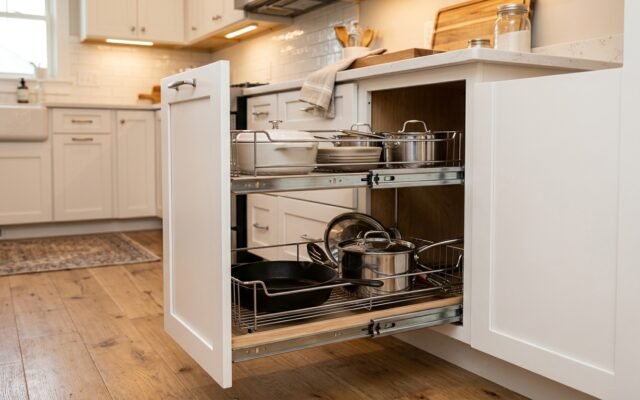
That recovery shows up most when you retrofit roll-out shelves or pull-out trash inserts into base cabinets. Aftermarket pull-out hardware mounts inside the stile boundary in a framed cabinet, shrinking the accessory width by 3 full inches per unit. In a frameless box, the hardware mounts directly to the sidewall at full width.
ANSI/KCMA A161.1 applies equally to both construction types for structural performance — 500-pound shelf-load without deflection exceeding 1/16 inch per foot. The structural difference is in the front: frameless boxes compensate for the missing frame by using full 3/4-inch plywood sides with dados routed at the front edge, giving the box torsional rigidity without the hardwood border.
What Face-Framed Cabinets Actually Give You
Plywood holds screws through 25,000 drawer cycles. Particleboard strips them after 5,000. Face-framed cabinets built on 3/4-inch plywood boxes are every bit as structurally sound as frameless, but the frame adds one critical installation advantage: flex tolerance.
When your wall plane is not plumb, a frameless cabinet box reveals every gap at the door reveal. Doors that need to be perfectly aligned against a flat wall look wrong the moment the wall kicks out 1/4 inch. Face-framed cabinets mask wall deviation because the stile and rail give you 3/4 inch of material to scribe, plane, or shim behind without it showing at the door gap.
Traditional American kitchens built before 1990 almost universally have out-of-plumb walls. If you are renovating one of those kitchens and keeping the original layout, face-framed boxes save you the cost of a carpenter straightening your walls before cabinet installation. That wall-prep work runs $800 to $2,500 in a typical kitchen, a savings that closes the price gap between framed and frameless quickly.
Cost: Where the Price Gap Actually Comes From
A stock face-framed 30-inch base cabinet (B30) runs $90 to $250 depending on box material and finish. An equivalent frameless B30 in the same stock tier runs $110 to $300. The 10% to 20% premium covers the thicker sidewall material and the precision-machined hinge-cup boring at the factory.
At the semi-custom tier, the gap narrows. Semi-custom frameless B30 units run $280 to $520. Semi-custom face-framed units run $240 to $480. At the custom tier, both types cost $500 to $1,200 per unit since labor and finish dominate the bill.
The true cost comparison includes installation labor. Frameless cabinets require your walls to be within 1/8 inch of plumb before hanging. If your installer charges $75 per hour and wall prep runs four extra hours, that is $300 added directly to your frameless installation cost that never shows up in the cabinet quote.
Which One Should You Choose?
Choose frameless if your home was built after 2000, your walls passed a plumb check, you want the widest possible interior openings for pull-outs and accessories, and your design leans modern or contemporary.
Choose face-framed if your home was built before 1990, your walls show more than 1/8-inch deviation across the base run, you prefer the traditional furniture look, or you are working in a partial renovation where adjacent cabinetry is already face-framed. Mixing frameless and face-framed boxes in the same kitchen creates reveal inconsistencies at door gaps that are very hard to correct after installation.
If neither fits cleanly, read our guide to comparing cabinet quotes before you commit — quote line items reveal which construction type a dealer is actually offering you, because some budget lines mislabel frameless boxes as semi-custom.
Frequently Asked Questions
Are frameless cabinets stronger than face-framed cabinets?
No. Frameless cabinets are not inherently stronger. Both pass ANSI/KCMA A161.1 testing when built on 3/4-inch plywood boxes. The structural difference is location: frameless boxes use thicker sidewall dados at the front edge; face-framed boxes use a hardwood border. Strength depends on plywood quality and joinery, not the presence of a face frame.
Do frameless cabinets cost more than face-framed?
Yes, frameless cabinets cost 10% to 20% more at the stock and semi-custom tiers because they require thicker sidewall material and precision-bored hinge plates. At the custom tier, both types converge in price since labor and finish dominate.
Can I mix frameless and face-framed cabinets in one kitchen?
No. Mixing the two creates inconsistent door reveals and visual gaps at the seam between cabinet types. If you have existing face-framed boxes and are adding new ones, match the construction type exactly.
Which is easier to install: frameless or face-framed?
Face-framed cabinets are easier to install in older homes because they tolerate wall imperfections better. Frameless installation requires walls within 1/8 inch of plumb. In a new build with straight walls, frameless is equally straightforward.
What hinge type do frameless cabinets use?
Frameless cabinets use 35mm cup hinges with clip-on mounting plates that attach directly to the sidewall. The most common are Blum CLIP top BLUMOTION hinges, which provide six-way adjustment and soft-close damping without requiring a face frame as a mounting surface.