The blind corner cabinet in your kitchen holds roughly 15 square feet of usable storage. Most homeowners access maybe 4 of it. The fix costs between $80 and $350 depending on which organizer system you choose. Here is what actually fits, what pulls out cleanly, and which option earns back the most shelf space.
Quick Comparison: All Four Solutions
| Solution | Usable Access | Minimum Opening | Installed Cost | Best For |
|---|---|---|---|---|
| Lazy Susan (kidney shelf) | ~60% of corner | 33″ cabinet opening | \$150–\$280 | Deep pots, heavy items |
| Blind Corner Pull-Out (cloud tray) | ~85% of corner | 36″ cabinet opening | \$200–\$350 | Maximum retrieval, tall items |
| Magic Corner (swing-out) | ~90% of corner | 15″ face opening | \$280–\$420 | Small kitchens, zero wasted motion |
| Rev-A-Shelf CB-MABSC-1 | ~80% of corner | 12″ face opening | \$160–\$240 | Budget blind corner fix, DIY-friendly |
Lazy Susan Cabinet: What It Is and When to Choose It
A lazy Susan cabinet uses a pie-cut corner box with two rotating kidney-shaped shelves. The shelves spin 360 degrees on a central pole. Pull a door and the shelf rotates to meet you.
The cabinet itself ships as a dedicated corner unit. You cannot retrofit most blind corner boxes into a true lazy Susan — the box dimensions differ. Lazy Susan cabinets require a 33-inch minimum face opening on each adjacent cabinet run.
Weight capacity: Most factory units handle 100 lbs per shelf. Rev-A-Shelf 5LB-36C (36-inch diameter) is rated at 100 lbs with a steel center pole. The Hafele kidney-shelf version (catalog #545.22.150) handles 75 lbs per tier.
The honest downside: Items at the back edge of the kidney shelves require the shelf to spin past its ideal stop point. You will push the shelf too far and it will swing back. Taller items tip. Anything unstable — bottles, open containers — slides to the outer rim during rotation.
Choose a lazy Susan when: You are framing new cabinets and can spec the corner box from scratch, you store heavy cast iron or large stockpots, and you want zero mechanical parts to fail.
Blind Corner Cabinet: What It Is and When to Choose It
A blind corner cabinet is a standard rectangular box where one side is deliberately hidden behind the adjacent cabinet face frame. The “blind” portion — usually 6 to 12 inches — is physically inaccessible without an organizer system.
Without an organizer, you store items by shoving them in and retrieving them by feel. This is where spatulas go to die.
Blind corner cabinets are the default in most pre-built kitchens because they cost less to manufacture than dedicated corner boxes. The tradeoff: you need an aftermarket organizer to make the space function.
Choose a blind corner when: Your kitchen is already built with this configuration, you want to avoid replacing the entire corner cabinet, or your adjacent run is less than 33 inches wide (which disqualifies a lazy Susan).
Blind Corner Organizer Options Ranked
Rev-A-Shelf CB-MABSC-1: Best Budget Pull-Out
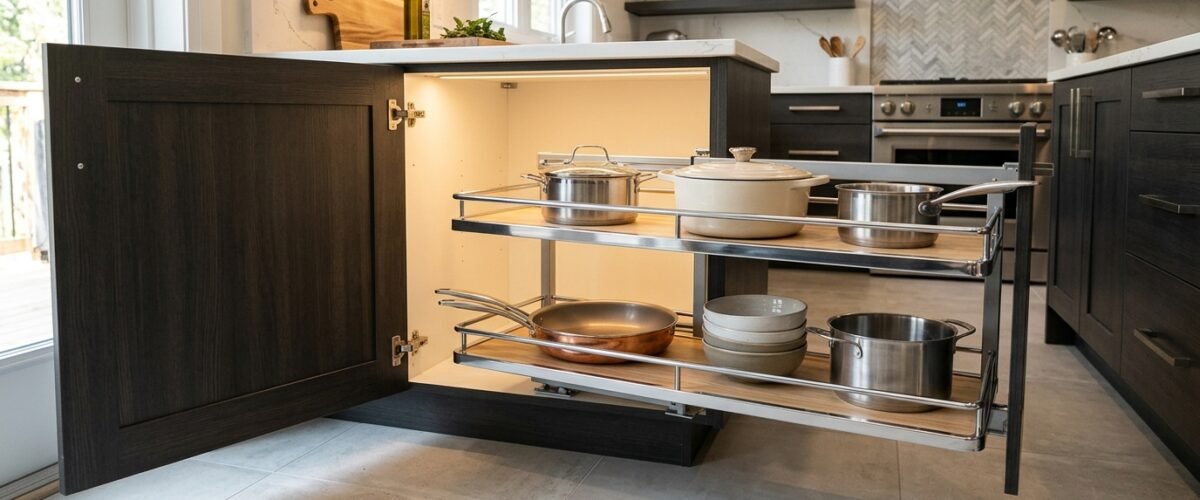
The CB-MABSC-1 mounts to the back wall of the blind cabinet. Two D-shaped pull-out shelves slide forward on full-extension slides when you open the face door. The front shelf comes with the door; the back shelf follows it out.
Weight rating: 75 lbs per shelf. Fits a 12-inch minimum face opening. Full depth of pull-out: 22 inches. The unit ships with all mounting hardware. Installation time: 45 minutes with a drill and a level.
Pull-out hardware quality matters — check that the slide mechanism uses full-extension steel slides, not plastic glides. The CB-MABSC-1 uses steel full-extension slides rated for 25,000 cycles per ANSI/KCMA A161.1 standards.
Street price: \$155–\$190 depending on retailer. Available at Wayfair, Home Depot, and Amazon.
Blum Space Corner: Best Mid-Range Swing-Out
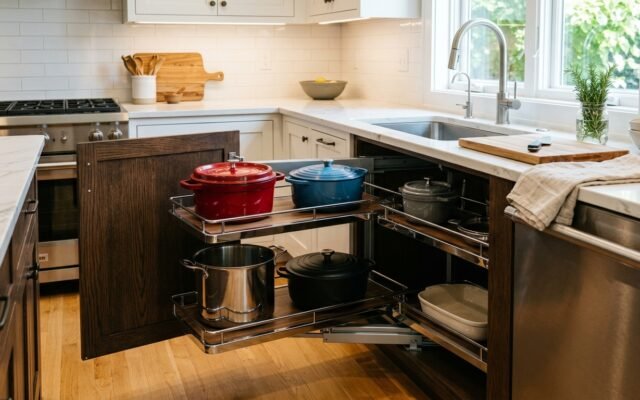
The Blum Space Corner (catalog #ZC7T5000) uses two trays that swing out on a scissor mechanism when the door opens. Both trays come fully into the kitchen interior. Nothing stays hidden.
Load capacity: 44 lbs per tray, 88 lbs total. Minimum face opening: 15 inches. Cabinet depth required: 19.75 inches minimum. The mechanism is fully adjustable with Blum’s tool-free adjustment system — same philosophy as their Tandem drawer slides.
The catch: installation requires removing the door and remounting it on the Blum hinge plate. Not a difficult job, but not a 15-minute swap. Expect 90 minutes on first install.
Street price: \$240–\$310 installed with hardware.
Hafele Magic Corner II: Best Full-Access Option
The Magic Corner II (Hafele catalog #546.72.990) pulls the back shelf forward first, then the front shelf swings out to the side. Both shelves end up fully accessible in front of the cabinet face.
This is the closest thing to eliminating the blind spot entirely. Load capacity: 55 lbs per shelf, 110 lbs total. Minimum corner opening required: 15 inches on the short face. The mechanism uses sealed stainless-steel ball bearings and a damped stop.
It costs more and requires more precise installation than a pull-out tray. But for a kitchen that gets daily use, it earns back the investment in frustrated retrieval time.
Street price: \$290–\$400 depending on size (available in 450mm and 550mm widths).
Sizing and Clearance Requirements
| Measurement | Lazy Susan Cabinet | Blind Corner + Pull-Out | Magic Corner / Swing-Out |
|---|---|---|---|
| Minimum face opening width | 33″ | 36″ (CB-MABSC-1: 12″) | 15″ |
| Typical cabinet depth | 24″ | 24″ | 21–24″ |
| Shelf diameter / depth | 33–36″ kidney shelf | 22″ pull-out depth | 450mm / 550mm |
| Door configuration | Single or bi-fold | Single full-overlay | Single full-overlay |
| Total usable storage | ~8–10 sq ft | ~12–14 sq ft | ~13–15 sq ft |
One number most homeowners miss: the 36-inch preferred opening for standard pull-out organizers. If your adjacent cabinet run is only 30 or 33 inches wide, a magic corner or swing-out system is your only real option for full access.
For corner cabinet sizing in a wider layout, see kitchen cabinet clearance rules — the same 1.5-inch minimum setback applies when the corner meets a window wall.
Which One Should You Choose?
| Your Situation | Best Option | Why |
|---|---|---|
| New construction, 33″+ opening available | Lazy Susan cabinet | No organizer cost, no maintenance, heavy loads handled |
| Existing blind corner, budget under \$200 | Rev-A-Shelf CB-MABSC-1 | Full-extension pull-out, DIY install, no cabinet modification |
| Existing blind corner, want maximum retrieval | Hafele Magic Corner II | Both shelves fully exit the cabinet, nothing stays hidden |
| Tight adjacent run under 15″ opening | Blum Space Corner | Narrowest minimum opening of all swing-out options |
| Corner cabinet next to refrigerator or appliance | Pull-out tray (CB-MABSC-1) | Swing-out mechanisms need clear swing path — refrigerators block it |
The lazy Susan wins on cost and simplicity when you are building from scratch. For an existing blind corner, the Rev-A-Shelf CB-MABSC-1 is the correct starting point. Upgrade to the Magic Corner II only if you use the corner cabinet daily and the retrieval frustration is real.
For a broader look at how corner storage fits into a full cabinet layout, the white oak kitchen cabinet guide covers corner framing in the material and layout section.
FAQ
Can I convert my lazy Susan to a pull-out blind corner?
No. A lazy Susan cabinet uses a dedicated corner box with a center pole mounting system. A blind corner pull-out requires a rectangular box with a full-depth side panel. The boxes are structurally different and cannot be swapped with organizers alone.
What is the minimum cabinet width for a lazy Susan?
33 inches face opening on both adjacent runs. A 36-inch opening gives you the full 36-inch kidney shelf diameter. Below 33 inches, the door cannot open past the shelf edge without binding. Use a magic corner or pull-out system instead.
Is the Rev-A-Shelf CB-MABSC-1 a DIY install?
Yes. Mount the rear bracket to the back wall of the blind cabinet, clip the shelves onto the slides, and attach the front shelf to the inside face of the door. No drilling into cabinet sides required. Budget 45 minutes and a cordless drill.
Do lazy Susan shelves hold heavy cast iron?
The Rev-A-Shelf 5LB-36C is rated at 100 lbs per shelf with a 1-inch steel center pole. A 12-inch cast iron skillet weighs 6–8 lbs. Even with four skillets plus lids, you stay well under the rating. Use the flat shelf version, not the kidney shelf, for heavy cast iron — it distributes load closer to the center pole.
What is the price difference between lazy Susan and magic corner systems?
Lazy Susan hardware: \$80–\$200 for a kidney shelf upgrade kit (existing corner box). Dedicated lazy Susan cabinet box: \$180–\$400 depending on brand. Magic Corner II system: \$290–\$400 for hardware alone, not including installation labor (\$80–\$150/hr for a cabinet installer).