Upgrading to soft close drawer slides cushions closing impact, stops drawer slam damage, and extends the service life of cabinet boxes and face frames. These specialized hardware mechanisms catch the drawer box during the final two inches of travel and quietly pull it flush against the cabinet frame. Consequently, homeowners protect delicate dinnerware, reduce kitchen noise, and eliminate the shock that loosens cabinet joinery over time.

How Soft Close Drawer Slides Function Inside Cabinet Boxes
Modern kitchen cabinets endure thousands of cycles every year. Standard friction glides transfer kinetic energy directly into the cabinet frame when pushed shut. In contrast, modern kitchen cabinet drawer slides absorb this force through a compact internal mechanical assembly.
Hydraulic Dampers and Spring Tension Mechanics
The core operating mechanism relies on two synchronized components working inside the metal track. First, a heavy-duty tension spring engages when you pull the drawer open. This action primes the glide for the return stroke.
Next, as you push the drawer inward, a small catch pin activates a sealed hydraulic cylinder. This fluid cylinder creates resistance against the spring. Therefore, the piston decelerates the drawer speed smoothly before the drawer front strikes the face frame.
In addition, high-end mechanisms feature self-cleaning ball bearings sealed inside lubricated tracks. These precision bearings prevent lateral wobble and maintain continuous alignment. As a result, the drawer box glides evenly even when heavily loaded with cookware or ceramic plates.
Furthermore, the internal hydraulic fluid retains consistent viscosity across typical indoor temperatures. Because the fluid does not thin in summer or thicken in winter, dampening resistance stays completely uniform year-round.
Preventing Wear and Tear on Dovetail Joinery
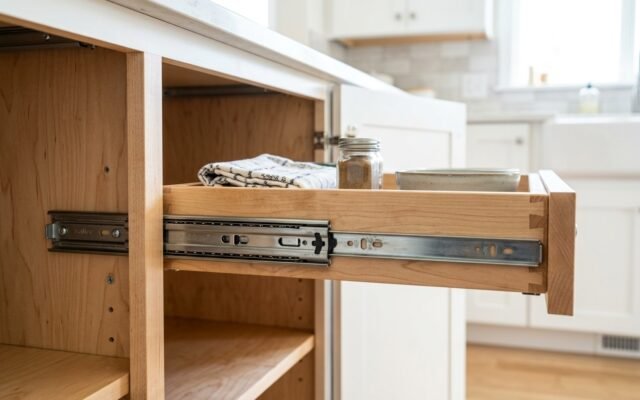
Cabinet drawer boxes typically feature dovetail corner joints. Repeated drawer slams force stored contents against the front subhead. Over time, this pounding loosens joints and pulls drawer faces away from the box.
Because soft close mechanisms dissipate momentum gradually, the internal contents do not shift forward violently. Dovetail joints experience almost zero sudden shock load. Ultimately, retrofitting quality hardware preserves your investment in solid wood kitchen cabinet drawers.
Also, face frames and drawer fronts avoid finish chipping. Hard impacts also crack paint lines along stiles and rails. Installing controlled dampers stops this surface damage before costly refinishing becomes necessary.
Undermount vs Side-Mount Soft Close Slides
Homeowners generally choose between two primary hardware configurations when replacing existing runners. You can install concealed undermount glides beneath the drawer box, or you can mount ball-bearing tracks directly to the exterior box sides. For an in-depth comparison of these profiles, review our guide on undermount vs side mount drawer slides.
Concealed Undermount Glides (Blum Tandem, Grass Dynapro)
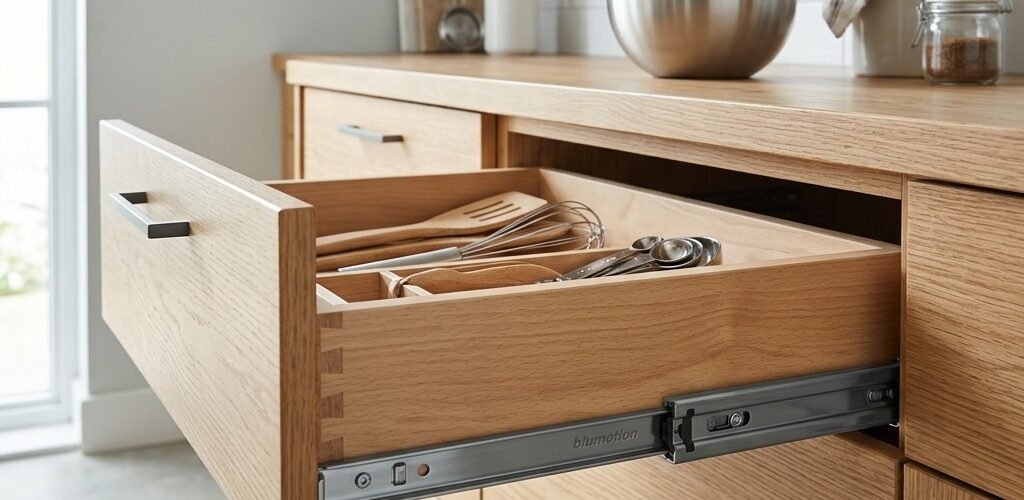
Concealed undermount glides mount directly under the drawer box bottom panel. Premium brands like Blum Tandem Plus Blumotion and Grass Dynapro lead this category. Because the hardware remains hidden beneath the box, wood dovetails stay completely visible when opened.
In addition, undermount slides provide exceptional stability. They utilize release locking clips fastened beneath the front corners of the box. These clips allow quick tool-free drawer removal and provide thumbwheels for leveling drawer reveals.
However, undermount glides require precise drawer box construction. Specifically, the drawer box bottom must be recessed at least 1/2 inch up from the bottom edges of the side walls. Homeowners looking for premium hardware can check current prices on Amazon for complete Blum slide sets with rear brackets.
Heavy-Duty Ball-Bearing Side-Mount Slides (Accuride, Knape & Vogt)
Side-mount slides attach to the exterior vertical sides of the drawer box and cabinet interior walls. Industry leaders like Accuride and Knape & Vogt manufacture reliable models. These slides operate on telescoping steel rails filled with ball bearings.
First, side-mount glides are remarkably forgiving during retrofit installations. You do not need to rebuild or notch your existing drawer boxes to accommodate them. As long as your cabinet opening provides the standard 1/2-inch clearance on each side, these tracks screw directly into place.
Second, side-mount slides cost considerably less than concealed systems. While undermount slides average $30 to $60 per pair, quality side-mount soft-close glides typically run between $18 and $35 per pair. Therefore, they represent the fastest and most economical upgrade path for existing builder-grade cabinets.
Load Capacities: Standard 75-Pound vs Heavy-Duty 100-Pound Glides
Weight ratings determine how well a slide performs under daily kitchen storage demands. Standard residential slides carry a dynamic rating of 75 to 90 pounds. This capacity easily handles typical flatware, cutlery, and kitchen linens.
In contrast, deep base cabinet drawers holding cast iron pans or small appliances demand heavy-duty 100-pound to 150-pound glides. Heavy-duty slides feature thicker steel rails and larger hydraulic pistons. Therefore, the dampening action remains reliable without bottoming out under substantial weight.
Also, you can find cabinet organizers on Wayfair to distribute cookware weight evenly across your drawers.
| Slide Style | Mounting Position | Side Clearance Required | Weight Capacity | Smoothness Rating | Average Pair Cost |
|---|---|---|---|---|---|
| Concealed Undermount | Beneath drawer bottom | Requires specific box notch | 90 to 110 lbs | Superior (Ultra-smooth) | $30 to $60 |
| Side-Mount Ball-Bearing | Vertical exterior box sides | Exact 1/2 inch per side | 75 to 100 lbs | Very Good | $18 to $35 |
| Heavy-Duty Side-Mount | Vertical exterior box sides | Exact 1/2 inch per side | 100 to 150 lbs | Very Good (Firm pull) | $35 to $55 |
| Epoxy Bottom-Mount (Standard) | Bottom box corners | Exact 1/2 inch per side | 50 to 75 lbs | Fair (No soft close) | $8 to $15 |
How to Measure Drawers for Replacement Soft Close Glides
Accurate measurements ensure a seamless retrofit. Specifically, you need three critical numbers: box depth, side clearance, and internal cabinet clearance.
Measuring Drawer Box Length and Slide Clearance (1/2-Inch Rule)
First, pull your drawer box entirely out of the cabinet. Measure the exterior length of the wooden drawer box from front face to rear panel. Never include the decorative drawer front panel in this measurement.
Standard drawer slides come in two-inch increments such as 16, 18, 20, and 22 inches. Always pick a slide length matching the box depth or rounding down to the nearest standard size. For example, a 21-inch box pairs with a 21-inch undermount slide or a 20-inch side-mount slide.
Next, apply the 1/2-inch clearance rule for side-mount replacements. Measure the total interior width of the cabinet opening between the face frame stiles. Then measure the total exterior width of the drawer box. Consequently, the cabinet opening must be exactly 1 inch wider than the drawer box, leaving precisely 1/2 inch of free space on each side.
Checking Face Frame Rear Mounting Brackets vs Frameless Interior Walls
Cabinet box construction dictates how you secure the rear ends of your slide tracks. In modern European frameless cabinets, interior side walls run flush with the front opening. Therefore, you can screw slide rails directly into the factory system holes on the cabinet interior walls.
In traditional American face frame cabinets, the face frame stiles overhang the interior side walls by 1/2 inch to 2 inches. Because the tracks cannot touch the wall, you must use rear mounting brackets. These brackets clip onto the back of each slide rail and anchor into the rear cabinet panel.
Before purchasing hardware, measure the interior depth from the face frame to the back wall. In particular, make sure your chosen slide and rear bracket assembly fit inside that depth without protruding forward.
Step-by-Step Retrofit Installation of Soft Close Glides
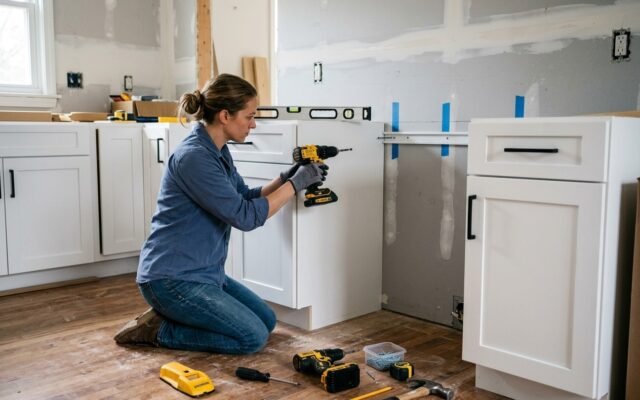
Retrofitting soft close hardware requires a cordless drill, a small level, and a tape measure. Also, you can find drawer slide jigs at Home Depot to speed up alignment and guarantee level placement.
Step 1: Removing Old Rollers and Installing Rear Brackets
First, empty the drawer contents and pull the box forward until the old glides hit their safety stop. Tilt the front of the drawer upward and lift the box free from the cabinet. Then set the drawer box on a flat work surface.
Next, unscrew the old runners from the cabinet interior and drawer box sides. Inspect screw holes for stripped wood fibers. If holes are enlarged, pack them with wood glue and toothpicks, then chisel the repair flush after drying.
After that, attach your rear mounting brackets onto the back end of each new cabinet slide rail. Slide the rail into the cabinet, seating the front flange flush against the face frame opening. Drive a single pan-head screw into the front elongated slot, but do not tighten it completely yet.
Step 2: Leveling Slide Runners and Aligning Locking Clips
Second, position a torpedo level across the top edge of the slide rail. Adjust the rear bracket vertically until the rail sits perfectly level from front to back. Once level, secure the rear bracket to the back cabinet wall using two 5/8-inch wood screws.
Similarly, install the opposing rail at the same height across the opening. Measure the distance between both tracks at the front and back. Both measurements must match within 1/16 of an inch to prevent binding.
For undermount glides, position the left and right front locking clips on the underside of the wooden drawer box. Press each clip tight against the front inside corners and drive the mounting screws straight down. Also, ensure the rear hook holes on the drawer back panel align with the slide prongs.
Step 3: Fine-Tuning Drawer Front Reveals With Adjustment Cams
Finally, align the drawer runners with the cabinet tracks and push the drawer inward. Push firmly until you hear the mechanism click and engage the clips. Then cycle the drawer twice to distribute hydraulic fluid.
Next, inspect the gap around the decorative drawer front. Premium soft close glides feature built-in adjustment dials on the front locking clips. Turn the vertical thumbwheels to raise or lower the drawer box up to 1/8 inch.
In addition, adjust the lateral tilt tabs located at the rear of the slide runners. These tabs shift the back of the drawer side to side. Consequently, fine-tuning these controls ensures consistent, uniform reveals between adjacent cabinet drawers.
Common Mistakes When Retrofitting Soft-Close Slides
Even experienced installers occasionally encounter issues when retrofitting slides. Fortunately, knowing these pitfalls helps you avoid drawer binding and jerky movement.
Forcing 1/2-Inch Side-Mount Slides Into 3/8-Inch Drawer Gaps
The most frequent error involves incorrect side clearance. Standard ball-bearing side-mount slides require exactly 1/2 inch of space on each side. If your opening only provides 3/8 inch of clearance, forcing tracks into place pinches the bearings.
When bearings get compressed, the slide will bind, scrape, and fail to soft close smoothly. Conversely, if your gap exceeds 1/2 inch, the catch pin will fail to grab the damper trigger. Therefore, always shim behind the slide tracks with thin plastic washers or wood strips if your gap is too wide.
If your drawer box is too wide for your opening, you must either plane down the drawer box sides or build a narrower replacement box. Instead of forcing parts, take time to adjust the woodwork properly.
Neglecting Weight Distribution in Deep Cookware Drawers
Another common mistake is placing standard 75-pound slides on deep pot-and-pan pullouts. Stacking heavy Dutch ovens and cast iron skillets can easily exceed 80 pounds of static weight. Under heavy loads, standard hydraulic dampers cannot generate enough counter-pressure.
Consequently, the heavy drawer slams past the damper cushion and hits the cabinet face frame hard. Always tally the weight of your kitchen items before selecting slides. Specifically, for wide drawers measuring over 30 inches, always choose heavy-duty 100-pound or 150-pound rated hardware.
Furthermore, ensure that the drawer bottom panel is constructed from minimum 3/8-inch or 1/2-inch cabinet-grade plywood. Thin 1/4-inch bottoms bow under heavy weight and rub against undermount slide mechanisms.
Skipping Rear Face Frame Support Brackets
On face frame cabinets, installers sometimes attempt to screw the slide rail directly to the side wall at an angle. This improper shortcut causes the track to bow inward as the drawer rolls backward.
Because tracks must stay parallel throughout their travel, bent rails cause friction. As a result, the soft-close trigger often disengages halfway through the cycle. Always install dedicated rear metal or nylon brackets to keep rails parallel.
Additionally, verify that the rear brackets are screwed into solid backing material. If the cabinet back is thin 1/8-inch hardboard, mount a 3/4-inch plywood furring strip behind the cabinet before anchoring the bracket screws.
Deep Drawers, Full-Extension Slides, and Single-Drawer Cabinets
Soft-close hardware is not one product. The right slide depends on how deep the drawer is, how much it carries, and whether the drawer is one of several in a base or the only drawer in the unit.
Full Extension Drawer Slides and Drawer Undermount Slides
Full extension drawer slides let the drawer open all the way out, so you can reach items at the back without kneeling. Drawer undermount slides sit beneath the drawer box instead of on its sides, which hides the hardware and gives a cleaner look. Most quality soft-close setups use full-extension undermount slides, such as Blum Tandem or Grass Dynapro, because they combine full access with a hidden damper. See our Undermount vs Side Mount Drawer Slides guide for the full comparison.
Deep Drawer Cabinet: Heavy Loads Need Heavy Slides
A deep drawer cabinet holds pots, pans, and small appliances, and those loads need 100-pound slides rather than the standard 75-pound rating. Deep drawers also need the weight spread evenly: a heavy stack on one side wears the damper and the ball bearings faster than the same weight spread across the drawer. If a deep drawer sags or closes unevenly, the slide rating is usually the problem, not the damper.
How to Make Drawers Soft Close
How to make drawers soft close on an existing cabinet is a retrofit job: remove the old roller or side-mount slides, fit soft-close slides to the drawer box and the cabinet sides, and set the rear brackets so the drawer runs level. The steps are in the retrofit section above. Some drawers can also take add-on dampers that clip to the existing slide, but a full slide swap gives a smoother close and lasts longer.
Single Drawer Cabinet and Kitchen Cabinet Shelf
A single drawer cabinet is a base with one deep drawer, usually under a cooktop or a sink run, and it takes one pair of full-extension soft-close slides. A kitchen cabinet shelf does not use soft-close hardware at all: shelves are fixed or adjustable on pins, and only drawers and doors need dampers. If a shelf rattles, the fix is a tighter pin fit or a felt pad, not a soft-close slide.
Frequently Asked Questions About Soft Close Drawer Slides
Can you add soft close to existing drawer slides?
Yes, you can add universal retrofit damper adapters to existing slides without replacing the entire track. These compact add-on kits attach to the cabinet interior wall and catch a metal pin screwed to the drawer box side. However, installing full replacement soft close tracks delivers significantly smoother performance.
Why is my soft close drawer hard to pull open?
Soft close slides require initial pull effort because opening the drawer resets the internal tension spring. If the pull feels excessively stiff, the slide tracks may be misaligned or pinched out of parallel. Specifically, checking your side clearance and lubricating the ball bearings with silicone spray usually resolves the issue.
How much clearance is required for soft close drawer slides?
Standard side-mount soft close slides require exactly 1/2 inch of clearance on each side of the drawer box, totaling 1 inch. Concealed undermount slides require a 1/2-inch bottom recess beneath the drawer box floor. In addition, they require specific drawer box side thicknesses between 1/2 inch and 5/8 inch.
What is the lifespan of soft close drawer slides?
High-quality soft close drawer slides from reputable manufacturers typically last 50,000 to 100,000 cycles. For an average household, this lifespan translates to 15 to 25 years of daily trouble-free use. Routine cleaning and avoiding excessive weight overloads also maximize the operating life of the hydraulic dampening cylinders.
Can you adjust the closing speed on soft close drawer slides?
Some premium undermount slides feature adjustable dampening tension levers located on the runner body. Shifting this switch increases or decreases the hydraulic resistance to accommodate lighter cutlery or heavier cookware loads. However, most standard side-mount slides feature factory-calibrated dampers that cannot be manually adjusted.
How do soft close drawers work?
A hydraulic damper inside the slide catches the drawer in the final two inches of travel and pulls it shut slowly and quietly, instead of letting it slam. Full-extension soft close slides, such as Blum Tandem and Grass Dynapro undermounts, let the drawer open all the way out while the damper controls the close.
Can you make any drawer soft close?
Almost any drawer can be made soft close by swapping its slides for soft-close slides, as long as the drawer box has the right side clearance: 1/2 inch per side for side-mount slides, or a 1/2-inch bottom recess for undermount slides. Very shallow or very narrow drawers may not have room for the damper, so check the clearance first.
Do shelves need soft-close hardware?
No. A kitchen cabinet shelf is fixed or adjustable on pins and does not move, so it needs no damper. Soft-close hardware is only for drawers and doors. If a shelf rattles, tighten the pin fit or add a felt pad.