Kitchen cabinet pull out shelves solve the most common complaint about base cabinet storage: everything stacked at the back disappears. A proper pull out shelf with full-extension ball bearing slides brings your entire cabinet depth within reach. Most base cabinets can be retrofitted in under an hour. However, the wrong slide hardware turns a straightforward project into a frustrating one that racks and binds within weeks.
Pull Out Shelf Slide Hardware Compared
The slide mechanism determines how much weight your shelf carries, how far it extends, and how long it lasts. The table below compares the four main slide categories used in residential cabinet pull out shelf retrofits.
| Slide Type | Extension | Weight Capacity | ANSI/KCMA Cycle Rating | Cost Per Pair | Best For |
|---|---|---|---|---|---|
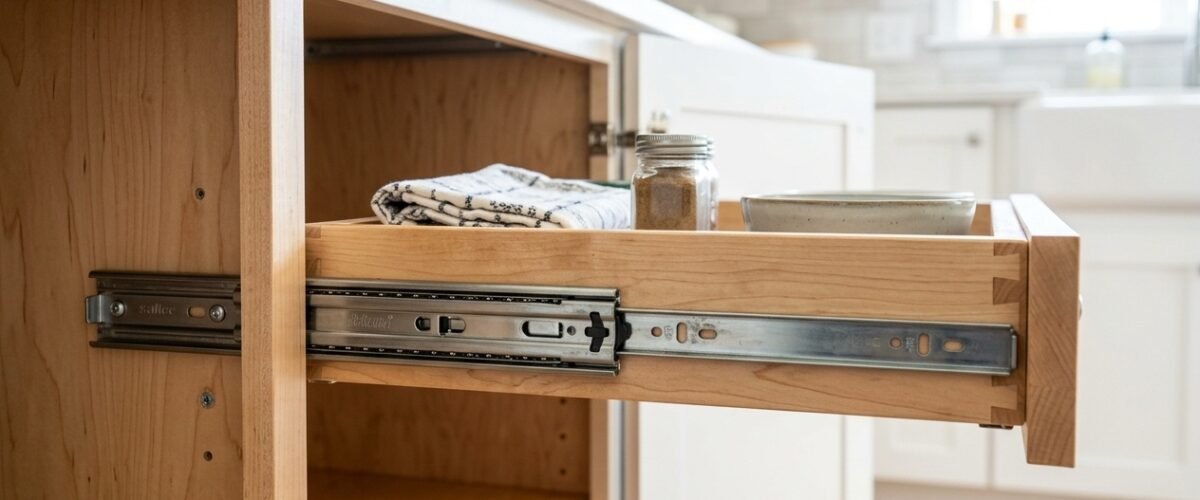
| Full-Extension Ball Bearing (Side Mount) | 100% (full depth) | 75 to 100 lbs | 75,000 cycles | $12 to $28 | Standard pull out shelf retrofits |
| Undermount Soft-Close | 100% (full depth) | 100 to 125 lbs | 100,000 cycles | $35 to $80 | Heavy pots, cast iron, appliances |
| 3/4 Extension Epoxy-Coated | 75% (partial depth) | 50 to 75 lbs | 25,000 cycles | $6 to $14 | Budget retrofits, utility areas |
| Soft-Close Undermount with Integrated Stop | 100% (full depth) | 125 lbs | 150,000 cycles | $55 to $120 | Commercial-grade, heavy daily use |
Always specify full-extension slides. Because a 3/4 extension slide leaves 6 inches of dead cabinet depth unreachable, it negates the primary benefit of the pull out shelf. For base cabinets 24 inches deep, full extension specifically brings items at the 22-inch depth mark to the front of the opening. Similarly, undermount slides clear more interior width than side-mount slides, which matters in narrow 9-inch and 12-inch base cabinets.
How to Measure Your Cabinet for Pull Out Shelves
Accurate measurements prevent the most common retrofit failure: ordering a shelf that does not clear the door hinge mounting plates or the face frame opening.
First, measure the interior cabinet width at the narrowest point. In face frame cabinets, the face frame reduces the inside clear opening by 1 inch to 1.5 inches total. Specifically, measure from the inner edge of the left stile to the inner edge of the right stile. That dimension is your opening width.
Second, calculate your shelf width. For side-mount slides, subtract 1 inch from the opening width to account for slide thickness on both sides. For example, a 17-inch clear opening requires a 16-inch wide pull out shelf platform.
Third, measure the interior cabinet depth from the back of the face frame to the back wall. Standard base cabinets run 22 to 23 inches of usable interior depth. In addition, check your hinge clearance. Soft-close hinge mounting plates can project 1.5 to 2 inches into the cabinet interior. If your top hinge sits lower than 4 inches from the shelf surface, relocate the slide mounting position down 1 inch to avoid binding.
The 4-Step Retrofit Installation Process
Installing kitchen cabinet pull out shelves does not require removing cabinet doors or cutting into existing boxes. The process below applies to both face frame and frameless cabinet boxes.
Step 1: Remove Existing Fixed Shelf and Clips
First, pull out the shelf pins from their holes and set the fixed shelf aside. In frameless Euro-box cabinets, the shelf rests on adjustable clips inserted into 5mm system holes. In face frame cabinets, the shelf often rests on metal shelf pins pressed into drilled holes. Either way, the shelf lifts straight out without any cutting or prying.
Step 2: Mark and Mount the Slide Rails
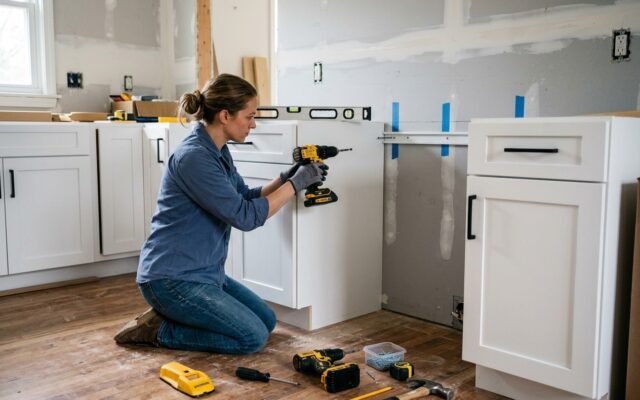
Hold one slide rail against the interior cabinet side wall at the desired shelf height. The slide body should sit level from front to back. Use a 2-foot level across the rail body to confirm. Then mark the mounting hole positions with a pencil and drill pilot holes sized for your mounting screws.
Because cabinet box walls in frameless construction are typically 5/8-inch thick melamine-over-particleboard, use coarse-thread screws no longer than 1/2 inch. Fine-thread machine screws strip this material immediately. Similarly, for face frame cabinets with 3/4-inch plywood boxes, a 3/4-inch coarse screw holds securely without breaking through to the exterior finish panel.
Step 3: Build or Assemble the Shelf Platform
Shelf platforms come in two forms. Pre-made pull out shelf kits include a wire or solid wood platform sized to common cabinet widths. Custom platforms cut from 3/4-inch birch plywood match your exact cabinet interior precisely.
For birch plywood shelves, apply iron-on birch edge banding to the front edge after cutting. Otherwise the exposed plywood edge catches crumbs and absorbs moisture over time. Sand the banded edge flush with a sanding block before installing the shelf. Finally, attach the slide members to the shelf sides per the manufacturer’s instructions and confirm the click-disconnect feature works before mounting inside the cabinet.
Step 4: Insert and Test the Shelf
Angle the shelf platform into the cabinet opening and engage both slides simultaneously. Push the shelf fully inward until the slide stops engage. Then pull it fully open. The shelf should glide smoothly without binding or racking side to side.
If the shelf racks or drags on one side, check that both rails are level. Even a 1/8-inch height difference between the left and right rail causes noticeable binding. Consequently, loosen the mounting screws on the low side, shim with a flat washer, and re-tighten before retesting the movement.
Weight Limits and What They Actually Mean
Hardware manufacturers rate slides in static weight capacity. However, the dynamic weight matters more for kitchen pull out shelves because dynamic weight reflects the load during extension and retraction under acceleration.
As a practical rule, halve the stated static weight when estimating your real-world safe load. Therefore, a 100-pound rated slide handles approximately 50 pounds of dynamic load comfortably in daily use. A fully stocked pull out shelf with cast iron pans, large stockpots, or canned goods easily reaches 40 to 60 pounds. For that application, choose a slide rated at 100 to 125 pounds minimum.
Blum Tandem Plus 563H slides rate at 90 pounds static with full-extension and integrated soft-close dampening. These slides meet the ANSI/KCMA A161.1 performance standard and represent the residential benchmark. Grass Dynapro slides offer comparable 88-pound capacity with similar performance at a similar price point. In addition, both brands provide a click-disconnect feature that lets you detach the shelf without tools for cleaning.
The Showroom Rack Test
Before purchasing any pull out shelf kit or slide hardware, perform this physical inspection test. Extend the slide fully and apply 20 pounds of downward pressure on the front corner of the shelf platform. Quality ball bearing slides rated above 75 pounds show zero noticeable twist or deflection under this load. In contrast, budget slides flex visibly and produce a slight grinding sound as balls skip over rough raceways.
Also check the slide extension stop. Pull the shelf to full extension and release it. The stop mechanism should catch positively and hold the shelf open without creeping back. A quality stop holds the shelf open with zero effort. Otherwise, a worn or weak stop lets the shelf retract under gravity when tilted even slightly.
Common Pull Out Shelf Mistakes
Several installation errors consistently result in shelves that stick, rack, or fail prematurely. Avoiding these four mistakes saves the most time.
- Using 3/4-extension slides instead of full-extension: You lose 6 inches of cabinet depth reach on a 24-inch cabinet. Because full extension is the only choice that uses the entire cabinet depth, always specify it.
- Mounting the rails out of level: Even 1/8 inch of height difference causes binding. Always check level before tightening any mounting screws.
- Ordering shelf widths without measuring the opening: Face frame cabinets lose 1 to 1.5 inches of clear opening width. Always measure at the narrowest interior point.
- Skipping pilot holes in particleboard: Driving screws directly into particleboard without pilots splits the substrate. Always drill pilots first, then drive screws slowly.
For broader base cabinet storage decisions, see our guide on door vs drawer base cabinets and our detailed review of roll out shelf inserts for base cabinets. In addition, if you are deciding between a pull out and a rotating corner solution, our comparison of lazy Susan vs pull out shelf covers the cost and storage trade-offs.
Frequently Asked Questions
Can you add pull out shelves to any kitchen cabinet?
Yes, you can add pull out shelves to most base cabinets without structural modification. Face frame cabinets and frameless Euro boxes both accept standard side-mount ball bearing slides. Sink base cabinets are the main exception because the plumbing prevents a full-width shelf platform from clearing the drain assembly.
What is the weight limit for kitchen cabinet pull out shelves?
Quality full-extension ball bearing slides support 75 to 125 pounds static load. For everyday residential use with pots, pans, and canned goods, choose slides rated at a minimum of 100 pounds static. Blum Tandem Plus 563H at 90 pounds and Grass Dynapro at 88 pounds are the residential benchmarks.
How deep should a pull out shelf be?
A pull out shelf should be as deep as your usable cabinet interior, typically 21 to 22 inches for a standard 24-inch base cabinet. Use full-extension slides so the shelf reaches the full depth. Shorter shelves on partial-extension slides leave dead storage space at the back of the cabinet.
Do pull out shelves reduce cabinet storage capacity?
Pull out shelves occupy approximately 1/2 inch of vertical space per shelf due to slide hardware thickness. However, they recover far more storage than they consume because items at the back of the cabinet become fully accessible. Net storage efficiency increases significantly overall.
Are pull out shelves worth installing in rental kitchens?
Yes, pull out shelves are worth installing in rentals because they screw into the cabinet interior and leave no visible damage upon removal. Store the original fixed shelves and reinstall them when you move out. You can take the pull out units to your next kitchen as well.