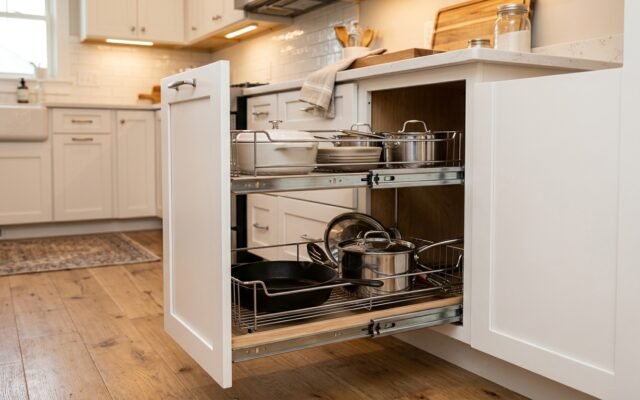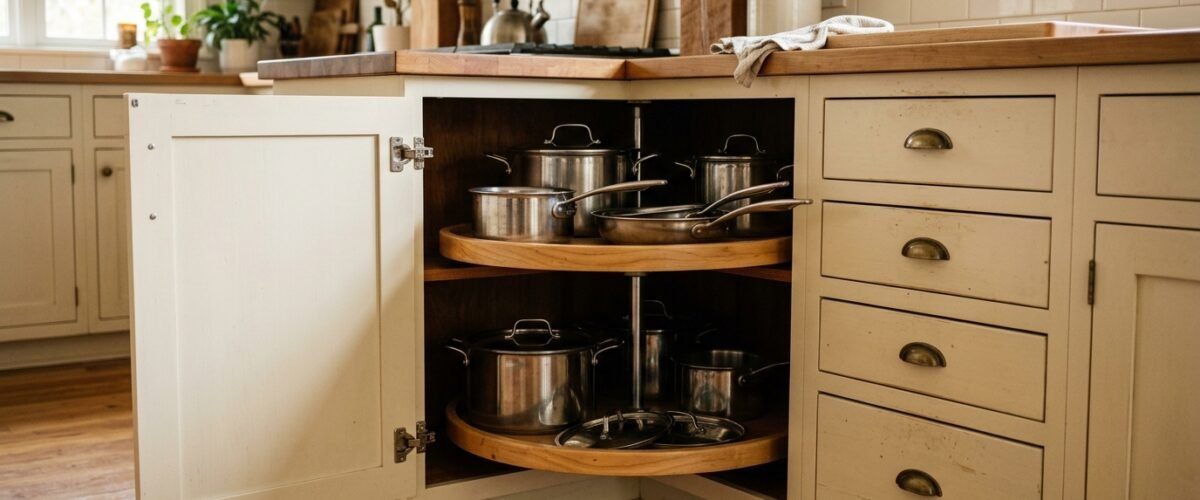
Lazy susans provide circular rotating storage at a lower price point ($200 to $450), but pull-out shelves deliver 25% more usable storage volume and bring heavy cookware directly into room lighting. When designing an L-shaped or U-shaped kitchen layout, corner base cabinets represent the single largest volume of potential dead space in the entire room. Choosing between a traditional spinning turntable and an articulating pull-out shelf determines how easily you reach stockpots, mixers, and dry pantry staples for the next two decades.
Evaluating your storage habits and remodel budget helps you select the right mechanical system for your space. Before ordering corner hardware, explore our detailed analysis of blind corner cabinet solutions to see how different corner layouts impact your cabinet footprint.
Quick Comparison
| Evaluation Factor | Traditional Lazy Susan | Fixed-Shelf Super Susan | Articulating Pull-Out Shelf (LeMans/Magic Corner) |
|---|---|---|---|
| Hardware Price Range | $150–$300 | $250–$500 | $550–$1,100 |
| Usable Volume Efficiency | 60–65% (circular cutouts leave corner voids) | 70–75% (no center pole) | 85–90% (rectangular trays fill the void) |
| Hardware Weight Capacity | 25–35 lbs per plastic shelf | 50–75 lbs per wooden shelf | 45–65 lbs per sliding tray |
| Center Obstruction | Central metal pole blocks tall boxes | Zero center pole (independent turntable) | Zero center pole (sliding cantilever track) |
| Item Retrieval Motion | Spin tray (reach inside dark cabinet) | Spin tray (reach inside dark cabinet) | Pull door (trays glide fully into room) |
| Breakdown & Jamming Risk | High (items fall off and jam rotation) | Low (sturdy ball-bearing turntable) | Moderate (requires square cabinet box) |
Usable Storage Capacity: Circular Trays vs. Rectangular Pull-Outs
Circular lazy susans inevitably waste 35% to 40% of their interior cabinet volume because round trays cannot fill square cabinet corners. A standard corner base cabinet occupies a 36×36-inch square footprint along your kitchen walls. When you place round plastic or wood turntables inside that square enclosure, the four corners outside the circle become unreachable dead zones where dropped spice jars vanish.
In contrast, modern articulating pull-out shelves use flowing contoured trays that maximize the cabinet’s natural rectangular geometry. Systems like the Kesseböhmer LeMans II or Hafele Magic Corner extend nearly 100% of their surface area out past the cabinet face frame. Consequently, you can lift heavy cast-iron Dutch ovens straight up toward your chest, rather than bending into a dark, shadowy cabinet corner to fish out cookware.
Hardware Durability and Weight Testing
A Super Susan with independent ball-bearing turntables outlasts a center-pole lazy susan by a wide margin under heavy kitchen loads. Traditional lazy susans mount two plastic trays onto a single vertical steel spindle. When homeowners load these trays with heavy canned goods, the concentrated downward stress causes plastic collar rings to crack. Eventually, the trays sag and drag noisily against the cabinet floor.
Conversely, a Super Susan screws heavy-duty commercial turntable mechanisms directly onto fixed 3/4-inch plywood shelves. Under ANSI/KCMA A161.1 load testing, these solid-wood turntables support over 500 pounds of static shelf load without deflecting more than 1/16 inch per foot. Similarly, high-end articulating pull-out shelves feature cold-rolled steel guide rails that support up to 65 pounds per tray, guaranteeing smooth operation even when loaded with heavy porcelain dishes.
Cost Comparison: Upfront Price vs. Long-Term Value
Traditional lazy susans cost substantially less upfront, making them the default choice for budget-conscious remodels. Installing a basic two-tier plastic lazy susan adds $150 to $300 to your cabinet package. Even upgrading to a premium all-wood Super Susan rarely exceeds $450 in total materials.
However, mechanical blind corner pull-outs require precision German or Austrian engineering, which drives their hardware price to $550 to $1,100. Furthermore, finish carpenters often charge an extra $150 to $250 in installation labor to align the complex sliding tracks properly. Still, for homeowners seeking aging-in-place ergonomics, eliminating the need to crawl on hands and knees easily justifies the higher price tag. To learn how to balance specialized accessories within your budget, read our kitchen cabinet budget planner.
Showroom Inspection Test: The 40-Pound Deflection Test
Before purchasing a corner solution in a kitchen showroom, perform this simple deflection test on their floor model. Open the corner cabinet and place a 40-pound object — such as two large cast-iron skillets or your firm downward hand pressure — onto the outer edge of the top shelf.
If testing a center-pole lazy susan, observe the vertical spindle. If the pole flexes visibly or the tray tips downward more than 1/4 inch, the hardware will bind when loaded at home. If testing an articulating pull-out shelf, glide the tray fully forward and press downward on the front edge. High-quality slides with rack-and-pinion synchronization will remain rock-solid, whereas cheap wire copies will twist and bind against the cabinet face frame.
Scenario Recommendation Matrix
| Your Specific Remodel Priority | Best Corner Storage Solution | Primary Decision Rationale |
|---|---|---|
| Tight budget under $5,000 | Traditional Super Susan | Delivers proven rotating storage for under $350 with zero maintenance |
| Ergonomics & physical accessibility | Articulating Pull-Out Trays | Brings every stored pot into lighted room space without bending |
| Heavy cast-iron and appliance storage | Wooden Super Susan on 3/4″ Plywood | Eliminates delicate sliding linkages; supports maximum pot weight |
| Sleek modern European design | Kesseböhmer LeMans II Shelves | Clean chrome rails match contemporary frameless slab cabinetry |
| Maximizing storage volume per dollar | Super Susan with 28-inch Trays | Excellent balance of internal volume capture and affordable pricing |
Frequently Asked Questions
Is a Super Susan better than a lazy susan? Yes, a Super Susan is significantly better than a traditional lazy susan because it eliminates the central vertical pole. Instead, rotating wood turntables mount directly to fixed 3/4-inch plywood shelves using heavy-duty ball-bearing swivels, providing superior weight capacity and preventing jams.
Why are blind corner pull-out shelves so expensive? Corner pull-out shelves use complex multi-pivot steel arms, heavy-gauge chrome rails, and integrated soft-close dampening pistons. Precision European manufacturing and high material costs drive prices between $550 and $1,100 per unit.
Can items fall off pull-out shelves into the cabinet? Modern articulating pull-out shelves feature 3-inch to 4-inch raised steel railings and textured non-slip surfaces that prevent items from sliding off during extension. In contrast, older lazy susans without high lips frequently lose small containers into the rear cabinet void.
How much weight can a corner pull-out shelf hold? Quality corner pull-out shelves, such as the Kesseböhmer LeMans II, support between 45 and 65 pounds per shelf. This weight capacity easily accommodates heavy kitchen stand mixers, slow cookers, and enameled cast-iron pots.
Do lazy susans waste corner space? Yes, circular lazy susan turntables waste approximately 30% to 35% of interior corner volume. Because round trays sit inside a square cabinet enclosure, the four exterior corners remain empty and inaccessible.