Blind corner cabinet solutions convert 6 to 9 cubic feet of inaccessible kitchen dead space into smooth, usable storage. When two perpendicular base cabinet runs meet at a 90-degree angle, one cabinet inevitably disappears behind the other, creating an awkward void that swallowed kitchenware for generations. Today, five distinct hardware and layout solutions solve this problem at price points ranging from $50 to $1,400.
Choosing the right corner mechanism prevents daily frustration and protects your remodel budget. Before ordering hardware, review our guide on hidden costs of kitchen cabinets to account for necessary clearance fillers and specialized trim.
Blind Corner Solutions Compared
| Solution Type | Hardware Brand & Model | Hardware Cost | Usable Space Efficiency | Installation Difficulty |
|---|---|---|---|---|
| Articulating Pull-Out Trays | Rev-A-Shelf Cloud / Hafele Magic Corner | $450–$950 | 80–85% | Moderate (needs square cabinet walls) |
| The Super Susan | Rev-A-Shelf 2-Shelf Wood Susan | $220–$450 | 70–75% | Easy (mounts on fixed interior shelf) |
| LeMans II Swing-Out Shelves | Kesseböhmer LeMans II | $550–$1,100 | 75–80% | Moderate (template mounting system) |
| Blum Space Corner Drawers | Blum Space Corner / Tandembox | $700–$1,500 | 85–90% | Advanced (requires custom cabinet box) |
| The Dead-Space Wall Off | Contractor 3-inch filler strip | $40–$80 | 0% corner (100% on adjacent runs) | Very Easy (standard straight cabinets) |
1. Articulating Pull-Out Trays (Magic Corner Systems)
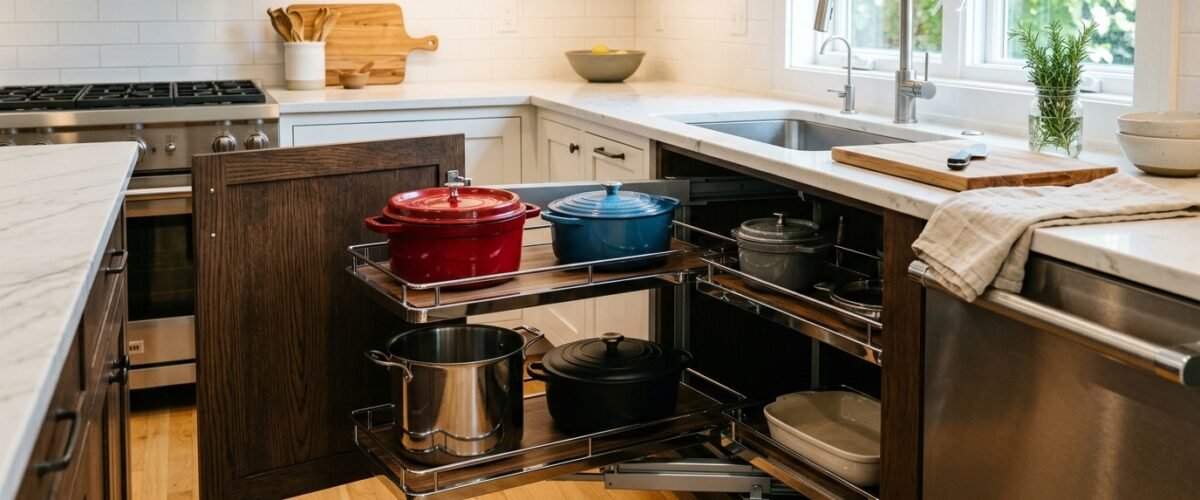
Articulating pull-out trays use a two-stage sliding track to pull items from the deepest cabinet recesses directly into your kitchen walkway. When you open the blind corner door, the front basket glides outward with the door frame. Simultaneously, a synchronized linkage pulls the hidden rear basket forward along an internal steel rail into the open cabinet threshold.
For example, the Hafele Magic Corner II and Rev-A-Shelf Cloud system provide four independent storage trays with non-slip solid surfaces. Each chrome basket supports up to 30 pounds of canned food, cookware, or small kitchen appliances. Because these systems extend fully outside the cabinet box, you can lift heavy items straight up without twisting your back. However, you must maintain perfectly square cabinet framing, as even 1/8 inch of out-of-square racking can cause the complex mechanical linkage to bind.
2. The Super Susan with Fixed Shelf Turntables
A Super Susan mounts independent solid-wood spinning turntables onto a fixed structural plywood shelf, eliminating the center pole completely. Traditional pole-mounted lazy susans wobble over time because the weight of heavy canned goods bears downward onto a single metal spindle. Eventually, the retaining pin slips, causing rotating trays to drag along the bottom cabinet floor.
In contrast, a Super Susan uses heavy-duty commercial ball-bearing turntables screwed directly onto thick 3/4-inch plywood shelves. Each pie-cut or round birch tray spins independently with zero center pole obstruction. Consequently, tall cereal boxes and oversized stockpots never tip over into a central spindle gap. At $220 to $450, the Super Susan delivers exceptional mechanical reliability at half the price of complex sliding European hardware.
3. LeMans II Articulating Shelves by Kesseböhmer
The Kesseböhmer LeMans II system uses flowing, contoured trays that swing outward past the cabinet face frame in a fluid arching motion. Named after the famous French racing circuit for its sweeping curve geometry, the LeMans tray extends 100% outside the cabinet opening with an effortless touch. In fact, each shelf operates independently and carries up to 55 pounds of heavy kitchen cookware.
Furthermore, the LeMans II features tool-free height adjustment cams on its main mounting column, allowing you to reconfigure vertical shelf spacing in seconds. While the hardware requires an investment of $550 to $1,100, its thick wooden shelf decks and solid steel railings last for decades. Installers appreciate that Kesseböhmer includes precise paper drilling templates, which eliminates guessing and prevents ruined cabinet interiors during hardware mounting.
4. Blum Space Corner Angle Drawers
Blum Space Corner drawers replace doors entirely with synchronized full-extension drawers that slide diagonally into the room. Rather than fighting an awkward hinged door, you simply pull open deep, V-shaped drawer boxes built with Blum Tandembox or Legrabox hardware. When closed, the angled drawer fronts align seamlessly with surrounding straight cabinetry.
Because these drawers utilize full-extension undermount slides with Blumotion soft-close dampening, you enjoy total top-down visibility over all stored goods. In addition, internal divider systems keep pot lids and cookware meticulously organized. Still, Space Corner systems represent the most expensive blind corner option, costing $700 to $1,500 in specialized drawer components while requiring an expert finish carpenter to build the custom angled cabinet carcass.
5. The Dead-Space Wall Off Strategy (Contractor Secret)
Walling off the blind corner entirely and installing wider straight drawer base cabinets on both sides is often the smartest financial choice. While spending $800 on a mechanical pull-out rescues dead corner space, that mechanism frequently robs adjacent cabinet runs of valuable width. By capping off the dead 24×24 inch corner void with a simple wood filler strip, you free up room to expand adjacent cabinets into wide 36-inch three-drawer bases.
As we demonstrate in our guide to drawer base cabinets vs door cabinets, wide drawer units deliver superior storage volume per dollar spent. For example, skipping a $900 blind corner organizer saves enough cash to upgrade three adjacent cabinets to all-plywood drawer bases. In smaller budget remodels, closing off the corner often creates a far more functional kitchen overall.
Clearance Rules: Avoiding Range and Dishwasher Collisions
Blind corner cabinets require a mandatory 3-inch filler strip between the cabinet face frame and perpendicular appliances to prevent handle collisions. If you place a blind corner base cabinet directly against an oven or dishwasher, the opening door will slam into adjacent handles before swinging 90 degrees. Because modern ranges feature protruding control handles, forgetting this buffer prevents blind pull-outs from clearing the door frame.
Therefore, always measure the depth of your appliance handles before setting corner cabinets. Specifically, if your range handle extends 2.5 inches beyond the cabinet face, install a 3-inch or 4-inch hardwood filler strip in the corner junction. This vital spacing ensures that pull-out trays and swing-out shelves clear surrounding hardware without chipping delicate painted finishes.
Which Solution Fits Your Remodel?
| Your Kitchen Situation | Best Blind Corner Choice | Why It Wins |
|---|---|---|
| Tight budget, maximizing storage elsewhere | Dead-Space Wall Off | Saves $600–$1,000 to fund wide drawer bases on adjacent walls |
| Need rugged reliability for heavy cast iron | Super Susan (Pole-Free) | Solid 3/4-inch plywood shelves handle maximum pot weight without failing |
| High-end remodel, priority on sleek ergonomics | Kesseböhmer LeMans II | Beautiful fluid extension, 55 lb tray rating, full outside-cabinet access |
| Deep layout with high pantry storage needs | Articulating Pull-Out Trays | Brings two tiers of buried pantry items directly into lighted room space |
| Custom cabinetry, no doors wanted anywhere | Blum Space Corner Drawers | Keeps consistent drawer horizontal lines across the entire kitchen perimeter |
Frequently Asked Questions
What is the difference between a blind corner and a lazy susan cabinet? A blind corner cabinet is a rectangular box tucked behind an adjacent cabinet, leaving only one door visible. In contrast, a lazy susan cabinet features a square footprint with a 90-degree notched corner door that provides direct diagonal access to rotating internal trays.
Is it worth putting an organizer in a blind corner cabinet? Yes, installing an articulating organizer or Super Susan transforms dead space into accessible storage for heavy pots and mixers. Without an organizer, the deep 24-inch void remains virtually unusable without crawling inside the cabinet.
Why are blind corner pull-outs so expensive? Blind corner organizers use complex multi-pivot linkages, synchronized steel slides, and heavy-gauge chrome baskets engineered to carry substantial weight cantilevered outside the cabinet box. Precision German and Austrian manufacturing standards drive higher hardware pricing.
Can you add a blind corner organizer to existing cabinets? Yes, aftermarket systems like the Rev-A-Shelf Cloud or Hafele Magic Corner install into existing cabinetry provided the door opening meets minimum width requirements (typically 15 to 18 inches) and internal plumbing or gas lines do not obstruct the space.
How much clearance is needed next to a blind corner cabinet? A blind corner cabinet requires at least a 3-inch filler strip adjacent to perpendicular cabinets or appliances. This spacing allows cabinet doors to open past 90 degrees without striking protruding range knobs, refrigerator doors, or dishwasher handles.