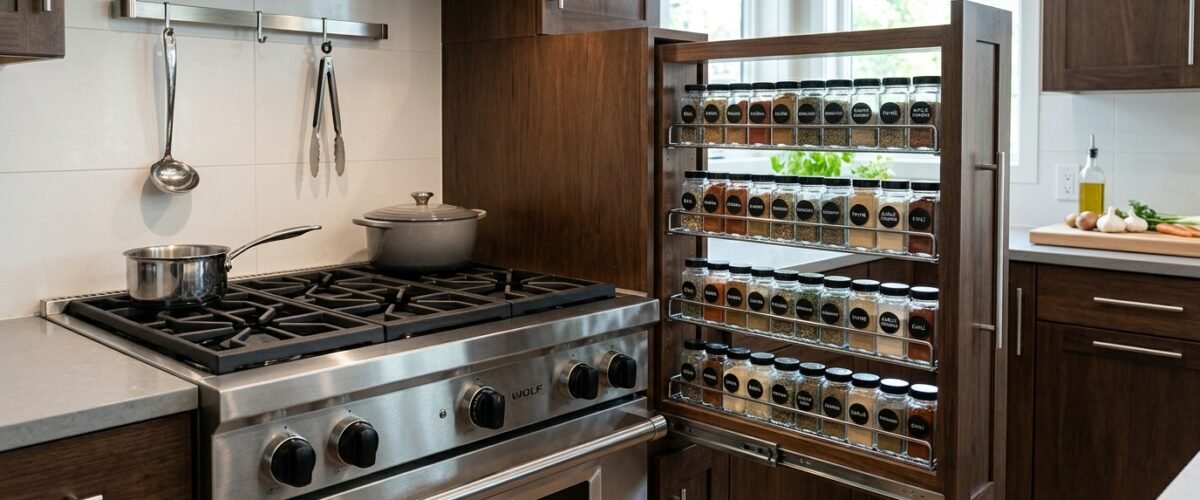
A filler cabinet is an ultra-narrow base cabinet — typically 3, 6, or 9 inches wide — equipped with an integrated pull-out organizer that turns unavoidable wall gaps into active kitchen storage. While standard base cabinets come in modular 3-inch increments starting at 12 inches, kitchen walls rarely match factory dimensions perfectly. Consequently, when a cabinet run ends three to six inches short of an appliance or corner wall, a specialized filler cabinet rescues that dead space.
Installing a functional filler unit prevents wasted void space while keeping cooking ingredients right beside your range. Before finalizing your base cabinet layout, read our guide on how to save money on kitchen cabinets to avoid overpaying for unnecessary custom trim pieces.
Filler Cabinet Sizing and Application Reference Chart
| Cabinet Width | Standard Depth | Interior Hardware Mechanism | Primary Storage Application | Optimal Placement |
|---|---|---|---|---|
| 3-inch Filler (B03) | 24 inches | Between-cabinet ball-bearing track | Spices, seasoning bottles, extracts | Directly flanking cooking range or cooktop |
| 6-inch Base (B06) | 24 inches | Full-extension undermount slides | Oils, vinegars, cooking wines, sauce bottles | Between prep sink and range zone |
| 9-inch Base (B09) | 24 inches | Top and bottom soft-close glides | Baking sheets, cutting boards, rolling pins | Adjacent to bake center or main food prep island |
| 12-inch Base (B12) | 24 inches | Multi-tier pull-out pantry rack | Canned goods, dry bulk staples, mixing bowls | Perimeter base run or tall pantry transition |
Filler Cabinet vs. Flat Filler Strip: The Real Difference
A decorative filler strip is a flat piece of painted wood that seals a gap, while a filler cabinet is a complete mechanical storage box. Standard filler strips cost $40 to $90 and merely cover empty air between your last cabinet face frame and the drywall. In contrast, a filler cabinet includes a solid hardwood face, an interior chassis, and heavy-duty steel slides that pull out into the room.
For example, installing a static 6-inch filler strip seals off nearly 5 cubic feet of dark, wasted space behind your wall. However, replacing that blank strip with a 6-inch Rev-A-Shelf 448 series pull-out costs $180 to $320 and gives you three tiers of adjustable chrome shelving. Because kitchen square footage is expensive to build, capturing every linear inch delivers enormous functional value over decades of meal preparation.
3 Primary Use Cases for Filler Cabinets
Kitchen designers strategically specify filler cabinets in three specific kitchen zones where narrow storage solves everyday workflow headaches.
First, flanking both sides of a gas range with 3-inch or 6-inch spice pull-outs keeps everyday seasonings within arm reach while cooking. Because spices degrade under direct sunlight and high cabinet heat, storing them inside a dark lower base unit preserves their flavor oils far longer.
Second, installing a 6-inch filler cabinet equipped with vertical stainless steel bins beside your prep zone creates the ultimate knife and utensil station. Instead of crowding your counter with bulky knife blocks, the pull-out conceals chef knives safely in slotted wooden blocks behind a closed cabinet door.
Third, placing a 9-inch vertical slot cabinet beside your oven accommodates oversized baking sheets and wooden cutting boards. Stacking flat pans horizontally inside wide drawers creates noisy, scratched piles that are frustrating to untangle. In contrast, vertical dividers let you slide out a single cookie sheet without disturbing surrounding cookware.
Construction and Hardware Specifications
Heavy-duty slides and rigid joinery are vital because narrow filler pull-outs experience substantial lateral leverage when extended. Under ANSI/KCMA A161.1 performance standards, base drawers must support continuous cycling without sagging. Specifically, quality filler organizers utilize full-extension undermount slides rated for 100 to 135 pounds, such as Blum Movento or Accuride 3832 series.
Furthermore, look for units built with 1/2-inch or 5/8-inch solid birch side rails and sealed maple dowels. Cheaper imports use thin wire baskets hung on basic side-mount slides, which wobble and scrape against adjacent cabinet face frames when loaded with heavy olive oil bottles. In addition, premium filler pull-outs feature adjustable rub bushings that guide the pull-out smoothly through the face-frame opening without scratching your cabinet finish.
Sizing and Clearance Rules for Installation
Filler cabinets require precise door swing clearance when placed next to perpendicular walls or large protruding appliances. If you place a 3-inch pull-out flush against an oven door, the pull-out handle can strike the range handle when extended forward. Therefore, always install a 1-inch or 2-inch static wood standoff buffer between the filler cabinet and any adjacent oven or dishwasher.
In addition, measure your wall for plumbness from the floor to the countertop line before installing narrow cabinets. Because residential walls lean inward or outward by 1/4 inch across a 34.5-inch base height, an unshimmed filler cabinet will tilt, causing internal slides to bind. To avoid layout errors, check our guide on kitchen island base cabinets for step-by-step leveling and anchoring techniques.
Frequently Asked Questions
What is the smallest filler cabinet you can buy? The smallest functional filler cabinet is a 3-inch wide base pull-out. These compact units mount directly between two standard cabinet face frames without needing an independent exterior wooden carcass, providing two or three narrow shelves for spice containers.
Can you add a filler pull-out to existing cabinets? Yes, aftermarket filler pull-out kits install easily into existing gaps provided you have at least 3 inches of open clearance between cabinet boxes. You simply attach the mounting tracks to the existing cabinet sidewalls and screw your matching cabinet face to the front bracket.
How much does a base filler cabinet cost? A standard base filler cabinet costs between $150 and $450 depending on width and slide quality. A basic 3-inch wire pull-out costs around $150, while an all-plywood 9-inch unit with Blum soft-close slides and solid maple shelves retails near $400.
Do filler cabinets require a separate cabinet box? Three-inch filler organizers do not require a separate cabinet box because they mount directly to the exterior sidewalls of adjacent cabinets. However, 6-inch and 9-inch models typically ship as complete self-contained cabinet carcasses with independent top, bottom, and side panels.
Are filler cabinets worth the extra money? Yes, filler cabinets are well worth the cost in kitchens with tight storage footprints. Converting a blank 6-inch dead-space strip into an organized spice or tray pull-out adds substantial daily utility for a modest hardware investment.