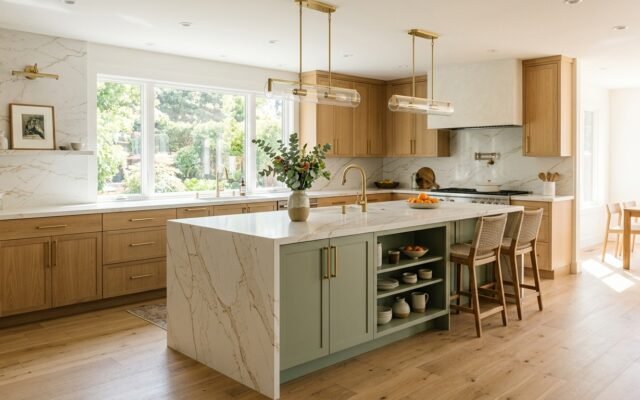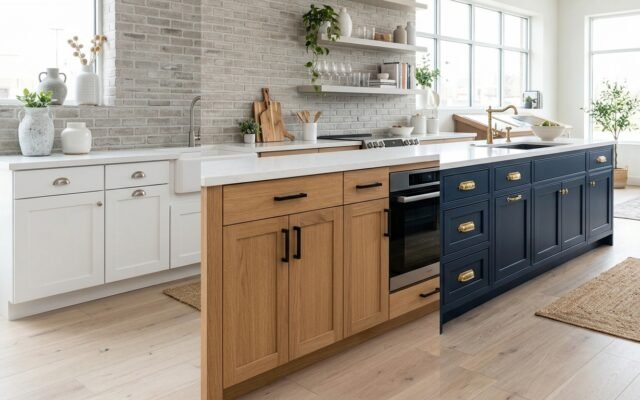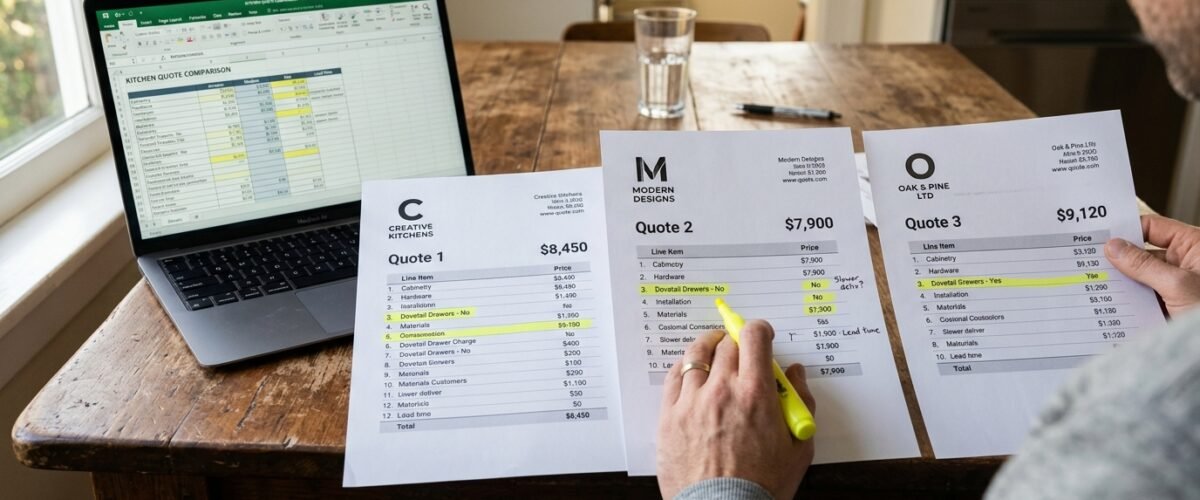
Two cabinet quotes for the same kitchen can show $8,400 and $11,200 respectively. However, the cheaper quote might exclude finished end panels, freight, toe kicks, and hardware — while the expensive one includes everything. Alternatively, both quotes might cover identical scope, meaning the cheaper dealer simply has a lower margin.
You cannot know which situation applies until you standardize both quotes on a line-by-line basis. This process takes under 20 minutes and consistently reveals $1,500 to $5,000 in hidden discrepancies. Here is the exact method.
Skill level: No prior cabinet knowledge required. Time: 15–20 minutes per quote comparison.
What You Will Need
- All cabinet quotes in writing (email or PDF, never verbal)
- A spreadsheet or notebook to create a standardized comparison line
- The room’s finished linear footage (total base cabinet run + total wall cabinet run measured separately)
- A list of every cabinet unit you need (model, width, height, depth for each position)
Step 1: Demand Itemized BOMs Before Comparing Anything
Never attempt to compare two lump-sum quotes. Because lump-sum figures deliberately combine materials, freight, and services into one total, they make honest comparison impossible.
Before you do anything else, contact every dealer and request an itemized Bill of Materials (BOM) — a spreadsheet listing every SKU in your order by model number, dimensions, quantity, and unit price. Specifically, the BOM must also line-item freight separately from merchandise. If any dealer refuses to provide an itemized BOM, remove them from your consideration entirely.
What success looks like: You have a BOM from each dealer showing individual line items with unit costs. Consequently, you can now compare actual component prices rather than opaque package totals.
Step 2: Verify Every Quote Covers the Same Scope
The most common apples-to-oranges comparison trap occurs when one quote includes certain components and another excludes them. Therefore, before comparing any dollar figures, confirm that all quotes include these eight scope items identically.
The 8-scope checklist — verify each item in every quote:
- Cabinet boxes — count the exact number and verify each SKU matches your layout plan
- Cabinet doors and drawer fronts — confirm the door style and finish tier matches across all quotes
- Finished end panels — one skin panel per exposed cabinet side facing the room
- Toe kick boards — typically one 96-inch board per 8 linear feet of base cabinet run
- Fillers and scribe molding — the quantity should match your layout’s gap requirements
- Crown molding and light rail (if applicable) — verify the profile and linear footage
- Hardware — confirm whether hinges, soft-close slides, and pulls are included or excluded
- Freight and delivery — verify residential LTL + liftgate service is itemized separately
If one quote includes items 3 through 8 while another excludes them, the apparent price gap is false. First, add the missing component costs to the cheaper quote before drawing any price conclusions.
Step 3: Standardize the Box Material Specification
Because box material determines 25-year durability, you must confirm the carcass specification for every quote before comparing price per linear foot. Specifically, look for these three box characteristics in the written material spec sheet:
Core material: The box sides, bottom, and floor must explicitly state “plywood” (not “furniture board,” “HDF,” or “engineered composite,” which are all particleboard). A plywood box holds screws at 2.5× the force of particleboard under ANSI/KCMA A161.1 load testing.
Back panel: A structural 1/2-inch plywood back panel allows direct wall stud anchoring. In contrast, a 1/8-inch hardboard picture-frame back uses an exterior hanging rail, which limits vertical load transfer into wall framing.
Drawer box: Confirm 5/8-inch solid wood or birch plywood drawer boxes with dovetail joinery. Alternatively, the quote might specify vinyl-wrapped particleboard with staple joints, which is significantly inferior.
What success looks like: You have a written spec sheet from each dealer stating these three specifications explicitly. Now you can legitimately compare prices at the same structural tier.
Step 4: Decode the Hardware Line
Hardware is the most frequently misrepresented line item in cabinet quotes because vague language makes cheap and premium options look identical on paper. For instance, “soft-close drawer slides” could mean a $6 unbranded import or a $48 Blum Tandem 563H — the wording is the same but the quality is not.
Ask every dealer two questions:
- “What is the exact brand and model number of the drawer slides included?”
- “What is the exact brand and model number of the hinges?”
Acceptable drawer slide brands: Blum Tandem series, Blum Movento, Grass Dynapro, Hettich Actro 5D. Furthermore, confirm full-extension travel (drawer extends 100% of its depth) rather than 3/4-extension, which restricts rear access to the back 25% of the drawer.
If one dealer specifies Blum Tandem 563H and another specifies unbranded soft-close, you must add $350 to $500 to the unbranded quote to account for hardware upgrades before comparing totals.
Step 5: Compare Freight Apples to Apples
Dealers use freight cost as a flexible margin lever. Because residential LTL freight for a 10×10 kitchen weighing 800 to 1,400 pounds actually costs $280 to $480 to your driveway, any freight charge above $550 contains a meaningful dealer markup.
Verify the freight line by asking each dealer for:
- The name of the freight carrier they use
- The estimated pallet weight and pallet count
- The itemized breakdown: base freight rate + residential surcharge + liftgate fee
Then, independently verify the base freight cost using ESTES Express, Saia, or R+L Carriers’ online quote tools. Specifically, enter the origin zip code (the warehouse location), your delivery zip code, the estimated weight, and freight class 92.5 for flat-pack cabinets or freight class 85 for pre-assembled.
What success looks like: Each dealer’s freight line either matches the carrier rate or shows a modest $50 to $80 dealer handling surcharge. If one quote shows freight at $800 while the carrier tool shows $350, that dealer adds $450 in undisclosed margin.
Step 6: Calculate True Price Per Linear Foot
Once you have standardized scope, verified box materials, decoded hardware, and normalized freight, calculate each quote’s true cost per linear foot for a final comparison.
The formula: Total merchandise cost (boxes + doors + hardware + trim) ÷ Total linear footage of cabinet run = True cost per linear foot
For example: $9,200 in merchandise across a 20-linear-foot kitchen = $460 per linear foot. That figure lets you quickly benchmark against market rates by tier:
| Tier | Expected Cost Per Linear Foot |
|---|---|
| Budget particleboard stock | $70–$140 |
| Mid all-plywood RTA | $130–$220 |
| Semi-custom assembled | $300–$550 |
| Full custom millwork | $600–$1,400 |
If a dealer quotes $480 per linear foot but specifies particleboard boxes, you are paying semi-custom prices for budget construction. Conversely, if a dealer quotes $195 per linear foot with verified plywood specs, you have found exceptional value in the RTA tier.
Step 7: Score Each Quote on Three Criteria
After normalizing every quote, rank each supplier on three objective criteria before making a final decision.
Criterion 1 — Price per linear foot at equivalent scope: The lowest number at the same material specification wins on cost.
Criterion 2 — Lead time and replacement part access: A dealer who ships from a local warehouse and replaces damaged parts within 48 hours is worth a 5% to 8% premium over a distant supplier with a 3-week damage claim process.
Criterion 3 — Design service quality: A dealer who provides an accurate CAD layout built from measured field dimensions is more valuable than one who drafts a rough sketch from verbal estimates. Because installation errors that stem from poor design cost $400 to $800 in carpenter fix-up labor, accurate design is a real financial benefit.
Common Mistakes When Comparing Cabinet Quotes
Comparing headline totals without verifying scope. The headline total is meaningless until you confirm both quotes cover identical components. Therefore, always run Step 2 before looking at any price.
Accepting “premium soft-close” as a hardware specification. That phrase appears in quotes at every price tier regardless of actual hardware quality. Consequently, always demand brand and model in writing before accepting the hardware line as equivalent across quotes.
Ignoring lead time differences. A quote from a stock dealer with in-warehouse inventory ships in 5 to 10 business days. A semi-custom order ships in 4 to 8 weeks. If your contractor has a project start date, a cheaper semi-custom order that delays the project by six weeks costs more in contractor scheduling fees than you saved.
Frequently Asked Questions
How many cabinet quotes should I get before deciding? Get at least three itemized quotes. Because pricing variance between dealers on identical cabinets routinely exceeds 30%, one or two quotes give you no benchmark. Specifically, getting a big-box store quote, an independent dealer quote, and a direct-RTA online quote together covers the full market price range efficiently.
Should the most expensive quote always be the best quality? No. High prices frequently reflect dealer margin, showroom overhead, and brand marketing rather than superior construction. In fact, some direct RTA suppliers ship better box materials at lower prices than premium showrooms, because they eliminate the dealer markup layer entirely.
What if two quotes use different cabinet brands entirely? Ignore brand names and focus exclusively on the written material specification: box core material, back panel thickness, drawer joinery type, and slide manufacturer. After all, two different brands at the same specification tier deliver identical structural performance. Brand name matters only when it signals an independently verified quality standard like ANSI/KCMA A161.1 certification.
Is it fair to show one dealer a competitor’s lower quote and ask them to match it? Yes, provided the competing quote covers identical scope. Specifically, bring both itemized BOMs to the same meeting and ask the dealer to explain every line item where their pricing differs. Reputable dealers will either justify the difference or adjust their price. Dealers who refuse to discuss line items typically have something to hide.
What is the right timeline to finalize a cabinet quote before ordering? Allow 2 to 3 weeks for quote review, material specification verification, and CAD layout revisions before placing your order. Furthermore, if your installation date is firm, add your supplier’s lead time on top of that and work backwards to establish your order deadline.