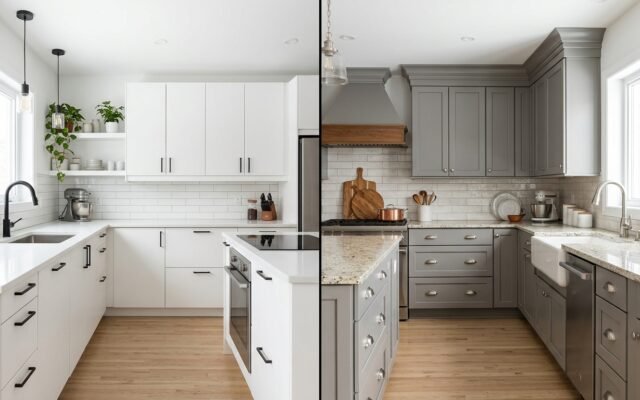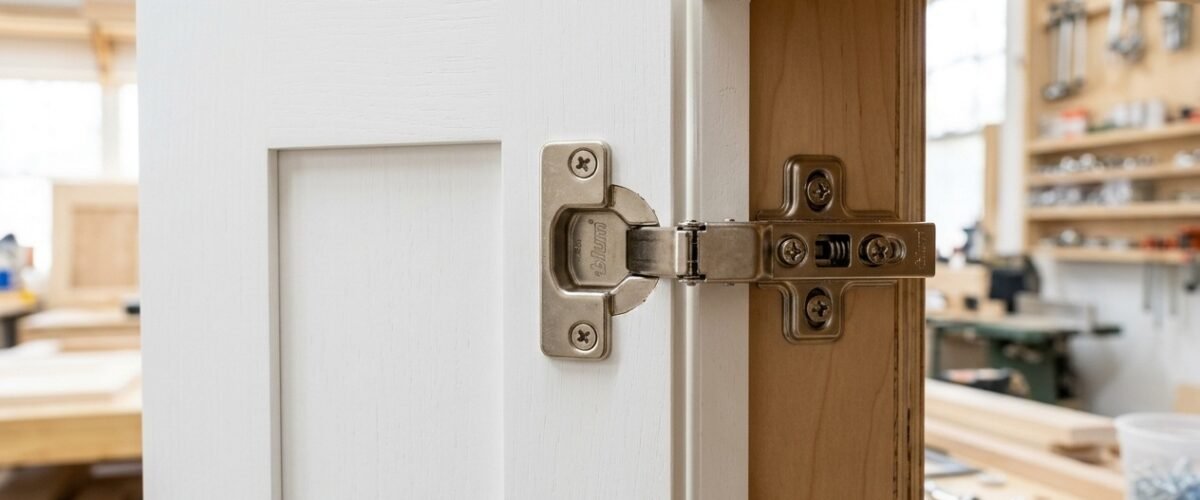
Kitchen cabinet hinges dictate how your cabinet doors align, swing, and close under daily kitchen use. For modern residential installations, concealed European cup hinges with integrated soft-close dampening are the industry standard. Before buying replacement doors or ordering hardware, you must calculate your exact door overlay to choose the correct mounting plate and hinge arm geometry.
Quick Comparison of Kitchen Cabinet Hinge Types
Selecting the correct hinge depends on your cabinet box construction and desired door reveal. The reference table below outlines the core hardware categories used in residential kitchens.
| Hinge Type | Door Overlay | Cabinet Frame Style | ANSI Cycle Rating | Cost Per Pair | Best Application |
|---|---|---|---|---|---|
| Full Overlay Concealed | Covers full frame (1/2 in. to 3/4 in.) | Frameless or Face Frame | 25,000+ cycles | $8 to $16 | Modern kitchens and maximum opening access |
| Half Overlay Concealed | Covers half frame (5/16 in. to 3/8 in.) | Frameless shared wall | 25,000+ cycles | $8 to $16 | Center partitions between two adjoining doors |
| Inset Concealed | Flush inside frame (zero overlay) | Framed or Frameless | 25,000+ cycles | $10 to $22 | Custom furniture-grade inset cabinetry |
| Surface Mount Butt Hinge | Variable (flush to partial) | Face Frame only | 15,000 cycles | $6 to $14 | Traditional colonial and rustic farmhouse |
| Semi-Concealed Knife Hinge | Partial overlay (1/4 in. to 1/2 in.) | Face Frame with slotted door | 15,000 cycles | $5 to $12 | Vintage kitchen restorations and budget updates |
The Three Main Types of Kitchen Cabinet Hinges
Understanding hinge geometry begins with door overlay. In short, overlay describes how much of the cabinet face frame or box edge is covered by the closed cabinet door.
Full Overlay Concealed Hinges
Full overlay hinges position the door so that it conceals nearly the entire cabinet box edge or face frame. On frameless European cabinets, only a 1/8-inch to 1/16-inch gap remains between adjacent cabinet doors. As a result, this creates a clean, continuous wall of cabinetry.
In addition, full overlay concealed hinges mount entirely inside the cabinet box. When the door is closed, no mechanical metal components remain visible from the outside. For contemporary kitchens, this hardware delivers the sleekest possible aesthetic.
Half Overlay Concealed Hinges
Half overlay hinges solve a specific mechanical problem on frameless cabinet boxes. Specifically, when two doors share a single 3/4-inch interior partition wall, standard full overlay hinges would collide. After all, their mounting plates and swing paths overlap inside the cabinet.
Instead, half overlay hinges feature a cranked hinge arm that offsets the door position. Each door covers approximately 5/16 of an inch of the shared stile. Consequently, this leaves an even reveal down the center seam while allowing both doors to open independently without binding.
Inset Cabinet Hinges
Inset hinges are engineered for doors that sit completely flush inside the cabinet face frame opening. Rather than resting on top of the frame, the door swings within the frame opening with a strict 3/32-inch reveal on all four sides.
Consequently, inset cabinetry requires exceptional manufacturing precision. In particular, inset concealed cup hinges feature deep cranked arms that swing the door inward before pivoting outward. They also allow micro-adjustments so you can keep reveal lines uniform across the entire kitchen run.
Overlay Math: How to Measure and Calculate Your Hinge Size
Ordering the wrong overlay hinge is the single most common mistake in DIY kitchen remodeling. Fortunately, calculating your required overlay is straightforward when you follow this formula.
Measuring Face Frame Cabinets
First, close your cabinet door and apply a strip of painter tape to the face frame along the hinge side edge. Then draw a light pencil line along the outer edge of the door onto the tape. Second, open the door and measure the distance from the inside frame edge to your pencil line.
That measurement is your overlay. For example, if the distance measures 1/2 inch, you need a 1/2-inch overlay hinge. In practice, common face frame overlays include 1/2 inch, 1-1/4 inch, and 1-3/8 inch.
Calculating Door Width from Cabinet Openings
If you are ordering custom replacement doors for existing face frame cabinets, use this standard equation:
Door Width = Opening Width + (Hinge Side Overlay + Handle Side Overlay)
For instance, assume your cabinet opening width is 18 inches. If you want a 1/2-inch overlay on both sides, your calculation is 18 + 0.5 + 0.5 = 19 inches finished door width. Also, understanding how doors relate to cabinet boxes helps when deciding between door vs drawer base cabinets.
Hardware Quality: Blum vs Grass vs Generic Clones
High quality kitchen cabinet hinges separate reliable builds from frustrating installations. Specifically, the industry benchmark for European concealed hardware is Blum, particularly their CLIP top BLUMOTION 71B3550 series.
Blum integrates hydraulic dampeners directly into the hinge cup. Therefore, the soft-close mechanism operates smoothly regardless of door closing speed. In addition, Grass TIOMOS hinges offer outstanding durability with tool-free click assembly and stepped closing force adjustments.
In contrast, generic unbranded hinges sold in bulk online often fail within two years. Because budget hinges use stamped steel hinge cups and low-grade silicone fluid dampers, they wear out quickly. Under heavy daily use, the dampening cylinder leaks oil and loses pressure. As a result, the door begins slamming shut.
Always verify that your hardware meets or exceeds ANSI/KCMA A161.1 performance standards. This rigorous certification requires hinges to complete 25,000 open-and-close cycles under full load without door sag exceeding 1/16 of an inch. For a deeper breakdown of construction standards, review our guide on kitchen cabinet hardware.
How Many Hinges Per Door? (Height and Weight Chart)
Never guess how many hinges a cabinet door requires. After all, installing too few hinges causes the top hinge to carry excessive lateral tension, which strips screw threads out of the box wall. Follow the industry sizing chart below.
| Door Height | Maximum Door Weight | Number of Hinges Required | Hinge Spacing Guideline |
|---|---|---|---|
| Up to 36 inches | Up to 12 lbs | 2 Hinges | 3 to 4 inches from top and bottom edges |
| 36 to 60 inches | 12 to 24 lbs | 3 Hinges | Third hinge centered between top and bottom |
| 60 to 80 inches | 24 to 38 lbs | 4 Hinges | Evenly spaced along the hinge stile |
| Over 80 inches (Pantry) | Over 38 lbs | 5 Hinges | Top two hinges clustered within 12 inches |
Notice the recommendation for tall pantry doors over 80 inches. Because tall cabinet doors experience substantial leverage when pulled open from the center, extra support is critical. Therefore, clustering two hinges near the top edge counters the outward pulling force and prevents long-term door binding.
The 90-Degree Swing Test
Professional cabinet installers perform this physical check on every newly hung door. First, open the cabinet door to exactly 90 degrees and release it gently without pushing.
A properly installed, plumb hinge holds the door stationary. Specifically, the door should neither drift open toward the wall nor creep shut. If the door swings on its own, your cabinet box is out of plumb or the hinge mounting plates require lateral adjustment instead.
Fortunately, modern concealed hinges feature three-way cam adjustment screws:
- Depth screw: Moves the door in and out relative to the face frame to eliminate corner rubbing.
- Height screw: Shifts the door vertically up or down to align top door edges across cabinet runs.
- Lateral screw: Adjusts the door side-to-side to balance the vertical gap between neighboring doors.
Using a standard number two Pozi or Phillips screwdriver, turn each cam screw a quarter turn at a time. Then check door movement after every turn until all reveal gaps look laser straight. When hanging heavy base doors, proper box leveling makes hinge adjustment much simpler. For this reason, consult our steps for how to install base cabinets for proper frame alignment tips.
Common Hinge Mistakes That Cause Sagging Doors
Cabinet door alignment problems rarely stem from defective doors. Instead, improper hinge installation creates mechanical failure over time. For that reason, avoid these four common installation pitfalls.
- Stripping pilot holes with power drivers: High-torque impact drivers strip wood fibers in composite face frames. Always hand-tighten mounting screws or set your drill clutch to low resistance instead.
- Mixing overlay ratings on the same run: Installing a 1/2-inch overlay hinge next to a 3/4-inch overlay hinge throws off the door reveal line completely. Standardize your overlay across the entire kitchen.
- Using generic cup hole depths: Standard European hinges require a 35mm cup hole drilled precisely 11.5mm to 13mm deep. Drilling too deep weakens thin shaker door panels, while shallow bores prevent flush seating.
- Ignoring cabinet box plumb: If the cabinet box is racked or twisted, hinges cannot compensate for the difference. Shim and level boxes before hanging doors.
Furthermore, consider your box structure when selecting hardware. Specifically, the structural requirements for frameless vs framed kitchen cabinets determine whether you need face frame adapter plates or direct-to-carcass Euro screws.
Frequently Asked Questions
What is the most common kitchen cabinet hinge?
The 35mm concealed European cup hinge with full overlay is the most common kitchen cabinet hinge. Specifically, it hides all mechanical components when doors are closed and features integrated soft-close dampening with three-way cam screw adjustment.
Can you replace standard cabinet hinges with soft-close hinges?
Yes, you can swap traditional hinges for soft-close models if your doors have standard 35mm cup bores. However, verify your door overlay and cup depth before ordering new hardware to ensure the replacement mounting plates align properly.
What does hinge overlay mean?
Overlay is the distance a cabinet door extends past the interior frame opening onto the face frame or box edge. For example, a 1/2-inch overlay door overlaps the cabinet frame by exactly one half inch on the hinge side.
Why is my cabinet door hanging crooked?
Crooked cabinet doors usually indicate misaligned hinge cam screws or loose mounting plates. Therefore, use a screwdriver on the lateral adjustment screw to shift the top or bottom of the door horizontally until reveal lines match.
How long do quality kitchen cabinet hinges last?
High quality hinges certified to ANSI/KCMA A161.1 standards last 15 to 25 years in residential kitchens. For instance, premium brands like Blum and Grass rate their hardware for 100,000 operational cycles under normal kitchen cooking conditions.