An appliance garage is a compartment built between your countertop and the upper cabinet above it, sized to hide one or two small appliances behind a tambour roll-up or hinged door. Installed cost runs $400 to $900 for a 12-to-18-inch wide unit, and the trade-off is permanent: you gain a hidden storage bay but lose counter depth and flexibility at that exact wall position forever. For homeowners with a KitchenAid stand mixer or a Vitamix blender that never moves from one spot, the cost and footprint make complete sense. For everyone else, a wall cabinet with a door swung up works better at a fraction of the price.
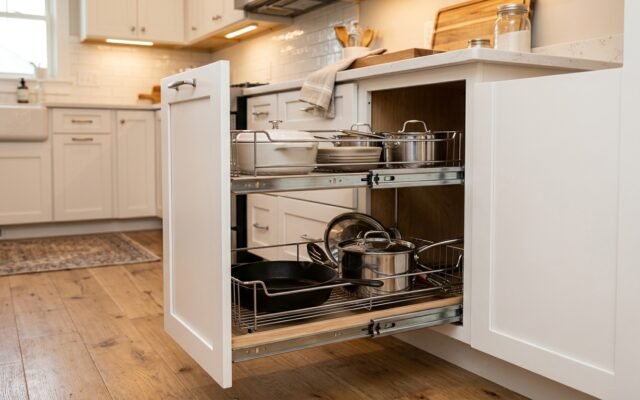
Before committing to an appliance garage, check whether a pull-out shelf insert under the counter solves the problem more cheaply — for appliances light enough to pull forward without lifting, a roll-out base cabinet shelf costs $60 versus $700 for an appliance garage.
Quick Comparison: Appliance Garage vs Alternatives
| Storage Solution | Cost | Hides Appliance? | Preserves Counter Space? | Requires Contractor? |
|---|---|---|---|---|
| Appliance Garage (tambour) | $400–$900 installed | Yes, fully | No (eats 15–18″ depth) | Yes |
| Flip-Up Wall Cabinet Door | $150–$350 installed | Yes, when closed | Yes | Minimal |
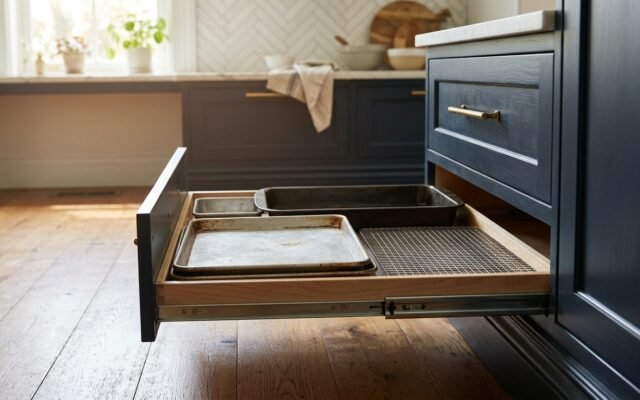
| Deep Drawer with Appliance Insert | $200–$450 installed | Partial | Yes | No |
| Roll-Out Base Shelf | $60–$95 DIY | No | Yes | No |
| Open Countertop Parking Spot | $0 | No | Yes | No |
What an Appliance Garage Actually Takes Up
The standard appliance garage occupies 15 to 18 inches of horizontal counter length and 18 to 24 inches of vertical height — the full space between your countertop surface and the bottom of your upper wall cabinets. Width varies by appliance: a toaster fits in a 12-inch unit, a stand mixer needs 18 inches, and a full coffee station with accessories needs 24 to 30 inches.
That counter depth loss is the real cost, however. Most kitchens have 25 inches of usable counter depth. An appliance garage with a closed tambour door reduces the available prep area directly in front of it to roughly 10 to 12 inches — not enough for a cutting board, not enough to plate a meal. Kitchen designers recommend placing appliance garages at the end of a counter run or in a corner position specifically because the counter depth restriction matters less at those locations.
In fact, electrical outlet placement inside the garage is mandatory if you plan to leave appliances plugged in. The National Electrical Code requires any outlet inside an enclosed cabinet to be on a GFCI-protected circuit if it is within 6 feet of a sink. Wiring a dedicated outlet inside a new appliance garage adds $150 to $300 to the installed cost.
Tambour Doors vs Hinged Doors: The Mechanical Trade-Off
Tambour doors roll upward on a track hidden inside the cabinet walls. Because the door disappears into the cabinet body rather than swinging out into the room, tambour doors work in tight spaces where a hinged door would block access to the counter beside it. The downside is mechanical: tambour slats are linked by a woven backing that cracks and separates over time in kitchens with high heat and humidity cycles. Consequently, a replacement tambour assembly runs $80 to $180 and requires the cabinet to be partly disassembled.
In contrast, hinged appliance garage doors swing fully open like a standard cabinet door and last indefinitely without mechanical wear. They require 15 to 18 inches of clearance in front of the counter to open without hitting the cook. In galley kitchens under 8 feet wide, that clearance is typically unavailable. In L-shaped or U-shaped kitchens with a dedicated appliance wall, hinged doors are the better choice.
Still, both door types are available in all standard cabinet finish lines — painted MDF, thermofoil, and solid wood. Match the door style and finish to your existing cabinet fronts exactly, because an appliance garage that sits between an upper and lower run must blend seamlessly or it reads as a renovation patch.
When an Appliance Garage Makes Sense
Specifically, you have one appliance that lives permanently in one spot and weighs over 20 pounds. A KitchenAid Artisan stand mixer weighs 26 pounds. A Vitamix 5200 weighs 12 pounds but has a 20-inch profile that clutters any open counter run. For these appliances, hiding them in a dedicated compartment is genuinely better than any alternative.
Also, your kitchen layout has a corner or end-of-run position where counter depth loss does not affect your prep workflow. A 12-inch appliance garage tucked into the right angle of an L-shaped counter at the furthest point from the sink and range sacrifices counter space you were never using for food prep anyway.
Finally, your kitchen design is contemporary or transitional and visual clutter on the countertop actively bothers you. For these homeowners, the $700 installed cost is a reasonable price for a permanently clean counter appearance.
When to Skip the Appliance Garage
Skip the appliance garage if your appliances vary — — if you rotate between a blender, a food processor, and a toaster depending on the week, a permanent fixed-width compartment serves only one at a time. The $700 investment makes sense for a permanent resident, not a rotating lineup.
Skip it also if your counter depth is already limited to 22 to 23 inches, which is common in older homes where walls encroach into the standard 25-inch counter depth. Losing another 15 inches of front clearance at the appliance garage position removes that counter section from all meaningful use.
Instead, skip it entirely and revisit a kitchen island base cabinet if your kitchen layout has room for an island — island counter space adds depth without sacrificing perimeter counter access, and island bases provide large-appliance storage in deeper drawers.
Frequently Asked Questions
How much does an appliance garage cost to install?
An appliance garage with a tambour door costs $400 to $900 installed, depending on width (12 to 30 inches), door mechanism (tambour vs hinged), and finish match to existing cabinetry. Custom woodwork versions from a finish carpenter run $900 to $1,500 for complex corner or curved configurations.
What is the standard size of an appliance garage?
Standard appliance garages are 12, 15, 18, 24, or 30 inches wide. Height is determined by the space between your countertop and the bottom of your upper wall cabinets, typically 18 to 24 inches. Depth matches the upper cabinet depth above it, usually 12 to 13 inches.
Can I install an appliance garage in an existing kitchen?
Yes, but only if the space between your existing upper and lower cabinets is open — no tile, no backsplash panel, and no structural obstruction. Most installations require removing a section of backsplash tile, running a new electrical outlet, and adding a face-frame filler on each side to close the gap neatly. Budget $500 to $1,200 for a full retrofit including electrical.
Do appliance garages need electrical outlets?
Yes, always wire an outlet inside the appliance garage — otherwise you will run cords under the tambour door, which defeats the purpose. Per NEC code, the outlet requires GFCI protection if the cabinet is within 6 feet of a sink.
What appliances fit in a standard appliance garage?
A 12-inch appliance garage fits a pop-up toaster or small coffee maker. An 18-inch unit fits a KitchenAid stand mixer with the bowl attached. A 24-inch unit fits a Vitamix blender plus accessories. A 30-inch unit can fit a full coffee station with grinder, maker, and supply drawer.