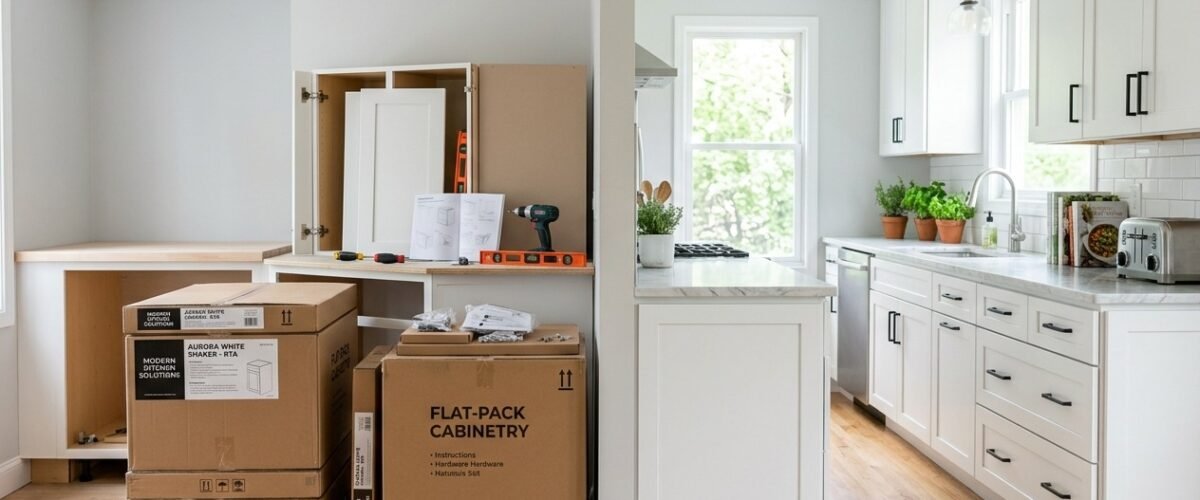
RTA cabinets save you 30% to 50% on material costs compared to pre-assembled boxes, but demand 20 to 45 minutes of assembly time per box and require basic shop tools. Pre-assembled cabinets arrive fully built from the factory and hang directly onto your walls, saving days of job-site labor at a higher upfront purchase price.
Deciding between ready-to-assemble and factory-assembled base cabinets comes down to your budget, project timeline, and willingness to build furniture boxes. Both options can provide durable plywood construction and dovetail drawers when sourced from reputable manufacturers.
Quick Comparison: RTA vs Pre-Assembled Base Cabinets
RTA cabinetry is the clear winner for budget-conscious DIYers looking to maximize material quality per dollar spent. Pre-assembled cabinetry is the best choice for busy homeowners, tight remodeling schedules, or projects where general contractor labor rates would erase DIY assembly savings.
The comparison table below outlines the core differences in pricing, build time, box construction, and freight risk between RTA flat-pack and factory pre-assembled base cabinets in 2026.
| Factor | RTA (Ready-to-Assemble) | Pre-Assembled / Factory-Built | Winner |
|---|---|---|---|
| Average Cost (10×10 Kitchen) | $2,200 – $5,500 | $4,500 – $11,000 | RTA (Saves 30% – 50%) |
| Assembly Labor Required | 20 – 45 min per cabinet box | 0 min (Unbox and hang immediately) | Pre-Assembled |
| Box Structural Joinery | Cam locks, pocket screws, or metal brackets | Glued, clamped, and pinned in factory jigs | Pre-Assembled (Tightest joints) |
| Shipping Freight Cost | $150 – $300 (Flat compact pallets) | $350 – $750 (Bulky volume freight) | RTA (Half the freight cost) |
| Freight Damage Risk | Low (Protected flat sheets and edge foam) | Moderate to High (Protruding face corners) | RTA |
| Storage Before Install | Compact (Fits inside a single bedroom or garage) | Huge footprint (Requires entire garage or living room) | RTA |
| Custom Size Options | Standard 3-inch modular increments only | 1-inch width and depth modifications available | Pre-Assembled |
| DIY Skill Level Needed | Intermediate (Drill, wood glue, bar clamps) | Beginner (Leveling and hanging only) | Pre-Assembled |
| Overall Value per Dollar | Maximum (All-plywood boxes for budget prices) | Convenience-driven (Pays premium for pre-built boxes) | RTA |
What Are RTA Kitchen Base Cabinets? (How Flat-Pack Construction Works)
Ready-to-assemble (RTA) kitchen base cabinets are precision-machined cabinet parts shipped flat in compact cardboard cartons with all necessary face frames, side panels, shelves, hinges, and drawer slides included. You assemble the components on-site using wood glue, mechanical fasteners, and basic hand tools before attaching the boxes to your kitchen walls.
Modern RTA cabinetry has evolved far beyond flimsy cam-lock particleboard furniture. Today’s top RTA brands use 1/2-inch or 3/4-inch furniture-grade birch plywood for the cabinet box sides, solid hardwood face frames, and 5/8-inch solid wood dovetail drawer boxes with soft-close undermount glides.
Parts are cut on computerized CNC routers to tolerances within 1/64 of an inch. Grooves, dados, and pilot holes come pre-drilled at the factory, ensuring that side panels align square with face frames when assembled with standard wood glue and pocket screws.
What Are Pre-Assembled Kitchen Base Cabinets? (Factory Build Standards)
Pre-assembled kitchen base cabinets are built, glued, clamped, squared, and cured inside the manufacturer’s factory before shipping. Each cabinet arrives at your home as a rigid, finished three-dimensional box ready to be shimmed, leveled, and screwed directly to the wall studs.
Factory assembly provides superior structural rigidity because commercial production lines employ pneumatic clamping tables, hot-melt industrial adhesives, and automated squaring jigs that apply thousands of pounds of even pressure while the glue bonds. Joint seams are tight and square right out of the box.
Pre-assembled lines also allow for extensive customization. Because the factory builds each box to order, semi-custom manufacturers can modify cabinet depths, install specialized interior roll-out pantries, or build custom corner angles that flat-pack RTA modular systems cannot accommodate.
Assembly Time Reality Check: How Long Does RTA Actually Take?
Assembling a standard single-door RTA base cabinet takes 45 to 60 minutes for your first box, and 20 to 30 minutes per box once you establish a workflow rhythm. Complex 3-drawer base banks and corner lazy susan units take 45 to 75 minutes each due to slide alignment and rotating hardware installation.
A full 10×10 kitchen containing 12 to 15 cabinet boxes requires 15 to 25 total hours of focused assembly labor. You must factor this time into your remodeling schedule before choosing RTA.
Here is an honest breakdown of the time required per cabinet type when working with standard tools:
- First Base Cabinet (Learning Curve): 50 to 60 minutes. You will spend time reading instructions, identifying fastener packets, and understanding how face frame pocket joints fit together.
- Standard 1-Drawer / 2-Door Base: 20 to 30 minutes. Once familiar with the locking system, applying glue and driving pocket screws goes very quickly.
- 3-Drawer Base Cabinet: 40 to 60 minutes. Assembling three individual dovetail drawer boxes, attaching drawer fronts, and squaring undermount glides doubles the build time.
- Corner Lazy Susan Base: 60 to 75 minutes. Aligning center pivot poles, attaching rotating trays, and squaring bi-fold doors requires patience and careful test fitting.
- Sink Base Cabinet: 25 to 35 minutes. With no interior drawer boxes or adjustable shelves, sink bases assemble quickly once the front sub-frame is locked.
- Full Kitchen (12 – 15 Boxes): 2 to 3 full working days for one person, or a single weekend if working with a partner on an assembly line setup.
Step-by-Step RTA Assembly Workflow and Tool Requirements
Assembling RTA base cabinets requires a clean 4×8 foot work table, a cordless drill with square-drive and Phillips bits, a bottle of Titebond II wood glue, a dead-blow rubber mallet, and two 36-inch bar clamps. Setting up a dedicated assembly station prevents scratches on finished door faces and cuts build time by 25%.
Following a consistent assembly order ensures that every box stays square and rigid under stone countertop weight. Use this six-step build sequence for every standard base box:
1. Dry-Fit the Components: Lay out the solid face frame face-down on a soft cardboard pad. Slide the two plywood side panels into the face frame grooves without glue to verify that dados align correctly.
2. Apply Wood Glue: Run a continuous 1/8-inch bead of wood glue along all side panel dados, face frame joints, and bottom shelf grooves. Glue provides 80% of the long-term joint strength; metal fasteners simply hold the pieces while glue cures.
3. Fasten Side and Bottom Panels: Lock the side panels into the face frame using the manufacturer’s pre-drilled pocket screws or interlocking metal brackets. Tap the panels firmly into place with a rubber mallet.
4. Slide the Cabinet Back and Top Stretchers: Slide the 1/2-inch plywood back panel into its rear groove. Secure the top structural hanging stretchers across the front and rear corners with 1-1/4 inch wood screws.
5. Check for Square: Measure diagonally corner-to-corner across the face frame and rear opening. If the two diagonal measurements are within 1/16 of an inch, your box is square. Tighten all fasteners.
6. Build and Mount Dovetail Drawers: Apply wood glue to the four dovetail corner joints of the solid birch drawer box. Tap corners together with your mallet, screw on the bottom panel, and click the drawer box onto the pre-mounted undermount soft-close glides.
Material Quality and Structural Durability: Plywood vs Particleboard
High-end RTA cabinets built from 1/2-inch or 3/4-inch plywood are significantly more durable than entry-level pre-assembled cabinets constructed from particleboard or engineered furniture board. Material selection matters far more than whether the box was glued in a factory or assembled on your living room floor.
Plywood consists of cross-laminated hardwood veneers bonded with waterproof adhesives. It resists moisture, holds cabinet hanging screws securely under heavy countertop loads, and will not sag over long spans. Particleboard swells permanently if exposed to minor plumbing drips under sink bases or dishwasher steam leaks.
When comparing RTA and pre-assembled lines, always verify the core box specifications:
Box Construction: Insist on 1/2-inch minimum or 3/4-inch side panels and 1/2-inch plywood backs with solid hanging rails. Avoid 3/8-inch particleboard backs that can pull away from wall screws under heavy stone loads.
Drawer Box Joinery: Look for 5/8-inch solid wood sides with true dovetail finger joints. Avoid stapled butt joints or folded vinyl-wrapped particleboard drawer boxes that loosen after a few years of daily use.
Shipping Costs, Storage Space, and Freight Damage Risk
RTA cabinets ship on compact flat pallets that cut freight costs in half and reduce transit damage by over 80% compared to bulky pre-assembled crates. Flat-pack boxes can be stored in a spare bedroom or small garage corner until installation day, whereas pre-assembled cabinets take up an entire room.
Freight damage is the hidden nightmare of kitchen remodeling. Pre-assembled cabinets travel as hollow boxes with protruding face frames and finished door corners that are vulnerable to forklift punctures and truck vibration during cross-country transit.
Freight Shipping Costs: Shipping a 10×10 kitchen of flat-packed RTA cabinets typically costs $150 to $300 because the entire order fits on two compact pallets. Shipping pre-assembled boxes for the same kitchen requires 100+ cubic feet of freight space, pushing LTL freight rates to $350 to $750.
Transit Damage and Delays: If a pre-assembled cabinet arrives cracked or crushed, getting a factory replacement takes 2 to 6 weeks, which can completely stall your renovation. If an RTA side panel arrives damaged, the supplier can ship an individual replacement panel via standard ground courier in 2 to 3 business days.
Job-Site Staging and Storage: A complete set of RTA flat boxes stacks neatly in a 4×8 foot corner of your garage or living room. Pre-assembled boxes take up massive space, forcing you to shuffle 15 large crates around your home while prepping walls and subfloors.
Top RTA and Pre-Assembled Cabinet Brands for 2026
Cabinet Joint and Conestoga lead the high-end RTA market with custom sizing and all-plywood construction, while Lily Ann Cabinets and Nuform dominate budget RTA value. For factory pre-assembled cabinetry, KraftMaid, Diamond, and Fabuwood remain the top choices for finish consistency and dealer support.
Here is an overview of the top brands in each category for 2026 renovations:
Top RTA Cabinet Brands:
- Cabinet Joint (Conestoga Wood Specialties): The gold standard of RTA. Uses 100% American hardwood, offers 1/16-inch custom dimension modifications, and features high-grade catalyzed conversion varnish finishes.
- The RTA Store: Massive selection of modern Shaker, traditional raised panel, and frameless European styles with free 3D design services and fast shipping.
- Lily Ann Cabinets: Patented dovetail assembly system that eliminates visible metal clips and cam locks. Excellent pricing on solid birch Shaker collections.
- Nuform Cabinetry: Affordable, heavy-duty all-plywood stock lines with pre-installed hardware brackets designed for rapid 20-minute DIY box assembly.
Top Pre-Assembled Cabinet Brands:
- KraftMaid (Cabinetworks Group): The most recognizable semi-custom brand in America. Sold through independent dealers and Home Depot, featuring extensive door style collections and lifetime structural warranties.
- Diamond Cabinets (MasterBrand): Semi-custom line with innovative interior organizational pullouts and multi-step paint finishes.
- Fabuwood: Semi-custom imported pre-assembled line known for exceptional quality-to-price ratio, 1/2-inch plywood construction, and Blum soft-close hardware standard on all lines.
- Merillat: Dependable builder-grade and mid-range cabinetry with fast turnaround times for straightforward kitchen footprints.
Who Should Choose RTA vs Pre-Assembled Cabinets?
Choose RTA if you are a hands-on DIYer looking to save thousands of dollars, want all-plywood construction on a tight budget, or have limited staging space. Choose pre-assembled if you have a tight project schedule, are hiring professional installers, or need complex custom dimension modifications.
Before making your final purchasing decision, review these clear situational guidelines:
Choose RTA Cabinets If:
- You are installing the cabinets yourself and want to reinvest labor savings into higher-end quartz countertops or professional appliances. Review our DIY base cabinet installation guide for the 7 essential setup rules.
- You want 1/2-inch or 3/4-inch plywood boxes and solid wood dovetail drawers, but your budget only allows for particleboard at local retail stores.
- You have a dry garage or spare room with space for a flat assembly workbench, wood glue, cordless drill, and bar clamps.
- You want to minimize total project investment. You can check full cost expectations across all cabinet categories in our kitchen base cabinet cost guide.
Choose Pre-Assembled Cabinets If:
- You are paying a general contractor or carpenter by the hour. Paying an installer $60 to $90 per hour to assemble flat-pack RTA boxes completely eliminates your material savings.
- You are on a tight construction timeline and need cabinets hung within 24 hours of delivery so stone countertop templating can begin immediately.
- Your kitchen walls have irregular alcoves, unusual ceiling soffits, or non-standard angles that require custom dimension reductions.
- You do not own woodworking tools and prefer not to spend weekend hours building boxes and squaring drawer slides.
Related Guides
- DIY Base Cabinet Installation: 7 Rules for Level & Solid Setup
- How Much Do Kitchen Base Cabinets Cost? (2026 Price Guide by Type)
- Kitchen Base Cabinet Sizes: The Complete Measurement Chart Every Homeowner Needs
Frequently Asked Questions
Do contractors charge more to install RTA cabinets?
Yes. If you hire a contractor to assemble RTA flat-pack boxes before hanging them, they typically charge an extra $30 to $55 per cabinet box in assembly labor. If you assemble the boxes yourself prior to installation, contractors charge their standard hanging rate of $50 to $75 per box.
Are RTA cabinets lower quality than pre-assembled cabinets?
No. High-quality RTA cabinets made from 1/2-inch or 3/4-inch solid plywood, solid hardwood face frames, and dovetail drawer boxes are significantly more durable than entry-level pre-assembled cabinets made from particleboard or MDF.
What tools do you need to assemble RTA kitchen base cabinets?
You need a cordless drill with driver bits, wood glue (such as Titebond II), a rubber mallet, a carpenter square, a tape measure, and two bar clamps. Dovetail drawer boxes and face frames snap together easily with glue and pocket screws.
Can one person assemble and install RTA base cabinets alone?
Yes. One person can easily assemble RTA base cabinets on a flat table or floor workspace. However, setting and leveling the first corner cabinet and moving heavy 36-inch drawer banks into final wall position goes faster and safer with a helper.