Every week, general contractors demolish high-end residential kitchens. During these tear-outs, crews haul away solid wood face frames, sturdy plywood boxes, and premium Blum hardware. Then, they pay trash haulers $300 to $600 per commercial dumpster to bury that material in landfills. Therefore, your goal is to intercept these valuable cabinets before they hit the disposal bin.
In this guide, we outline six reliable sourcing channels alongside proven timing strategies for each option. Furthermore, we provide a 5-point safety inspection checklist that you must run before loading any cabinet into your vehicle. After all, free cabinets that harbor hidden moisture rot, toxic lead paint, or cockroach nests will cost you thousands in repairs later.
Skill level: Beginner DIY. Time: 1–3 hours for initial sourcing, a 10-minute on-site inspection, and a half-day for truck loading and transport.
What You Will Need
- Tape measure and framing square (to verify cabinet footprints and ensure boxes remain perfectly 90 degrees)
- 3M LeadCheck Swabs ($24 for an 8-pack at Home Depot) — mandatory for testing any painted cabinet from homes built before 1980
- Flathead screwdriver — to probe suspect corners and check joint tightness
- High-lumen LED flashlight — to illuminate deep dado grooves and rear mounting corners
- Cargo van, pickup with ratchet straps, or rented 10-foot box truck — because base cabinets occupy substantial volume
Step 1: Source From Demolition Contractors
General contractors who remodel homes in affluent neighborhoods routinely rip out cabinet packages worth $8,000 to $20,000 at retail. Frequently, these sets feature solid maple face frames, all-plywood carcasses, and intact soft-close drawer glides.
Why they give them away: A standard 20-yard construction dumpster costs $400 to $700 in dumping fees. Therefore, when you offer to carry out and haul away the cabinet run yourself, you eliminate their disposal expense. In short, you save the contractor real money.
How to find active demolition jobs: First, drive through older affluent neighborhoods on weekday mornings. Look for roll-off dumpsters in driveways, city building permits taped to front windows, or plumbing vans parked outside. Second, post in local neighborhood Facebook groups: “I will haul away intact kitchen cabinets from upcoming remodels at zero charge to you.” Third, visit local independent kitchen design studios and ask whether their preferred remodel contractors have upcoming tear-outs scheduled.
What to expect: A typical demo set yields 12 to 18 base and wall cabinets. While you might encounter stripped hinge screws or minor scuffs, the core plywood boxes usually remain structurally sound.
Move fast: Contractors maintain tight project timelines. Consequently, you usually have a narrow 48-hour to 72-hour window before demolition crews take hammers to the woodwork.
Step 2: Check Habitat for Humanity ReStore
Habitat for Humanity ReStores accept donated architectural building supplies from local home remodels and commercial overruns. As a result, they receive complete kitchen cabinet sets on a weekly basis.
What you find: Often, you discover semi-custom or custom solid wood sets donated by homeowners who simply wanted a modern aesthetic. These inventory drops frequently include 10 to 18 matching cabinets with crown molding and kick plates, priced between $15 and $60 per box. Consequently, an entire 10×10 layout averages only $200 to $800 total.
Strategy: Visit your nearest ReStore weekly because inventory turns over fast. In addition, introduce yourself to the warehouse manager and ask if they maintain a call list for kitchen donations. Always bring your kitchen footprint dimensions and a framing square so you can evaluate a set immediately before another buyer claims it.
One caveat: Volunteer staff price these donations without knowing technical cabinet grading. For example, a particleboard Hampton Bay box might carry the exact same $40 price tag as a heavy maple KraftMaid unit. Therefore, always execute our 5-point inspection before paying at the register.
Step 3: Set Facebook Marketplace and Craigslist Alerts
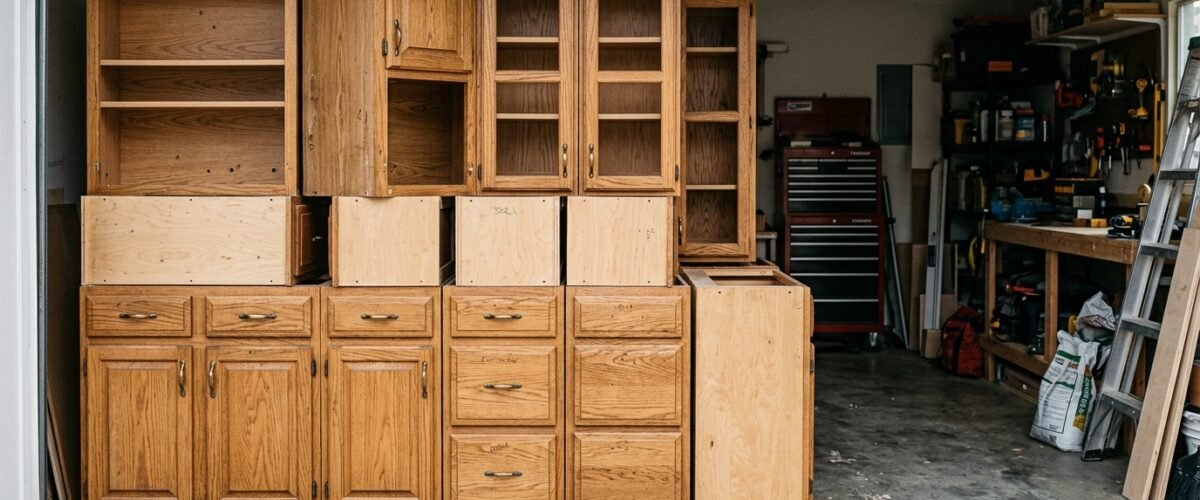
Homeowners who finish kitchen demolitions often stack their old cabinets in the garage and list them online. Unlike fast-moving contractor jobs, private sellers give you more breathing room because their primary goal is clearing garage parking space.
How to search effectively: Set instant keyword notifications on Facebook Marketplace for free cabinets, kitchen demolition, cabinet removal, and free kitchen. Similarly, check the Craigslist “Free” section each morning. Because premium solid-wood sets attract intense competition, the best listings vanish within hours.
What to pay: Expect prices from $0 to $300 for an entire layout. However, never pay more than $50 per box for unverified private listings, since you absorb all structural risk without any warranty.
Red flag: Avoid listings where the homeowner has already separated the doors and drawer slides from the carcass boxes into loose piles. In fact, purchasing replacement hinges and Blum slides for a 12-box kitchen will cost you $400 to $800 in extra hardware.
Step 4: Ask Kitchen Showrooms About Floor Model Blowouts
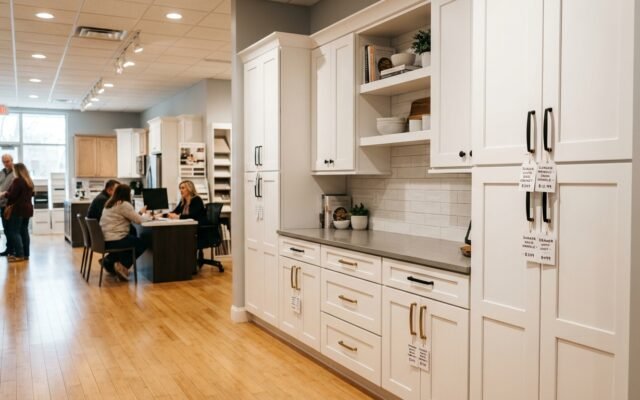
Independent kitchen showrooms redesign their display floor vignettes every 24 to 36 months. At that point, dealers must clear out custom displays originally worth $15,000 to $40,000. To make room for new manufacturer lines, showrooms discount these floor sets by 70% to 85%.
Timing: Showroom display rotations happen most frequently in January and August. Specifically, January follows the post-holiday slow period, whereas August precedes the lucrative autumn remodeling season.
How to find them: Walk into dedicated kitchen design studios (not big-box retail centers) that carry brands like KraftMaid, Wellborn, or Starmark. Speak directly with the showroom manager: “Do you sell your display vignettes when updating lines, and when is your next floor rotation?” Often, they will take your phone number or direct you to a regional dealer warehouse.
What you get: Floor models represent the highest-quality salvage available. Dealership staff clean and maintain these displays daily, so all hardware remains in pristine working order. Nevertheless, remember that designers configure displays to fit showroom walls rather than your home layout. Therefore, prepare to add a matching filler strip or a single new cabinet to fit your exact room dimensions.
Step 5: Find Builder Surplus Auctions
When multi-family condominium or apartment builders purchase excessive cabinet inventories, they offload the remaining inventory to commercial liquidators. Consequently, surplus auction houses sell these brand-new units at 50% to 80% below wholesale distributor cost.
To locate these sales, search Google for building material liquidators or contractor surplus auctions in your metropolitan area. In addition, monitor websites like GovPlanet and regional auctioneers for construction overrun announcements.
What to expect: Builder surplus almost always consists of standard production-grade particleboard lines like American Woodmark or basic MasterBrand runs. While these cabinets work well in utility rooms or rental properties, you should never pay more than $15 to $25 per box for builder-grade particleboard stock.
Step 6: Check Architectural Salvage Warehouses
If you are restoring a vintage craftsman home or Victorian property, architectural salvage warehouses offer unmatched historical lumber quality. In truth, you cannot buy pre-1960 dense, old-growth wood at modern retail lumberyards at any price.
Typically, vintage units cost $25 to $150 per cabinet at architectural yards. Because old-growth lumber grew slowly over centuries, the wood grain remains remarkably dense and rot-resistant. You can locate reputable dealers by searching the Old House Research and Architectural Center (ORCA) directory.
The 5-Point Inspection Before You Load Anything
Always run this quick 10-minute diagnostic on every cabinet set before loading a single box. Skipping this step has forced many homeowners to scrap their salvage after hauling it home.
Check 1 — Moisture rot at the sink base: First, open the sink base doors and inspect the bottom shelf alongside the lower four inches of both sidewalls. If you detect dark discoloration, soft wood when prodded with a screwdriver, or a musty odor, moisture has compromised the core. Because an unstable sink base cannot safely carry the load of a heavy cast-iron or undermount sink, you should reject the entire set if the sink base is rotted.
Check 2 — Frame square test: Next, press your framing square firmly against an interior rear corner. Both metal legs of the square must sit flush against both walls. If you see a gap exceeding 1/4 inch, the cabinet box has racked out of square during removal. Unfortunately, out-of-square boxes cause stubborn door alignment failures that shims cannot correct.
Check 3 — Lead paint protocol: Furthermore, any painted finish applied prior to 1980 could contain toxic lead. You cannot identify lead through visual inspection alone. Instead, snap a 3M LeadCheck swab, rub the liquid over an unvarnished paint chip, and wait 30 seconds. If the chemical turns pink or red, lead paint is present. While you can safely encapsulate lead paint, stripping it requires certified containment gear.
Check 4 — Pest inspection: Then, slide each drawer completely out of the box and shine your flashlight into the rear dado grooves. Cockroach egg cases appear as dark, ridged cylindrical capsules approximately 6 to 8 millimeters in length. Because a single overlooked egg cluster can infest your entire household within weeks, immediately leave any cabinets that show pest debris.
Check 5 — Hardware inventory count: Finally, tally up all hinges, mounting baseplates, drawer glides, and drawer boxes. Genuine replacement Blum CLIP top hinges cost $5 to $7 each, while a pair of Blum Tandem undermount slides runs $50. Consequently, if a 12-cabinet set lacks hardware for eight doors and four drawers, you will immediately spend over $350 on replacement hardware alone.
Common Mistakes
Hauling cabinets without explicit owner permission. Always obtain written or text authorization from the property owner or general contractor before removing materials from job sites. Otherwise, local authorities could treat removal as scrap theft.
Ignoring room layout dimensions. Before driving to inspect cabinets, sketch your exact kitchen footprint. Demolition kitchens built for spacious U-shaped plans rarely fit narrow galley layouts without purchasing expensive custom filler pieces.
Skipping the sink base check. Remember that under-sink plumbing leaks account for nearly all cabinet structural rot. Therefore, always inspect the sink cabinet first before examining other boxes.
Frequently Asked Questions
Is it legal to take cabinets from a demolition job site? You must obtain direct verbal or written consent from the site general contractor or homeowner first. Because contractors remain legally responsible for all demolition debris on-site, loading materials without explicit permission can constitute trespassing or theft.
Can I donate my old cabinets to Habitat for Humanity ReStore? Yes, provided the cabinet boxes remain structurally intact, fully functional, and completely free of water damage. However, you should always phone your local branch beforehand to confirm that their warehouse has floor space available for a multi-piece set.
What if free cabinets are the wrong size for my kitchen? You can easily bridge gaps between cabinet edges and walls by installing color-matched filler strips. Standard 3-inch hardwood filler strips cost between $25 and $50. Alternatively, you can add a single new standard box to complete your run and order matching door fronts from an online supplier.
How do I clean used kitchen cabinets before installing them? Mix equal parts warm water and distilled white vinegar to clean dirt and neutralize lingering odors. For heavy cooking grease, use Krud Kutter at a 4:1 dilution ratio. Afterward, scuff-sand painted surfaces with 120-grit paper and seal them with an oil- or shellac-based primer before repainting.
Are cabinets made before 1980 structurally safe to use? Yes, assuming they pass a lead swab test and feature sound joinery. In fact, mid-century cabinets often feature old-growth solid wood that outperforms modern composite materials in strength and longevity. However, inspect the glue joints carefully because vintage animal hide glue can degrade over decades.