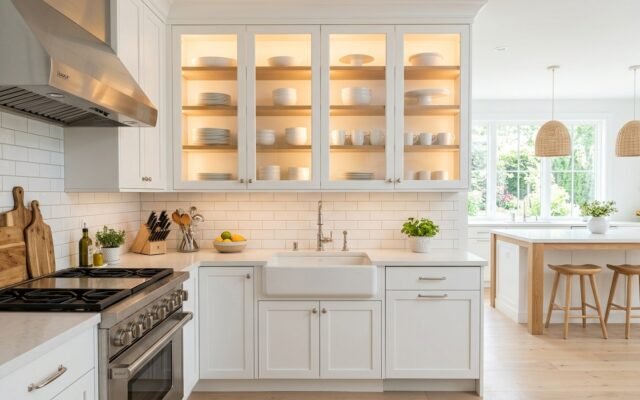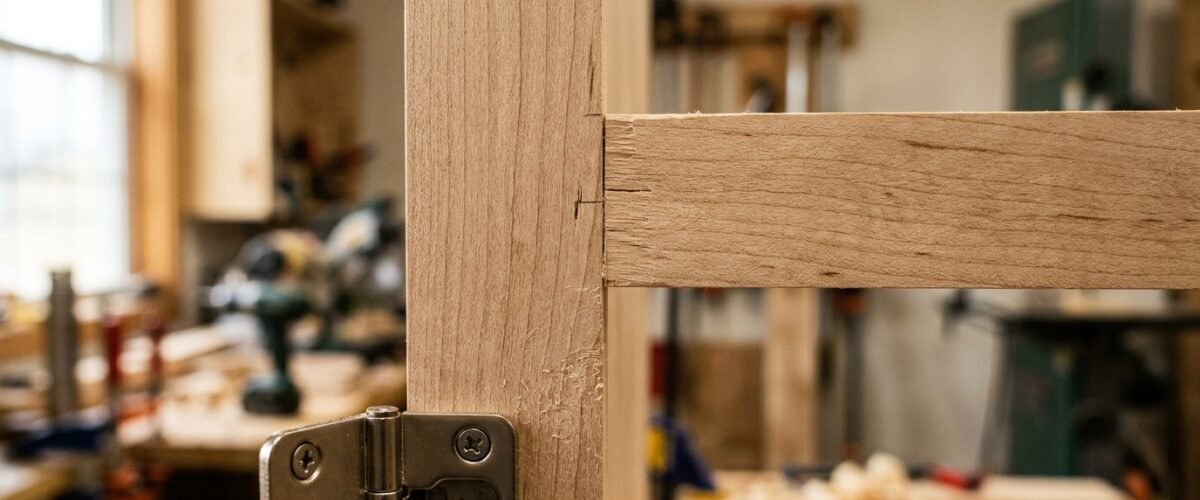
A face frame is a ladder of solid hardwood boards — typically 1.5-inch vertical stiles and 1.5-inch horizontal rails — glued and stapled to the front opening of a cabinet box, adding structural rigidity and providing hinge mounting points for cabinet doors. Face-framed cabinets dominate the North American residential cabinet market, appearing in roughly 80% of kitchens built before 2015, because they produce a traditional furniture-style appearance and tolerate out-of-plumb walls better than frameless European alternatives. In fact, understanding how face frames work helps you evaluate cabinet quality, compare overlay options, and estimate installation complexity before ordering.
Knowing whether your cabinets are face-framed or frameless changes your hardware selection, installation method, and total project cost. Before comparing cabinet styles, review our comprehensive breakdown of frameless vs framed kitchen base cabinets for a direct side-by-side analysis.
Face Frame Anatomy: Parts and Dimensions
| Face Frame Component | Typical Dimension | Function |
|---|---|---|
| Stile (vertical board) | 1.5 inches wide × 3/4 inch thick | Flanks the left and right sides of the cabinet opening |
| Rail (horizontal board) | 1.5 inches wide × 3/4 inch thick | Spans the top and bottom of the cabinet opening |
| Center Stile (mullion) | 1.5 inches wide × 3/4 inch thick | Divides double-door openings into two equal bays |
| Face Frame Wood Species | Hard maple, alder, poplar, cherry | Must match or complement the door species and finish |
| Face Frame Thickness | 3/4 inch | Projects 3/4 inch in front of cabinet box sidewall |
Why Face Frames Exist: Structural and Aesthetic Functions
Face frames serve two simultaneous roles that plain frameless European boxes cannot achieve without additional hardware engineering.
First, face frames provide structural rigidity to the cabinet front opening. When a cabinet installer lifts an upper cabinet onto the wall and drives screws through the back panel into wall studs, the front opening of the box can rack side-to-side under its own weight. Because a 3/4-inch thick hardwood frame bonds all four edges of the opening into a rigid ladder, the cabinet maintains its square geometry during lifting, mounting, and heavy loading.
Second, face frames provide a stable, thick hardwood surface for hinge cup mortising. European cup hinges require drilling a 35mm flat-bottomed hole into the door back and a separate mounting plate into the cabinet interior wall. When a cabinet lacks a face frame, hinges mount directly into 1/2-inch plywood sidewalls. In contrast, face-framed cabinets allow full-overlay and partial-overlay hinges to mount into the 3/4-inch hardwood stile, providing superior screw thread purchase compared to thin plywood.
Door Overlay and Face Frame Reveals
The face frame determines how much of the cabinet opening remains visible when doors are closed — a dimension called the door reveal. Three standard overlay configurations exist for face-framed cabinets, and each creates a distinct visual aesthetic.
First, full-overlay doors cover the entire face frame stile and rail with only a 1/8-inch reveal gap between adjacent doors. Because doors completely hide the hardwood frame, full-overlay face-framed cabinets closely resemble the clean slab appearance of European frameless cabinetry. However, full-overlay requires precisely adjusted European hinges and costs $40 to $90 more per door pair in hardware.
Second, partial-overlay doors leave 1/4 inch to 3/8 inch of the face frame stile visible on each side. This traditional configuration requires inexpensive surface-mounted or offset hinges and delivers the classic American kitchen look that dominated homes built from 1970 through 2005.
Third, inset doors sit completely flush inside the face frame opening with a tight 1/16-inch reveal on all four sides. While inset cabinets produce the highest-end custom appearance, they require the face frame to be perfectly square and the door to be precisely fitted during humid and dry seasonal cycles. Consequently, inset doors cost $80 to $160 more per door pair to produce and install.
How Face Frames Affect Interior Cabinet Access
The 1.5-inch stiles on each side of a face-framed cabinet reduce the clear interior opening width by 3 inches per cabinet box. For a standard 24-inch door base cabinet with two 1.5-inch face frame stiles, the clear interior opening measures approximately 21 inches wide rather than 24 inches. In contrast, a frameless base cabinet provides the full 24-inch interior opening because no face frame stiles obstruct the opening.
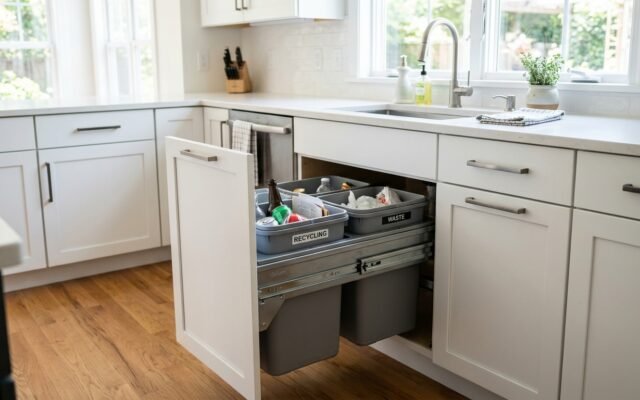
This interior width reduction matters significantly when retrofitting roll-out shelves, pull-out trash systems, and drawer organizers into face-framed cabinets. Because aftermarket pull-out hardware mounts to cabinet sidewalls inside the stile boundary, the accessible interior width shrinks by approximately 3 inches. Therefore, always measure the clear opening inside the face frame — not the cabinet exterior width — when ordering roll-out accessories or filler pull-outs.
Face Frame Wood Species: What to Specify
Hard maple represents the industry standard for painted face frames because it accepts paint evenly with minimal grain telegraphing through the topcoat. Softer woods like poplar absorb paint similarly at lower cost, making them a practical budget alternative for MDF or painted cabinet lines. For natural wood stained kitchens, the face frame must match the door species precisely, because stain absorption rates and grain patterns differ between species. Mixing alder stiles with cherry doors creates visible tonal mismatches visible from across the room.
Specifying solid wood species is particularly important when comparing cabinet quote itemizations, since some budget dealers substitute MDF face frames painted to simulate solid wood. MDF face frames cannot accept screw repairs after stripping and swell irreversibly with exposure to kitchen moisture.
Frequently Asked Questions
What is the difference between a face-framed and frameless cabinet?
A face-framed cabinet has a solid hardwood border glued to the front of the box, while a frameless cabinet presents the raw plywood or MDF box edges directly to the room. Face-framed cabinets offer superior hinge mounting and traditional aesthetics, while frameless cabinets provide 15% to 20% more accessible interior opening width.
Does a face frame make cabinets stronger?
Yes, a properly glued and nailed solid hardwood face frame increases cabinet torsional rigidity significantly. The 3/4-inch hardwood frame keeps the cabinet opening square during installation, heavy loading, and seasonal humidity changes that cause plywood to expand and contract.
Why are face-framed cabinets more common in the USA?
Face-framed cabinets dominate the American market because they require less precision during installation, tolerate out-of-plumb walls more forgivingly, and produce a traditional furniture aesthetic that American homeowners recognized as high quality for decades.
Can you add a face frame to a frameless cabinet?
No, adding a structural face frame to a frameless cabinet after manufacturing is not practical. The box proportions, hinge mounting plates, and door overlay dimensions are engineered around the frameless geometry and cannot be retrofitted with a traditional hardwood frame.
How thick is a standard cabinet face frame?
A standard cabinet face frame measures 3/4 inch thick. The face frame projects this 3/4 inch forward from the front plane of the cabinet sidewalls, creating a slight ledge that serves as the door stop and hinge mounting surface.