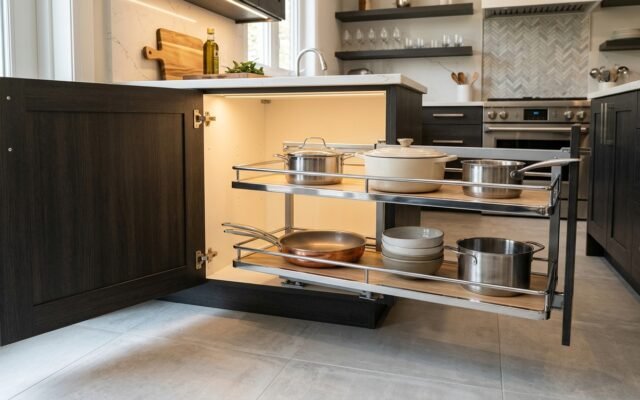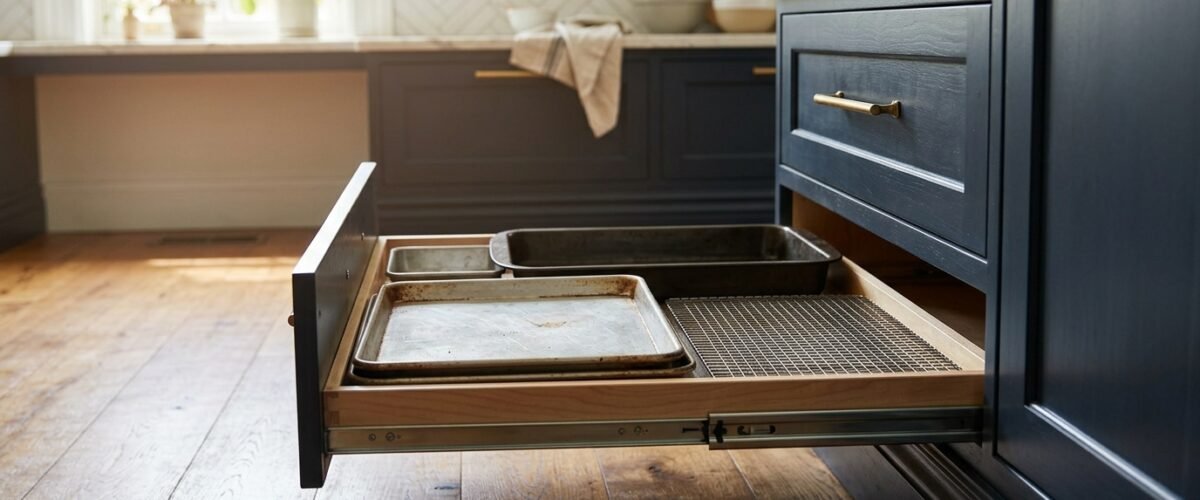
Toe kick drawers convert the recessed 3.5-inch to 4-inch space beneath every base cabinet into a hidden storage bay holding flat baking sheets, large platters, yoga mats, and seasonal kitchen linens. While standard base cabinets measure 34.5 inches high, they reserve the bottom 4 inches for a recessed toe-kick panel to allow comfortable standing proximity. Because most homeowners treat this space as dead air, the average 10×10 kitchen hides between 12 and 18 linear feet of completely unused drawer storage directly under their feet.
Installing toe kick drawers requires no additional cabinetry and no room to lose. Before modifying your existing base run, review our guide on the hidden costs of kitchen cabinets to budget for hardware and finish carpentry.
Toe Kick Drawer Dimensions and Capacity Reference
| Toe Kick Drawer Spec | Standard Measurement |
|---|---|
| Exterior Drawer Width | 12 to 34 inches (spans one cabinet module) |
| Usable Interior Height (clear) | 2.75 to 3.25 inches |
| Usable Interior Depth (clear) | 20 to 22 inches |
| Usable Interior Width (clear) | 10 to 32 inches (depends on module) |
| Approximate Cubic Volume per 30″ Drawer | 2.5 to 3.5 cubic feet |
| Maximum Recommended Load | 25 to 35 lbs per drawer unit |
What to Store in Toe Kick Drawers
Toe kick drawers excel specifically for flat, oversized, and infrequently-used items that consume precious space inside standard cabinet boxes.
First, baking sheets, half-sheet pans, and large roasting trays fit perfectly inside the shallow 3-inch height profile. Because most home bakers own four to eight oversized metal sheet pans, stacking them flat inside a toe kick drawer eliminates the tower of sliding metal pans that typically crash out of standard base cabinets.
Second, oversized serving platters, turkey roasters, and holiday casserole dishes rarely fit neatly inside standard 9-inch deep drawers. However, a 20-inch deep toe kick drawer stores these wide, flat pieces in a single layer at floor level, where they remain readily accessible for Thanksgiving and holiday entertaining seasons.
Third, thin kitchen linens like tablecloths, placemats, and cloth napkins roll neatly into the shallow toe kick space. Storing linens at floor level keeps them away from sharp utensils that can snag delicate fabric inside crowded standard drawers.
Fourth, pet food mats, yoga mats, and bathroom scales slide into toe kick drawers beneath kitchen peninsula cabinets because their flat geometry matches the 3-inch height clearance precisely.
Hardware Specifications: Touch-Latches vs. Handle Pulls
Two distinct opening mechanisms serve toe kick drawers, and each suits a different installation preference.
Touch-latch systems use a magnetic push-to-open mechanism that requires no visible hardware on the face of the drawer. Because toe kick drawers sit at floor level, bending down to grip a pull handle daily becomes annoying. With a touch-latch, you simply tap the drawer face with your foot while your hands carry baking supplies, and the spring mechanism pops the drawer open. Rev-A-Shelf model 6552 series uses a precision push-to-open system that accommodates drawer loads up to 25 pounds.
In contrast, recessed D-ring pulls mount flush into the drawer front face. Because they protrude less than 3/8 inch from the drawer face, they allow the toe kick recess to maintain its standard 3-inch clearance while providing a positive finger grip. Furthermore, flush D-ring pulls work better than touch-latches in kitchens with smooth-faced painted MDF fronts, where repeated foot tapping risks denting or cracking the finish.
Slide Options: Spring-Loaded Undermount vs. Side-Mount Tracks
Spring-loaded undermount slides represent the best mechanical choice for toe kick drawers because they keep the entire slide mechanism hidden beneath the drawer box. Rev-A-Shelf toe kick slides feature stainless steel tracks that mount directly to the sub-floor beneath the cabinet, supporting the drawer box from below. Consequently, the face frame opening remains visually clean without exposed metal track rails.
In contrast, standard side-mount tracks require 1/2 inch of horizontal clearance on each drawer side, reducing usable interior width from 32 inches to roughly 31 inches on a 33-inch cabinet. Since toe kick drawers are already shallow, sacrificing interior width matters significantly. Specifically, the Rev-A-Shelf TKOSC series or Häfele Conexis foot drawer system delivers the best balance of mechanical reliability and hidden slide geometry.
DIY Installation Guide
Installing toe kick drawers into existing kitchen cabinets is a realistic weekend project for capable DIYers.
First, measure the interior depth and width of the toe kick opening at floor level before ordering hardware. Because dishwasher drain lines, electrical conduit, and plumbing P-trap pipe-runs often occupy this space beneath sinks and dishwashers, measure each individual module independently.
Second, order a drawer box sized 1.5 inches narrower than the clear interior opening to allow for slide track clearance. When your hardware arrives, dry-fit the slide tracks onto the sub-floor without fasteners to verify the drawer box slides smoothly.
Third, screw the bottom slide track firmly into the sub-floor using 1.5-inch wood screws, then mount the corresponding top track underneath the cabinet frame bottom rail. Finally, attach the decorative toe kick panel to the drawer front using pre-drilled cleats so the front face aligns flush with adjacent static toe kick boards.
Frequently Asked Questions
How much space do toe kick drawers provide?
Each 30-inch wide toe kick drawer provides approximately 2.5 to 3.5 cubic feet of usable interior volume. In a standard 10×10 kitchen with 18 linear feet of base cabinetry, installing toe kick drawers in every viable module adds 15 to 25 cubic feet of hidden storage.
Can you add toe kick drawers to existing cabinets?
Yes, toe kick drawers install into existing toe kick spaces without modifying the cabinet boxes above. You remove the static toe kick board, mount spring-loaded slide tracks to the sub-floor, and install a shallow drawer box fitted with a matching replacement panel.
Are toe kick drawers worth the cost?
Yes, toe kick drawers are worth their cost of $80 to $220 per drawer unit in kitchens with limited storage. They convert completely dead space into functional storage without requiring any cabinetry modifications or room expansion.
What is the maximum weight a toe kick drawer holds?
Quality toe kick drawers with spring-loaded undermount slides hold between 25 and 35 pounds per drawer. Avoid overloading with heavy cast-iron pieces, since concentrated weight near the floor strains low-mounted slide tracks.
Can you install toe kick drawers under a dishwasher or sink?
No, dishwashers and sink base cabinets block the sub-floor with plumbing, drain hoses, and electrical service lines. Skip these modules and install toe kick drawers only under solid dry-storage base cabinets with clear sub-floor access.