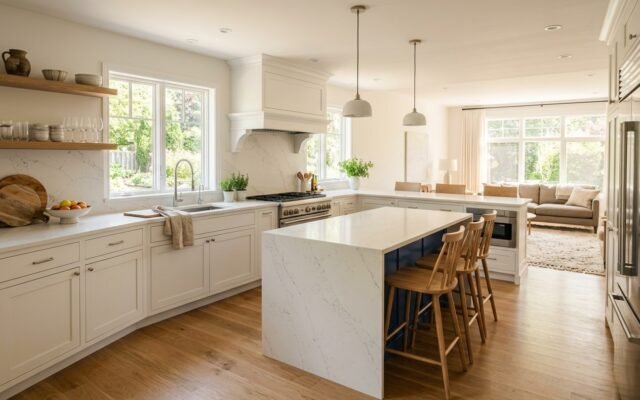
Base cabinets carry your heavy stone countertops, house your sink and appliances, and provide 75% of your functional daily kitchen storage. Picking the right mix between standard doors, deep drawer banks, and specialized pull-out organizers determines whether your kitchen works effortlessly or leaves you digging on your knees for buried cookware. Most homeowners default to standard builder-grade door cabinets to save money upfront, only to spend hundreds of dollars retrofitting pull-out wire baskets later.
Before you place a cabinet order or finalize a floor plan, you need to understand how each base cabinet configuration functions under real kitchen conditions. Standard base cabinets sit at 34-1/2 inches tall and 24 inches deep across nearly all American manufacturers, but the internal hardware and face configuration vary dramatically. Here is the full breakdown of all seven base cabinet types, complete with dimensions, price ranges, and layout recommendations.
Quick Comparison: 7 Kitchen Base Cabinet Types at a Glance
This side-by-side comparison highlights standard manufacturing widths, primary storage functions, and average pricing for each base cabinet category.
| Cabinet Type | Standard Widths | Best For | Average Cost (Stock to Semi-Custom) |
|---|---|---|---|
| Standard Drawer-Over-Door | 12″ to 36″ (3″ increments) | General pantry storage, tall bottles, small appliances | $120 – $450 |
| Multi-Drawer Base Bank | 15″ to 36″ (3″ increments) | Pots, pans, cast iron, dinnerware, utensils | $220 – $750 |
| Sink Base Cabinet | 30″ to 42″ | Drop-in/undermount sinks, garbage disposals, cleaning supplies | $180 – $550 |
| Blind Corner Base Cabinet | 36″ to 48″ | Long corner runs, articulating swing-out shelf retrofits | $220 – $650 |
| Lazy Susan Corner Cabinet | 33″ or 36″ (corner footprint) | 360-degree rotating access to dry goods and mixing bowls | $320 – $850 |
| Pull-Out Waste & Recycling | 15″ to 21″ | Concealed dual trash/recycling bins, prep scrap disposal | $220 – $580 |
| Base Filler & Specialty Pull-Out | 9″ to 12″ (or 3″-6″ fillers) | Spices, baking sheets, cutting boards, narrow gap storage | $160 – $420 |
1. Standard Drawer-Over-Door Base Cabinets
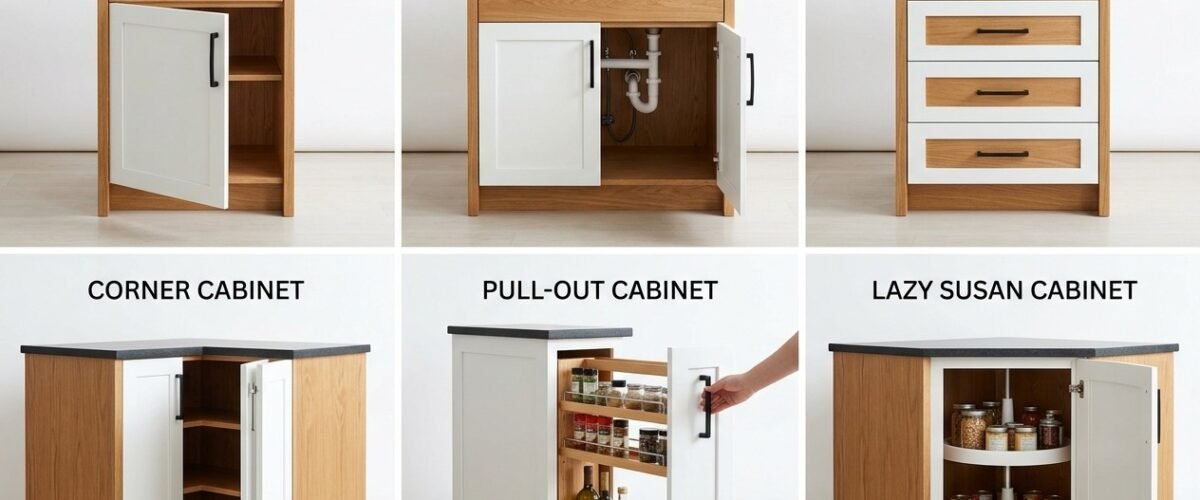
The standard drawer-over-door cabinet is the baseline unit found in builder-grade homes and budget remodel packages. This configuration features a single shallow top drawer (4 to 5 inches deep) positioned above one or two hinged cabinet doors opening to a storage cavity with a half-depth or full-depth adjustable shelf.
Standard widths range from 12 to 36 inches in 3-inch increments, measuring 24 inches deep and 34-1/2 inches tall without countertops. Cabinets from 12 to 21 inches wide feature a single door, while cabinets 24 to 36 inches wide feature double doors. Stock versions start between $120 and $220, while semi-custom plywood boxes range from $300 to $450.
The primary downside is poor ergonomic access. Because the lower cavity is 24 inches deep, items on the bottom shelf migrate toward the rear corners. Retrieving cookware requires kneeling on the floor and clearing front items. To solve this limitation, contractors install aftermarket hardwood roll-out trays mounted to the internal cabinet stiles.
Best applications include secondary pantry runs, laundry rooms, and utility zones where you store tall items like stand mixers, beverage bottles, or bulk paper goods that do not fit inside pull-out drawers.
2. Multi-Drawer Base Cabinets (2-Drawer, 3-Drawer, and 4-Drawer Banks)
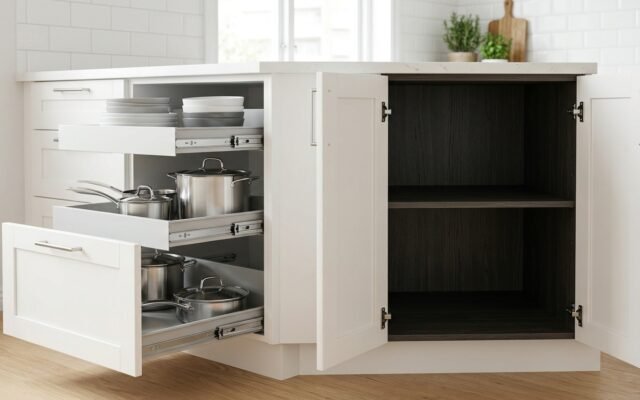
Multi-drawer base cabinets represent the most valuable functional upgrade in modern kitchen design. Instead of reaching into dark cavities, you pull the entire storage volume forward into plain view and easy reach. Professional kitchen designers now allocate 50% to 60% of base cabinet runs to multi-drawer banks.
Drawer banks are manufactured in three distinct configurations:
- Three-Drawer Banks (The Workhorse): Features one shallow 5-inch top drawer for flatware and utensils, followed by two deep 10-inch lower drawers for cookware, mixing bowls, and dinnerware sets.
- Two-Drawer Banks (Deep Cookware): Features two oversized 13-inch deep drawers engineered for large stockpots, Dutch ovens, cast iron skillets, and small appliances like air fryers.
- Four-Drawer Banks (Utensil Specialist): Features four equal-height shallow drawers (roughly 5 to 6 inches deep) designed for baking tools, spices, kitchen linens, and specialty gadgets.
Quality drawer base cabinets rely on 5/8-inch or 3/4-inch solid hardwood dovetail drawer boxes paired with full-extension undermount drawer slides rated for 100 to 150 pounds of dynamic load with soft-close dampers. Prices range from $220 to $400 for stock units and $450 to $750 for semi-custom models.
Position your primary 3-drawer banks adjacent to your cooktop or range. This placement allows you to store cooking utensils in the top drawer and heavy sauté pans in the deep drawers below.
3. Sink Base Cabinets (Standard and Apron-Front Configurations)
Sink base cabinets are specialized structural boxes built without internal fixed shelving or functional upper drawer boxes to accommodate the sink basin, plumbing traps, water lines, and garbage disposals. The upper front face features a decorative false drawer front or a pair of false drawer heads that match the rest of your cabinet run.
Standard widths include 30, 33, 36, 39, and 42 inches. The sizing rule is straightforward: your sink base cabinet width must be at least 3 inches wider than your sink basin width to allow adequate clearance for mounting clips and basin rims. A standard 33-inch double-bowl undermount sink requires a 36-inch sink base cabinet. When planning your layout, verify your plumbing stub-out locations against standard kitchen base cabinet sizes before finalizing your cabinet order.
Two primary styles dominate the market:
- Standard Undermount/Drop-In Sink Base: Features standard-height double doors beneath a fixed false front. Many homeowners upgrade the false drawer panel with stainless steel tip-out trays to store scrub sponges and dish brushes.
- Farmhouse / Apron-Front Sink Base: Features shorter cabinet doors with a reinforced upper support shelf designed to carry 150 to 200 pounds of heavy fireclay or cast iron farmhouse sinks with exposed decorative front aprons.
Prices for sink base cabinets run from $180 to $320 for stock models and $350 to $550 for reinforced semi-custom apron-front boxes. To protect the interior floor of the cabinet from minor plumbing leaks and detergent spills, install a waterproof silicone under-sink drip mat during rough installation.
4. Blind Corner Base Cabinets
Blind corner base cabinets are engineered for kitchen layouts where two cabinet runs meet at a 90-degree corner. The cabinet box extends along one wall while overlapping the perpendicular cabinet run, leaving a concealed void space behind the intersecting cabinet face.
Standard box widths measure 36, 42, or 48 inches, but the cabinet requires 42 to 48 inches of total wall footprint when installed because the unit must be pulled away from the intersecting wall corner to allow the operational door to clear adjacent hardware. Prices range from $220 to $400 for stock units and $420 to $650 for semi-custom plywood boxes.
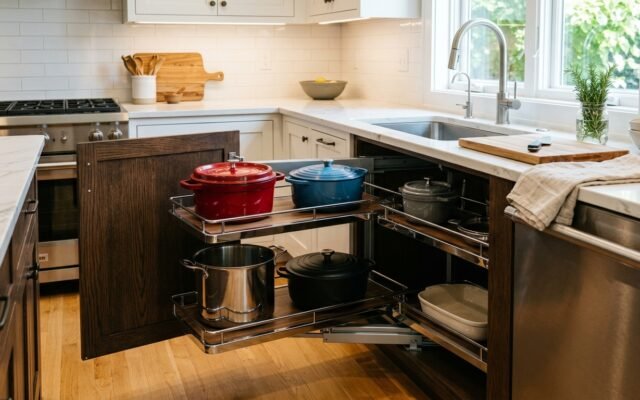
The challenge with a blind corner cabinet is accessibility. Without organizational hardware, reaching into the deep 24-inch void requires awkward bending, and items stored in the back corners are easily forgotten. Modern contractors solve this issue by installing articulating blind corner pull-outs, such as two-tier kidney-shaped shelves or cloud-style pull-out trays that glide out of the blind pocket into the open kitchen room.
If you are deciding between a blind corner and a rotating corner unit, review our dedicated guide on corner kitchen base cabinet options to calculate the usable cubic storage volume for your specific floor plan dimensions.
5. Lazy Susan Corner Base Cabinets
Lazy Susan corner cabinets occupy the corner footprint using a dedicated 90-degree diagonal or pie-cut geometry. Instead of a dead void, the interior features two or three rotating turntable trays mounted to a heavy-duty vertical center pole or fixed to interior corner shelves.
Standard footprints measure 33×33 inches or 36×36 inches along the two corner walls. Two primary door configurations exist:
- Pie-Cut Bi-Fold Doors: The two door panels are hinged together in an L-shape and open outward into the kitchen room, providing unobstructed visual access to the full diameter of the rotating trays.
- Attached Rotating Doors: The door panels are attached directly to the circular trays and rotate inward into the cabinet box when pushed. While sleek, this design can pinch fingers and occasionally drops small items off the back edges behind the turntable.
- Diagonal Corner Cabinets: Features a single flat door set at a 45-degree angle across the corner. This design provides generous shelf area but projects further into the kitchen walkways.
Tray construction materials include heavy-gauge polymer plastic, chrome-plated wire, and multi-ply solid maple hardwood with 1-inch raised retaining rims. Quality turntable hardware supports 40 to 60 pounds per shelf on smooth steel ball bearings. Costs range from $320 to $550 for stock units and $550 to $850 for semi-custom units with solid hardwood revolving trays. Use lazy susans for storing canned goods, small appliances, mixing bowls, and bulk cooking oils.
6. Pull-Out Waste and Recycling Base Cabinets
Dedicated pull-out waste and recycling cabinets conceal ugly trash bins behind a seamless cabinet door face that matches the rest of your kitchen cabinetry. The cabinet door is fastened directly to an internal heavy-gauge steel carriage that glides outward on heavy-duty bottom-mount slides.
Standard widths measure 15 inches for single-bin models (holding one 35-quart or 50-quart container) and 18 to 21 inches for dual-bin models (holding two 35-quart or 50-quart bins for separated trash and recycling). Premium models include a shallow top drawer above the bin carriage for storing rolls of trash bags and cleaning wipes, or an integrated wooden container lid that seals odors inside the bins when closed.
Prices for factory-built waste pull-out cabinets range from $220 to $380 for stock boxes and $380 to $580 for semi-custom models equipped with 150-pound rated soft-close slides. If you have an existing standard 15-inch or 18-inch door cabinet, you can convert it into a waste pull-out for $120 to $200 using an aftermarket bottom-mount slide kit and door-mounting brackets.
Recommended placement: directly between your main prep countertop and your sink base. This allows you to scrape food prep scraps, vegetable peelings, and dinner plates directly into the bins without walking across the kitchen floor.
7. Base Filler and Specialty Pull-Out Cabinets
Specialty narrow pull-out cabinets turn narrow gaps and awkward leftover wall dimensions into high-density organized storage. These cabinets measure 9 inches or 12 inches wide and feature full-height vertical pull-out carriages equipped with specialized interior accessories.
Common specialty configurations include:
- Vertical Spice Pull-Outs: Multi-tiered wooden or chrome shelves with adjustable guard rails to keep spice containers, olive oils, and cooking vinegars upright and organized next to the cooktop.
- Baking Sheet and Tray Dividers: Vertical plywood partition slots that hold large cookie sheets, muffin tins, cutting boards, and pizza pans upright without stacking.
- Utensil and Knife Pull-Outs: Stainless steel canisters and integrated hardwood knife blocks built into a narrow sliding carriage for safe, ergonomic cutlery storage.
- Architectural Filler Pull-Outs: 3-inch and 6-inch sliding mechanisms installed between standard cabinet boxes to eliminate empty dead wall spaces.
Costs for narrow specialty base cabinets run from $160 to $280 for stock units and $280 to $420 for semi-custom units with pre-installed organization hardware. Adding one 9-inch spice pull-out and one 9-inch tray divider adjacent to your cooking range eliminates clutter from your main countertops.
How to Plan the Optimal Base Cabinet Ratio for Your Kitchen
Creating an efficient kitchen layout requires balancing your budget against daily ergonomic convenience. Standard door cabinets cost less upfront, but multi-drawer banks and specialized pull-outs deliver far higher long-term utility.
Follow this proven contractor planning formula when budgeting and laying out your base cabinet runs:
- 60% Drawer Banks: Allocate the majority of your linear base run to 3-drawer and 2-drawer banks for pots, pans, plates, flatware, and dry goods.
- 20% Wet & Waste Storage: Reserve space for your sink base cabinet (36 inches) and dedicated pull-out trash cabinet (18 inches) in the primary cleaning zone.
- 20% Corner & Specialty Cabinets: Complete your layout with one lazy susan or blind corner organizer and one narrow 9-inch pull-out for spices or cutting boards.
This balanced distribution keeps your kitchen organized, prevents dead storage zones, and ensures your remodeling investment delivers strong long-term value.
Related Guides
- Kitchen Base Cabinet Sizes: The Complete Measurement Chart Every Homeowner Needs
- Corner Kitchen Base Cabinet: 4 Types Ranked by How Much Storage You Actually Get
- Shaker vs Flat-Front Slab Cabinets: 2026 Design Showdown
Frequently Asked Questions About Kitchen Base Cabinet Types
Are drawer base cabinets worth the extra cost over standard door cabinets?
Yes. Drawer base cabinets cost 20% to 35% more than standard door cabinets, but they provide full visual and physical access to all stored items without kneeling. They hold more weight and keep cookware organized far more effectively than deep stationary shelves.
What is the best base cabinet type for kitchen corners?
A 36-inch lazy susan corner cabinet with independent rotating trays provides the most balanced combination of storage capacity, durability, and ease of access. For long straight walls meeting at a corner, a blind corner cabinet equipped with an articulating swing-out shelf is the best alternative.
How do you determine the correct sink base cabinet width?
Measure the overall exterior width of your sink basin and add at least 3 inches. A standard 33-inch undermount kitchen sink requires a 36-inch sink base cabinet to accommodate mounting clips and plumbing clearances inside the cabinet walls.
Can you convert a standard door base cabinet into pull-out drawers later?
Yes. You can install aftermarket hardwood roll-out trays or trash pull-out kits inside existing standard door base cabinets using side-mount or bottom-mount brackets. Quality retrofit kits cost between $60 and $180 per cabinet.