Sage Green Kitchen Cabinets: 11 Looks Ranked by Light, Upkeep and Cost
Searches for “sage green kitchen cabinets” are up over 400% year over year, and Pinterest counts 37,000 searches for “sage green kitchen” in its trend data. The problem is not finding a sage kitchen you like. The problem is picking a sage that still looks right in your light, hides the fingerprints your household makes, and fits what a repaint actually costs. This list ranks 11 looks on those 3 measurable things: light (the paint’s LRV), upkeep (a 1 to 5 score), and cost (a pro repaint per linear foot, totaled for a 20-linear-foot kitchen). The winner is not the prettiest photo. It is the look that survives your room.
The 11 Looks, Ranked by Light, Upkeep and Cost
The ranking below scores every look on 3 axes, then orders them by the combined score. Light is the paint’s LRV on the 0 to 100 scale, where 100 is pure white and 0 is black. Upkeep is a 1 to 5 score: 5 hides fingerprints, grease, and water spots best, 1 shows everything. Cost is a pro repaint at $30 to $70 per linear foot, using the $50 midpoint, adjusted for door style: slab adds 0%, shaker adds 10%, two-tone adds 15% for the second color, beadboard and inset add 25% for the extra prep. Every total assumes a 20-linear-foot kitchen. Green has overtaken gray as a top cabinet color choice in the Houzz Kitchen Trends Study, and 86% of designers named green a top choice in the NKBA 2026 Trends Report, so the color itself is a safe bet. The shade is where people go wrong.
| Rank | Look | Paint + LRV | Upkeep (1-5) | Repaint / lin ft | 20-ft total |
|---|---|---|---|---|---|
| 1 | Pale sage two-tone | Sea Salt SW 6204, LRV 63 | 3 | $58 | $1,150 |
| 2 | Clary Sage two-tone | Clary Sage SW 6178, LRV 41 | 5 | $58 | $1,150 |
| 3 | October Mist shaker | October Mist BM 1495, LRV 46 | 4 | $55 | $1,100 |
| 4 | Svelte Sage full run | Svelte Sage SW 6164, LRV 41 | 5 | $55 | $1,100 |
| 5 | Sage + white oak | Clary Sage SW 6178, LRV 41 | 5 | $55 | $1,100 |
| 6 | Sage + brass + marble | Evergreen Fog SW 9130, LRV 30 | 4 | $55 | $1,100 |
| 7 | Acacia Haze slab | Acacia Haze SW 9132, LRV 32 | 4 | $50 | $1,000 |
| 8 | Evergreen Fog island only | Evergreen Fog SW 9130, LRV 30 | 4 | $50 | $1,000 |
| 9 | Sage + black farmhouse | Svelte Sage SW 6164, LRV 41 | 4 | $55 | $1,100 |
| 10 | Retreat deep sage | Retreat SW 6207, LRV 21 | 3 | $55 | $1,100 |
| 11 | Pewter Green statement | Pewter Green SW 6208, LRV 12 | 2 | $55 | $1,100 |
Read the table this way: rank 1 wins on light, rank 2 wins on the combined score for most households, and ranks 10 and 11 are not bad looks. They are looks that demand strong daylight or added lighting, and they punish you on upkeep. If your kitchen faces north, stop at rank 6. If it faces south, all 11 are open to you. The rest of this article walks the list in rank order, with the exact paint code, the pairing, and the catch for each one.
1. Pale Sage Two-Tone: Sea Salt Lowers, White Uppers at LRV 63
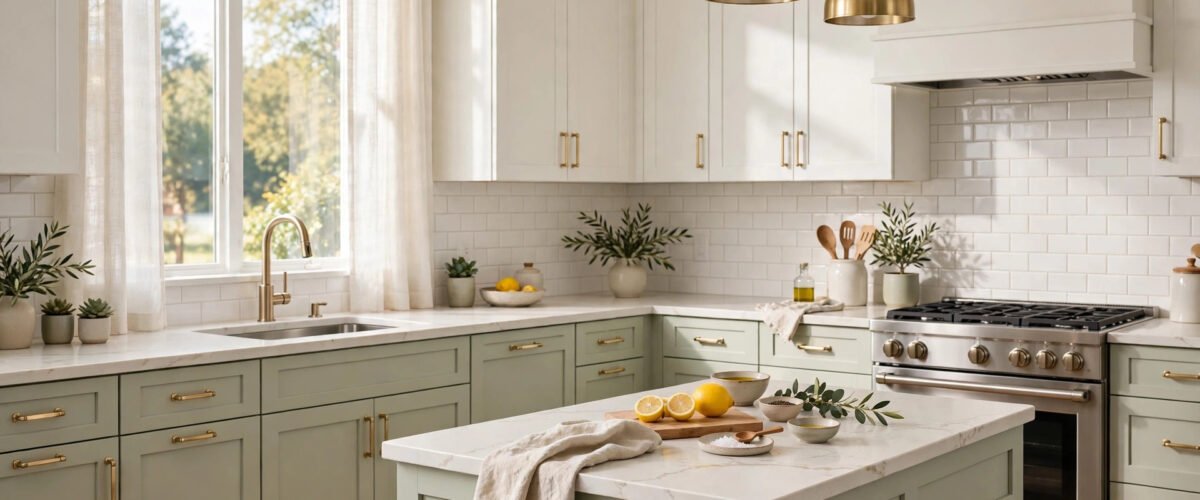
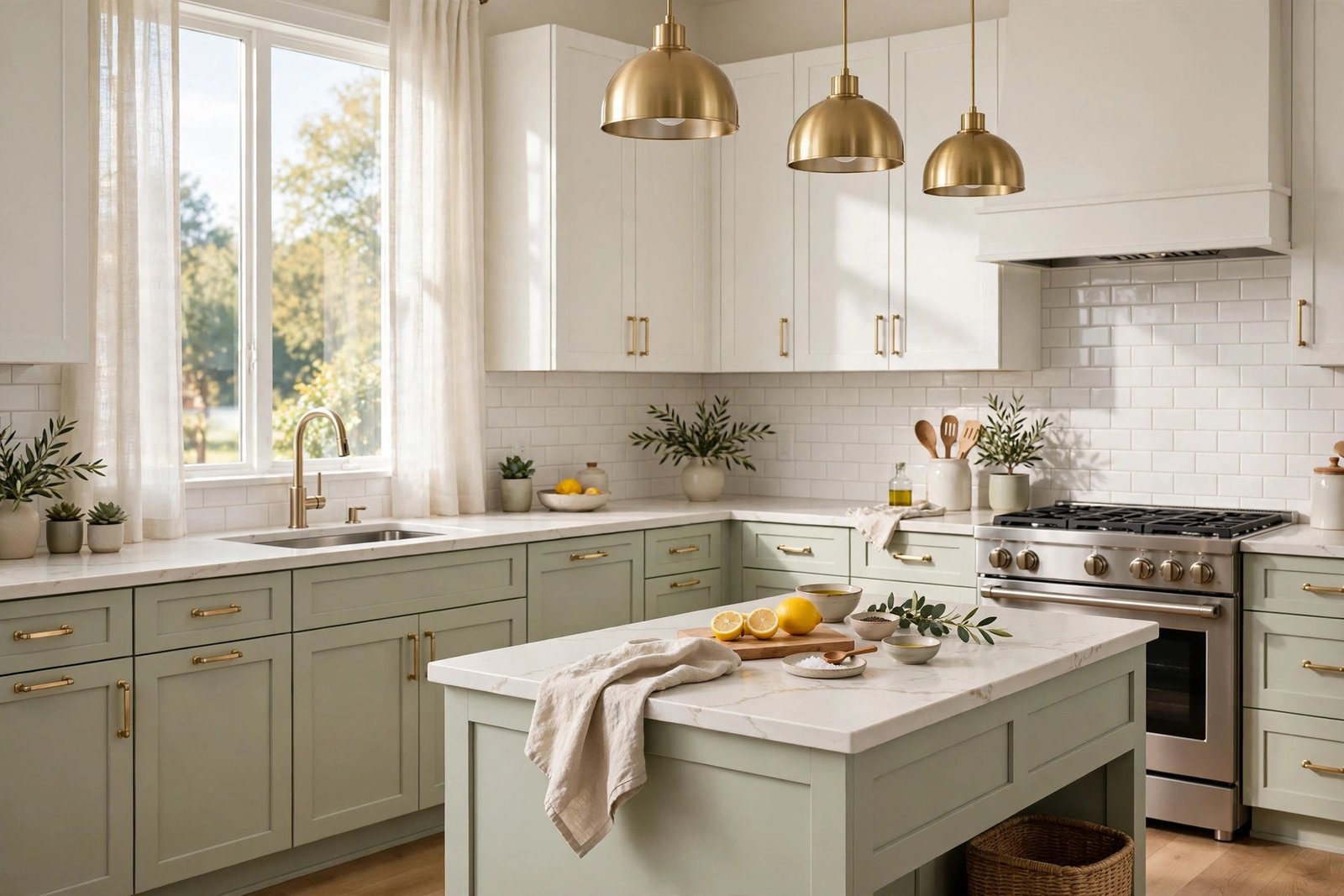
This is the brightest sage look you can buy, and the safest pick for a dark kitchen. Sea Salt (SW 6204) has an LRV of 63, which means it reflects 63% of the light that hits it. That is 22 points lighter than Clary Sage at 41 and 33 points lighter than Evergreen Fog at 30. Put it on the base cabinets only, keep the uppers white, and the room reads light even at 4 pm in winter. The white uppers bounce light back down onto the sage, which is why two-tone beats full sage in a north-facing room. The catch is upkeep: at LRV 63 the paint shows grease splatter near the range and coffee drips near the sink faster than any mid-tone sage. Score 3 out of 5. Wipe the 2 doors flanking the range every day, or the splatter sets. Cost is $58 per linear foot and $1,150 for a 20-foot run, because two colors add a 15% premium on the $50 midpoint. If your kitchen gets less than 3 hours of direct sun a day, start here and stop looking.
2. Clary Sage Two-Tone: The Best Combined Score at LRV 41
Clary Sage (SW 6178) is the look most households should pick. Its LRV of 41 sits in the true mid-tone band: deep enough to read as a real color on the wall, light enough to hold up in a room with one window. Upkeep is the best on this list at 5 out of 5, because a mid-tone gray-green with warm yellow undertones hides fingerprints, dust, and water spots better than pale sage or dark sage. Pair it with white uppers and brushed brass pulls, and you get the most-pinned combination in the 2026 data without paying for it: the same $58 per linear foot and $1,150 total as rank 1, since the two-tone premium is the same. The one weakness is warm light. Under 2700K bulbs at night, Clary Sage leans olive. If your evening lighting is warm, test the swatch at 8 pm before you commit. For a full breakdown of how this shade compares with the rest of the green family, see the green kitchen cabinets guide.
3. October Mist Shaker: LRV 46 in a Classic Door at $55 per Foot
October Mist (BM 1495) is Benjamin Moore’s answer to the same problem Clary Sage solves, 5 LRV points lighter at 46. That gap matters in a small kitchen: 5 points of reflectance is the difference between a color that holds at dusk and one that goes flat. Shaker doors add 10% to the repaint because every recessed panel edge needs sanding and a second pass with the sprayer, which puts this look at $55 per linear foot and $1,100 for 20 feet. Upkeep scores 4 out of 5: the shaker recess collects dust along the inner edge, so you wipe the panel grooves once a week. Choose this over Clary Sage if your cabinets are already shaker and your kitchen is under 120 square feet. The lighter LRV buys you back the brightness a small room loses. If you want the full shade list with exact codes before you narrow it down, the kitchen cabinet paint colors guide lists the 2026 shades with their codes.
4. Svelte Sage Full Run: One Color, LRV 41, and the Lowest Upkeep Effort
Svelte Sage (SW 6164) shares Clary Sage’s LRV of 41 but reads warmer and more khaki, because its undertone leans yellow-brown rather than yellow-green. A full run in one color costs $55 per linear foot and $1,100 for 20 feet: no second color, but the shaker upcharge still applies if your doors are shaker. Upkeep is 5 out of 5, tied for best on the list, and the full run has a practical advantage the two-tone looks do not: one paint can for touch-ups, one color to match in 3 years. The risk is monotony. A full sage run in a kitchen under 100 square feet can feel like a green box. Break it with a white oak open shelf or a light stone backsplash, not with a second paint color. That keeps the repaint simple and the room from closing in.
5. Sage Plus White Oak: Clary Sage Lowers With Wood Uppers at $55 per Foot
This is the pairing designers cite most in 2026: sage lowers with white oak uppers or open shelves. The wood warms the sage, the sage cools the wood, and neither one has to carry the room alone. Use Clary Sage (SW 6178, LRV 41) on the lowers and unfinished or clear-coated white oak above. Cost is $55 per linear foot and $1,100 for 20 feet for the painted portion; the oak is priced separately as a material, not a repaint. Upkeep scores 5 out of 5 on the painted lowers, but the oak needs its own care: oil or hardwax finishes want a refresh every 12 to 24 months, and steam from the sink will darken unsealed oak within a year. Seal the oak within 12 inches of the sink with a water-resistant topcoat, or put the oak shelves on the opposite wall. For the wood side of this pairing, the white oak cabinets guide covers grades and finishes.
6. Sage Plus Brass Plus Marble: Evergreen Fog at LRV 30 With $1,100 Repaint
Evergreen Fog (SW 9130) is Sherwin-Williams’ 2022 Color of the Year and still the most-searched deep sage, at LRV 30. That is 11 points darker than Clary Sage, which makes it a statement color, not a neutral. It works when the rest of the kitchen is light: white marble or quartz counters, brass hardware, and pale walls. The brass is doing real work here, not decoration: warm metal pulls the eye and stops the gray-green from reading flat. Cost is $55 per linear foot and $1,100 for 20 feet. Upkeep is 4 out of 5: the mid-dark tone hides fingerprints well, but unlacquered brass shows water spots, so the pulls near the sink need a weekly wipe. Do not use this look in a north-facing kitchen without adding under-cabinet light at 200 to 400 lumens per linear foot. Below LRV 35, the color needs that light or it turns muddy after sunset.
7. Acacia Haze Slab: LRV 32, Flat Doors, and the Cheapest Repaint at $50 per Foot
Acacia Haze (SW 9132) is the cool, dusty olive-green slab look, at LRV 32. Flat-panel doors have no recesses and no grooves, so the painter charges the base rate with no style upcharge: $50 per linear foot and $1,000 for 20 feet, the cheapest repaint on this list. Upkeep is 4 out of 5: flat doors wipe clean in one pass, but the cool undertone shows dust more than the warm sages do. This is the right pick for a contemporary kitchen where you want the color to read modern, not cottage. The risk is fingerprints on a flat matte surface: they show as shiny patches where hands touch. A satin sheen instead of matte cuts that problem in half, and it costs nothing extra. If your kitchen is slab already, this is the best value on the list.
8. Evergreen Fog Island Only: LRV 30 Where It Cannot Darken the Room
Painting only the island Evergreen Fog (SW 9130, LRV 30) and leaving the perimeter white or pale is the lowest-risk way to use a dark sage. The island is 1 piece of furniture in the middle of the room, not 20 feet of wall, so its LRV barely affects the room’s light. Cost is $50 per linear foot of island run, and a typical 8-foot island runs about $400 to $560 for the repaint. Upkeep is 4 out of 5: the island takes the most contact in the kitchen, from knees, bags, and chairs, so the paint on the island ends takes more scuffs than wall cabinets do. A satin or semi-gloss sheen on the island survives scuffs better than matte. Choose this if you love Evergreen Fog but your kitchen faces north or east. You get the color in the room without paying for it in light.
9. Sage Plus Black Farmhouse: Svelte Sage at LRV 41 With Black Hardware
Svelte Sage (SW 6164, LRV 41) with matte black pulls, black faucet, and a farmhouse sink is the cottage version of the sage trend. The black hardware gives the soft color a hard edge, which keeps the room from feeling washed out. Cost is $55 per linear foot and $1,100 for 20 feet. Upkeep is 4 out of 5: the sage hides marks well, but matte black hardware shows every water spot and fingerprint, so the pulls and faucet need a daily wipe in a hard-water home. The failure mode here is mixing black finishes: matte black pulls, oil-rubbed bronze faucet, and black stainless appliances are 3 different blacks, and side by side they clash. Pick 1 black finish and repeat it on every piece of hardware. For the sink side of this look, the farmhouse sink base cabinet guide covers the base sizes that fit a farmhouse sink.
10. Retreat Deep Sage: LRV 21 for a South-Facing Room Only
Retreat (SW 6207) sits at LRV 21, which is 20 points below Clary Sage and 9 below Evergreen Fog. In a south-facing kitchen with 6 or more hours of direct sun, it reads as a rich, enveloping green. In any other direction, it reads as dark by 3 pm. Cost is $55 per linear foot and $1,100 for 20 feet. Upkeep is 3 out of 5: dark paint shows dust, lint, and water spots, and every touch-up is visible because the color is saturated enough that a brush mark reads. If you pick this, budget for a pro sprayer, not a brush, and add under-cabinet lighting at 300 to 400 lumens per linear foot. Do not pick it for a kitchen under 150 square feet. The color needs room to breathe, and a small room gives it none.
11. Pewter Green Statement: LRV 12 and the Highest Upkeep Cost
Pewter Green (SW 6208) is the darkest sage on this list at LRV 12, which means it reflects only 12% of the light that hits it. It is a statement wall color that happens to come in a cabinet paint can. In a large south-facing kitchen with white counters and brass, it looks intentional and expensive. Everywhere else it looks like a mistake. Cost is $55 per linear foot and $1,100 for 20 feet, but the real cost is upkeep: 2 out of 5, the worst on the list. Dark green shows dust within a day, water spots within an hour of doing dishes, and every fingerprint on every door. A full Pewter Green kitchen needs a weekly wipe-down of every door front, and touch-ups show because the pigment is dense. Pick this only if you have strong daylight, white surfaces to bounce it, and the habit of wiping doors down. Otherwise, use it on 1 wall of uppers or the island, and keep the rest of the room pale.
How These 11 Looks Were Ranked
The ranking uses 3 numbers, not taste. Light is the paint’s published LRV. Upkeep is a 1 to 5 score where 5 hides fingerprints, grease, and water spots best and 1 shows them fastest; mid-tone sages at LRV 30 to 46 score highest because they sit between pale paint that shows grease and dark paint that shows dust. Cost is the pro repaint range of $30 to $70 per linear foot from the 2026 HomeGuide and Fixr guides, taken at the $50 midpoint and adjusted for door style. The combined score weights light first for dark rooms and upkeep first for busy households. If your kitchen has 2 or more cooks and 3 or more kids, move any rank 2 to 5 look to the top of your list: their upkeep score of 5 matters more than 5 LRV points. If your kitchen faces north, move any look above LRV 41 to the top and ignore the rest. The table at the top of this article is the ranking. This section is the method behind it, so you can re-rank it for your own room.
Pick Your Sage by Window Direction in 4 Steps
Your window direction decides your LRV band before your taste gets a vote. Work the tree below, then check the table.
- North-facing or no direct sun: pick LRV 41 to 63. Clary Sage, Svelte Sage, October Mist, or Sea Salt. Add under-cabinet light at 200 to 400 lumens per linear foot if you go below LRV 46.
- East- or west-facing, 3 to 5 hours of sun: pick LRV 30 to 46. Evergreen Fog, Acacia Haze, Clary Sage, and October Mist all work. East light is cool in the morning and warm in the evening, so test the swatch at both ends of the day.
- South-facing, 6 or more hours of sun: any LRV from 12 to 63 works. This is the only direction where Retreat at 21 and Pewter Green at 12 hold their color all day.
- No window over the sink or prep zone: pick LRV 46 or higher, and add under-cabinet lighting at 300 to 400 lumens per linear foot. A windowless sink wall is the worst place for a dark sage, because there is no daylight to rescue it.
If you are repainting rather than ordering new, the same tree applies. The paint does not know whether the cabinet is new or 10 years old. It only knows how much light hits it.
A 10 by 12 Foot North-Facing Kitchen, Worked Start to Finish
Take a 10 by 12 foot kitchen with 1 north window, 20 linear feet of cabinets, and 2 cooks. The window gives cool, weak light for about 3 hours a day. Step 1: the tree says LRV 41 to 63. Step 2: the upkeep score matters because 2 cooks mean daily grease near the range, so the shortlist is Clary Sage two-tone (rank 2) and Svelte Sage full run (rank 4). Step 3: the two-tone costs $1,150 and the full run costs $1,100, a $50 difference. Step 4: pick Clary Sage two-tone, because the white uppers add reflected light the north window cannot, and the $50 buys back brightness every day for the life of the paint. Step 5: add under-cabinet LED strips at 300 lumens per linear foot along the 10-foot prep run, which is 3,000 lumens of task light for about $200 to $1,000 installed. Total job: $1,150 for paint plus the lighting. The same kitchen in Evergreen Fog would save $50 on paint and cost you the color after 4 pm. That is the trade, in numbers.
3 Mistakes That Cost a Repaint
Mistake 1: choosing from a phone screen. Phone screens run 30 to 50% brighter than a wall in a real room, so every sage looks 10 LRV points lighter on your phone than it will on your cabinet. A $50 repaint of 1 door in the real color, or a 12-inch swatch card, costs less than a $1,100 repaint of the wrong sage. Repaint cost if you skip the test: $1,000 to $1,400 for a 20-foot kitchen.
Mistake 2: painting sage over oak without a stain-blocking primer. Oak tannins bleed yellow-brown through light paint within 6 months, and sage at LRV 41 or higher shows every bleed mark. A stain-blocking primer adds about $100 to $200 in materials and 1 day of drying. Skipping it means sanding the doors back and starting over: $550 to $1,400 for the affected run.
Mistake 3: mixing warm and cool sage in one kitchen. Clary Sage is warm and yellow-leaning. Evergreen Fog is cool and gray-leaning. Put one on the lowers and the other on the island and the room looks like 2 kitchens. The fix costs $50 to $70 per linear foot to repaint the smaller run, or $400 to $560 for an 8-foot island. Pick 1 sage, 1 undertone direction, and repeat it.
The 3-Swatch Test Before You Order
Do this before you order paint or sign a painter’s quote. It takes 3 days and about $30 in sample cards.

- Buy 12-inch sample cards, not 2-inch chips, in your top 3 sages. Tape 1 card to a lower door and 1 to an upper door for each color.
- Look at 8 am, noon, and 8 pm. Write down which color reads green, which reads gray, and which reads muddy at each time. The 8 pm check matters most: that is when you cook dinner.
- Hold a white sheet of paper next to each swatch. The paper shows you the undertone: yellow, gray, or blue. If 2 swatches show different undertones, drop 1 of them.
- Wipe each swatch with a damp cloth after 24 hours. The one that shows the wipe mark least is your upkeep winner.
- Order the winner in a satin sheen. Matte shows touch marks, semi-gloss shows every brush line, and satin splits the difference on a cabinet door.
If you are ordering new cabinets rather than repainting, the same test applies to the factory finish sample. A factory sage and a paint-store sage with the same name are not the same color. Test the actual sample, not the name.
What a Sage Repaint Costs in 2026
A pro repaint runs $30 to $70 per linear foot, or $2,000 to $6,500 for an average kitchen, with labor at 80 to 85% of the bill. DIY materials run about $400 for an average kitchen. The spread is wide because prep is the job: degreasing, sanding, and priming take 3 to 5 days, and the paint itself is the cheap part. Get 3 quotes on the same basis, per linear foot, and make each painter count the same 20 feet. A quote per door ($70 to $125 per door) and a quote per linear foot ($30 to $70) can describe the same kitchen at prices $1,000 apart. The table at the top of this article uses the per-linear-foot basis so every look compares fairly. For the wider cost picture before you commit to paint versus new cabinets, the how much do kitchen cabinets cost guide puts repaint against replacement.
7 Questions About Sage Green Cabinets, Answered
Is sage green still trendy in 2026?
Yes. Searches for sage green kitchen cabinets are up over 400% year over year, and green has overtaken gray as a top cabinet color in the Houzz Kitchen Trends Study. Sage now behaves like a neutral, not a trend color, which is why it survives repaint cycles.
What LRV should sage green cabinets have in a north-facing kitchen?
Pick LRV 41 to 63. Clary Sage at 41 is the lowest safe choice, Sea Salt at 63 is the brightest. Below LRV 41, a north-facing kitchen needs added under-cabinet light at 200 to 400 lumens per linear foot or the color turns gray by late afternoon.
Does sage green hide fingerprints better than white?
Yes, if you pick a mid-tone. Sage at LRV 30 to 46 hides fingerprints and grease better than white at LRV 85 or higher, because the color is close to the color of the marks. Pale sage at LRV 63 and dark sage at LRV 12 both show marks faster than a mid-tone.
What countertop goes best with sage green cabinets?
White quartz or marble is the safest pairing: it bounces light back onto the sage and keeps the room bright. White oak works as a second choice for warmth. Dark counters with dark sage close the room in, so pair dark sage only with a light counter.
Can I paint my existing cabinets sage instead of buying new ones?
Yes, and it is the cheaper path. A pro repaint runs $30 to $70 per linear foot, or $2,000 to $6,500 for an average kitchen, against $3,026 or more for a new 10 by 10 RTA kitchen. Use a stain-blocking primer on oak, and test a 12-inch swatch at 8 am, noon, and 8 pm first.
Does sage green work in a small kitchen?
Yes, if you pick LRV 41 or higher and keep the uppers white or pale. A full run of dark sage at LRV 21 or below in a kitchen under 100 square feet reads as a green box. Two-tone with white uppers is the small-kitchen version of this trend.
What hardware color goes with sage green cabinets?
Brushed brass is the most common pairing because warm metal balances the cool gray in sage. Matte black works for a farmhouse look, and polished nickel works if your faucet is already nickel. Pick 1 metal and repeat it on pulls, knobs, and faucet.