Putting cabinets on the wall is a 4-hour job for a first-timer with a helper, and the tools fit in one trip to the store: a stud finder, a 4-foot level, a drill, washer-head cabinet screws, a ledger board, shims, and two clamps. You need about $45 in hardware if you already own the drill and the level. If you are building the boxes yourself first, read how to build kitchen cabinets before you hang anything, because a box that is not square will not hang straight no matter how careful the install is.
What You Will Need: 9 Tools and About $45 in Hardware
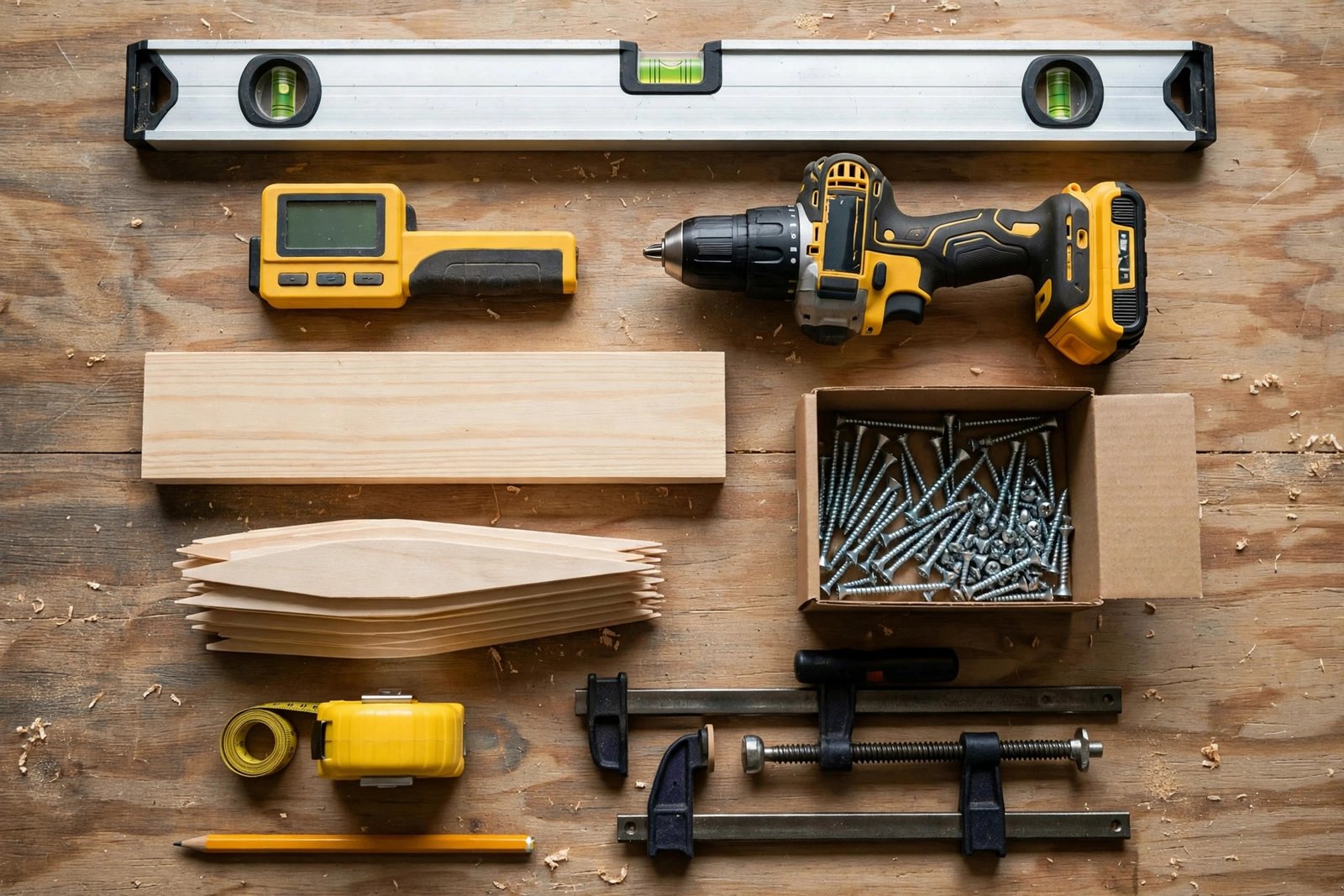
Nine tools and about $45 in hardware cover a 3-cabinet run. Borrow the level and the clamps if you do not own them, and buy the screws a size up from what feels right: a screw that is too short is the most common reason a cabinet pulls away from the wall.
| Tool or material | What it does | Price |
|---|---|---|
| Stud finder | Finds the center of each stud behind drywall | $15 |
| 4-foot level | Checks the ledger line and the cabinet run | Borrow or own |
| Cordless drill and driver bits | Drives screws and pilot holes | Own |
| #8 x 2-1/2 in washer-head cabinet screws, 100-pack | Holds cabinets to studs | $17 |
| #8 x 1-1/4 in washer-head screws, 100-pack | Joins cabinet faces together | $12 |
| Ledger board, 1×4 pine, 8 ft | Temporary shelf the cabinets rest on | About $6 |
| Wood shims, bundle | Fills gaps between cabinet and wall | About $5 |
| 2 clamps | Hold faces flush while you join them | Borrow or own |
| Tape measure and pencil | Marks the line and the stud centers | Own |
Remove the doors and drawers from every cabinet before you lift it. A 30-inch wall cabinet weighs 40 to 55 pounds empty, and the doors add weight exactly where you do not want it: at the front, pulling the box forward while you hold it up.
The 7 Steps to Hang Wall Cabinets

- Mark the 54-inch line and find every stud. Measure 54 inches up from the floor and draw a level line across the whole run, because the bottom of the cabinet sits 54 inches off the floor over a 36-inch counter with an 18-inch gap. Find each stud with the finder, mark both edges, and mark the center with an X. Check: the line reads level end to end and every stud center is marked. Time: 20 minutes.
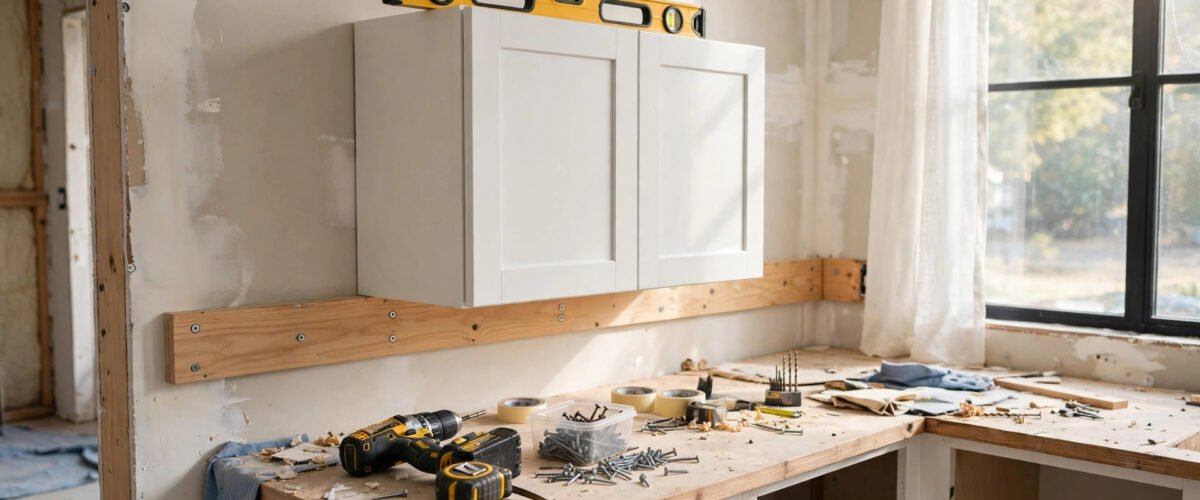
- Screw the ledger board to the studs. Set a straight 1×4 pine board with its top edge on the line and drive a 2-1/2 inch screw into every stud it crosses. Check: the board does not flex when you press down on it, and the level still reads true on its top edge. Time: 15 minutes.
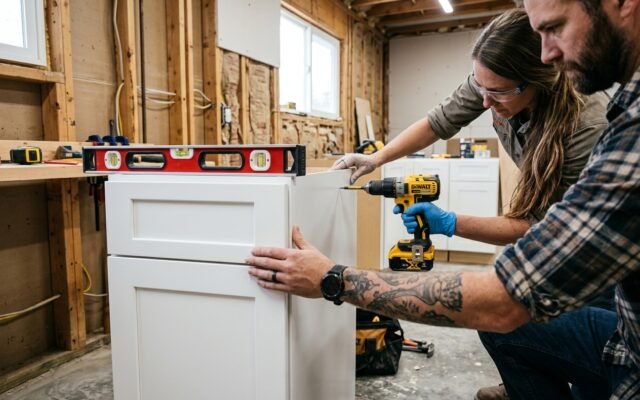
- Set the first cabinet on the ledger. Start with the corner cabinet, or the leftmost cabinet if there is no corner. Lift it with a helper, set the bottom on the ledger, and push the back tight to the wall. Check: the bottom sits flat on the ledger with no rocking, and the side reads plumb. Time: 15 minutes.
- Drive 2 screws per stud through the rails. Drill pilot holes through the top and bottom mounting rails, centered on each stud, then drive 2-1/2 inch washer-head screws through them. Snug each screw until the washer seats, then stop: burying the head crushes the rail and cracks the cabinet back. Check: pull the top of the cabinet toward you and it does not move. Time: 10 minutes per cabinet.
- Hang the next cabinet, clamp the faces flush, and join them. Set the next cabinet on the ledger beside the first, clamp the face frames together so the fronts sit flush within 1/16 inch, then drive 1-1/4 inch screws through the frames in 2 to 3 places. Check: run your hand across the joint and feel no step between the faces. Time: 20 minutes per cabinet.
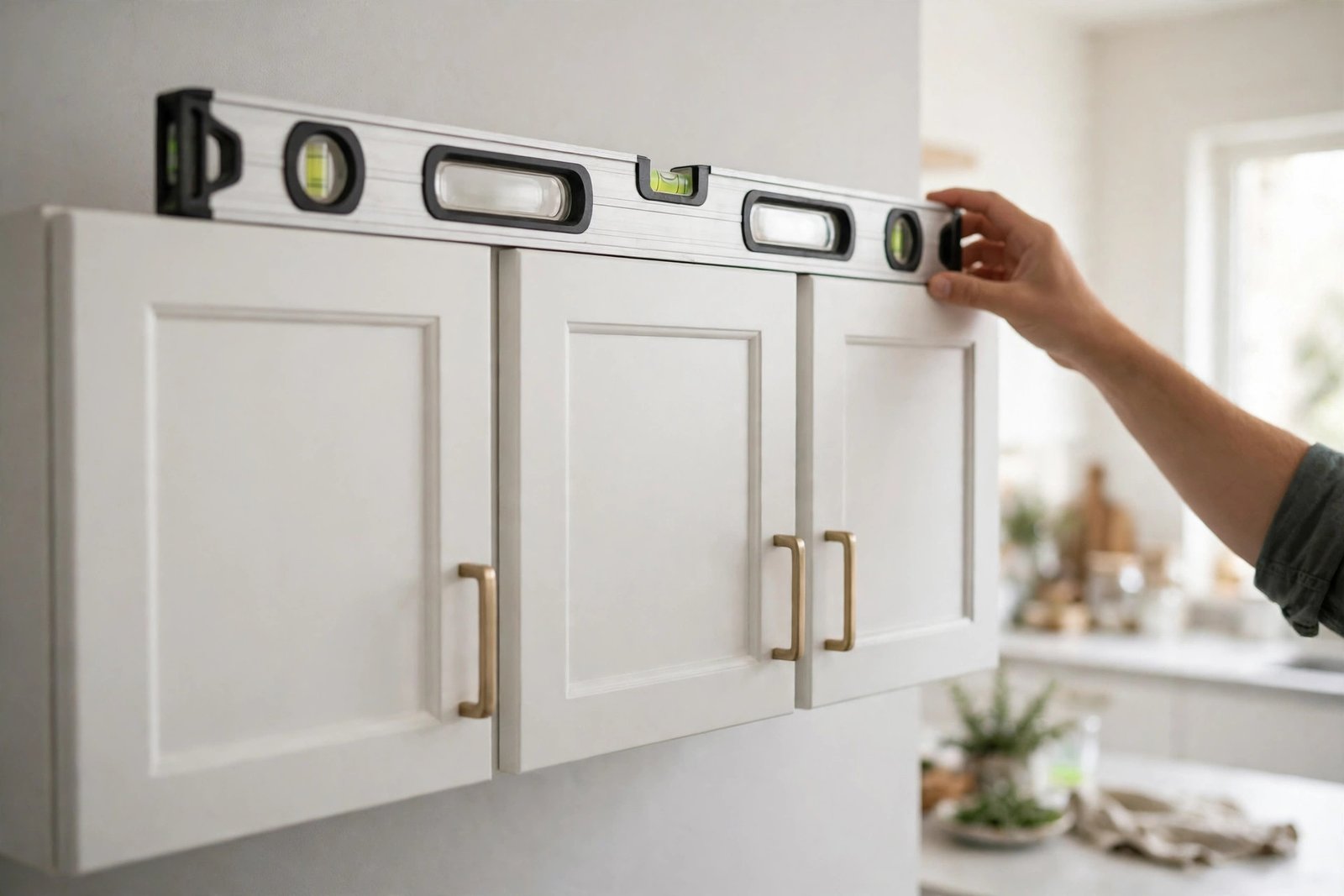
- Shim the gaps and check level across the run. Slide shims between the cabinet backs and the wall at each stud line until the faces sit in one plane, then check the tops with the 4-foot level and the fronts with the level held vertical. Check: the bubble reads true on the top of every cabinet and down the face of the run. Time: 15 minutes.
- Remove the ledger, hang the doors, and load-test. Take the ledger board off the wall, rehang the doors, and adjust the hinges until every door closes without rubbing. Load each shelf with about 25 pounds of dishes and check again after 24 hours. Check: doors close cleanly, gaps stay even, and no cabinet has moved on the line. Time: 30 minutes.
Total working time runs about 2.5 hours for a 3-cabinet run, plus 30 minutes of measuring and layout and 15 minutes of cleanup, which puts a first-timer at about 4 hours. A second run takes about 2.5 hours total, because the measuring goes twice as fast once you have done it.
How Many Screws Hold a Loaded Cabinet: 4 Screws, 90 Pounds
Two screws per stud is the number, and the math behind it is reassuring. A 30-inch wall cabinet weighs 40 to 55 pounds empty and about 90 to 110 pounds loaded with dishes, and it hits 2 studs, so 4 screws carry the load at about 25 pounds per screw. A number 8 cabinet screw carries a 360-pound shear rating, which means the screw itself is never the weak link: the grip of the threads in the stud and the strength of the cabinet back give out long before the screw snaps. The loaded weight includes dishes on the shelves, and the shelf weight limits for your current cabinets show how fast that adds up.
| Cabinet width | Studs hit | Screws (2 per stud) | Loaded weight | Load per screw |
|---|---|---|---|---|
| 12 in | 1 | 2 | 60 lb | 30 lb |
| 24 in | 2 | 4 | 85 lb | 21 lb |
| 30 in | 2 | 4 | 100 lb | 25 lb |
| 36 in | 3 | 6 | 115 lb | 19 lb |
The top screws do the hard work. A 12-inch deep cabinet holds its weight about 6 inches out from the wall, which pries the top of the cabinet away from the wall while the bottom pushes into it. That is why the top rail gets the same 2 screws as the bottom rail, and why a cabinet hung with screws only through the bottom rail sags forward within months.
A 10-foot wall shows how the numbers add up in a real kitchen. Take 120 inches of wall, leave 30 inches clear above the range with no cabinet, and 90 inches remain for wall cabinets: a 36-inch cabinet, a 30-inch cabinet, and a 24-inch cabinet. Studs sit 16 inches on center from the corner, at 16, 32, 48, 64, 80, 96, and 112 inches. The 36-inch cabinet hits studs at 16 and 32 for 4 screws, the 30-inch cabinet hits studs at 64 and 80 for 4 screws, and the 24-inch cabinet hits studs at 96 and 112 for 4 screws, plus the ledger takes one screw per stud while it is up. The whole run needs 12 cabinet screws and 7 ledger screws, and a 100-pack box covers the job three times over. Keep 30 inches above the cooking surface clear of any unprotected cabinet bottom, and measure the range zone before you mark the 54-inch line, not after.
No Studs Where You Need Them: 3 Fixes That Hold
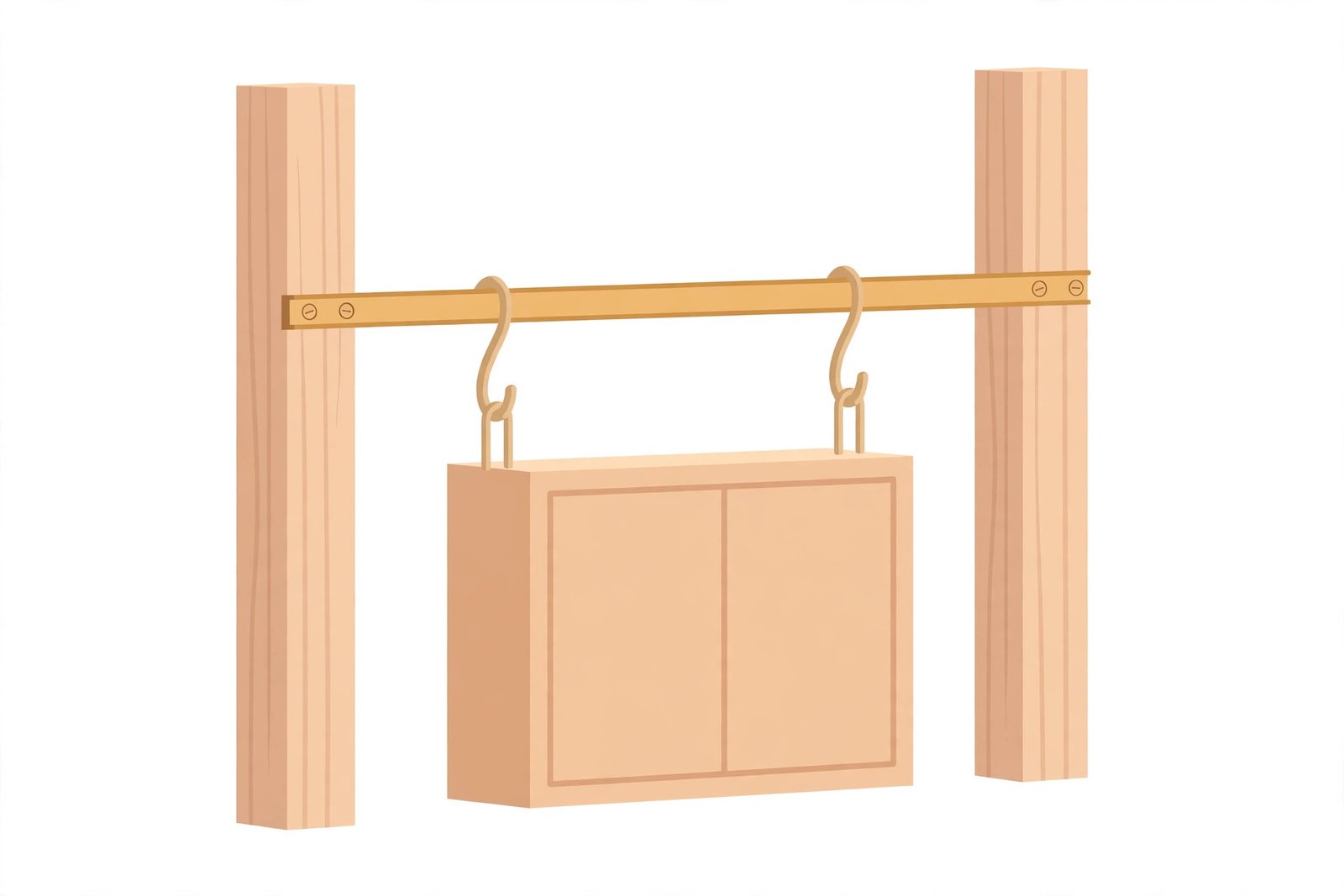
A cabinet that lands between studs still hangs safely if you move the load sideways to the nearest stud. Pick the fix by what the wall gives you.
Studs within 32 inches: hang a suspension rail. Screw a steel cabinet rail level across the wall into 2 studs, then hook the cabinets over it. The rail carries the load to the studs and lets you slide each cabinet sideways to its exact position before locking it down. This is the standard fix for a single cabinet with no stud behind it.
One stud behind the cabinet: screw to it and add a French cleat. Drive 2 screws into the one stud, then screw a 30-inch aluminum cleat to the wall across the same stud and hang the cabinet from the cleat as well. The cleat spreads the remaining load across the wall instead of leaving it all on 2 screws.
No studs at all: toggles, derated. A toggle anchor rated at 265 pounds in half-inch drywall carries about 66 pounds of safe working load, because the maker says to use one-fourth or less of the maximum rating. Four toggles on a rail give you about 264 pounds of safe working load, more than double a loaded 30-inch cabinet at 100 pounds. Never hang a cabinet on toggles alone without a rail: the rail spreads the load across all four anchors, while 2 screws through a cabinet back put the whole load on 2 points in drywall that crumbles around them over time.
Plaster and lath walls need longer screws into the studs, because the plaster layer is thicker and crumbles if a toggle expands inside it. Metal studs need fine-thread screws made for metal, or toggles rated for metal studs: wood screws spin in a metal stud and hold nothing.
4 Mistakes That Make Cabinets Sag (and the Fix for Each)
The cabinet pulls away from the wall. The screws missed the stud and bit only drywall, so the weight slowly opens the holes. Fix: take the cabinet down, find the stud centers with a finder and a finish nail, and rehang it with 2 screws per stud. A drywall patch and paint run $40 to $80 if the old holes need covering.
The run sags in the middle. The cabinets are joined to each other but not screwed to a stud at the joint, so the middle of the run drops under load. Fix: drive 2 screws through the rails into the nearest stud on each side of the joint, then relevel. Cost: nothing if the screws are on hand, and 1 hour of work.
The doors rub after loading. The cabinet racked during install, so the box is a fraction out of square and the doors bind once dishes go in. Fix: loosen the wall screws, relevel the box, retighten, and adjust the hinges. Cost: 30 minutes and no materials.
The ledger line is not level. The whole run slopes 1/4 inch over 10 feet because the ledger went up on a line drawn from the floor instead of a level. Fix: take the cabinets down and redo the ledger on a level line, which costs 1 hour. Prevention costs nothing: check the ledger with the 4-foot level before the first cabinet goes on it.
Time and Cost: 4 Hours DIY vs $165 to $255 Pro
A first-timer hangs a 3-cabinet run in about 4 hours including measuring and cleanup, and spends about $45 on hardware. A handyman charges $55 to $85 per cabinet, so the same 3 cabinets cost $165 to $255 in labor, and a specialist charges $100 to $500 per cabinet. Hourly rates for install work run $38 to $80, and a pro finishes a 3-cabinet run in about 2 to 3 hours on site.
| Option | Time | Cost | When it wins |
|---|---|---|---|
| DIY, first run | 4 hours | About $45 in hardware | You own a drill and a level and the run is straight |
| DIY, second run | 2.5 hours | About $45 in hardware | You have done it once and the walls are true |
| Handyman | 2-3 hours on site | $165-$255 for 3 cabinets | No helper, no level, or the wall is out of plumb |
| Specialist installer | 2-3 hours on site | $300-$1,500 for 3 cabinets | Custom cabinets, scribed panels, or a full kitchen |
Hire the pro when the wall is out of plumb by more than 1/2 inch over the run, when the cabinets are custom and need scribing, or when you have no helper to lift. A 30-inch cabinet at 50 pounds is a two-person lift onto a ledger, and a dropped cabinet costs more than the install you were trying to save. If the rest of the kitchen is still in pieces, the full sequence in installing kitchen cabinets puts the uppers before the bases for a reason: you work over an empty floor instead of leaning across finished base cabinets. If an island is part of the same remodel, hang the uppers before the island goes in.
Frequently Asked Questions: 6 Answers
How high should wall cabinets be above the counter?
Hang them with the bottom 54 inches off the floor, which leaves an 18-inch gap above a standard 36-inch counter. Raise the line if the counter is taller, and keep 30 inches clear above a cooktop.
Can you hang a wall cabinet with only one stud?
Yes. Drive 2 screws into the one stud and add a suspension rail or a French cleat that reaches a second stud. Never hang a loaded cabinet on drywall anchors alone without a rail.
How many screws do you need per wall cabinet?
Two screws per stud, one through the top rail and one through the bottom rail. A 30-inch cabinet hitting 2 studs takes 4 screws, and a 36-inch cabinet hitting 3 studs takes 6.
Do you need a ledger board to hang cabinets?
You need either a ledger board or a helper. The ledger carries the weight while you drive the screws, so one person can hang a cabinet alone. Without it, a second person holds the box.
Can you hang wall cabinets alone?
Yes, with a ledger board and cabinets under 36 inches wide. Remove the doors first to cut the weight, and do not lift a 36-inch or wider cabinet alone: it weighs 50 pounds or more and tips forward off the ledger.
How long does it take to hang 3 wall cabinets?
About 4 hours for a first-timer, including measuring, layout, and cleanup. A pro finishes the same run in 2 to 3 hours on site, and a second DIY run takes about 2.5 hours.