A kitchen cabinet shelf is a 3/4-inch board on four pins, and it still decides whether your dishes are reachable or buried. Wall cabinet shelves run 12 inches deep, base cabinet shelves run 24 inches deep, and the standard test load is 15 pounds per square foot held for 7 days. This guide gives you the standard sizes, the weight each width actually holds, the materials that sag and the ones that do not, and a worked layout for a 36-inch wall cabinet.
Standard Kitchen Cabinet Shelf Sizes: 12, 24, and 36 Inches
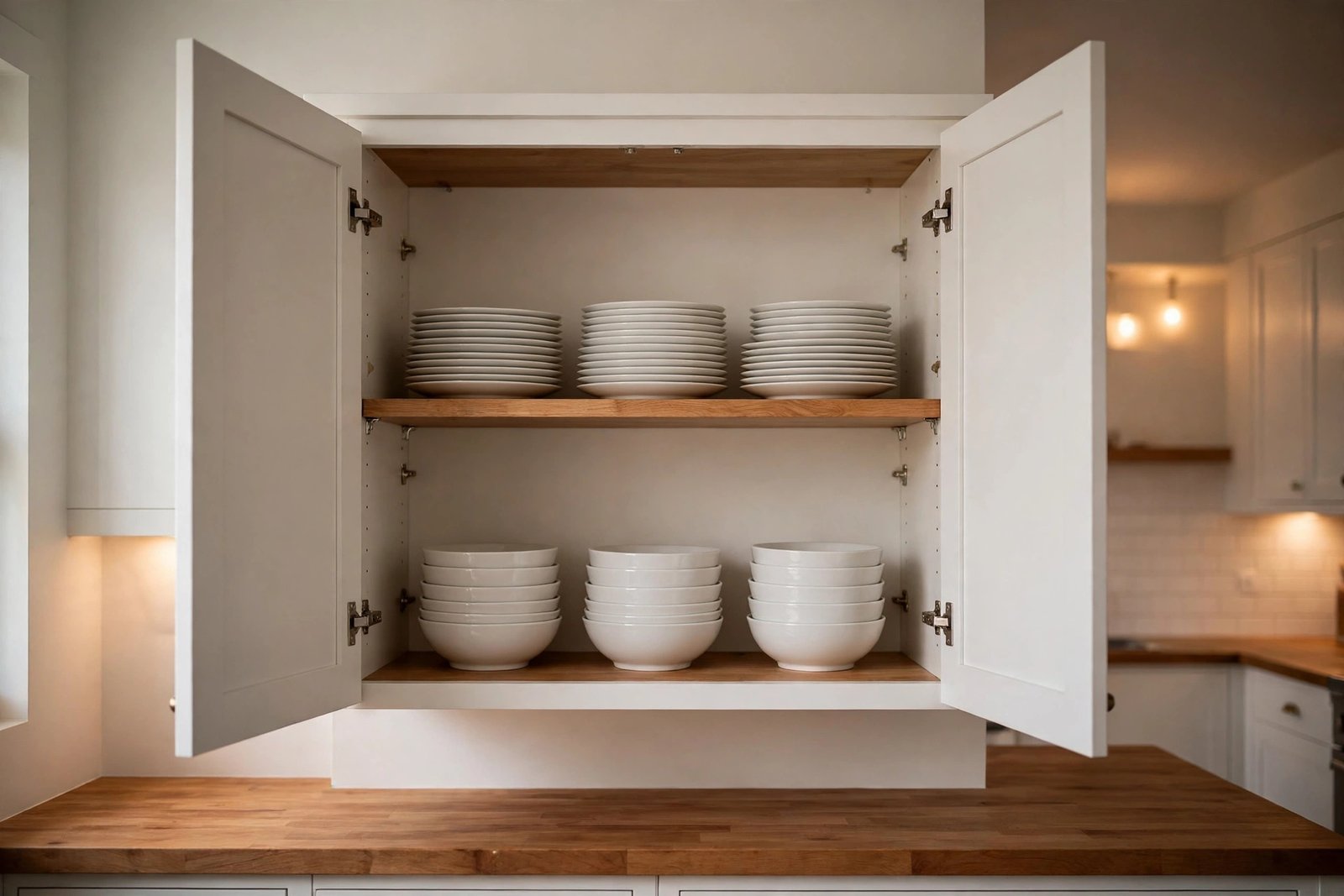
Wall cabinets hold 12-inch-deep shelves. Base cabinets hold 24-inch-deep shelves, cut about 1/4 inch short so the door closes. Pantry shelves fall between 12 and 16 inches deep. Shelf widths follow the cabinet: 12, 15, 18, 24, 30, and 36 inches are the standard widths, and a 36-inch cabinet gives you a 34-inch shelf once the 3/4-inch sides are counted on both ends.
| Cabinet | Shelf depth | Shelf width | Vertical spacing |
|---|---|---|---|
| Wall cabinet | 12 in | 10 to 34 in | 8 to 18 in |
| Base cabinet | 22 to 23 in | 10 to 34 in | 10 to 18 in |
| Pantry cabinet | 12 to 16 in | 10 to 34 in | 10 to 12 in |
| Corner cabinet | 12 to 24 in | varies | 12 to 18 in |
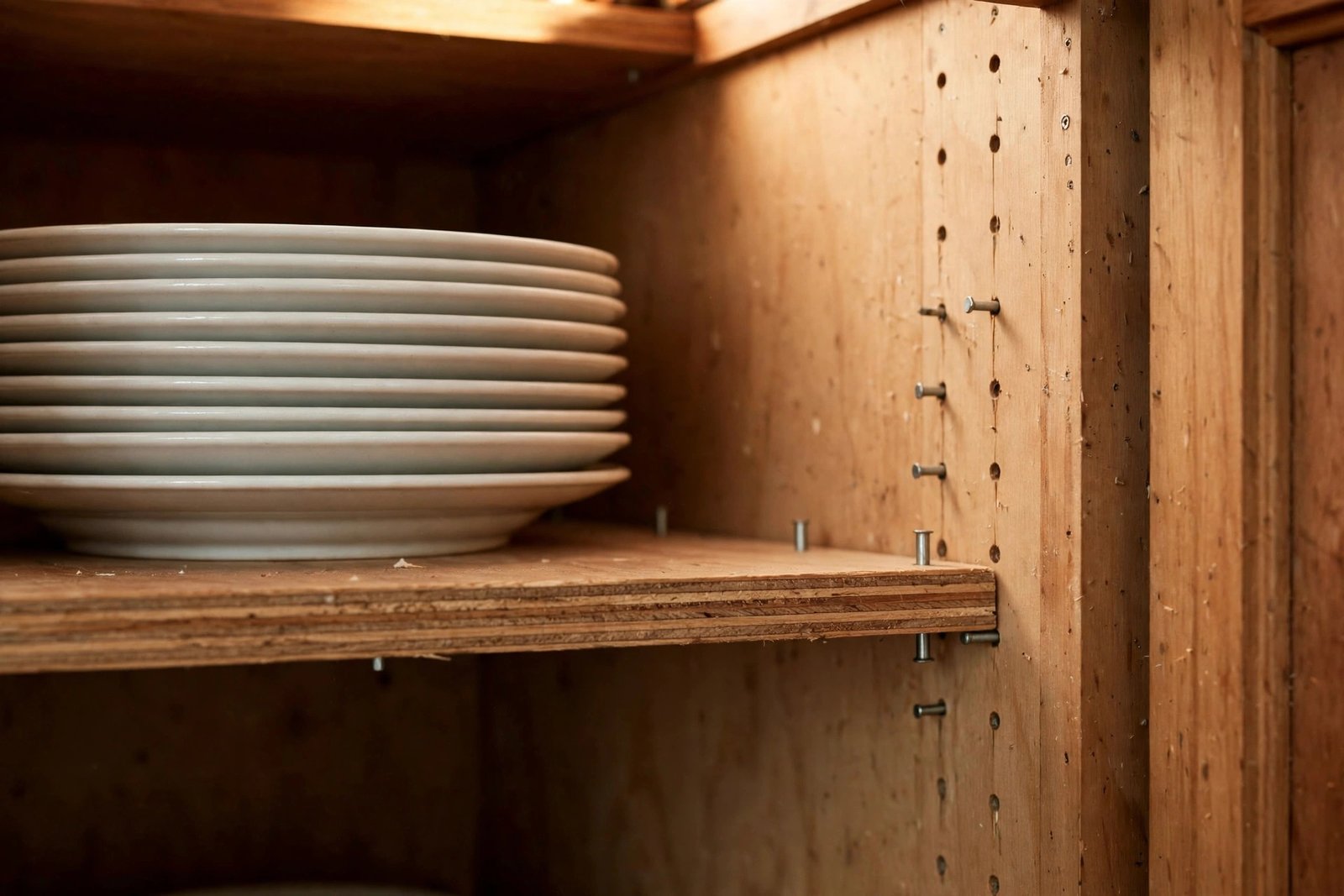
Vertical spacing is where most kitchens go wrong. Plates need 11 inches of clearance to stack and lift out. Bowls need 9 inches. Glasses need 10 inches for a tall tumbler. Mugs need 8 inches. Set the bottom shelf for your tallest item, then space the rest. Adjustable shelves move in 1-inch increments on pin holes spaced 1 to 1.25 inches apart, so you can tune the layout after the dishes are in. For the pins themselves, see our shelf pin guide.
How Much Weight Can a Cabinet Shelf Hold? 15 Pounds per Square Foot
The number that matters is the KCMA test load. Shelves and cabinet bottoms are loaded at 15 pounds per square foot, and the load stays on for 7 days, with no excessive deflection and no joint separation allowed. That is the ANSI/KCMA A161.1 standard, the only nationally recognised performance standard for kitchen cabinets. A shelf that passes it holds the load for a week without sagging past the limit, which is 1/16 inch of deflection per foot of span and 1/4 inch maximum between supports.
Here is what 15 pounds per square foot means for each standard shelf width. The table is computed from the test load, using an 11.25-inch-deep wall shelf.
| Cabinet width | Shelf area | KCMA test load | What that holds |
|---|---|---|---|
| 12 in | 0.78 sq ft | 12 lb | 6 dinner plates |
| 18 in | 1.17 sq ft | 18 lb | 9 dinner plates |
| 24 in | 1.56 sq ft | 23 lb | 12 dinner plates |
| 30 in | 1.95 sq ft | 29 lb | 15 dinner plates |
| 36 in | 2.34 sq ft | 35 lb | 18 dinner plates |
A dinner plate weighs about 2 pounds, so the plate counts are the practical translation. The key line is the 36-inch shelf: 35 pounds is the certified load, and a full stack of plates plus bowls gets there fast. If your 36-inch shelf holds more than 35 pounds, it is carrying more than the standard ever tested. That is when material choice decides whether it sags. The load is not the whole story, because a shelf can pass the 7-day test and still sag over 2 years. Long-term creep is covered in the materials section below.
Shelf Materials Compared: 5 Materials, 1 Sag Test
Sag is the failure that matters. A shelf does not break. It bows in the middle, a little more every month, until plates slide and the gap under the shelf disappears. The test for it is the Sagulator, a free shelf deflection calculator from WoodBin. Its rule is simple: long-term sag past 0.02 inches per foot of span is visible, and the target is to stay under it. The table below gives the longest span each material can carry at 40 pounds per foot of shelf while staying inside that limit, for an 11.25-inch-deep shelf resting on pins.
| Material, 3/4 in thick | Max span, 3/4 in | Max span, 1 in thick |
|---|---|---|
| Red oak | 29 in | 39 in |
| White oak | 29 in | 39 in |
| Baltic birch plywood | 25 in | 33 in |
| Douglas-fir plywood | 23 in | 30 in |
| MDF | 14 in | 18 in |
| Particleboard / melamine | 12 in | 16 in |
Read the table from the bottom up. A 3/4-inch MDF shelf fails the sag limit past a 14-inch span, and a melamine shelf past 12 inches. Both are standard in stock cabinets, and both sit in 30-inch and 36-inch cabinets. That is why sagged shelves are almost always MDF or particleboard in a wide cabinet. Plywood at 3/4 inch holds to 23 or 25 inches, and solid oak to 29 inches. None of the 3/4-inch materials passes a 36-inch span at 40 pounds per foot, which is why wide shelves need a fix: a thicker board, a front edge strip, or a centre support.
Creep makes the gap worse over time. Under a permanent load, deflection keeps growing: about 60 percent more for solid wood, 80 percent for plywood, and 225 percent for particleboard and MDF. A melamine shelf that looks flat on day one can sag 3 times as far after 2 years. The fix that costs least is a glued 1.5-inch solid wood strip on the front edge, which cuts deflection to about 0.38 times the bare board. For the full material comparison, see our plywood cabinet guide and MDF vs plywood cabinets.
Worked Example: Laying Out a 36-Inch Wall Cabinet
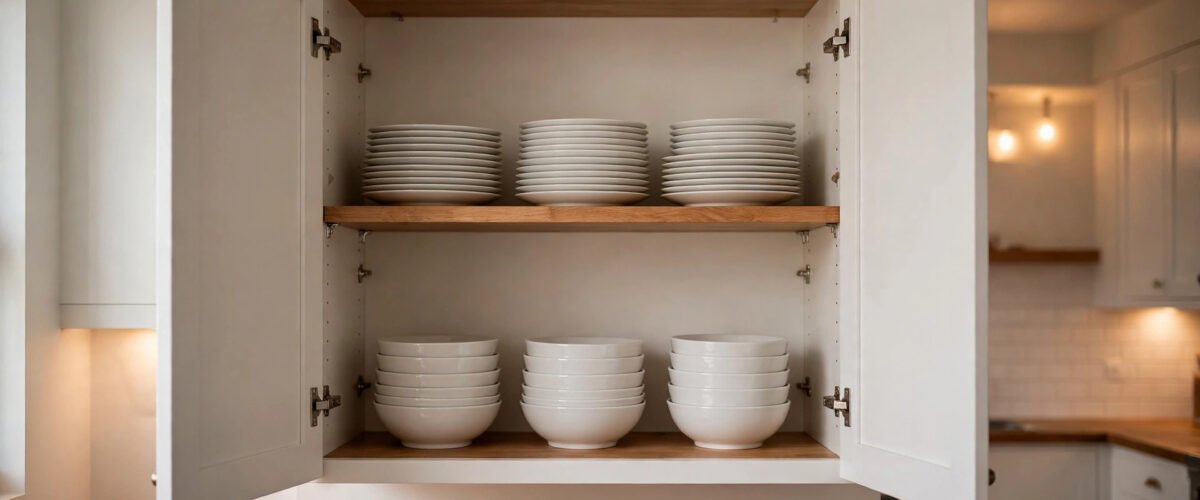
Take a standard 36-inch wall cabinet, 12 inches deep, 30 inches tall, with 2 adjustable shelves. Inside width is 34 inches. Here is the exact layout, shelf by shelf, for everyday dishes.
Bottom shelf (fixed, the cabinet bottom): 12 dinner plates in one stack, 10.5 inches across, plus 6 salad plates at 8 inches. Clearance needed: 11 inches above the plates to lift the top one out without tilting. Set the first adjustable shelf 12 inches above the cabinet bottom.
Middle shelf: 8 bowls at 10 inches across, plus 6 mugs. Bowls need 9 inches of clearance. Set the second adjustable shelf 10 inches above the middle shelf.
Top shelf: glasses and tumblers, 10 inches tall, plus small ramekins. Clearance needed: 11 inches to the cabinet top. Total height used: 12 plus 10 plus 11 is 33 inches, which is 3 inches over the 30-inch cabinet. So one shelf has to give: drop the top shelf to glasses only at 8 inches, and the total is 30 inches exactly.
The lesson is arithmetic, not taste. A 36-inch wall cabinet holds plates, bowls, and glasses for 6 place settings, and nothing more, once real clearances are counted. If the count does not fit, the answer is a second cabinet, not tighter spacing. Tighter spacing means plates that cannot lift out, which is the most common daily annoyance in a new kitchen.
Adjustable vs Fixed Shelves: 90-Pound Pull-Outs
Most modern cabinets use adjustable shelves on metal pins, and most older or high-end custom cabinets use fixed shelves routed into the sides. Fixed shelves hold more, because they are part of the box, but they cannot move without a saw. Adjustable shelves move in 1-inch steps and give up some load capacity at the pins. For a wall cabinet, adjustable wins: dish heights change, and the pins let the layout follow. For a base cabinet, neither wins, because the back half of a 24-inch-deep shelf is unreachable on your knees.
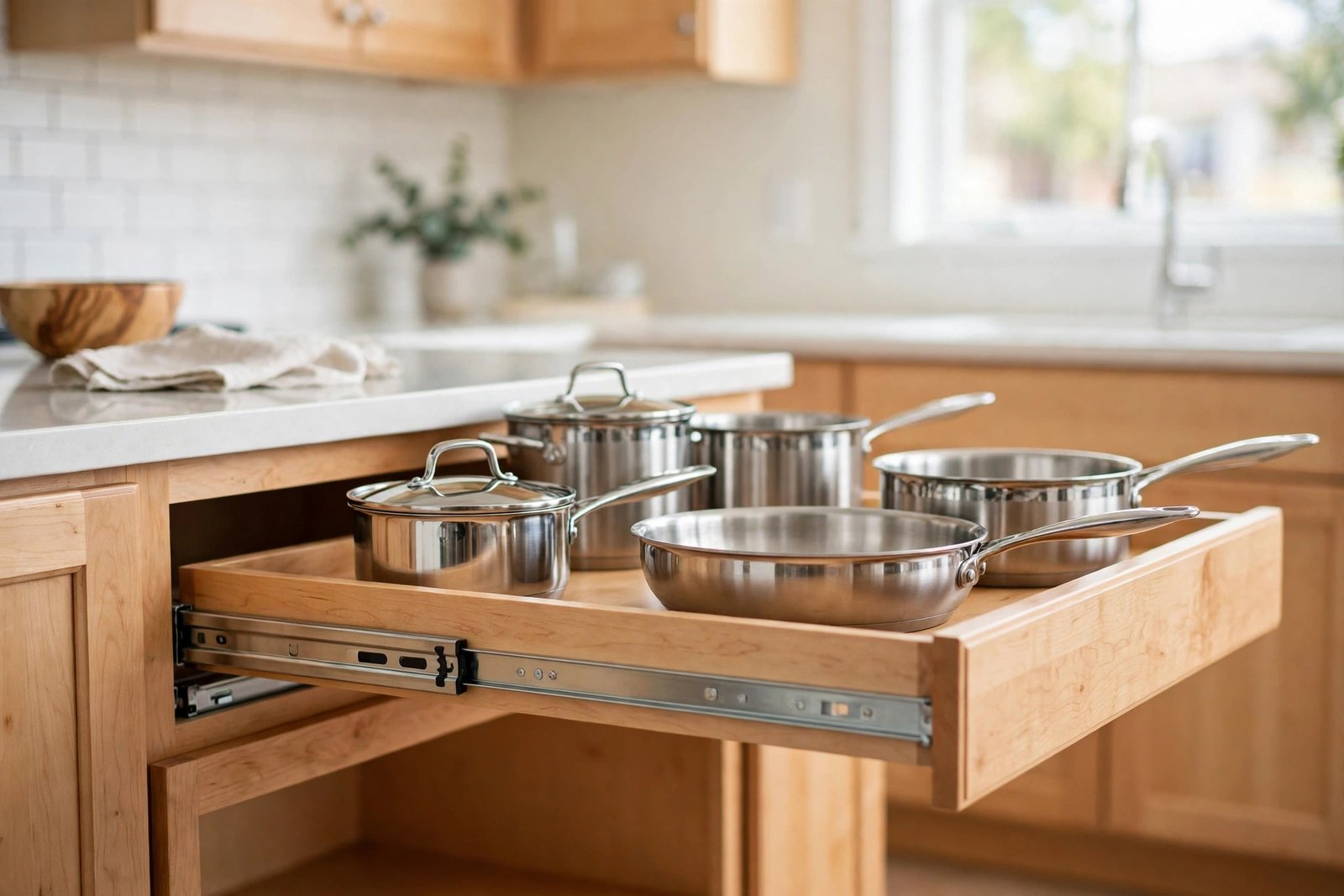
The base cabinet answer is a pull-out shelf. A pull-out runs on full-extension slides and brings the back half out to you. A Rev-A-Shelf 5330 pull-out shelf for a 36-inch base cabinet runs on 90-pound full-extension slides with soft close, which is more than double the 35-pound KCMA test load for a 36-inch fixed shelf. The slides, not the board, set the limit, so match the slide rating to your heaviest load: pots and pans need the 90-pound rating, dishes need 75, and canned goods need 100 or more across the unit. For slide types and retrofit steps, see our pull-out shelves guide and our drawer slides guide.
3 Shelf Failures and What They Cost to Fix
Failure 1: the sagged MDF shelf. A 36-inch melamine shelf loaded with plates sags 1/4 inch in the middle after 2 years, and plates start sliding toward the centre. Fix: replace it with a 3/4-inch Baltic birch plywood shelf cut to 34 inches, plus a glued hardwood edge strip. Parts cost $30 to $45. Time: 45 minutes. A plywood shelf at the same span sags about half as much as MDF, and the edge strip cuts it again.
Failure 2: the blown pin hole. A shelf pin pulls out of a particleboard side, the hole crumbles, and the shelf drops one corner. Fix: drill the hole out to 3/8 inch, glue in a hardwood dowel, let it cure overnight, and re-drill a 5 mm pin hole. Parts cost $8. Time: 20 minutes plus overnight curing. Do not just move the pin to the next hole: the load is the same, and the next hole blows the same way.
Failure 3: the overloaded 36-inch shelf. A 36-inch shelf carrying 50 pounds of cast iron and canned goods is 15 pounds past its certified load. It will not break this month. It will creep, and in a year the sag is visible from the doorway. Fix: move the cast iron to a pull-out shelf rated for it, and split the canned goods across two shelves. Parts cost $0. Time: 30 minutes of rearranging. The most expensive shelf failure is the one you keep loading.
Adding a Shelf Yourself: 45 Minutes and $18
Adding one adjustable shelf to a cabinet that has pin holes is a 45-minute job. Measure the inside width and subtract 1/4 inch for clearance. Cut a 3/4-inch plywood board to that width and the cabinet depth minus 1/4 inch. Iron on edge banding, trim it flush, and set the shelf on 4 pins. Budget: plywood offcut $12, 4 shelf pins $3, edge banding $3, for $18 in parts. Tools: tape measure, circular saw or a hardware store cut, iron, and a utility knife. Time: measure 5 minutes, cut 15, edge band 10, install 15.
If the cabinet has no pin holes, add 10 minutes and a shelf-pin jig, which drills a row of 5 mm holes spaced 32 mm apart. Do not drill freehand: a hole 1 mm off means a shelf that rocks. If the shelf spans more than 30 inches, add a centre support cleat on the back wall, which cuts the span in half and the sag to one-sixteenth.
Pre-Order Shelf Checklist: 8 Checks
Run these before you order cabinets, while changes are still free.
- Count the shelves per cabinet on the order. Stock cabinets ship 2 shelves in a wall cabinet and 1 in a base. Ask for a third in tall cabinets.
- Ask the shelf material by name. Plywood or solid wood for spans over 24 inches. MDF or melamine only under 18 inches.
- Ask the shelf thickness. 3/4 inch is standard. 5/8 inch sags sooner and is not worth the saving.
- Check the pin holes: 5 mm pins in rows spaced 32 mm apart, with 4 pins per shelf, not 2.
- Measure your tallest item. A 10-inch tumbler needs 11 inches of clearance. Order the cabinet height to fit it.
- Count the plates per shelf against the 15-pound-per-square-foot load. A 36-inch shelf holds 35 pounds, which is 18 dinner plates, not 24.
- Order pull-out shelves for base cabinets that hold pots, pans, or canned goods. Fixed shelves waste the back half.
- Ask for a spare shelf and 8 spare pins with the order. A spare costs $15 now and a week of waiting later.
Kitchen Cabinet Shelf: 6 Questions Answered
How deep is a kitchen cabinet shelf?
Wall cabinet shelves are 12 inches deep. Base cabinet shelves are 22 to 23 inches deep, cut 1/4 inch short so the door closes. Pantry shelves run 12 to 16 inches deep.
How much weight can a kitchen cabinet shelf hold?
The KCMA test load is 15 pounds per square foot for 7 days. For a 36-inch wall shelf that is 35 pounds, or about 18 dinner plates. A pull-out shelf on 90-pound slides holds more, because the slides set the limit.
Why do cabinet shelves sag?
Long-term creep under a permanent load. MDF and particleboard creep the most, up to 225 percent past the first deflection, which is why a shelf that looks flat on day one sags after 2 years. Plywood creeps 80 percent and solid wood 60 percent.
What is the best material for a kitchen cabinet shelf?
Baltic birch plywood at 3/4 inch for spans up to 25 inches, and solid oak to 29 inches. Add a hardwood front edge strip for any span over 24 inches. Avoid MDF and melamine past 14 and 12 inches.
Can I add a shelf to an existing cabinet?
Yes, if the cabinet has pin holes. A 3/4-inch plywood shelf, 4 pins, and edge banding costs $18 and takes 45 minutes. Without pin holes, add a shelf-pin jig and 10 minutes.
Are pull-out shelves worth it?
For base cabinets, yes. A fixed 24-inch-deep shelf wastes the back 12 inches, because reaching it means kneeling and emptying the front. A pull-out on 90-pound slides brings the whole shelf out, and the cost is one shelf plus slides.