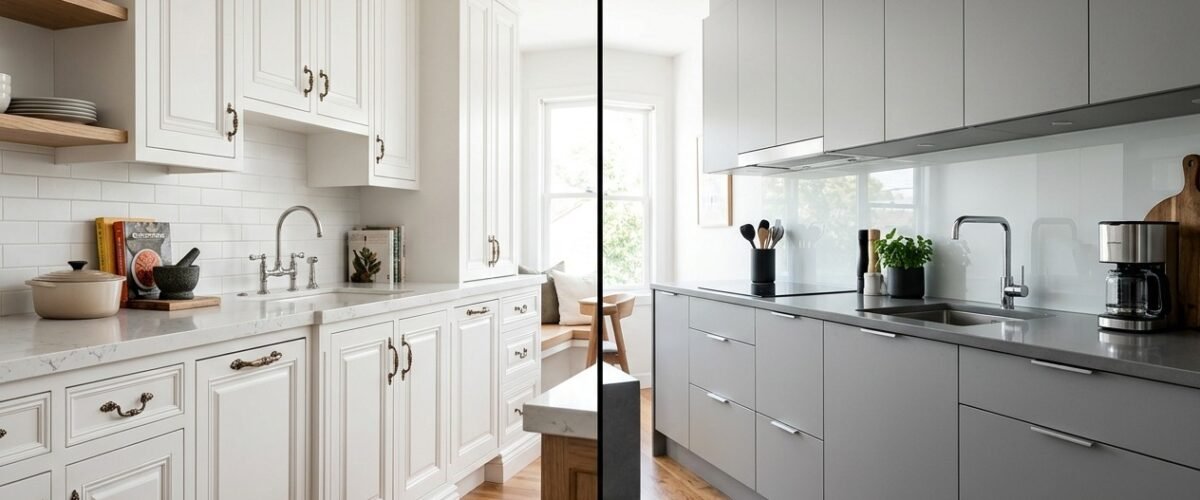
Choosing between Shaker and flat-front slab cabinets determines your daily cleaning routine, cabinet fabrication costs, and the architectural flexibility of your kitchen for the next decade. If you want maximum resale appeal, traditional craftsmanship, and a door profile that adapts to transitional, farmhouse, or classic interiors, choose five-piece Shaker cabinets. If you want five-second wipe-down maintenance, clean minimalist lines, or continuous horizontal wood grain patterns across your cabinet run, choose flat-front slab cabinets. This guide compares both door profiles across construction methods, maintenance requirements, paint and stain performance, pricing, and long-term home resale value.
Quick Comparison: Shaker vs. Flat-Front Slab Doors
Here is how five-piece Shaker doors and flat-front slab doors compare across the core performance metrics that matter most during a kitchen remodel:
| Feature / Factor | Shaker Cabinets | Flat-Front Slab Cabinets | Winner |
|---|---|---|---|
| Door Construction | 5-piece solid frame with recessed center panel | Single flat panel with solid core & edge banding | Tie (Style Dependent) |
| Daily Cleaning Effort | Requires dusting along inside 90-degree frame ledge | Smooth single-pass wipe-down with microfiber cloth | Flat-Front Slab |
| Average Cost (Builder / RTA) | $180 – $380 per standard 30-inch box | $150 – $340 per box (laminate / TFL) | Flat-Front Slab |
| Average Cost (Custom Hardwood) | $450 – $800 per 30-inch box | $500 – $950+ per box (matched wood veneer) | Shaker |
| Paint Finish Durability | Excellent on tight-grain maple and MDF panels | Best on high-density MDF or sprayed lacquer | Shaker |
| Wood Grain & Stain Display | Grain broken up by vertical stiles and rails | Continuous uninterrupted grain across cabinet run | Flat-Front Slab |
| Design Versatility | Adapts to transitional, farmhouse, and classic styles | Best suited for modern, Scandinavian, and Japandi | Shaker |
| 10-Year Resale Appeal | Broadest buyer demand across all geographic markets | Strong in urban/modern markets, polarized elsewhere | Shaker |
What Makes Shaker Style Cabinets Unique?
Shaker cabinets feature a five-piece door assembly consisting of four solid perimeter frame pieces (two vertical stiles and two horizontal rails) surrounding a recessed flat center panel. This design originated with 19th-century American Shaker communities, who rejected ornate carvings in favor of clean proportions, durability, and honest wood joinery.
The standard traditional Shaker door uses 2-1/4 inch to 3-inch wide frame rails joined with coping or mitered tenon joints. In recent years, slim Shaker doors (also known as micro-Shaker or skinny Shaker) have gained popularity, using slender 1/2-inch to 3/4-inch outer rails for a refined transitional look that bridges classic depth and modern minimalism.
A key engineering advantage of Shaker construction is the floating center panel. In solid wood cabinetry, wood fibers naturally expand across their grain width during humid summer months and contract during dry winter heating seasons. Setting the center panel inside a dado groove with expansion spacers allows the panel to move freely without splitting the outer frame or pulling apart corner joints.
Shaker cabinets accommodate both painted enamel finishes and natural wood stains with balance. When painted in popular hues like forest green or warm greige (see our guide on top 10 kitchen cabinet color trends), the recessed frame creates subtle shadow lines that add architectural depth. When built from solid hardwoods like white oak, cherry, or hard maple (reviewed in our best wood species for kitchen cabinets guide), the perimeter frame highlights classic woodworking craftsmanship.
What Defines Flat-Front Slab Cabinets?
Flat-front slab cabinets use a single, smooth panel with zero frame pieces, bevels, grooves, or decorative profiles across the door face. Originating in European frameless cabinetry and mid-century modern architecture, slab doors emphasize minimalist geometry, continuous planes, and uncluttered kitchen sightlines.
Because wide slabs made from single solid wood boards cup and warp under ambient humidity shifts, modern slab doors use dimensionally stable core materials. The core is built from high-density fiberboard (MDF), furniture-grade hardwood plywood, or multi-layer particleboard substrate sealed on both faces and wrapped along all perimeter edges with edge banding.
Surface options for flat-front slab doors range from budget-friendly thermally fused laminate (TFL) to architectural hardwood veneers. Premium slab kitchens feature sequence-matched or bookmatched wood veneers, where the natural grain of walnut or rift-cut white oak flows continuously across multiple adjacent cabinet doors and drawer fronts like a single piece of furniture.
Slab doors are predominantly paired with frameless European cabinet boxes. In frameless construction, doors mount directly to inside cabinet walls with concealed cup hinges, leaving minimal 1/8-inch reveal gaps. This creates a clean facade that integrates smoothly with modern built-in appliances and handleless push-to-open hardware systems.
Cost Difference: Material, Fabrication, and Installation Costs
Flat-front slab cabinets cost 10% to 20% less than Shaker cabinets in laminate finishes, but premium hardwood veneer slab doors cost 15% to 30% more than standard five-piece Shaker doors. The price spread depends heavily on whether you choose synthetic surface materials or authentic architectural hardwoods.
For budget remodels, flat-front slab doors offer solid savings. Automated manufacturing plants cut slab panels from large 4×8 composite sheets with CNC routers and apply edge banding in a single high-speed pass. This eliminates the multi-step cutting, tenoning, gluing, and clamping required to build a five-piece Shaker frame. Budget RTA laminate slab cabinets cost $150 to $340 per 30-inch base box compared to $180 to $380 for comparable Shaker units.
In mid-range painted cabinetry, pricing between Shaker and slab doors is virtually identical. A high-quality painted Shaker door (using hard maple frames with an MDF center panel) runs $320 to $580 per box, while a painted MDF slab door costs $290 to $520 per box. The labor cost shifts from woodworking assembly to spray booth finishing.
At the luxury tier, slab doors become significantly more expensive than Shaker. Fabricating sequence-matched or bookmatched natural walnut or rift-cut white oak slab doors requires master veneer grading, precision slicing, and custom hand-pressing. A complete custom run of bookmatched veneer slab cabinets ranges from $500 to $950+ per box, surpassing standard solid wood Shaker cabinetry.
Maintenance and Cleaning: Which Cabinet Profile Demands More Daily Work?
Flat-front slab cabinets are significantly faster and easier to clean than Shaker cabinets because they have no recessed inside corners to trap cooking grease, dust, and food spills. If low maintenance is your top priority, flat-front slab doors win decisively.
The primary maintenance challenge with Shaker cabinets is the lower horizontal frame ledge. The bottom rail on base cabinet doors forms a flat 90-degree shelf that catches airborne cooking oil, flour dust, and food crumbs. Over time, grease accumulates in the recessed corners where stiles meet rails, requiring detail cleaning with a microfiber cloth or soft brush.
Flat-front slab cabinets eliminate this issue. With no ledges or grooves, cleaning a slab cabinet requires nothing more than a single downward swipe with a damp microfiber cloth and mild dish soap solution. There are no recessed corners where moisture or grease can collect.
However, slab doors present their own maintenance consideration: fingerprint visibility on dark or high-gloss finishes. Smooth flat surfaces reflect light continuously, making handprints noticeable around door edges without hardware. To minimize cleaning on slab cabinets, choose textured wood-grain veneers, light-to-medium colors, or modern ultra-matte anti-fingerprint surfaces.
Paint vs. Stain Suitability: How Each Door Handles Color and Grain
Five-piece Shaker doors provide the best structural profile for painted finishes, while flat slab doors offer the best canvas for displaying natural hardwood grain and translucent stains. Understanding how wood expands helps you choose the right finish for each door style.
When painting solid wood cabinets, seasonal humidity changes cause stiles and rails to move at different rates. On five-piece solid wood doors, this movement frequently causes hairline fissures along the joint where the horizontal rail meets the vertical stile. Professional cabinet makers solve this by building painted Shaker doors with solid wood outer frames and MDF center panels, or by routing the profile out of a single sheet of MDF.
For stained wood finishes, flat slab doors deliver unmatched visual impact. The broad, uninterrupted surface of a slab door displays the grain flow, cathedral arches, or linear rift-cut patterns of white oak and walnut across entire drawer banks without being chopped up by stiles and rails.
Staining Shaker cabinets works well in traditional and Craftsman homes, but the contrasting grain directions between vertical stiles and horizontal rails create visual breaks. If you want a rich stained wood look, slab doors deliver a cleaner, more contemporary presentation.
Kitchen Style Compatibility: Traditional, Transitional, and Modern Spaces
Shaker cabinets deliver universal compatibility across traditional, transitional, Craftsman, and modern farmhouse homes, while slab cabinets belong in contemporary, Scandinavian, mid-century modern, and industrial spaces. Matching your cabinet profile to your home architecture ensures a cohesive renovation.
Transitional kitchens represent over 60% of modern kitchen remodels because they blend traditional warmth with clean contemporary lines. Shaker cabinetry is the cornerstone of transitional design. Pair Shaker doors with quartz countertops, a subway tile backsplash, and modern brushed brass or matte black hardware to create a balanced space.
In modern farmhouse interiors, Shaker cabinets pair naturally with apron-front fireclay sinks, open wood shelving, and classic cup pulls. In historic Craftsman homes, stained oak or cherry Shaker cabinetry complements wide baseboards and crown mouldings.
Flat-front slab cabinets define mid-century modern, Scandinavian, and Japandi kitchens. Pairing warm walnut or pale white oak slab cabinets with solid white quartz countertops, integrated finger-pull channels, and clean panel-ready appliances creates a tranquil culinary space free from visual clutter.
Resale Value Impact: How Buyers View Shaker vs. Slab in 2026
Shaker cabinets provide safer and broader return on investment for general home resale because prospective homebuyers view them as a neutral, timeless standard. Real estate market data shows that Shaker kitchens appeal to the widest demographic of buyers across virtually all price points.
Because Shaker cabinetry is stylistically neutral, future homebuyers can easily customize the space without replacing cabinet boxes. A new homeowner can change wall paint, swap cabinet hardware, or install a new tile backsplash to update a Shaker kitchen for under $1,000.
Flat-front slab cabinets carry strong resale appeal in specific housing markets: urban condominiums, modern architectural homes, and metropolitan areas where contemporary design is preferred. In these markets, luxury slab cabinetry with bookmatched walnut veneers commands top dollar.
However, in suburban or traditional family neighborhoods, slab cabinets can polarize buyers who perceive flat slab doors as overly modern or commercial. If your primary goal is maximizing short-term home appraisal value before selling, Shaker cabinetry remains the lowest-risk investment.
Which Cabinet Style Should You Choose for Your Kitchen?
Choose Shaker if your home features classic mouldings, you want broad resale protection, or you love painted finishes with subtle shadow lines. Choose flat-front slab if you prioritize fast daily cleaning, love natural continuous wood grain, or want a sleek contemporary kitchen.
Consider your daily cooking habits when deciding. If your household cooks frequently with high-heat oil or includes young children who leave sticky handprints across low drawer banks, the quick wipe-down convenience of slab doors saves hours of cleaning time each month.
If you love elements of both styles, consider slim Shaker (micro-Shaker) doors. With 1/2-inch outer rails, slim Shaker provides just enough frame depth to cast subtle shadow lines while reducing the horizontal ledge width, offering a practical compromise between classic craft and modern simplicity.
Frequently Asked Questions
Are Shaker cabinets going out of style in 2026?
No. Shaker cabinets remain the most popular cabinet door style in North America, representing over 60% of all kitchen remodels. The profile has adapted through modern variations like slim micro-Shaker frames and rich earthy paint colors, ensuring long-term design relevance and high resale appeal.
Why do paint cracks appear at Shaker cabinet joints?
Solid wood stiles and rails naturally expand and contract with humidity changes, causing hairline cracks in brittle paint films along the 90-degree frame seams. To prevent paint cracking, choose cabinet doors built with solid wood frames and high-density MDF center panels or one-piece routed MDF construction.
Are slab cabinets cheaper than Shaker cabinets?
Yes, in laminate, melamine, and thermofoil finishes, flat slab cabinets cost 10% to 20% less than Shaker cabinets due to lower manufacturing assembly labor. However, high-end slab doors made with sequence-matched or bookmatched hardwood veneers cost 15% to 30% more than standard Shaker doors.
Which cabinet door style makes a small kitchen look bigger?
Flat-front slab cabinets make small kitchens feel larger and more open because their unadorned surfaces create continuous horizontal and vertical sightlines with zero visual clutter. Pairing light-toned slab doors with full-overlay frameless boxes maximizes interior storage and visual airiness in tight spaces.