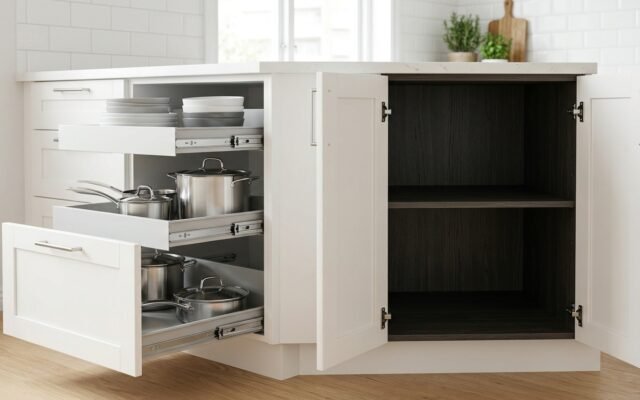
Corner kitchen base cabinets can easily become wasted dead space or hard-to-reach clutter without the right mechanism. Here is how pull-out swing trays, lazy Susans, diagonal bases, and blind corners rank for usable storage, wall footprint, and installation cost.
The Four Major Corner Kitchen Base Cabinet Types Compared
Before ranking, here’s a quick overview of what each type actually is:
- Blind corner base cabinet: A standard cabinet box that extends into the corner with one section “blind” (hidden behind the adjacent cabinet run). Access is through one door; the blind section is reached by reaching around the corner.
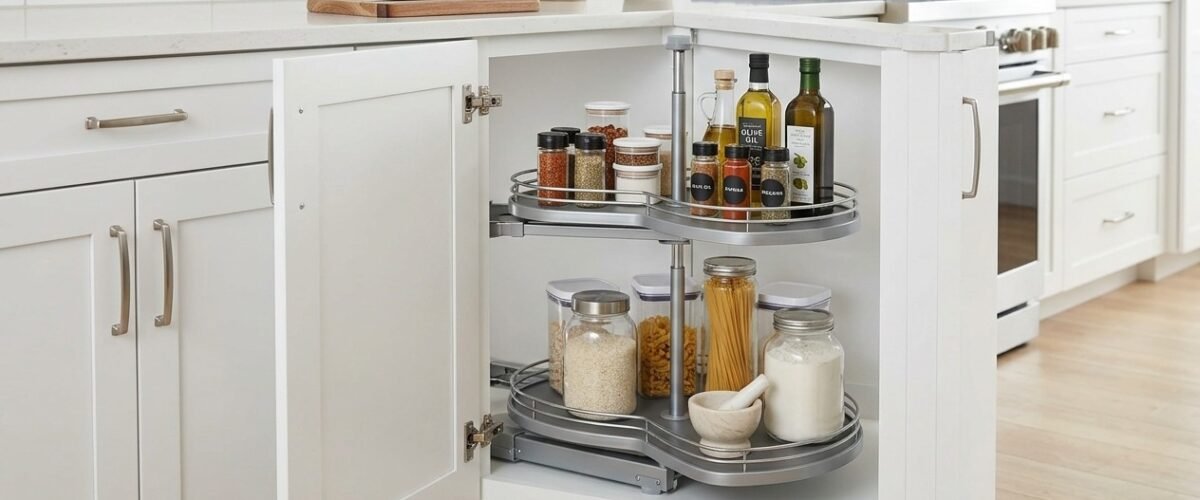
- Lazy Susan corner cabinet: A square or pie-cut corner box with rotating circular shelves. Both walls of the corner are accessible through a single opening (or two doors that open with the shelf).
- Easy Reach / Super Susan corner cabinet: An evolution of the lazy Susan using a D-shaped or kidney-shaped rotating shelf that pulls out of the cabinet as it rotates, bringing the back section forward.
- Diagonal corner base cabinet: A cabinet set at 45 degrees to both walls, with a single wider door on the angled face. Common in cabinet lines under the name “diagonal base” or “angled base.”
Each type has specific rough-opening requirements, cabinet run implications, and storage trade-offs. Let me rank them from most to least usable storage, based on what I’ve actually seen people use and what they leave stuffed with things they forgot they owned.
#1 Ranked: Easy Reach / Pull-Out Corner (Best Usable Storage)
The Easy Reach cabinet — also sold as “Super Susan,” “Magic Corner,” or “Le Mans corner” depending on the manufacturer — wins on practical usable storage because it solves the fundamental problem of every other corner solution: the back half of the cabinet is hard to reach. The Easy Reach shelf pulls out and rotates simultaneously, bringing the rear of the cabinet to the front opening. Nothing stays hidden.
How it works: Two D-shaped or kidney-shaped shelves are mounted on a pivot-and-slide mechanism. When you open the cabinet doors and pull the shelf, it rotates out of the corner on a parallelogram arm while simultaneously pulling the back shelf forward to the front of the opening.
Storage specs:
- Typical usable storage: 65–75% of the total cubic volume (vs. 30–40% for a blind corner with no pull-out)
- Cabinet size required: 33 x 33 inches minimum (some manufacturers require 36 x 36)
- Door configuration: usually two doors that open together (one attached to the shelf)
Best brands: Hafele Freestyle, Rev-A-Shelf 5PSP series, Grass Navaro. Pull-out mechanism kits run $180–$450, which is in addition to the base cabinet cost.
What it doesn’t do well: Very tall items (stand mixers, large stockpots) can interfere with the shelf rotation. And the mechanism does require maintenance — after 5–8 years the slide bearing can wear and the shelf starts to drag. Budget $80–$150 for a replacement mechanism kit at that point.
#2 Ranked: Lazy Susan (Best for Large Items)
The classic lazy Susan corner cabinet is the second most practical corner option — not because the rotating shelf is efficient, but because the format gives you maximum clearance height and diameter for bulky items. A full-size lazy Susan base cabinet has two full-circle or three-quarter-circle shelves that spin on a central pole, and there’s no mechanism to break, jam, or wear out beyond the bearing itself.
Storage specs:
- Typical shelf diameter: 28 inches (in a 33-inch cabinet) to 32 inches (in a 36-inch cabinet)
- Two rotating shelves: approximately 1,200–1,500 square inches of total shelf surface
- Cabinet size required: 33 x 33 inches minimum; 36 x 36 is more common
| Lazy Susan Type | Access | Shelf Diameter | Approx. Cost (mechanism only) |
|---|---|---|---|
| Full-circle (kidney notch for pole) | Single front opening | 28″–32″ | $50–$180 |
| Pie-cut (two doors, quarter-circle shelves) | Two doors open 270° | 28″–30″ effective | $80–$240 |
| Three-quarter circle | Single door, 270° shelf | 28″–31″ | $60–$200 |
The real limitation: Items at the back of the rotating shelf are technically accessible — they just require rotating the shelf until they come to the front. In practice, small items fall off the back of the shelf into the dead zone behind the shelf edge, and they’re essentially lost. Anything that can roll (cans, jars) will migrate to the back with every rotation.
What it does well: Large, flat items like pizza pans, cutting boards, and baking sheets lay flat and stay put. Stand mixers and food processors sit solidly on the wide shelf and roll out easily. The open format means height isn’t restricted.
#3 Ranked: Diagonal Corner Base Cabinet (Best Aesthetics, Okay Storage)
The diagonal corner cabinet places a cabinet at a 45-degree angle to both walls, creating a single door on the angled face. It’s the most architecturally attractive corner solution and it’s the easiest to access — one wide door, one open bay, no rotating shelves or pull-out mechanisms. But that simplicity comes at a storage cost.
Storage specs:
- Interior dimensions: typically 24 to 27 inches across the opening, with a depth that follows the 45-degree angle
- One or two fixed shelves inside
- Cabinet takes up approximately 24 x 24 inches of wall space on each wall at the corner
- Total usable storage: roughly 40–50% of the cubic volume — the angled back walls create dead zones in every corner of the interior
The diagonal cabinet is the right choice when aesthetics matter as much as storage — in visible corner configurations in open-plan kitchens where the corner is seen from the living room, or in a kitchen where a rotating mechanism would create a maintenance headache. It’s also the right choice when the adjacent cabinet runs need to be short and you can’t afford the 36-inch-per-wall footprint that a lazy Susan or Easy Reach requires.
Rough-opening requirement: The diagonal base takes 24 inches from each wall at the corner, so the adjacent cabinets start 24 inches from the corner wall. This is the smallest corner footprint of any solution — good for small kitchens.
#4 Ranked: Blind Corner Base Cabinet (Most Common, Least Efficient)
The blind corner cabinet is the most common corner solution in builder-grade kitchens, and it’s at the bottom of this ranking for one reason: without an add-on pull-out system, the blind section (typically 12 to 18 inches hidden behind the adjacent cabinet) is functionally useless storage. It holds things you’ll never reach without crawling.
How it’s configured: A standard base cabinet box extends 12 to 18 inches into the corner, beyond where the adjacent cabinet run starts. The blind portion is only accessible through the one open door, by reaching around and into the corner — typically from the front opening on the non-blind side.
Standard dimensions:
- Cabinet widths: 36, 39, or 42 inches on the long side (the blind section depth varies)
- Takes 12 to 18 inches from the adjacent wall — that’s the “blind” section
Why it’s still so common: It’s cheap. A blind corner base costs $200–$450 depending on width. It’s also easy to install — no special mechanism, no precise fitting of rotating shelves. Builders use it because it’s fast and inexpensive, not because it’s practical.
The upgrade path: A blind corner with a pull-out organizer (Hafele, Rev-A-Shelf, or KV brand) transforms it into something close to an Easy Reach cabinet. The pull-out shelf mounts to the blind-side door and pulls forward when the door opens, bringing the contents with it. Cost for a quality pull-out organizer: $180–$380 installed.
Corner Cabinet Sizing: How Much Wall Space Each Type Consumes
Every corner cabinet solution takes a different bite out of your adjacent cabinet runs. Here’s the side-by-side comparison:
| Corner Type | Wall Space Used (each wall) | Min. Run on Each Adjacent Wall | Typical Cabinet Cost |
|---|---|---|---|
| Blind corner base | 36″–42″ | 12″+ from corner | $200–$450 |
| Lazy Susan | 33″–36″ | 3″+ (or flush) | $280–$600 |
| Easy Reach / Magic Corner | 33″–36″ | 3″+ (or flush) | $400–$900 with mechanism |
| Diagonal corner | 24″ | 3″+ from corner | $250–$550 |
The lazy Susan and Easy Reach cabinets consume almost the same wall space but deliver radically different storage access. In most kitchens where corner storage is important, the Easy Reach is the right spend — the extra $120 to $300 over a lazy Susan is recovered in the time you won’t spend spinning and fishing for items at the back of the shelf.
Installation Sequence: Why the Corner Cabinet Goes In First
One of the most common installation errors: treating the corner cabinet like just another box in the run. It’s not — it’s the anchor. Every other cabinet position in an L-shaped or U-shaped kitchen is measured from the corner cabinet. Install it wrong and every adjacent run is wrong.
The correct sequence:
- Set and level the corner cabinet first — before any other box touches the floor
- Verify it’s level in all directions (front-to-back and side-to-side) and plumb
- Fasten it to both walls at the corner using 2-1/2″ screws into studs on each wall
- Measure the adjacent cabinet run positions from the corner cabinet’s finished face, not from the wall
- Work outward from the corner in both directions simultaneously — this way you catch any filler strip math errors before you’ve installed 8 more cabinets in the wrong positions
For lazy Susan cabinets: the rotating shelves are usually installed after the cabinet is set, leveled, and fastened. Don’t try to install a lazy Susan mechanism in the box and then set the box — the shelf gets in the way of the drill and the level.
Corner storage is often the deciding factor in whether a kitchen actually functions well on a daily basis. If you’re still in the planning phase, lock down your corner type before finalizing any other cabinet order — then check out our kitchen base cabinet sizes guide to make sure the widths on your adjacent runs land in standard increments and you’re not creating a filler strip nightmare.
Related Guides
- Kitchen Base Cabinet Sizes: The Complete Measurement Chart Every Homeowner Needs
- Sink Base Kitchen Cabinet: How to Choose the Right Width, Depth & Plumbing Clearance
- Kitchen Base Cabinet Types: A Complete Guide for 2026
Frequently Asked Questions
Which corner base cabinet provides the most usable storage?
Easy Reach (pull-out swing tray) cabinets provide the most usable storage (65% to 75% volume efficiency) because articulated shelves glide entirely outside the cabinet, eliminating unreachable dark corners.
What is the difference between a lazy Susan and a Super Susan?
A standard lazy Susan rotates on a central pole fixed to the cabinet top and bottom. A Super Susan features rotating turntable trays mounted on ball-bearing turntables atop fixed wooden shelves, holding heavier items without pole obstruction.
Why must corner base cabinets be installed first?
Corner cabinets dictate the 90-degree alignment and baseline height for both adjacent cabinet runs. Installing the corner unit level and plumb first prevents compounding layout and filler strip errors along connected walls.