Plywood Kitchen Cabinets vs MDF: Which Box Material Wins?
Plywood wins for cabinet boxes in any spot that gets wet or carries weight. MDF wins for painted doors. Particleboard wins only on price, and only in dry rooms. The rest of this guide puts numbers on each of those claims, so you can pick by the math instead of by the sales pitch.
Most cabinet quotes never name the box material. The salesperson says “all wood” and the invoice says “engineered wood,” and neither tells you whether the box under your sink is plywood, MDF, or particleboard. That one word decides whether a slow leak costs you nothing or a new cabinet. Wood cabinets vary the same way, so the material question matters before the style question.
Plywood vs MDF vs Particleboard: The 60-Second Comparison
Here is the whole comparison in one table. Plywood costs the most per sheet and sags the least. Particleboard costs the least and fails first. MDF sits between them on price and below both on strength.
| Plywood | MDF | Particleboard | |
|---|---|---|---|
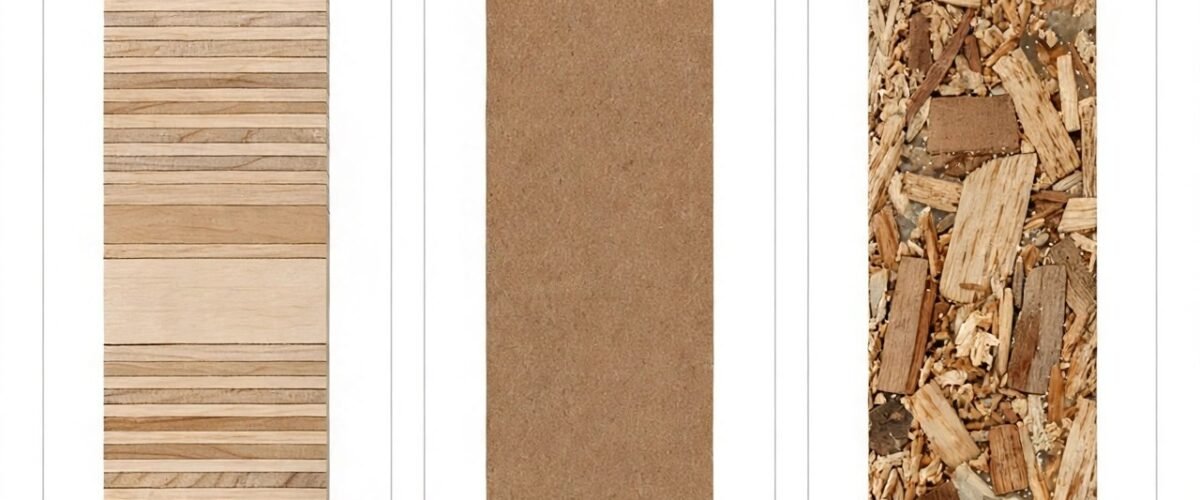
| What it is | 7-13 veneer layers, cross-laminated | Fine wood fibers + resin, pressed | Large wood chips + resin, pressed |
| 3/4″ 4×8 sheet price | $46-$76 (birch $75.73) | $49.98 | $29.37 |
| Sheet weight, 3/4″ 4×8 | ~70 lb | 90-96 lb | 80-95 lb |
| Installed cost per linear foot | $150-$500 | $100-$300 | $100-$300 |
| Screw holding | Excellent | Good on face, weak on edge | Poor, pulls out |
| Moisture resistance | Good to excellent | Poor, swells 5-11% in 24 hours | Very poor, disintegrates |
| Sag at 36″ span, 25 lb/ft | 0.09″ | 0.29″ | 0.37″ |
| Max span, 3/4″ shelf | 32″ | 28″ | 24″ |
| Formaldehyde limit | 0.05 ppm | 0.11 ppm | 0.09 ppm |
| Best use | Boxes, shelves, wet zones | Painted doors, dry trim | Budget boxes, dry rooms only |
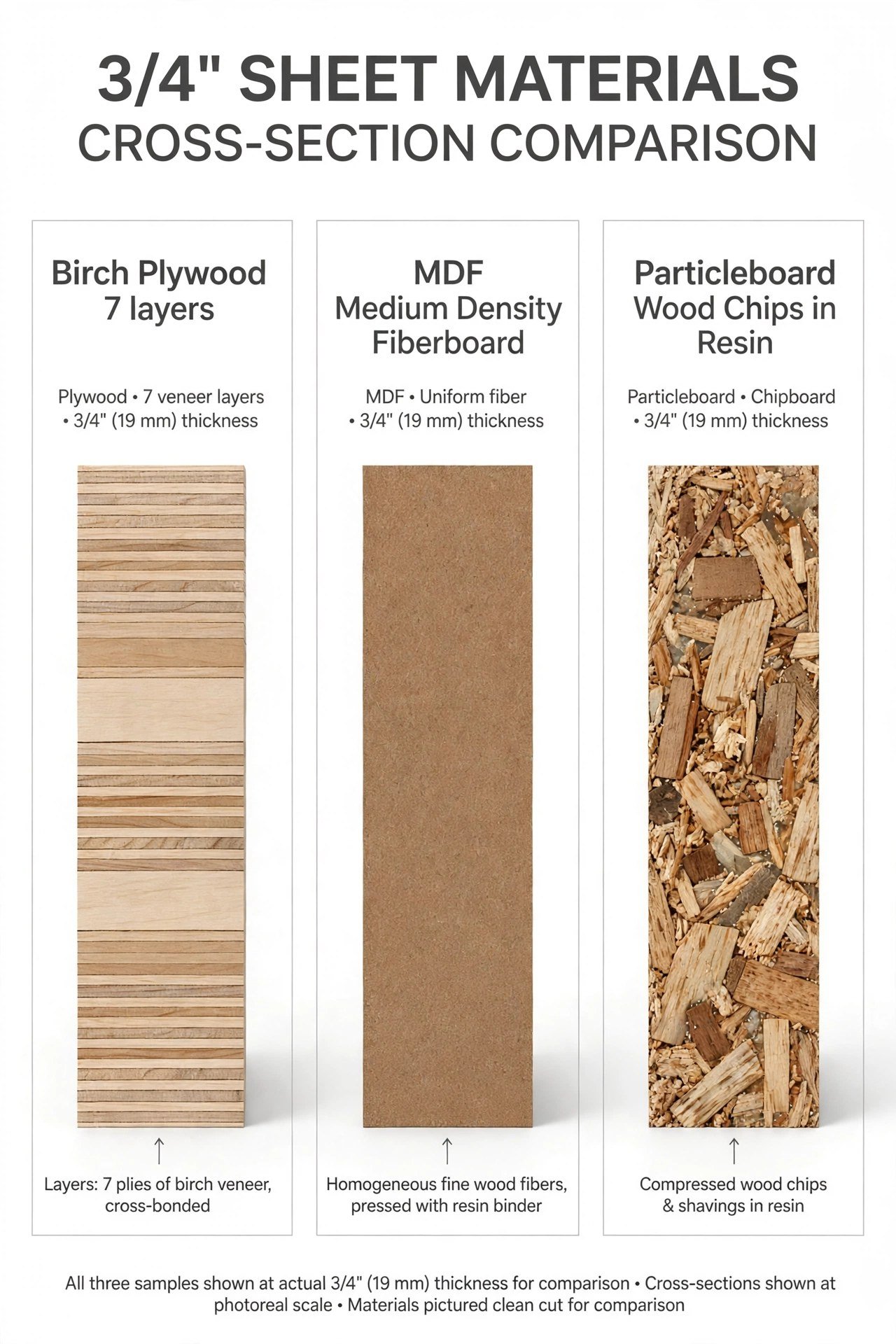
The sheet prices are 3/4-inch sheets at Home Depot in October 2026. Baltic birch runs higher at $138.68 a sheet, and cabinet-grade plywood starts at $46.48. The installed cost ranges come from 2026 US cabinet pricing guides, which put materials at 25-50% of the total project cost.
Plywood Cabinets: What 3/4-Inch Plywood Actually Gives You
Plywood gives you two things the other materials cannot: screw holding that survives a hinge being removed and reinstalled, and a box that dries out after a leak instead of swelling apart. A 3/4-inch sheet is actually 23/32 inches thick, and the cross-laminated veneer layers are why a screw bites into real wood grain in every direction.
The strength shows up in the sag numbers. A 10-inch deep, 3/4-inch plywood shelf carrying 25 pounds per foot sags 0.02 inches at a 24-inch span and 0.09 inches at 36 inches. The beam stiffness behind that is 1.4 million psi, more than three times the 0.45 million psi of MDF. Baltic birch holds about 47 pounds per linear foot at a 24-inch span before deflection becomes visible, and unlike MDF it springs back when the weight comes off.
Plywood also survives the steam test. After six weeks of steam exposure, plywood changed dimension by 0.6% and kept 92% of its screw-hold strength. Particleboard changed 3.4% and kept 65%. That is the difference between a cabinet that looks the same in year 10 and one that does not close right.
The downsides are real. Plywood costs $46 to $76 a sheet against $29 for particleboard, and the face veneer on big-box C-3 grade plywood is thin enough to sand through if you are careless. PureBond plywood uses a soy-based adhesive with no added formaldehyde, which is the cleanest option if indoor air matters to you. For a painted finish, plywood grain can telegraph through the paint, which is why many shops use MDF doors on plywood boxes.
MDF Cabinets: 1 Smooth Surface With 3 Weaknesses
MDF gives you one thing nobody else can: a dead-flat, grain-free surface that takes paint like glass. That is why nearly every painted cabinet door in a mid-priced kitchen is MDF, even when the box behind it is plywood.
The weaknesses are strength, moisture, and weight. A 3/4-inch MDF shelf sags 0.06 inches at 24 inches and 0.29 inches at 36 inches under the same 25-pound load where plywood sags 0.02 and 0.09. The visual limit is span divided by 360, about 0.10 inches at 36 inches, so MDF is already past the point where the eye notices the bow. Worse, MDF creeps: leave the load on for 18 months and the shelf stays bowed even after you empty it. Plywood recovers. MDF does not.
Moisture is the bigger risk. MDF swells 5-11% in 24 hours when a cut edge gets wet, and the swelling is permanent. A single leak under a sink destroys an MDF carcass the same way it destroys particleboard. And a full 4×8 sheet weighs 90-96 pounds against about 70 for birch plywood, so a run of MDF boxes is noticeably harder to hang.
MDF makes sense in exactly two places: painted doors and drawer fronts, and trim in dry rooms. It does not make sense as a sink base, a shelf over 28 inches, or any box next to a dishwasher. The formaldehyde limit for MDF is 0.11 ppm, the highest of the three materials, so ask for CARB Phase 2 compliant stock if anyone in the house is sensitive.
Particleboard Cabinets: The $29 Sheet With a 5-Year Clock
Particleboard gives you the lowest price in the store and the shortest life in the kitchen. A 3/4-inch sheet costs $29.37, about 40% less than MDF and 60% less than birch plywood. That is the whole case for it, and the case ends there.
The numbers are blunt. Particleboard sags 0.07 inches at 24 inches and 0.37 inches at 36 inches under a 25-pound load, past the visual limit at every span a kitchen actually uses. Its stiffness is 0.35 million psi, one quarter of plywood. Screws pull out of the edge because there is no grain to bite into, only chips and resin. Hinges loosen, shelf pins wallow out their holes, and a door that was adjusted on install day needs adjusting again within a year.
Water ends the argument. Particleboard disintegrates when it gets wet, and a kitchen gives it plenty of chances: a slow supply-line drip, a dishwasher leak, a sponge left on the counter edge. In a six-week steam test it swelled 3.4% while plywood moved 0.6%. Flat-pack furniture lasts 10-15 years in a dry bedroom. The same material under a kitchen sink is a 5-year clock.
Use particleboard only when the budget is fixed under $150 per linear foot, the room stays dry, and you accept that the sink base and the dishwasher run will need replacing sooner. Never put it under a sink. Never use it for a shelf longer than 24 inches.
Shelf Sag Test: 0.02 Inches vs 0.29 Inches at 36 Inches
This is the test that decides the material, because a sagging shelf is the failure you actually see every day. The table below runs the beam deflection formula for a 10-inch deep, 3/4-inch shelf carrying 25 pounds per running foot, which is a full shelf of dishes or books.
| Span | Plywood (1.4M psi) | MDF (0.45M psi) | Particleboard (0.35M psi) | Visual limit (span/360) |
|---|---|---|---|---|
| 24″ | 0.02″ | 0.06″ | 0.07″ | 0.07″ |
| 30″ | 0.05″ | 0.14″ | 0.18″ | 0.08″ |
| 36″ | 0.09″ | 0.29″ | 0.37″ | 0.10″ |
| 42″ | 0.17″ | 0.53″ | 0.69″ | 0.12″ |
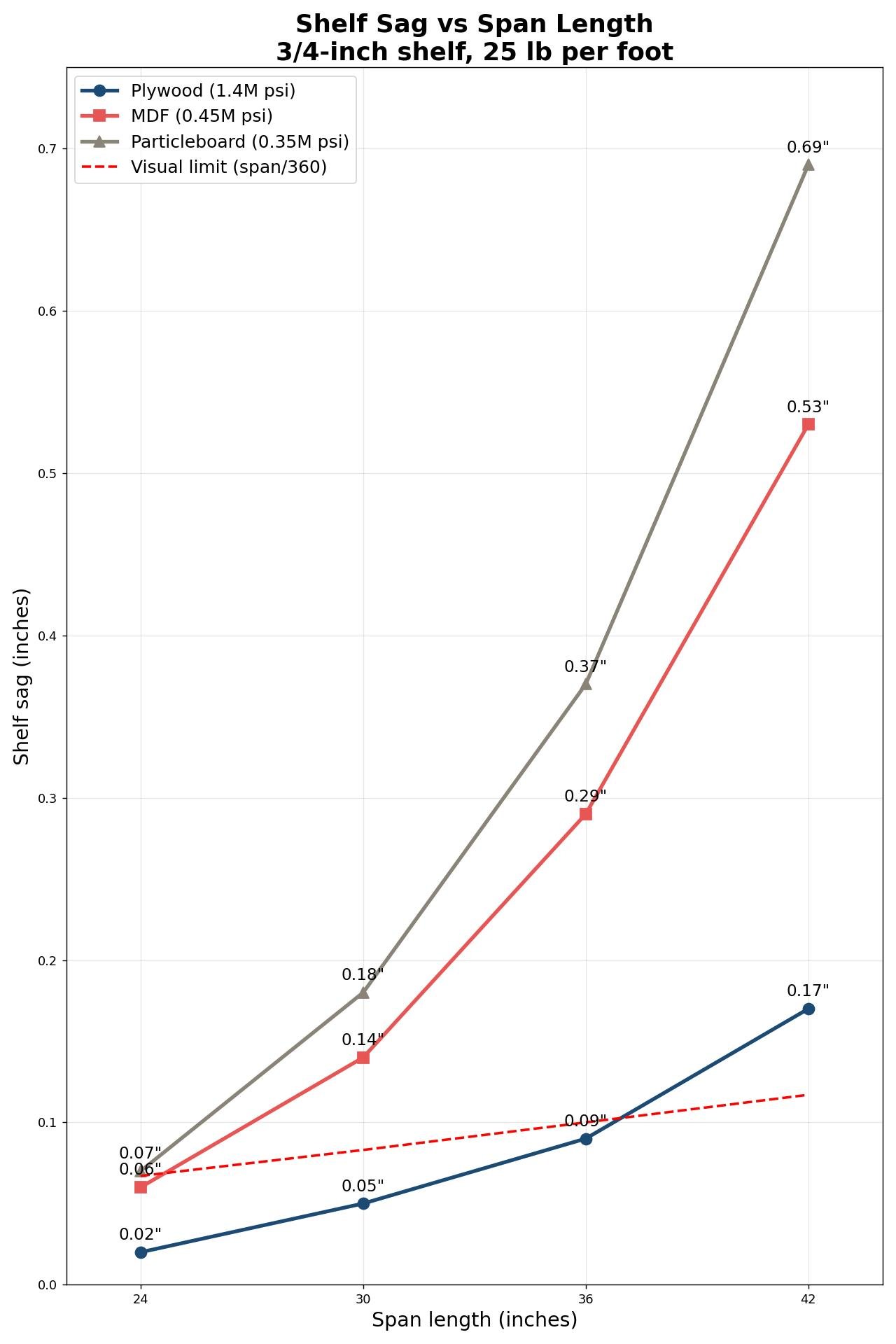
Read the table against the visual limit column. Plywood stays under the limit through 36 inches. MDF passes at 24 inches and fails at 30. Particleboard fails at 24 inches. That is why the maximum unsupported span is 32 inches for plywood, 28 for MDF, and 24 for particleboard. A second test at a heavier 50-pound load tells the same story: Baltic birch sags 0.01 inches at 24 inches and 0.03 at 36, while MDF sags 0.03 and 0.12.
The fix for a long span is not a different material. It is a shorter span or a stiffer edge. A 1×2 hardwood strip glued to the front edge of a shelf works like a T-beam and cuts sag by two-thirds. Kitchen cabinet shelves over 30 inches should get that strip no matter what material you choose, and adjustable shelves need a center support past 36 inches.
The 10-Year Cost: $1,500 Upfront vs $700 in Repairs
The upfront gap looks big until you divide it by the job. Here is the worked example for a 10-foot run of base cabinets, five 24-inch boxes, using the verified sheet prices.
| Particleboard | MDF | Birch plywood | |
|---|---|---|---|
| Sheets needed (3/4″, boxes only) | 4 | 4 | 4 |
| Panel cost | $117.48 | $199.92 | $302.92 |
| Installed cost, 10 linear feet | $1,000-$3,000 | $1,000-$3,000 | $1,500-$5,000 |
| Panel premium vs particleboard | $0 | $82.44 | $185.44 |
| Premium as share of a $2,500 job | 0% | 3.3% | 7.4% |
The panel premium is the smallest line in the job. On a $2,500 installed kitchen, upgrading from particleboard to birch plywood costs $185 more in panels, or 7.4% of the total. Labor, hardware, doors, and finishing cost the same either way.
Now add one leak. A slow supply-line drip swells a particleboard or MDF sink base at year 5. The repair is a replacement cabinet at $280-$620, a plumber to disconnect and reconnect at $150-$250, and disposal at about $50, for $480-$920 all in. A plywood sink base in the same leak usually dries out with a fan and costs $0-$75. These repair figures are estimates from the installed cost ranges above.
| 10-year total (mid-range install + 1 leak) | Particleboard | MDF | Birch plywood |
|---|---|---|---|
| Installed, mid-range | $2,000 | $2,000 | $3,250 |
| One leak repair | $700 | $700 | $35 |
| 10-year total | $2,700 | $2,700 | $3,285 |
Plywood still costs about $585 more over 10 years in the single-leak case, and this guide will not pretend otherwise. The premium buys you a second leak for free, shelves that stay flat, and hinges that hold adjustment. If your kitchen has a history of leaks, or the sink base sits over a finished basement, that $585 is cheap insurance. If the kitchen stays dry for a decade, particleboard wins on dollars alone. Custom cabinet costs follow the same pattern: the panel is the cheapest decision in the room.
Which Material Should You Choose? 4 Questions Decide It
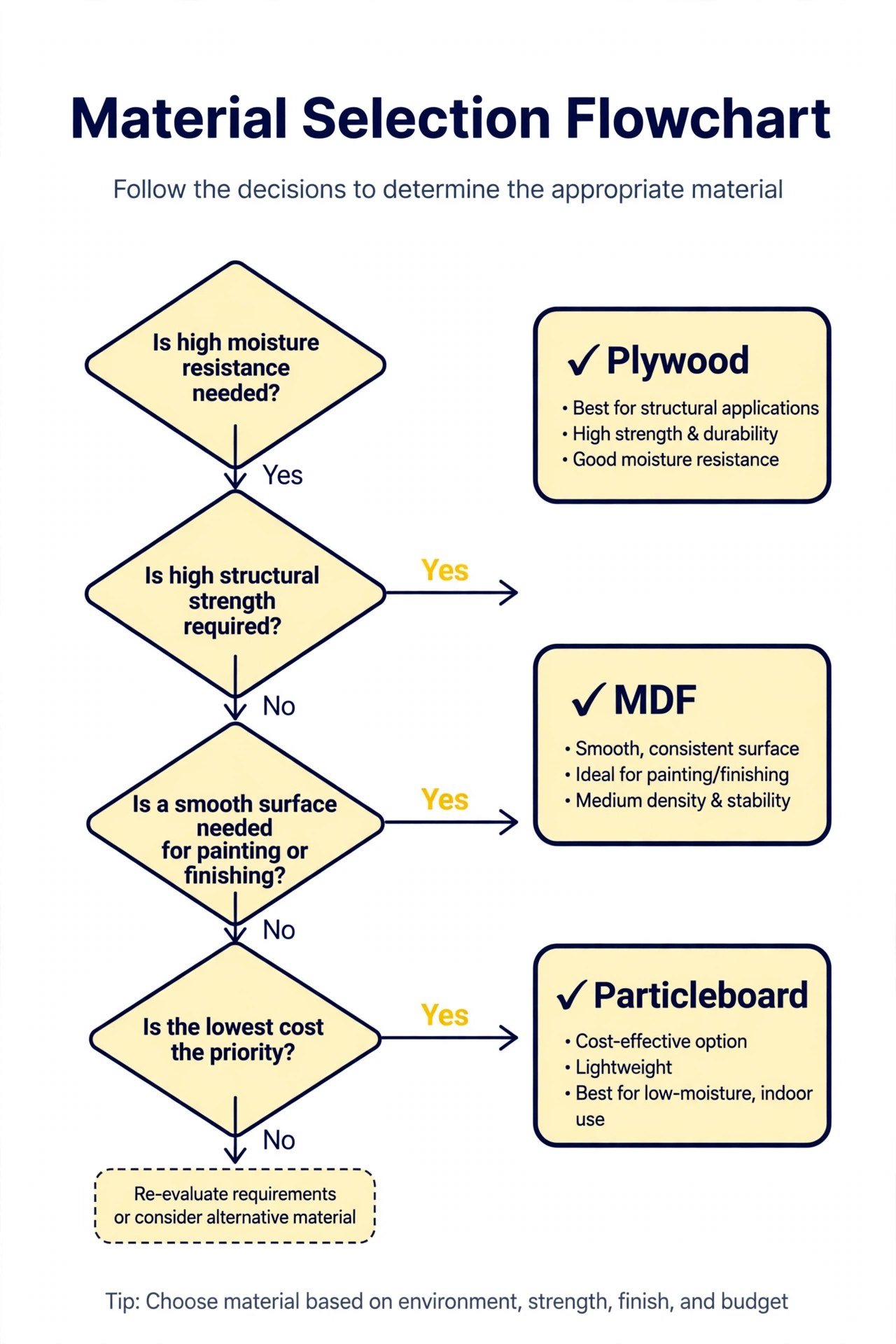
Answer these four questions in order and the material picks itself. The first question that points to plywood ends the decision.
1. Is the budget fixed under $150 per linear foot? Yes, and the room stays dry, and you accept earlier replacement: particleboard. No: go to question 2.
2. Is it a painted door or drawer front? Yes: MDF for the door, plywood for the box behind it. This hybrid is what most mid-priced kitchens actually are. No: go to question 3.
3. Does it sit next to water? Sink base, dishwasher run, or refrigerator water line: plywood boxes, no exceptions. MDF and particleboard both swell permanently from one leak. No: go to question 4.
4. Will the shelf carry more than 25 pounds per foot or span more than 28 inches? Yes: plywood shelves, or add a hardwood front edge and a center support. No: MDF is fine for the shelf, and particleboard works if the span stays under 24 inches.
One more rule covers the edge case: if anyone in the house is sensitive to formaldehyde, ask for CARB Phase 2 compliant stock in any material and prefer plywood at 0.05 ppm over MDF at 0.11 ppm. The limit is printed on the panel stamp, not the sales brochure.
4 Failure Modes and What Each One Costs to Fix
Every material fails differently, and the repair bill tells you which failure to fear most.
Swollen sink base. Particleboard and MDF absorb a leak and never come back. The bottom edge swells, the door rubs, the toe kick delaminates. Repair: new cabinet $280-$620, plumber $150-$250, disposal about $50. Total: $480-$920. Plywood in the same leak usually needs a fan and a day to dry.
Hinge pull-out. Particleboard edges crumble around hinge screws, so doors sag and rub. Repair: longer screws with epoxy filler $15-$40 as a do-it-yourself fix, or a new door at $120-$260 if the screw holes are stripped past saving. Plywood and MDF hold hinges far better because the screw bites into continuous material.
Sagging shelf. A 36-inch MDF shelf under a full load of dishes sags 0.29 inches, past the point the eye notices. Repair: replacement shelf $35-$90, plus a hardwood front edge at $12-$25 and new shelf pins. The permanent fix is a shorter span or a plywood shelf.
Delaminated veneer. Cheap plywood with a thin face veneer peels when steam from a kettle or dishwasher hits the edge. Repair: re-glue and clamp $0-$20 if caught early, or a replacement panel at $60-$150. Ask for a thicker face veneer, A-1 or B-2 grade, if the panel will sit near steam.
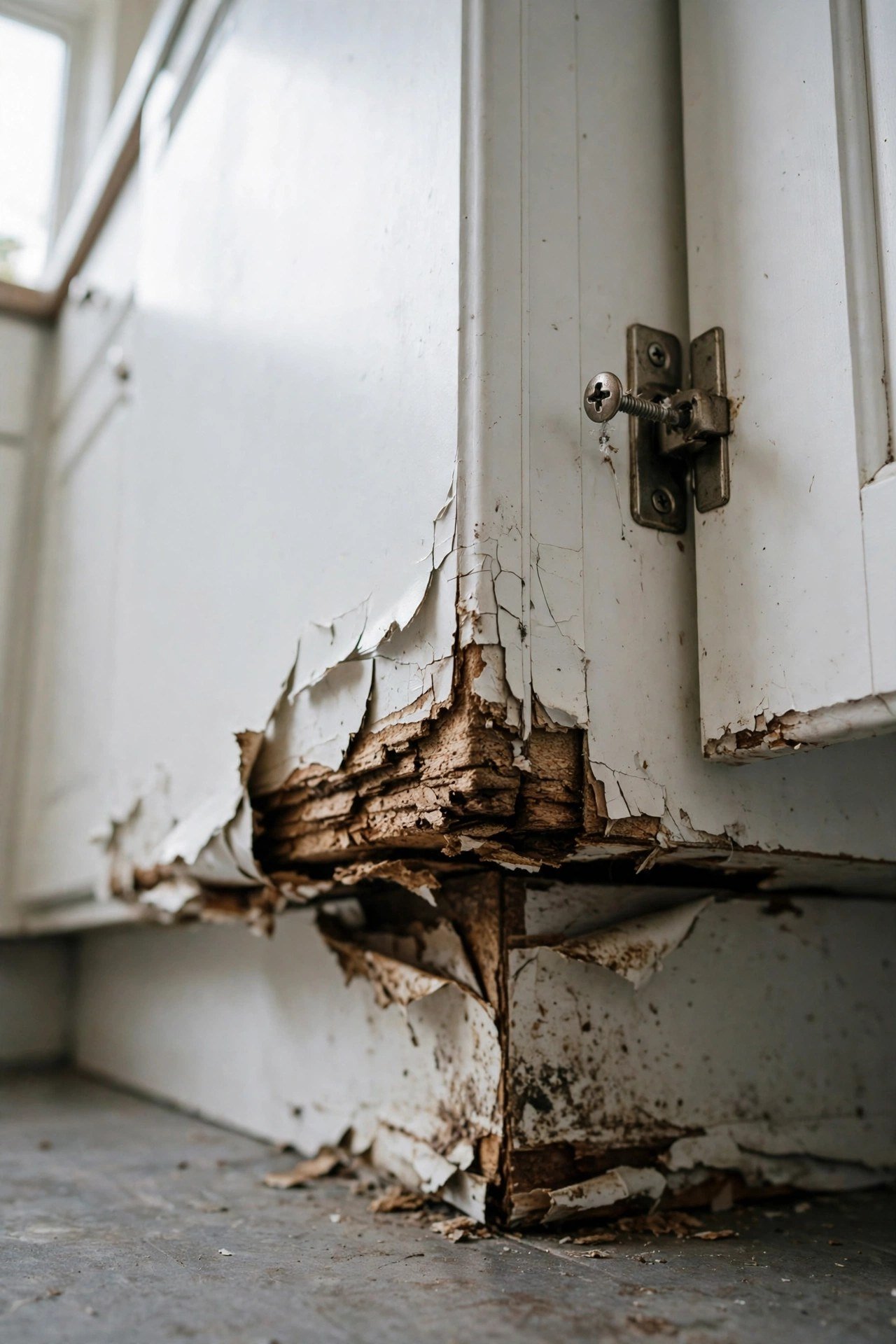
Sink base cabinets deserve the most attention here because they combine the two worst risks: water below and weight above. Spend the plywood money on the sink base first, then the dishwasher run, then the rest of the kitchen.
How to Check the Material on Your Invoice: 3 Numbers
The invoice is where the material switch happens, so check three numbers before you sign.
1. The panel stamp. Every sheet carries a grade stamp. Plywood should read HPVA C-3 or better for paint grade, A-1 or B-2 for a visible face. MDF should read CARB Phase 2. If the stamp is missing, the material is ungraded, and ungraded panels are where the cheapest bid hides its margin.
2. The formaldehyde limit. The US formaldehyde limits are 0.05 ppm for plywood, 0.09 ppm for particleboard, and 0.11 ppm for MDF. Ask the supplier to put the number on the quote. A supplier who will not quote it is a supplier who did not check it.
3. The sheet count and price. A 10-foot run of base cabinets needs about 4 sheets of 3/4-inch panel for the boxes. At the verified prices that is $117 for particleboard, $200 for MDF, and $303 for birch plywood. If your quote shows 2 sheets for the same run, the boxes are thinner than 3/4 inch, or the quote is missing material. Base cabinet height and depth drive the sheet count, so a quote that skips the panel list is a quote you cannot check.
Is plywood better than MDF for kitchen cabinets?
Yes for boxes, no for painted doors. Plywood holds screws better, sags less, and survives leaks. MDF gives a smoother painted finish because it has no grain to telegraph through the paint. Most good kitchens use both: plywood boxes, MDF doors.
Can you use particleboard for kitchen cabinets?
Yes in dry rooms on a tight budget, and only with spans under 24 inches. Never use it under a sink or next to a dishwasher. One leak can swell a particleboard base past repair, and the repair costs $480-$920.
What thickness plywood do I need for cabinet boxes?
Use 3/4-inch plywood for box sides, bottoms, and shelves. It actually measures 23/32 inches. Use 1/2-inch only for backs and drawer bottoms. Thinner panels save about $15 a sheet and cost you the span and the screw holding.
Is MDF safe in a kitchen?
Yes when it is CARB Phase 2 compliant and sealed. The US formaldehyde limit for MDF is 0.11 ppm, higher than plywood at 0.05 ppm. Keep MDF away from water: a cut edge that gets wet swells 5-11% in 24 hours and never shrinks back.
How much more do plywood cabinets cost than MDF?
About $185 more in panels on a 10-foot run, or 7.4% of a $2,500 installed job. Installed, plywood runs $150-$500 per linear foot against $100-$300 for MDF and particleboard. The panel premium is the smallest line in the quote.
Which material is best for a sink base cabinet?
Plywood, with no close second. The sink base is the one cabinet guaranteed to see water eventually. Plywood dries out after a leak. Particleboard and MDF swell permanently and need a $480-$920 replacement.