White Oak and Black Kitchen: 9 Pairings Ranked by Cost, Contrast and Upkeep
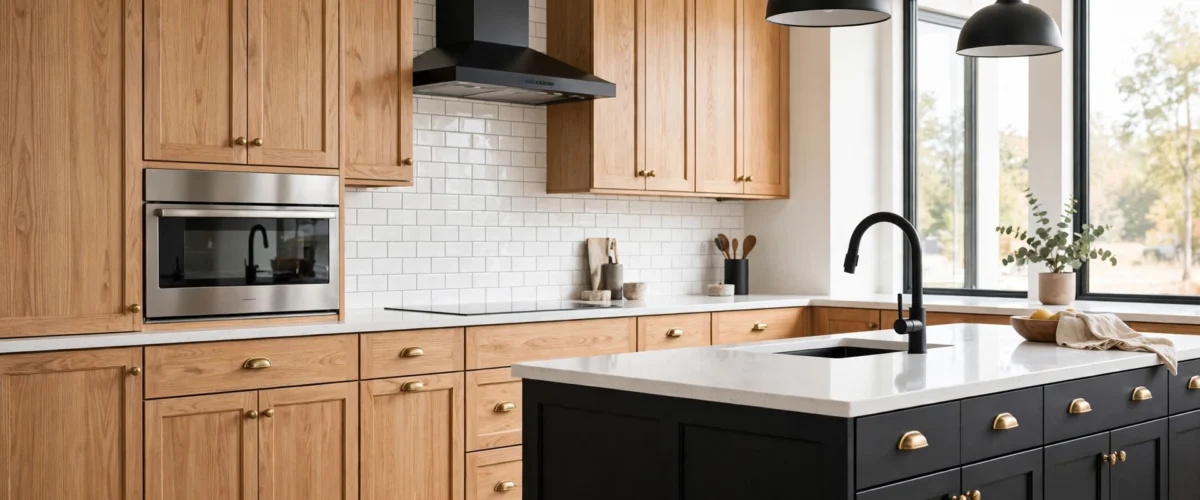
Searches for “white oak and black kitchen” are up 625% in the Pinterest Spring Trend Report, and the trade numbers back the search spike. This is not a white-oak article with a black accent thrown in. It is a white-oak-AND-black article: every pairing below uses both materials, and each one is ranked on 3 measurable things: cost for a 20-linear-foot kitchen, contrast (how much of the room is black), and upkeep (a 1 to 5 score, where 5 hides fingerprints, dust, and water spots best). The winner costs the least and hides the most. The most expensive pairing costs 3 times as much and needs the most wiping. Pick by your room size and your light first, then by the photo you like. If you are still choosing the oak itself, the white oak cabinets guide covers rift-sawn vs plain-sawn grades before you pick a pairing.
The 9 Pairings, Ranked by Cost, Contrast and Upkeep
The table below scores every pairing on the same basis. Cost assumes a 20-linear-foot kitchen and uses the verified 2026 ranges: white oak semi-custom at $450 to $750 per linear foot, taken at the $600 midpoint, and fully custom rift-sawn at $800 to $1,200 or more. Black painted cabinetry is priced at the same semi-custom range, because the black is paint on a standard box, not a species premium. Black quartz is $65 to $120 per square foot installed, soapstone is $70 to $130. Contrast is the share of the room that reads black, using the 60-30-10 rule as the target: oak 60%, black 30%, brass and stone 10%. Upkeep is a 1 to 5 score: 5 hides marks best, 1 shows everything. Wood-tone cabinetry at 29% has overtaken white at 28% for the first time in the Houzz 2026 Kitchen Trends Study, and white oak is the favourite species of 51% of design professionals in the NKBA 2026 Trends Report, so the oak half of this pairing is the safe bet. The black half is where the money and the upkeep go.
| Rank | Pairing | Black share | Upkeep (1-5) | 20-ft kitchen cost |
|---|---|---|---|---|
| 1 | Black hardware only | 5% | 4 | $12,000-$15,000 |
| 2 | Black island, oak perimeter | 25% | 4 | $12,000-$15,000 |
| 3 | Black faucet + black hardware | 8% | 3 | $12,500-$15,500 |
| 4 | Oak uppers, black lowers | 35% | 3 | $12,000-$15,000 |
| 5 | Black range hood, oak everywhere else | 15% | 3 | $13,000-$17,000 |
| 6 | Black quartz counters on oak bases | 20% | 2 | $14,600-$18,000 |
| 7 | Black-framed glass cabinets, oak interiors | 20% | 3 | $14,000-$19,000 |
| 8 | Black slab wall + oak island | 40% | 2 | $16,000-$24,000 |
| 9 | Full black perimeter, oak island only | 55% | 2 | $16,000-$24,000 |
Read the table this way: rank 1 wins on cost and upkeep, rank 2 wins on impact per dollar, and ranks 8 and 9 are not bad looks. They are looks that demand a large, bright room and a weekly wipe-down, and they cost the most because they use the most custom oak. If your kitchen is under 150 square feet, stop at rank 5. If it faces north or has 1 window, stop at rank 3. The rest of this article walks the list in rank order, with the exact cost, the black share, and the catch for each one.
1. Black Hardware Only: The Cheapest Way In at 5% Black
This is the quietest version of the look, and the best value on the list. Keep every cabinet in white oak, rift-sawn so the grain runs straight and calm, and dress it with long matte black bar pulls. The black hardware is the entire contrast story: no black paint, no dark stone, and it is enough. Cost is $12,000 to $15,000 for a 20-foot semi-custom oak kitchen at $450 to $750 per linear foot, plus $300 to $800 for the pulls. Black share is 5%. Upkeep is 4 out of 5: the oak hides marks well, and the pulls are the only black to wipe. Use 2 pull lengths for rhythm: a long bar on drawers and a short bar on doors. The catch is finish matching. Matte black pulls, a matte black faucet, and black stainless appliances are 3 different blacks, and side by side they clash. Pick 1 black finish and repeat it. If your faucet is already chrome or nickel, keep the pulls black and the faucet as it is. Two metals are fine. Three blacks are not.
2. Black Island, Oak Perimeter: The Most Impact per Dollar at 25% Black
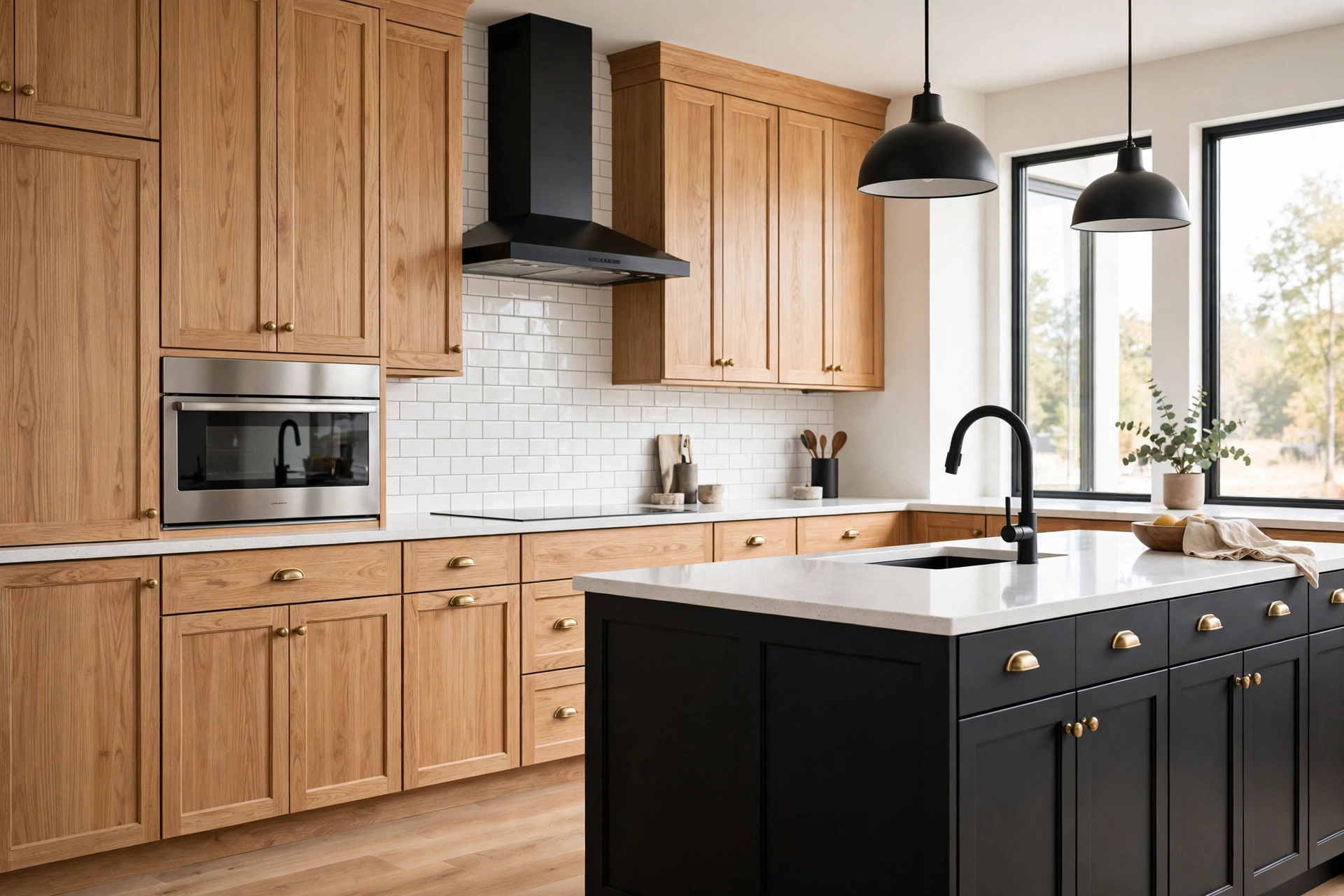
Keep every perimeter cabinet in white oak and turn the island black. This is the single most transformative move in a white oak and black kitchen, and it costs the same as rank 1 because the island is painted black on a standard box, not built in a premium species. Cost is $12,000 to $15,000 for the 20-foot kitchen, with the island inside that total. Black share is 25%, close to the 30% target in the 60-30-10 rule. Upkeep is 4 out of 5: the oak perimeter hides marks, and only the island needs wiping. The island takes the most contact in the kitchen, from knees, bags, and chairs, so use a satin or semi-gloss black on the island, not matte. Satin wipes clean and hides scuffs better. Keep 42 to 48 inches of clearance around the island, so the black block does not crowd the walkway. If your island is under 6 feet long, this pairing still works, but the black reads as an accent, not an anchor. At 8 feet or more, it anchors the room. For the island sizing behind this, the kitchen peninsula guide covers island sizing and base cabinet layouts.

3. Black Faucet Plus Black Hardware: 8% Black, 3 Out of 5 on Upkeep
Add a matte black faucet to rank 1 and the black share rises from 5% to 8%. Cost is $12,500 to $15,500: the oak kitchen plus pulls, plus a black faucet at $200 to $600. Upkeep drops to 3 out of 5, because a black faucet shows every water spot and fingerprint, and the faucet is touched more than any pull. In a hard-water home, the faucet needs a daily wipe. In a soft-water home, twice a week is enough. The faucet is also the piece most likely to clash: a matte black faucet next to matte black pulls looks intentional, but a matte black faucet next to oil-rubbed bronze pulls looks like a mistake. Match the faucet to the pulls exactly, same brand line if you can. If you cannot match them, keep the faucet in the metal you already have and put the black on the pulls only. This pairing is the right pick if you want more black than rank 1 but you rent or you are not ready to paint a cabinet black.
4. Oak Uppers, Black Lowers: 35% Black, Bright on Top
Put white oak on the uppers and black on the lowers. The black sits at the base of the room, where it grounds the kitchen, and the oak uppers reflect light back down, so the room stays bright despite the dark base. Cost is $12,000 to $15,000, the same as ranks 1 and 2, because both runs are standard boxes in different finishes. Black share is 35%, above the 30% target, which is why this pairing needs a room with at least 2 windows or 4 or more hours of direct sun. Upkeep is 3 out of 5: the black lowers show dust, lint, and scuffs from shoes and chairs, and they sit at the height where dust settles. The risk is a top-heavy look in reverse: if the black lowers are wider than the oak uppers, the room reads bottom-heavy. Keep the uppers and lowers the same width on each wall, or make the uppers wider by 6 inches on the main wall. Do not use this pairing in a kitchen under 120 square feet. The black base closes a small room in from the floor up.
5. Black Range Hood, Oak Everywhere Else: 15% Black, 1 Focal Point
Wrap the range hood in matte black and keep every cabinet in white oak. The hood is the tallest object in the kitchen, so a black hood reads as a focal point from every angle, and the oak everywhere else keeps the room warm. Cost is $13,000 to $17,000: the oak kitchen plus $1,000 to $2,000 for a black hood surround, depending on whether it is painted wood or blackened steel. Black share is 15%. Upkeep is 3 out of 5: the hood sits over the range, where grease and steam rise, so it needs a weekly wipe with a degreaser. A black hood shows grease faster than a stainless hood, because the grease is light against the dark surface. The catch is scale. A hood that is narrower than the range looks like a mistake. Match the hood width to the range width, 30 inches for a 30-inch range, and run it to the ceiling if the ceiling is under 9 feet. If the ceiling is higher, stop the hood 12 inches below it and the room keeps its proportions.
6. Black Quartz Counters on Oak Bases: 20% Black, 2 Out of 5 on Upkeep
Run black quartz across the perimeter counters on white oak bases. The counter is the horizontal black line in the room, and it grounds the oak without painting a single cabinet. Cost is $14,600 to $18,000: the oak kitchen plus black quartz at $65 to $120 per square foot installed, for a typical 40 square feet of counter, which is $2,600 to $4,800. Black share is 20%. Upkeep is 2 out of 5, the worst on this list alongside ranks 8 and 9: polished black quartz shows haze, wiping marks, dust, and every water spot. Use a honed or leathered finish instead of polished, and the marks drop by half. Honed black quartz costs the same per square foot, so this is a free fix. The other choice is soapstone at $70 to $130 per square foot installed. Soapstone handles hot pans and darkens with oil into a patina, but it scratches easily and the scratches sand out, which is a trade most households accept. Pick quartz if you want no sealing and no oiling. Pick soapstone if you want heat resistance and you do not mind the patina. Do not pick polished black granite. It shows every fingerprint and it needs sealing.
7. Black-Framed Glass Cabinets With Oak Interiors: 20% Black, Jewelry for the Room
Glass-front cabinets framed in black metal, with interiors lined in white oak and lit from within, are the most decorative pairing on this list. The black frame is the contrast, the oak interior is the warmth, and the light inside makes both visible at night. Cost is $14,000 to $19,000: the oak kitchen plus $2,000 to $4,000 for 2 to 3 glass-front cabinets with black frames, oak interiors, and lighting. Black share is 20%. Upkeep is 3 out of 5: the glass needs a weekly wipe, and the oak interior shows dust because the light inside makes it visible. Keep the glass cabinets to 2 or 3, on 1 wall only. More than that and the kitchen reads as a display case. Put everyday dishes behind solid doors and display pieces behind the glass. The light inside should be 2700K warm white, not 4000K cool white, or the oak reads gray. This pairing suits a kitchen with a dining area, where the glass cabinets face the table and act as a dresser. It suits a galley kitchen less, because the glass reflects the narrow walls.
8. Black Slab Wall Plus Oak Island: 40% Black, Custom Oak Prices
Paint 1 full wall of slab cabinets black and build the island in white oak. The black wall is the backdrop, the oak island is the furniture in front of it, and the contrast is the whole room. Cost is $16,000 to $24,000: the black wall at semi-custom prices plus the island in custom rift-sawn oak at $800 to $1,200 or more per linear foot. Black share is 40%, above the 30% target, which is why this pairing needs a room over 180 square feet with 2 or more windows. Upkeep is 2 out of 5: the black slab wall shows dust within a day and fingerprints on every door, and flat slab doors show touch marks as shiny patches. A satin sheen cuts that in half and costs nothing extra. The oak island needs its own care: oil or hardwax finishes want a refresh every 12 to 24 months, and steam from the sink darkens unsealed oak within a year. Seal the oak within 12 inches of the sink. This is the right pick if you love black and you have the room and the light for it. It is the wrong pick for a north-facing kitchen under 150 square feet, where the black wall reads as a cave by 3 pm. For the oak side of this pairing, the white oak cabinets guide covers rift-sawn vs plain-sawn grades and finishes.
9. Full Black Perimeter, Oak Island Only: 55% Black, the Boldest and the Hardest to Live With
Paint every perimeter cabinet black and build only the island in white oak. The island glows against the dark walls, and the room reads as a black kitchen with a wood centerpiece. Cost is $16,000 to $24,000, the same as rank 8, because the island is custom rift-sawn oak and the perimeter is painted black. Black share is 55%, nearly double the 30% target. Upkeep is 2 out of 5: every black door shows dust, water spots, and fingerprints, and the room needs a weekly wipe-down of every door front. This pairing needs a large, bright room: over 200 square feet, south- or west-facing, with white or light counters to bounce light back onto the black. Without those, the room closes in. The failure mode is the black-on-black clash: matte black cabinets, black quartz counters, and a black faucet are 3 blacks that read as 1 flat surface. Break it with white quartz counters and brass pulls, so the oak island is not the only light object in the room. Pick this only if you have strong daylight, white surfaces to bounce it, and the habit of wiping doors down. Otherwise, use rank 2 and get the same contrast for $4,000 to $9,000 less.
How These 9 Pairings Were Ranked
The ranking uses 3 numbers, not taste. Cost is the verified 2026 range for white oak by tier, plus the verified counter ranges, computed for a 20-linear-foot kitchen. Contrast is the share of the room that reads black, measured against the 60-30-10 rule: oak 60%, black 30%, brass and stone 10%. Upkeep is a 1 to 5 score where 5 hides fingerprints, grease, and water spots best and 1 shows them fastest. Black hardware scores 4 because only the pulls need wiping. Black quartz scores 2 because a polished dark counter shows every mark. The combined score weights cost first for most households and upkeep first for busy households. If your kitchen has 2 or more cooks and 3 or more kids, move any rank 1 to 3 pairing to the top of your list: their upkeep score of 4 matters more than the drama of rank 8 or 9. If your kitchen faces north, move any pairing under 25% black to the top and ignore the rest. The table at the top of this article is the ranking. This section is the method behind it, so you can re-rank it for your own room.
Pick Your Pairing by Room Size and Light in 4 Steps
Your room size and your window direction decide your black share before your taste gets a vote. Work the tree below, then check the table.
- Under 120 square feet, or 1 window, or north-facing: keep black at 5% to 15%. Rank 1, rank 3, or rank 5. The oak does the work and the black is an accent.
- 120 to 180 square feet, 2 windows, east- or west-facing: black at 20% to 30% works. Rank 2, rank 4, or rank 6. The black island is the best pick in this band.
- Over 180 square feet, 2 or more windows, south- or west-facing: black at 35% to 40% works. Rank 7 or rank 8. The black wall needs the light and the room to hold it.
- Over 200 square feet, south-facing, white counters: any black share works, including rank 9 at 55%. This is the only band where a full black perimeter holds its color all day.
If you are repainting rather than ordering new, the same tree applies. The paint does not know whether the cabinet is new or 10 years old. It only knows how much light hits it.
A 10 by 12 Foot Kitchen, Worked Start to Finish
Take a 10 by 12 foot kitchen with 2 east windows, 20 linear feet of cabinets, and an 8-foot island. The windows give 4 hours of direct sun. Step 1: the tree says black at 20% to 30%, so the shortlist is rank 2 (black island, 25%) and rank 6 (black quartz, 20%). Step 2: upkeep matters because the household has 2 cooks, so rank 2 wins at 4 out of 5 against rank 6 at 2 out of 5. Step 3: cost is $12,000 to $15,000 for rank 2 against $14,600 to $18,000 for rank 6, so rank 2 saves $2,600 to $3,000. Step 4: pick rank 2, black island with oak perimeter, and spend the saving on a white quartz counter at $50 to $120 per square foot, which bounces light onto the black island. Step 5: use matte black pulls in 2 lengths and a matte black faucet from the same brand line, so the black matches. Total: $12,000 to $15,000 for cabinetry, plus the counter. The same kitchen in rank 9 would cost $16,000 to $24,000 and need a weekly wipe-down of every black door. That is the trade, in numbers.
3 Mistakes That Cost a Repaint or a Replacement
Mistake 1: mixing 3 different blacks. Matte black pulls, oil-rubbed bronze faucet, and black stainless appliances are 3 different blacks, and side by side they clash. Pick 1 black finish and repeat it on every piece of hardware. Repaint or replacement cost if you mix them: $300 to $800 to swap the pulls and faucet to one finish.
Mistake 2: putting black slab cabinets in a small, dark kitchen. A black slab wall in a kitchen under 150 square feet with 1 north window reads as a cave by 3 pm, and the fix is repainting the wall. A repaint costs $50 to $70 per linear foot, or $400 to $560 for an 8-foot run. Test the black share with the tree in this article before you order.
Mistake 3: leaving white oak unsealed near the sink. Steam darkens unsealed oak within a year, and oil or hardwax finishes want a refresh every 12 to 24 months. Seal the oak within 12 inches of the sink with a water-resistant topcoat, or put the oak on the opposite wall. Replacement cost if the oak darkens unevenly: $450 to $750 per linear foot to replace the affected run in semi-custom oak.
The 6-Step Pre-Order Finish Checklist
Do this before you order cabinets or sign a quote. It takes 1 evening and about $0.
- Measure the room: ___ square feet, ___ windows, facing ___. My black-share band from the tree is ___%.
- Pick 1 black finish and write it down: ___. My pulls, faucet, and hood all use this finish.
- Pick the oak cut: rift-sawn (straight grain, 20-35% premium over plain-sawn) or plain-sawn (cathedral grain, lower cost). My cut is: ___.
- Pick the counter finish: honed black quartz (hides marks) or polished (shows marks). My counter is: ___.
- Check the island clearance: 42 to 48 inches around the island. My clearance is: ___ inches.
- Order 1 oak sample and 1 black sample. Hold them together in the room at 8 am, noon, and 8 pm. The pair that still looks right at 8 pm is the winner.
If the samples clash at 8 pm, change the black, not the oak. The oak is the expensive half.
What a White Oak and Black Kitchen Costs in 2026
A semi-custom white oak kitchen runs $450 to $750 per linear foot, or $9,000 to $15,000 for 20 feet. Fully custom rift-sawn oak runs $800 to $1,200 or more per linear foot, or $16,000 to $24,000 for 20 feet. White oak carries a 20% to 35% premium over maple or red oak, and rift-sawn carries another 20% to 35% over plain-sawn, because each log yields fewer straight-grained boards. Black painted cabinetry costs the same as any painted semi-custom box, so the black half of the pairing is the cheap half. The counter is the second lever: black quartz at $65 to $120 per square foot installed adds $2,600 to $4,800 for 40 square feet, and soapstone at $70 to $130 adds $2,800 to $5,200. Get 3 quotes on the same basis, per linear foot, and make each cabinetmaker count the same 20 feet. A quote per door and a quote per linear foot can describe the same kitchen at prices $1,000 apart. For the wider cost picture, the how much do kitchen cabinets cost guide puts oak against replacement.
7 Questions About White Oak and Black Kitchens, Answered
Is a white oak and black kitchen still trendy in 2026?
Yes. Searches for the pairing are up 625% in the Pinterest Spring Trend Report, wood has overtaken white as the top cabinet choice in the Houzz 2026 study, and white oak is the favourite species of 51% of design professionals in the NKBA 2026 report.
How much black should a white oak kitchen have?
Use the 60-30-10 rule: oak 60%, black 30%, brass and stone 10%. In a small or north-facing kitchen, keep black at 5% to 15%. In a large, south-facing kitchen, 35% to 40% works.
What is the cheapest white oak and black pairing?
Black hardware only. Keep every cabinet in oak and add matte black pulls for $300 to $800. The kitchen costs $12,000 to $15,000 for 20 feet in semi-custom oak, and the black share is 5%.
Does black show fingerprints more than white oak?
Yes. Black quartz scores 2 out of 5 on upkeep and black slab cabinets show dust within a day. White oak scores 4 out of 5 because the grain hides marks. Use a honed finish on black counters and a satin sheen on black cabinets to cut the marks in half.
Rift-sawn or plain-sawn white oak?
Rift-sawn for a modern kitchen: straight, calm grain, no cathedral arches. Plain-sawn for a traditional kitchen: visible cathedral grain, lower cost. Rift-sawn costs 20% to 35% more than plain-sawn because each log yields fewer straight-grained boards.
What countertop goes best with white oak and black cabinets?
White quartz is the safest bridge: it bounces light onto the black and keeps the room bright. Black quartz works if the room is large and bright and you pick a honed finish. Soapstone works if you want heat resistance and you accept the patina.
Can I do white oak and black in a small kitchen?
Yes, if you keep black at 5% to 15%: black hardware, a black faucet, or a black range hood. A black island works in a kitchen over 120 square feet. A full black perimeter needs over 200 square feet and a south-facing window.