Kitchen Counter Organization: 15 Ideas That Keep the Counter Clear (and Still Usable)
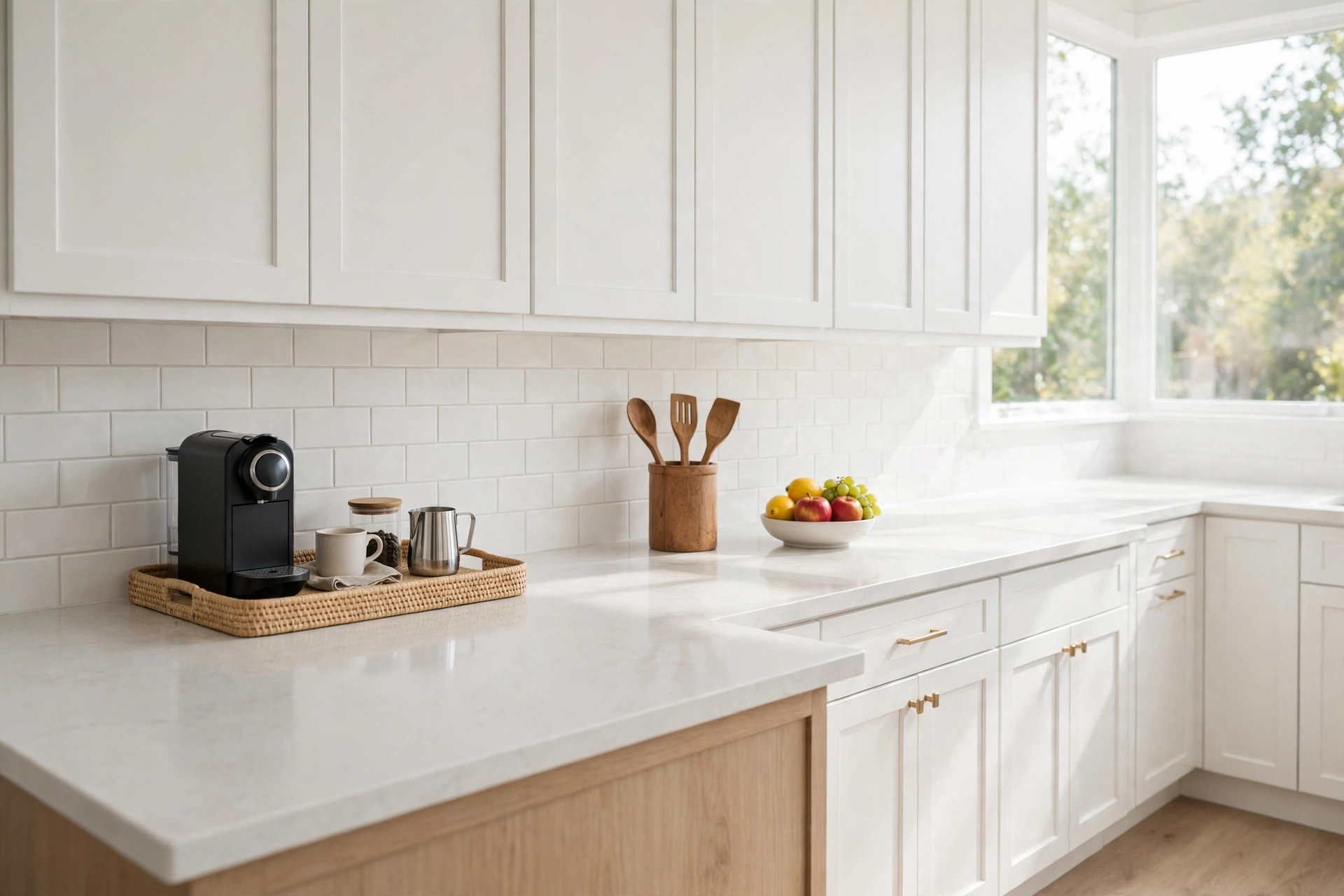
Your counter is a work surface, not a storage shelf. When it fills up, cooking slows down, cleaning takes longer, and the kitchen never looks clean even right after you wipe it. The fix is not buying more containers. It is deciding what earns a spot on the counter and giving everything else a real home. This list ranks 15 ideas by one measurable thing: how many square feet of counter each one frees, and what it costs to get that space back. The winner costs nothing. The most expensive idea on the list buys back 3 square feet for $800 to $4,000. Start at the top and stop when your counter hits the 60% rule: at least 60% of the run stays empty at all times, so you always have a clear stretch to work on. This article covers the surface only — for the inside of the cabinets, pull-outs and inserts, see the kitchen cabinet organizers guide.
The 15 Ideas, Ranked by Counter Space Freed
The table below scores every idea on 2 numbers: square feet freed and cost. Footprints use a standard counter depth of 25.5 inches. A coffee maker is about 1.5 square feet. A toaster is about 1 square foot. A knife block is about 0.8 square feet. A utensil crock is about 0.5 square feet. The cost per square foot freed is the idea’s cost divided by the space it buys back, so you can compare a $0 habit with a $4,000 cabinet on the same basis. 60% of design professionals name minimalism a rising force in the NKBA 2026 Kitchen Trends Report, which is why the clear-counter look keeps winning: it is the style the trade is already building toward.
| Rank | Idea | Sq ft freed | Cost | Cost per sq ft freed |
|---|---|---|---|---|
| 1 | The daily-use test | 4-6 | $0 | $0 |
| 2 | The 60%-empty rule | 3-5 | $0 | $0 |
| 3 | Move the knife block to the wall | 0.8 | $25-$60 | $31-$75 |
| 4 | One tray per zone | 1-2 | $20-$60 | $10-$60 |
| 5 | Coffee zone in one corner | 2-3 | $0-$40 | $0-$20 |
| 6 | The back-strip rule | 1-2 | $0 | $0 |
| 7 | Riser for oils and spices | 1 | $15-$40 | $15-$40 |
| 8 | Rolling cart for heavy appliances | 2-3 | $40-$120 | $13-$60 |
| 9 | Wall rail for utensils and mugs | 1-2 | $30-$80 | $15-$80 |
| 10 | Appliance garage | 3 | $80-$4,000 | $27-$1,333 |
| 11 | Beverage station in a cabinet | 2-3 | $150-$300 | $50-$150 |
| 12 | Over-sink board and rack | 1-2 | $30-$70 | $15-$70 |
| 13 | Cutting boards vertical, not flat | 1 | $0-$25 | $0-$25 |
| 14 | The 5-minute nightly reset | 2-4 | $0 | $0 |
| 15 | Seasonal rotation | 1-2 | $0 | $0 |
Read the table this way: ranks 1, 2, 6, 14, and 15 are free, and together they free 10 to 16 square feet on a typical 10-foot run. That is most of the job. The paid ideas buy back the last few feet. If your budget is $100, buy ranks 3, 4, 7, and 13 and skip the rest. If your budget is $1,000 or more, add rank 10. The rest of this article walks the list in rank order, with the exact test, size, or price for each one.
1. The Daily-Use Test: Keep Only What You Touch Every Day
This is the idea that frees the most counter for $0, and it is the one every other idea depends on. Take everything off the counter. Put back only the items you used yesterday, today, and will use tomorrow: for most households that is a coffee maker, a kettle or toaster, and a utensil crock. Everything else goes in a cabinet, a drawer, or out of the kitchen. The test is strict on purpose. A blender you use twice a month does not pass. A stand mixer you use every Sunday does not pass. A waffle maker you use 4 times a year does not pass. The test frees 4 to 6 square feet on a typical counter because the average counter holds 6 to 8 appliances and only 2 or 3 of them are daily. If an item fails the test and you still want it handy, rank 8 gives it a cart home. Do not skip this step and buy trays first. A tray full of weekly-use items is still clutter, just tidier clutter.
2. The 60%-Empty Rule: Measure It, Do Not Guess It
A counter feels clear when at least 60% of it is empty. Measure your main run in feet, multiply by 0.6, and that is the length that must stay bare. On a 10-foot run, 6 feet stay empty. On a 6-foot galley run, 3.6 feet stay empty. The rule works because it turns a feeling into a number you can check in 5 seconds: stand back, look at the run, and ask whether 6 of the 10 feet are bare. The most useful part of the rule is the prep stretch. Keep one continuous run of 24 to 36 inches completely clear, between the sink and the range, where food moves from washing to cooking. That stretch is where chopping, mixing, and plating happen. If your coffee maker sits in the middle of it, move the coffee maker to a corner and the stretch opens up. This idea frees 3 to 5 square feet for $0, and it is the standard every other idea on this list is judged against.
3. Move the Knife Block to the Wall and Win Back 0.8 Square Feet
A knife block takes about 0.8 square feet of counter and it sits in the middle of the prep zone, which is the worst place for it. A magnetic strip on the backsplash or a wall-mounted rail holds the same knives in zero counter space. Mount the strip at 60 inches from the floor, above the backsplash and clear of the range, so blades are out of reach of small hands and away from steam. A strip costs $25 to $60 and holds 5 to 7 knives. The cost per square foot freed is $31 to $75, which sounds high until you remember the space it frees is prep space, the most valuable inches on the counter. If you rent, use a strip with adhesive mounts rated for the weight of your knives, and check the rating before you load it. If you keep the block, move it to the far end of the counter, not the middle of the prep stretch. For the drawer side of knife storage, the kitchen cabinet drawers guide covers drawer inserts that hold knives flat.
4. One Tray per Zone, Never More Than 2 Trays on a Counter
A tray turns 5 loose items into 1 object with edges. Put cooking oils, salt, and pepper on a metal or stone tray by the range. Put soap and a sponge on a small tray by the sink. Put coffee, sugar, and beans on a tray in the coffee corner. The rule is 1 tray per zone and never more than 2 trays on the whole counter, because a third tray is the start of a collection. A tray costs $20 to $60 and corrals about 1 to 2 square feet of small items into a footprint you can lift in one hand to wipe under. Use a tray with a lip at least 0.5 inches high, so bottles do not slide off when you move it. Wood trays look warm but stain near the sink; use metal, stone, or glazed ceramic within 12 inches of water. Wipe under the tray once a week. A tray that never moves hides crumbs and grease, which is the opposite of what it is for.
5. Coffee Zone in One Corner: 24% of Renovators Already Do This
Coffee gear spreads. A maker, a grinder, mugs, beans, and a kettle can cover 2 to 3 square feet across 2 zones if you let them. Put all of it in one corner, on one tray or one riser, and the spread stops. The corner is the right spot because corners are bad for prep: you cannot chop in a corner without your elbows hitting the walls. Coffee gear fits there because you stand in one place to make coffee. 24% of renovating homeowners now include a dedicated beverage station in the Houzz 2026 Kitchen Trends Study, and the coffee corner is the no-renovation version of the same idea. Cost is $0 to $40 for a tray or a mug rail. Keep mugs on a wall hook above the corner, not on the counter, and the zone shrinks to the maker plus the tray. If 2 people make coffee at different times, keep the zone to 18 inches wide. Wider than that and it stops being a zone and starts being a second counter.
6. The Back-Strip Rule: Decor Lives 10 to 15 cm From the Wall
The back strip is the 4 to 6 inches of counter against the backsplash. Nothing you chop, mix, or plate needs that strip, because your hands work at the front edge. So the back strip is where the few things that stay out should live: a utensil crock, a leaning board, a jar of oils on a tray. Keep the front 20 inches of the counter clear. This costs $0 and frees 1 to 2 square feet of working space, because it moves the crock and the boards out of the prep stretch and into the strip where they belong. The test is simple: if you have to lift an item to use the counter underneath it, it is in the wrong place. A crock against the backsplash passes because you reach past it. A fruit bowl in the middle of the counter fails because you lift it to chop. Corners follow the same rule. A leaning board in a corner is fine. A cookbook stand in a corner is fine. Food prep in a corner is not, because corners give you no elbow room.
7. A 2-Tier Riser Doubles the Back Strip for $15 to $40
A 2-tier riser stacks oils on top and vinegars below in the same footprint, which doubles what the back strip holds without widening it. Use it for the 6 to 8 small bottles that otherwise line up single file along the backsplash and eat 2 feet of run. A riser costs $15 to $40 and frees about 1 square foot. Pick a riser 12 to 15 inches wide and no taller than 12 inches, so it clears the bottom of the wall cabinets, which sit 18 inches above the counter. Do not put a riser in the prep stretch. It belongs in the back strip or a corner, where its height does not block your view or your reach. Wipe the riser weekly. Oil drips run down to the lower tier and set if you leave them, and a sticky riser is worse than no riser.
8. Rolling Cart for Heavy Appliances: $40 to $120 Buys Back 2 to 3 Square Feet
A stand mixer, a food processor, and a blender are the 3 appliances most likely to fail the daily-use test and most likely to stay out anyway, because they are heavy to lift from a low cabinet. A rolling cart solves that. Park the cart in a pantry, a laundry room, or the end of the counter run, and wheel it to the counter when you need it. A cart costs $40 to $120, and the best ones hold at least 50 pounds per shelf and have locking casters. That weight rating matters: a stand mixer weighs 25 to 30 pounds, and a cart that tips when you pull it is a broken mixer. This idea frees 2 to 3 square feet for $13 to $60 per square foot, the cheapest paid space on this list after trays. Measure the cart before you buy it. It must fit through the doorway to its parking spot, and it must be no wider than 24 inches or it blocks the walkway when you wheel it out.
9. Wall Rail for Utensils and Mugs: 1 to 2 Square Feet for $30 to $80
A wall rail on the backsplash holds spatulas, tongs, measuring cups, and 3 to 4 mugs on hooks, which takes the utensil crock and the mug stack off the counter. A rail costs $30 to $80 and frees 1 to 2 square feet. Mount it 18 inches above the counter, under the wall cabinets, and keep it within 24 inches of the range so the tools are where you cook. Do not overload it. A rail with 10 hooks and 10 tools is a wall of clutter, just vertical. Keep 5 to 7 tools on it and put the rest in a drawer. If your backsplash is tile, use a rail with mounts that screw into studs or use tile-rated anchors, not adhesive pads, which fail under the weight of cast-iron tools. For the cabinet side of this storage, the kitchen cabinet shelf guide covers shelf weight limits for the mugs and tools that move off the rail into a cabinet.
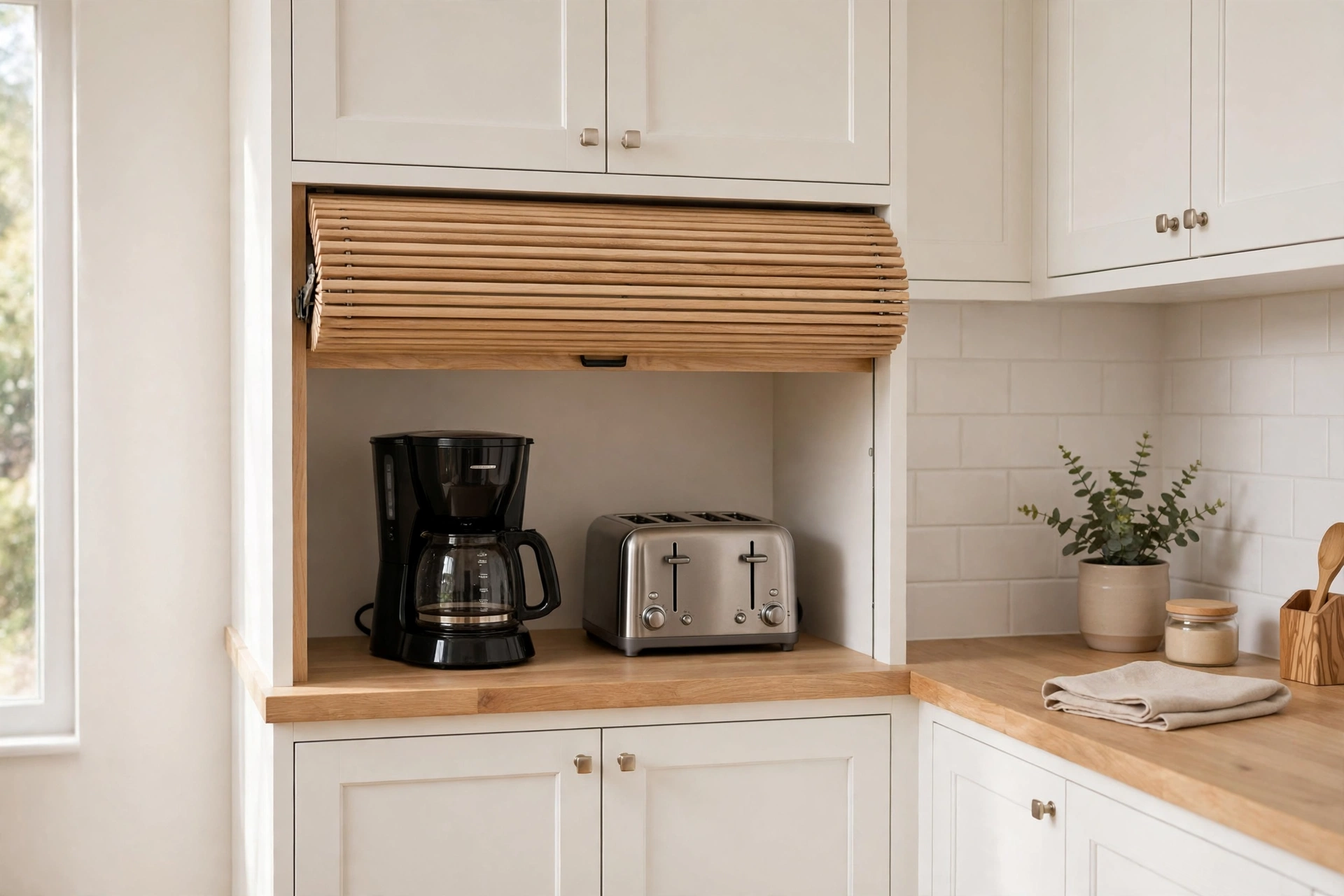
10. Give Appliances a Garage, Not a Parking Spot
An appliance garage is a cabinet that sits on the counter, between the base and wall cabinets, with a door that lifts up or rolls back. Open it, use the coffee maker, close it, and the counter looks clear even though nothing moved. A standard garage is 24 to 36 inches wide and 18 inches tall, which fits a coffee maker and a toaster side by side and hides about 3 square feet of appliances. A countertop garage adds $800 to $2,500 above a standard upper with hinged or lift-up doors, and $1,500 to $4,000 with a tambour door, when it is built into a new kitchen. A tall pocket-door station with outlets, lighting, and a pull-out shelf runs $4,000 to $10,000 or more. A retrofit garage that sits on the counter costs $80 to $200 and needs no installation. The cost per square foot freed runs $27 to $1,333, the widest range on this list, because the retrofit and the built-in are different products. Buy the retrofit first. If you use it every day for 3 months, the built-in is worth pricing. If you stop opening it after 2 weeks, you saved $800 or more. One rule: the garage needs an outlet inside it. Without one, you pull the coffee maker out to plug it in, and the garage becomes a cupboard.
11. Beverage Station in a Cabinet: The $150 to $300 Drawer Outlet Fix
If the coffee zone works but the cord and the mugs still spread, the next step is a beverage station inside a cabinet, not on the counter. The cheapest version is a drawer outlet: an electrician adds a receptacle inside a drawer or a cabinet, so the coffee maker lives in the cabinet, plugged in, and the counter stays empty. A drawer outlet costs $150 to $300 installed. The station frees 2 to 3 square feet for $50 to $150 per square foot. This is electrical work, so hire a licensed electrician and ask for GFCI protection on the new receptacle. Do not run an extension cord into a cabinet. That is a fire risk, and it is the mistake that turns a $200 fix into a $2,000 repair. Measure the cabinet before you commit: the coffee maker needs 18 inches of height inside the cabinet, and the drawer needs a depth of at least 21 inches to hold it. For the full built-in version of this idea, the solid wood pantry cabinet guide covers tall pantry cabinets that hold a beverage station behind closed doors.
12. Over-Sink Board and Rack: 1 to 2 Square Feet You Already Own
An over-sink cutting board and a dish rack that sits over the sink use space you already have and free 1 to 2 square feet of counter. The board spans the sink, so you chop over the basin and scraps fall where you rinse them. The rack holds dishes over the sink while they drain, instead of on a mat beside it. A board costs $30 to $70. Measure the sink first: the board must span the inside width of the sink, not the outside, and it must be at least 0.75 inches thick or it flexes under a knife. Do not leave a wooden board over the sink overnight. It traps moisture and warps. Dry it upright after use. This idea works best in a small kitchen, where the sink is the largest single surface after the counter and every square foot counts double.
13. Cutting Boards Vertical, Not Flat: $0 to $25 Frees 1 Square Foot
Cutting boards stored flat on the counter take about 1 square foot each and they stack into a pile you have to lift through to find the one you want. Store them vertical, leaning against the backsplash in a corner, or upright in a cabinet slot next to the prep zone. Vertical storage costs $0 to $25 for a divider or a rack, and it frees about 1 square foot. Keep 2 boards out at most: 1 large board for prep and 1 small board for quick jobs. The rest live in the cabinet. A board leaning against the backsplash in the back strip passes the back-strip rule. A stack of 4 boards flat on the counter fails it. Wash and dry boards before you lean them. A damp board against the wall leaves a mark on the backsplash within a week.
14. The 5-Minute Nightly Reset: The Habit That Holds the Other 14
A clear counter is a habit, not a one-time reset. Every evening, spend 5 minutes putting away anything that migrated during the day, wiping the surface, and returning each item to its zone. The reset frees 2 to 4 square feet a day, because the counter collects mail, keys, chargers, school papers, and grocery bags between meals. Those items do not belong in the kitchen at all. Give them a home outside it: a tray by the door for keys and mail, a charging spot in another room. The reset works because it is short. A 30-minute weekly clean fails because it feels like a chore. A 5-minute nightly reset feels like closing the kitchen. Do it at the same time every night, right after dinner, and it holds. Skip it for 3 nights and the counter is full again. That is the failure mode for every idea on this list, and it costs $0 to prevent.
15. Seasonal Rotation: Swap the Slow Cooker for the Air Fryer
Appliances have seasons. The slow cooker works in winter. The air fryer works in summer. The ice cream maker works in July and not in January. Keep the appliance for the current season on the counter or the cart, and store the out-of-season one in a high cabinet. Rotation costs $0 and frees 1 to 2 square feet, because it stops 2 appliances from sharing a spot meant for 1. Do the swap on the first day of each season, not when you notice the clutter. Put a note on the calendar. The swap takes 10 minutes: 1 appliance out of the cabinet, 1 appliance in, wipe the shelf. If an appliance has not been used in 2 seasons, it leaves the kitchen. Donate it or sell it. Storage is not a home for appliances you no longer use.
A 10-Foot Counter Run, Worked Start to Finish
Take a 10-foot run with a sink at one end and a range at the other. Before: coffee maker, toaster, blender, stand mixer, knife block, utensil crock, 4 spice jars, a fruit bowl, a stack of 3 cutting boards, mail, and a phone charger. That is about 12 square feet of stuff on 21 square feet of counter, so only 43% is clear. Step 1: the daily-use test removes the blender, the stand mixer, the spice jars, and the mail, which frees 5 square feet. Step 2: the knife block goes to a wall strip, which frees 0.8 square feet. Step 3: the crock moves to the back strip and the boards go vertical, which frees 1 square foot. Step 4: the coffee maker, toaster, and mugs move into one corner zone on a tray, which frees 2 square feet. After: the counter holds a coffee zone in the corner, a crock in the back strip, and a fruit bowl in the far corner. Clear space is 13.2 square feet out of 21, or 63%, which passes the 60% rule. The prep stretch between sink and range is 36 inches clear. Total cost: $25 to $60 for the knife strip and $20 to $40 for the tray, or $45 to $100. No cabinet work. No garage. That is the point: the free ideas do most of the job, and the paid ideas finish it.
3 Mistakes That Put the Clutter Back in a Week
Mistake 1: buying containers before you remove anything. A $200 set of matching canisters on a full counter is still a full counter. Remove first, then buy only what the remaining items need. Cost of skipping this: $100 to $200 in containers that hold clutter instead of removing it.
Mistake 2: putting the coffee maker in the middle of the prep stretch. The prep stretch is the 24 to 36 inches between sink and range. A coffee maker there forces you to chop around it every day. Move it to a corner and the stretch opens up. Cost of skipping this: 2 square feet of prep space lost every day, and a kitchen that feels cramped even when it is clear.
Mistake 3: hiding appliances in a cabinet with no outlet. A coffee maker in a cabinet without power has to come out to be used, which means it lives on the counter anyway. Add the outlet first, or keep the appliance on the counter in a zone. Cost of skipping this: $150 to $300 for the outlet later, plus the months the appliance sat on the counter while you planned the fix.
The 5-Minute Nightly Reset Checklist
Do this every night after dinner. It takes 5 minutes and about $0.
- Clear the prep stretch: move everything off the 24 to 36 inches between sink and range. My prep stretch is ___ inches, from ___ to ___.
- Return each item to its zone: coffee gear to the coffee corner, oils to the range tray, soap to the sink tray. My zones are: ___.
- Remove what does not belong in the kitchen: mail, keys, chargers, bags. My outside-the-kitchen home for these is: ___.
- Wipe the counter and under each tray. Trays that never move hide crumbs.
- Check the 60% rule: is at least 60% of the run bare? My run is ___ feet, so ___ feet must stay empty.
If step 5 fails 3 nights in a row, something on the counter fails the daily-use test. Remove it.
What Counter Organization Costs in 2026
The free ideas cost $0 and free 10 to 16 square feet. The $100 tier buys a knife strip, 2 trays, a riser, and a board divider, and frees another 3 to 4 square feet. The $150 to $300 tier adds a drawer outlet and turns a cabinet into a beverage station. The $800 to $4,000 tier adds a built-in appliance garage, and the $4,000 to $10,000 tier adds a tall pocket-door station. Start at $0. Spend the next $100 only after the free ideas have held for 2 weeks. Price the garage only after the retrofit version has been used daily for 3 months. The most expensive idea on this list is the one you buy before you remove anything, because it organizes clutter instead of removing it.
7 Questions About Kitchen Counter Organization, Answered
How much counter space should stay clear?
At least 60% of the run. On a 10-foot run, 6 feet stay empty. Keep one continuous stretch of 24 to 36 inches clear between the sink and the range for prep.
What should stay on the kitchen counter?
Only what you use every day: a coffee maker or kettle, a toaster, and a utensil crock. Everything used weekly or less goes in a cabinet, a drawer, or on a rolling cart.
How do I measure the 60% on an L-shaped or galley counter?
Measure each run separately and multiply each by 0.6, so an 8-foot run needs 4.8 feet bare and a 6-foot galley run needs 3.6 feet bare. Keep one continuous 24 to 36 inch prep stretch clear on the longest run, between the sink and the range, and count the corner once, not twice. If 6 of 10 feet are not bare on a 10-foot run, something on the counter fails the daily-use test.
Do appliance garages work in a small kitchen?
Yes, and they help most there. A 24-inch garage hides 3 square feet of appliances. Start with a retrofit garage at $80 to $200 before pricing a built-in at $800 to $4,000.
Where should the coffee station go?
In one corner, on one tray, with mugs on a wall hook above it. Corners are bad for prep and good for coffee, because you stand in one place to make it. Keep the zone to 18 inches wide.
How do I keep counters clear with kids?
Give everything outside the kitchen a home by the door, and run the 5-minute nightly reset after dinner. The reset is the habit that holds the other ideas. Skip it for 3 nights and the counter fills up again.
What is the difference between counter organization and cabinet organization?
Counter organization is about the surface: what lives on it, in zones, and what gets put away. Cabinet organization is about the inside: pull-outs, inserts, and deep base cabinets. This article covers the surface only.